QUICK ANSWER
Clamp, push, swap, press. Two minutes per dart.
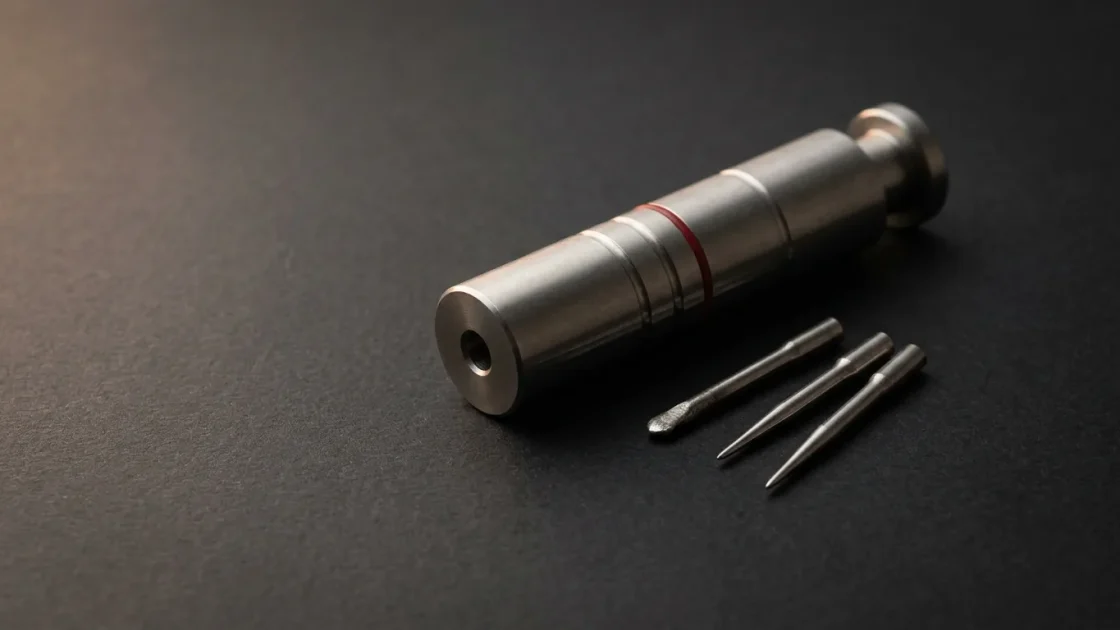
A repointing tool costs ~£15 (~$20) and lasts forever. Screw the extractor into the barrel thread, wind the T-bar to push the old point out, insert the new one, wind it back in. That is the entire process.
Below: every step with photos, which points fit which barrels, common mistakes that damage your darts, and when you should repoint in the first place.
Dart points wear out. They go blunt, they bend, and eventually they cost you more in bounce-outs than a replacement set costs in cash. The fix takes two minutes and one tool.
This guide covers how to repoint darts at home – the full step-by-step, the equipment you need, and the mistakes that ruin barrels. If you are not sure what types of points exist, start with our dart point types guide and come back here when you are ready to swap them.
When Should You Repoint Your Darts?
Four signs. Any one of them is reason enough.
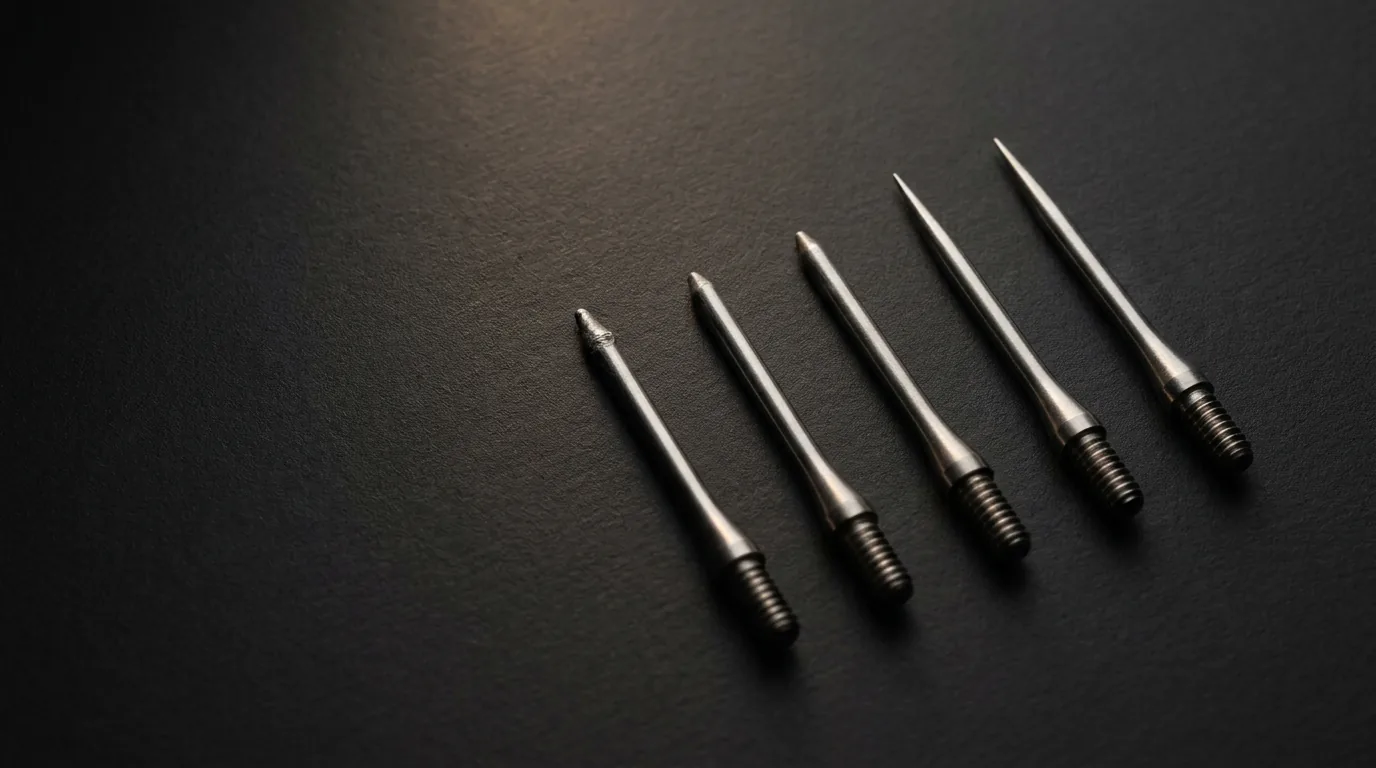
The tip is flat. Hold the point under a bright light. If you see a tiny circular reflection at the very tip instead of a sharp point of light, it is blunt. A flat tip pushes sisal fibres apart instead of sliding between them. That is what causes bounce-outs.
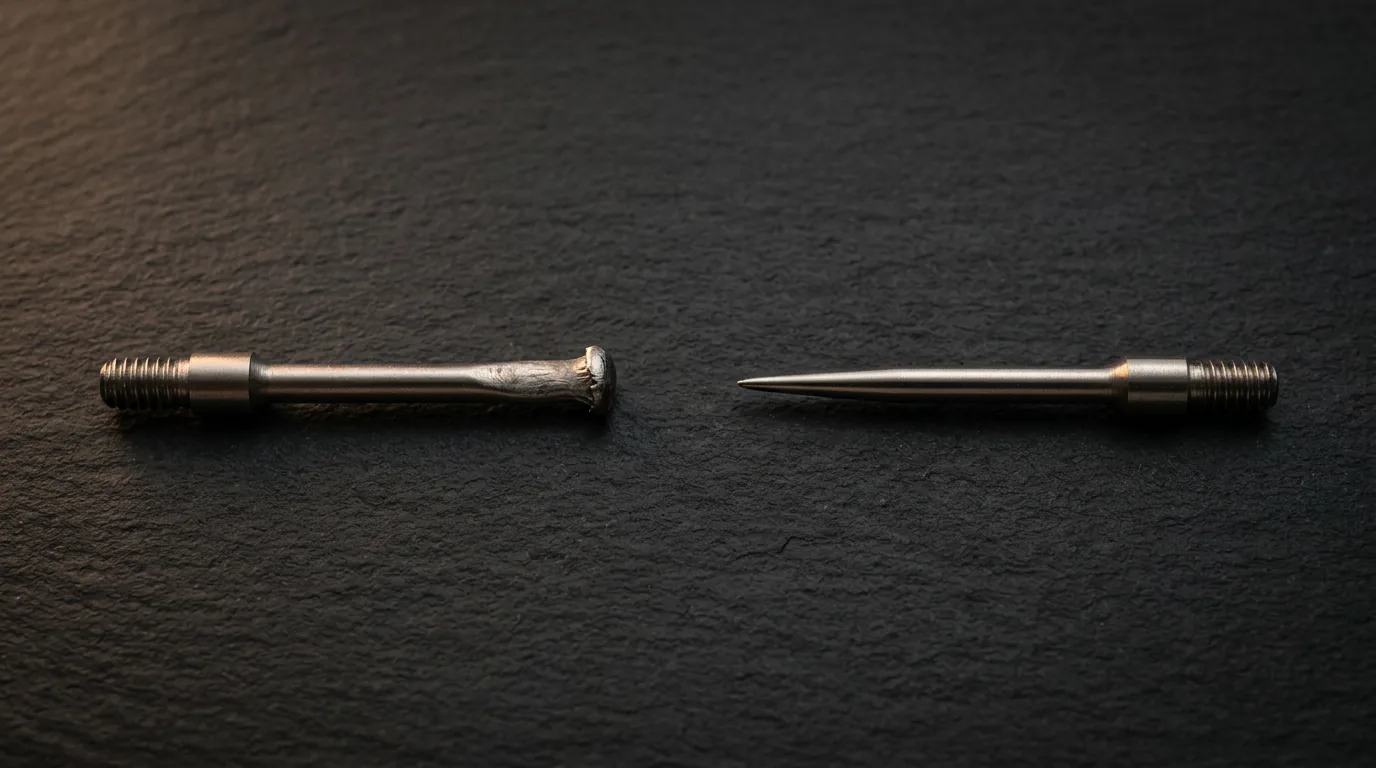
The point is bent. Roll the dart slowly on a flat surface. If the point wobbles or traces a circle instead of rolling straight, it has a curve. This usually happens when a dart hits the wire at a steep angle. A bent point throws your grouping off because the dart enters the board at an angle you did not intend.
You want a different length. Switching from 32mm standard points to 38mm long points shifts the balance point forward by 2-3mm. That changes the throw arc. Some players repoint seasonally – longer points in winter when they throw flatter, shorter points in summer when their throw loosens up. It costs £3 (~$4) per set instead of buying new darts.
The point is loose. Push the tip sideways with your thumb. If it moves at all, it has worked loose in the barrel. A loose point absorbs impact energy instead of transferring it to the board, which increases bounce-outs and kills your confidence in tight finishes.
If your flights are looking tired too, see our guide on when to replace dart flights – same maintenance mindset, different component.
What You Need to Repoint Darts
Four items. Total cost under £25 (~$32) and you will use them for years.
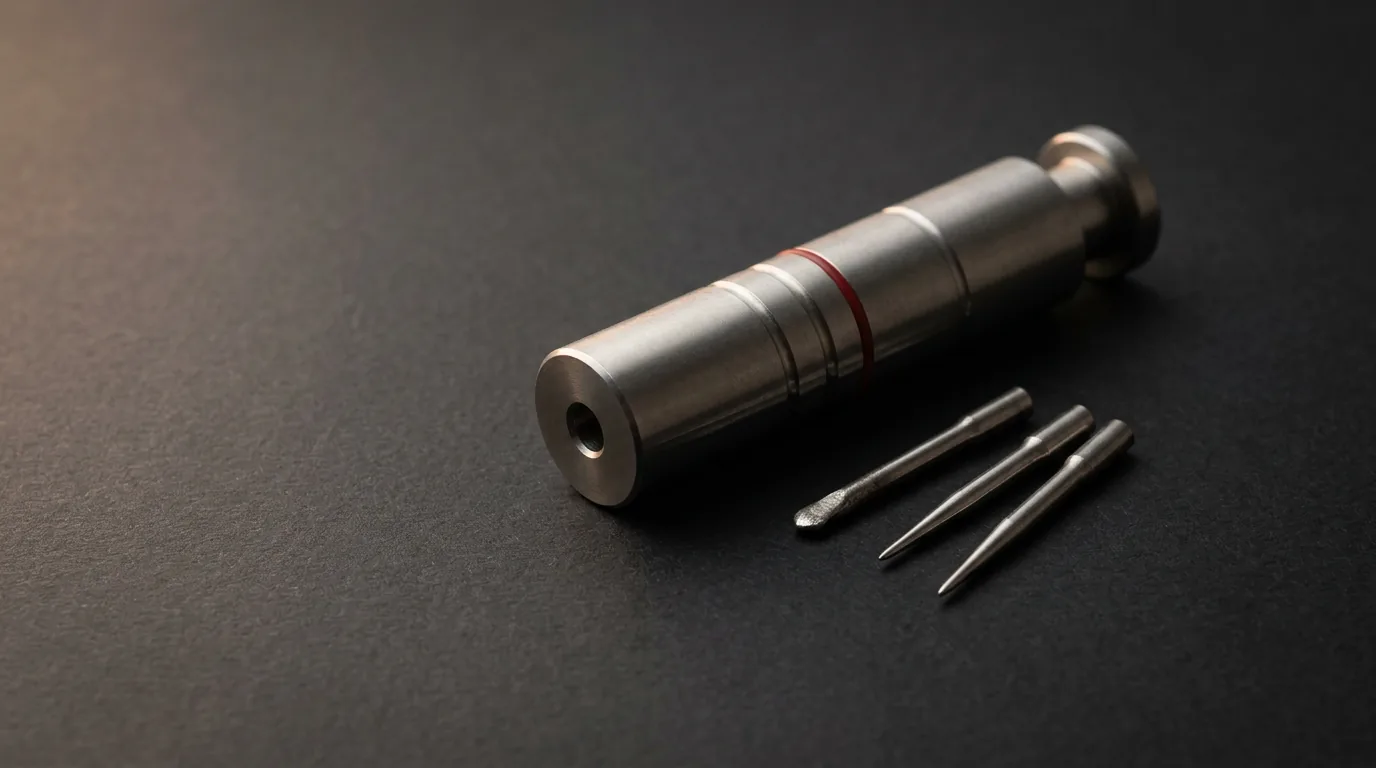
A repointing tool – £12-25 (~$15-32). Designa and Mission make good budget options at £12-15 (~$15-20). Winmau’s SFB tool is the premium choice at £20-25 (~$25-32). All work the same way – a T-bar handle, a barrel clamp, and an extracting screw. Most include both 2BA and 1/4 BSF thread adapters.
Replacement points – £2-8 (~$3-10) per set of 3. Plain smooth steel points are cheapest. Knurled or grooved points cost more but grip the board better. Target Storm and Mission Sniper points sit at the top end around £5-10 (~$7-13).
An emery board or fine sandpaper – for scuffing new smooth points so they grip inside the barrel. You probably already have one.
An Allen key – included with every repointing tool. Tightens the base screws that grip the new point during installation.
KEY TAKEAWAY
A repointing tool costs less than one set of replacement darts. It pays for itself the first time you use it.
Step-by-Step: How to Repoint Darts
Nine steps. The whole process takes under two minutes once you have done it a couple of times.
1
Strip the Dart
Remove the flight and shaft. You only want the bare barrel with the old point still in it.
2
Clamp the Barrel
Slide the barrel into the repointing tool body, point-end facing out through the base hole.
3
Screw in the Extractor
Thread the extracting screw (2BA or 1/4 BSF) fully into the barrel from the shaft end. Hand-tight is fine.
Step 4: Push the old point out. Wind the T-bar handle clockwise. The extractor pushes against the old point from inside the barrel, forcing it out through the nose. You will feel resistance, then a pop as the point breaks free. Keep winding until the point falls out.
Step 5: Insert the new point. Take the new point and slide it into the barrel nose. Push it in straight – do not angle it. The point should sit about 5-10mm into the barrel before you need the tool to press it further.
Step 6: Grip the new point. Use the Allen key to tighten both base screws evenly. These grip the new point from both sides so it stays centred while the barrel is pressed down onto it. Do not over-tighten – just firm enough to hold.
Step 7: Press the point in. Wind the T-bar anticlockwise this time. The barrel is pulled down onto the stationary new point. Apply firm, steady pressure. You will feel the point seating into the barrel. Keep winding until the point is fully inserted with the correct length exposed.
Step 8: Release and check. Loosen the base screws, unscrew the T-bar, and remove the dart. Roll it on a flat surface. The point should track perfectly straight. If it wobbles, the point went in crooked – remove it and try again before the interference fit sets permanently.
Step 9: Scuff if needed. If the new point is smooth (no knurl or groove), run an emery board along the sides 4-5 times. Just enough to take the shine off. This creates micro-texture that helps the point grip inside the barrel. Skip this step with knurled or grooved points – they already have built-in grip.
Roll the dart on a flat surface after every repoint. If the point wobbles, it went in crooked. Fix it immediately – a crooked point gets harder to remove the longer you leave it.
SCOUT’S TAKE
Do it yourself. Every time. Paying a shop £3-5 per dart to repoint is throwing money away when the tool costs £15 and the job takes two minutes. The only exception is if your barrel has a press-fit point with no thread – those need a machine press, and that means a shop.
Can You Repoint Without a Tool?
Technically, yes. Practically, don’t.
The pliers method works in an emergency. Grip the point with pliers, hold the barrel in a cloth, and twist while pulling. The problem: pliers slip, scratch the barrel, and apply uneven force. One slip and you have gouged a grip groove. Not worth the risk on a £40+ set of tungsten darts.
The rivet gun method is better. Unicorn makes a point puller built on rivet gun principles. You insert the point into the gun nozzle and squeeze. The mechanism pulls the point straight out. It works, but it only removes points – you still need something to press the new one in.
Never hammer a point in or out. Tungsten is hard but brittle. Impact force from a hammer can crack the barrel internally without any visible damage. The barrel might split weeks later during a throw.
The dedicated repointing tool does both jobs – removal and installation – in one device for £12-15 (~$15-20). There is no good reason to improvise. The darts501 repointing reference covers the rivet gun method in more detail if you want to compare approaches.
Which Points Fit Your Darts?
Two things matter: the thread size and the point length.
Thread size. Over 90% of modern darts use 2BA thread (4.5mm external diameter). This is the standard across Target, Winmau, Red Dragon, Harrows, Designa, Mission, and most Unicorn models. The other option is 1/4 BSF (6.35mm) – used by some older darts and a few specialist barrels. If you are not sure which yours is, try screwing in a standard nylon shaft. If it fits easily, your darts are 2BA.
Point length. Four standard sizes:
- 26mm (short) – reduces front weight, shifts balance towards the centre or rear
- 32mm (standard) – the default length that comes with most darts out of the box
- 38mm (long) – adds front weight, helps darts land nose-down for tighter grouping
- 41mm (extra long) – specialist length, used by some PDC pros for maximum board clearance in tight clusters
For the full breakdown of point types including moveable, conversion, and soft tip, read our dart point types guide.
Common Repointing Mistakes
Five errors that damage darts. All of them are avoidable.
Inserting the point crooked. The most common mistake. If the new point enters the barrel nose at even a slight angle, it presses against one side of the bore and can permanently widen the hole. Always push the point in straight, check the alignment visually before applying pressure, and roll-test after every repoint.
Over-tightening the base screws. The screws only need to hold the point still while the barrel is pressed on. Cranking them down crushes the point and can deform the barrel nose from the outside. Finger-tight plus a quarter turn with the Allen key is enough.
Skipping the scuff on smooth points. New smooth points look clean but they have a polished surface that does not grip well inside the barrel bore. Without the micro-texture from scuffing, the point can work loose after 20-30 sessions and start wobbling. Four passes with an emery board prevents this.
Using the wrong thread size. Forcing a 1/4 BSF extractor into a 2BA barrel strips the thread. Always check which adapter you need before screwing anything in. If it does not thread smoothly by hand, stop.
Forcing a bent point out sideways. A bent point needs to come out straight, the same way it went in. If you try to wiggle it out at an angle, you widen the barrel bore unevenly. Use the repointing tool – the straight-line extraction force is exactly what a bent point needs.
ONE SET OF POINTS, THREE DIFFERENT DARTS
How point length changes your throw
Swapping from 26mm to 38mm points shifts the balance point of a 23g dart forward by roughly 2-3mm. That is enough to change whether the dart flies nose-down or level.
Shorter points suit rear-grip throwers who want a parabolic arc. Longer points suit front-grip throwers who throw flat and hard. The same barrel with different points genuinely feels like a different dart.
For more on how weight distribution affects your throw, see our guide on choosing dart weight.
Frequently Asked Questions
How much does it cost to repoint darts?
A repointing tool costs £12-25 (~$15-32) and lasts indefinitely. Replacement points cost £2-8 (~$3-10) per set of 3 depending on type. Total cost for the first repoint is under £25 (~$32). Every repoint after that costs only the price of the points.
Can you repoint soft tip darts?
Soft tip points screw in and out by hand – no repointing tool needed. Just unscrew the old tip and screw in the new one. The thread is standard 2BA on almost all soft tip darts. The repointing tool is only needed for steel tip darts where the point is press-fitted into the barrel.
How often should you repoint darts?
There is no fixed schedule. Repoint when the tip is blunt, bent, loose, or when you want to switch point length. A player throwing 3-4 times per week on a bristle board might repoint every 3-6 months. Someone who only plays once a week could go a year or more. Check the tip under a bright light every few weeks – if you see a flat reflection, it is time.
Do all dart points fit all barrels?
No. Check the thread size first. Over 90% of modern darts use 2BA thread (4.5mm). Some older darts and specialist barrels use 1/4 BSF thread (6.35mm). If a standard nylon shaft screws in easily, your darts are 2BA. Never force a wrong-sized point – it strips the thread permanently.
More from TheDartScout’s maintenance guides: learn the different dart point types, find out how to clean tungsten darts, or read our guide on how to re-grip a dart barrel. For a full breakdown of what makes up a dart, start with anatomy of a dart. Or take our dart recommendation quiz to find the right set for your throw.