QUICK ANSWER
Winmau Blade 6 Dual Core for most players. One80 Gladiator 3+ for less.
The Blade 6 Dual Core has two-layer vein-free sisal, 60-degree embedded blade wire, and the Rota-Lock mounting system. It’s the board every forum keeps recommending. The Gladiator 3+ gives you sword-edge wires and Kenyan sisal at a lower price point.
Below: 7 bristle boards ranked by community consensus. Wire types explained. Maintenance tips included.
Buying the best dartboard for home should be simple. It isn’t. Amazon UK lists over 50 bristle dartboards, and most review sites rank them by price without explaining the one thing that actually matters: wire type. The difference between a razor-blade embedded wire and a round galvanised wire is the difference between darts that stick and darts that bounce off the spider into your wall.
We cross-referenced Reddit’s r/darts community, the DartsNutz forum, and 10 retailer recommendation pages to find which boards actual players recommend for home use. Then we verified every spec against the manufacturer’s product page – wire thickness, sisal origin, mounting system, dimensions. The result: 7 bristle boards ranked by real consensus. For the full decision framework, see TheDartScout’s guide to choosing a dartboard. For budget planning, see our home darts setup guide.
According to TheDartScout’s research, the wire system accounts for more scoring variation than sisal quality, brand, or price tier. Every board below uses staple-free construction except the budget pick – and we’re honest about that trade-off. All seven boards are bristle (sisal fibre) boards designed for steel-tip darts. We didn’t include electronic dartboards – they use plastic segments, soft-tip darts, and serve a different market. If you’re looking for an electronic board, our electronic vs bristle comparison covers that decision. This guide is for players who want the best dartboard for home steel-tip play – the same format used in PDC, WDF, and every pub league in the country. Every spec below – wire type, sisal origin, mounting system – was verified against the manufacturer’s own product page. Where the community reports issues that the manufacturer doesn’t acknowledge (like the Target Aspar’s holding power complaints), we’ve noted those clearly in the cons section. No spec in this article comes from a single unverified source.
The 7 Best Dartboards for Home at a Glance
| Pick | Board | Wire Type | Sisal | Tier | Best For |
|---|---|---|---|---|---|
| Best Overall | Winmau Blade 6 DC | 60-degree blade | Dual core vein-free | Premium | Most home players |
| Best for Beginners | One80 Gladiator 3+ | Sword Edge | 1st grade Kenyan | Mid-Range | First real board |
| PDC Standard | Winmau Blade 6 TC | 60-degree blade | Triple core + carbon | Premium | Serious players |
| Best Value | Winmau Blade 5 DC | Blade wire | Dual density | Budget | Previous gen quality |
| Best Budget | Viper Shot King | Round wire | Compressed | Budget | Ultra-budget entry |
| Best Alternative | Shot Bandit Gen 4 | 0.8mm micro ribbon | African medium | Mid-Range | Non-Winmau option |
| Most Durable | Target Aspar | Smart Edge | High-density African | Mid-Range | Hard throwers |
Best Overall – Winmau Blade 6 Dual Core
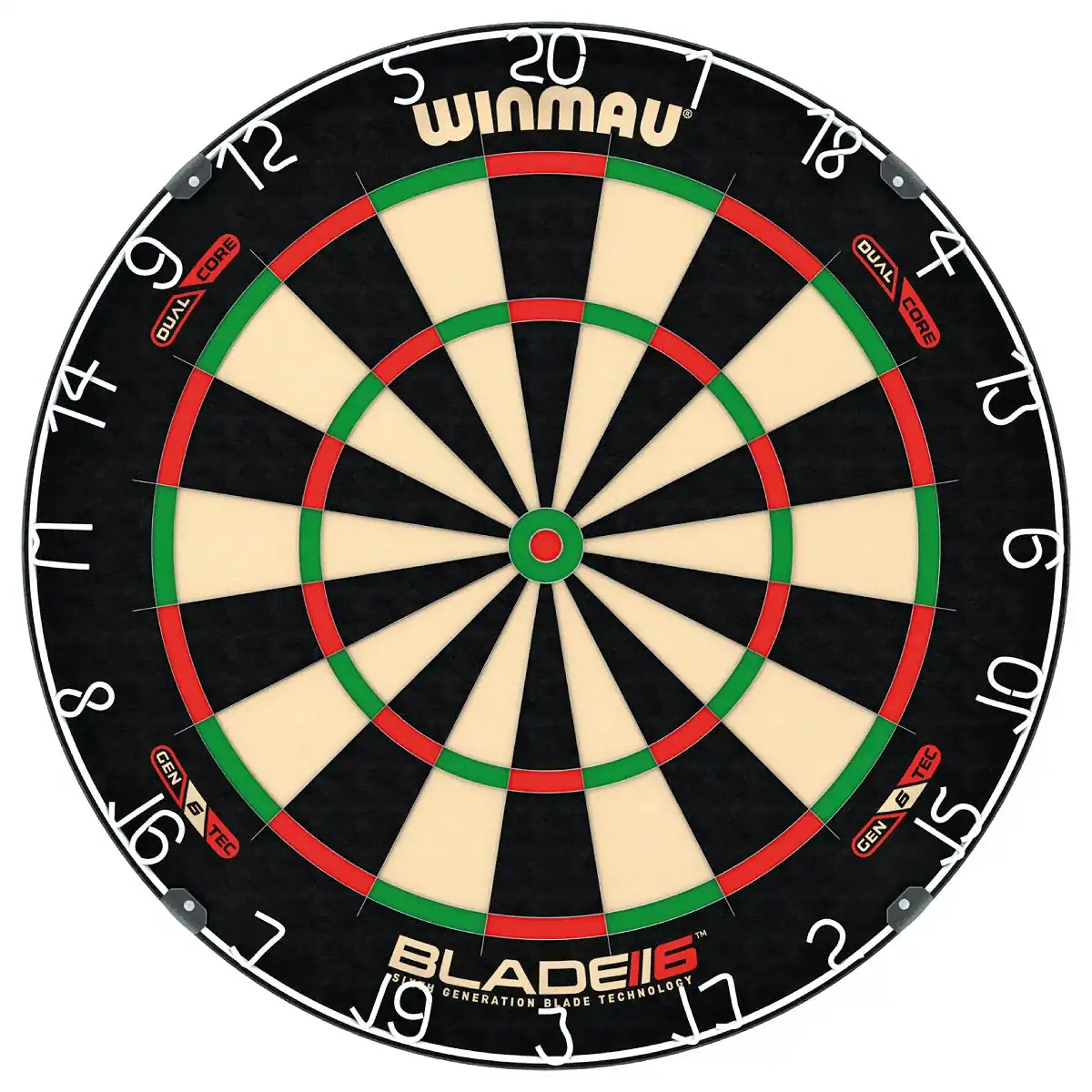
Winmau Blade 6 Dual Core
60-degree blade wire, dual core vein-free sisal, Rota-Lock
The Blade 6 Dual Core is the dartboard the darts community keeps coming back to. The “dual core” refers to a two-layer sisal construction: a lower-compression outer layer that lets darts penetrate smoothly, and a higher-compression inner core that absorbs the kinetic energy and holds the dart in place. The result is a board that accepts darts easily but grips them firmly – the combination that matters most for scoring.
The wire system is where the Blade 6 earns its name. The 60-degree angled blade wire is embedded into the sisal rather than sitting on top of it. When a dart hits wire on a traditional board, it deflects outward and bounces. On the Blade 6, the wire’s angle directs the dart downward into the sisal instead. Winmau’s Density Control technology makes the bullseye and outer bull wires 25% thinner than the previous generation, which means fewer bounce-outs in the highest-value zones.
The Rota-Lock mounting system uses a triple-wheel lock that lets you rotate the board without removing it from the wall. Rotation matters because the treble 20 bed takes the most punishment – rotating the board every week or two distributes wear evenly and extends the board’s life. The Blade 6 measures 17.75 inches in diameter and 1.5 inches deep, meeting WDF tournament specifications.
What We Liked
- 60-degree blade wire with Density Control – minimal bounce-outs
- Dual core sisal – smooth penetration + firm retention
- Rota-Lock mounting – rotate without removing from wall
- Vein-free sisal surface for consistent playability
Watch Out For
- Premium price – costs roughly double the budget picks
- Some hard throwers find the sisal “too soft”
OUR VERDICT
The home dartboard to beat
Blade wire, dual core sisal, Rota-Lock, WDF approved. The Blade 6 Dual Core is the most recommended board on every forum we checked. If you’re buying one board for home, this is it.
Best for Beginners – One80 Gladiator 3+
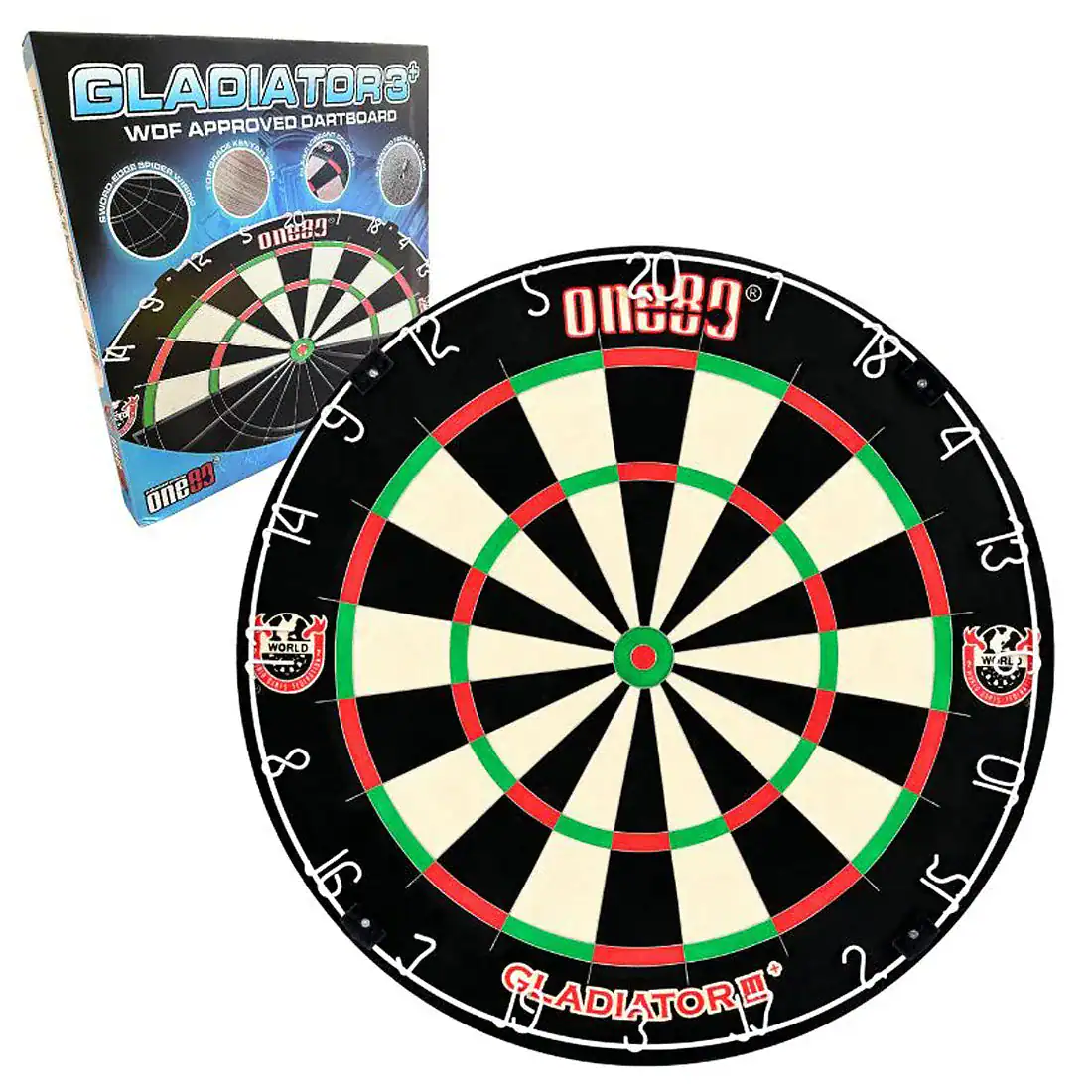
One80 Gladiator 3+
Sword Edge wire, 1st grade Kenyan sisal, WDF approved
The Gladiator 3+ is where most players should start if the Blade 6 stretches the budget. One80 uses 1st grade Kenyan sisal, which is denser and firmer than the East African sisal in the Winmau boards. That firmness means the board takes longer to break in – expect a slightly harder feel for the first few sessions. But once broken in, the self-healing is reliable and the board holds its shape well under regular use.
The Sword Edge wiring is One80’s version of blade wire – thin, staple-free stainless steel embedded into the sisal. It doesn’t quite match the Blade 6’s 60-degree angle technology, but the practical difference in bounce-outs is small for home play. The anti-glare rotatable number ring is a nice touch – easy-to-read numbers that stay upright regardless of rotation position. For a deeper look at how board construction affects your game, see our dartboard selection guide.
At 45cm tournament diameter and roughly 5kg, the Gladiator 3+ is a substantial board. The Rotafix system allows 360-degree rotation without removing the board. It’s WDF approved, meaning it meets the same dimensional standards as boards used in international competition. Community consensus calls it “80% of Blade 6 quality at a noticeably lower price.”
What We Liked
- Sword Edge staple-free wire – low bounce-outs
- 1st grade Kenyan sisal – dense and durable
- WDF approved tournament specifications
- Noticeably cheaper than Blade 6 at similar quality
Watch Out For
- Firmer sisal – needs break-in period
- Quieter impact sound (preference, not a flaw)
OUR VERDICT
The smart first board
Sword Edge wire, Kenyan sisal, WDF approved, and priced below the Blade 6. If you’re setting up at home for the first time, the Gladiator 3+ is where your money goes furthest.
PDC Tournament Standard – Winmau Blade 6 Triple Core
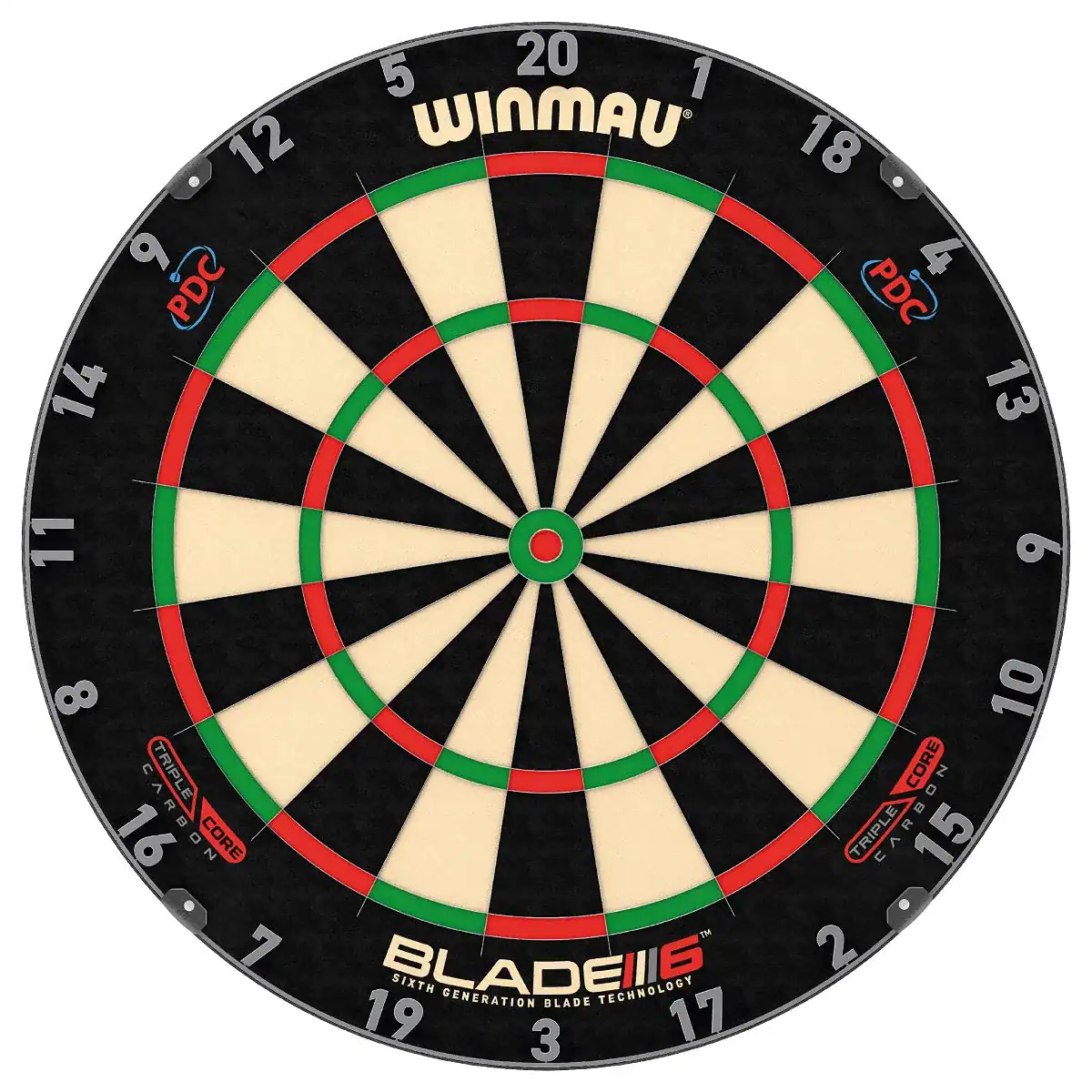
Winmau Blade 6 Triple Core
Triple core carbon sisal, laser-cut anti-glare ring, Spirit Master
This is the exact dartboard used on-stage at PDC professional tournaments and televised events. Luke Littler, Luke Humphries, and Michael van Gerwen all throw at a Triple Core. The third sisal layer is reinforced with carbon fibre, creating a base that absorbs impact without deforming over time. The low-compression outer core, high-compression inner core, and carbon-reinforced base work together to create the most durable bristle board available.
Beyond the triple core, you get two features the Dual Core doesn’t have: a laser-cut anti-glare number ring (patent pending) and the Spirit Master levelling tool. The anti-glare ring eliminates reflections under overhead lighting – useful if you’ve set up a dedicated ring light. The Spirit Master is a built-in bubble level that tells you whether the board is straight without needing a separate tool.
Is it worth the premium over the Dual Core for home use? For most players, honestly, no. The Dual Core handles home-level play volume perfectly well. The Triple Core earns its price if you practice daily for hours, host league nights, or simply want the same board you see on television. The wire system and Rota-Lock mounting are identical to the Dual Core – the difference is purely in the sisal construction.
What We Liked
- Carbon fibre reinforced base – ultimate durability
- Laser-cut anti-glare number ring
- Spirit Master levelling tool included
- Exact board used in PDC professional events
Watch Out For
- Highest price on this list – overkill for casual home play
- Same wire system as Dual Core – the upgrade is sisal only
OUR VERDICT
The board the pros throw at
If you want what’s on television, this is it. But for home use, the Dual Core gives you the same wire and mounting at a lower price. The Triple Core is for daily players and league hosts.
Best Value – Winmau Blade 5 Dual Core
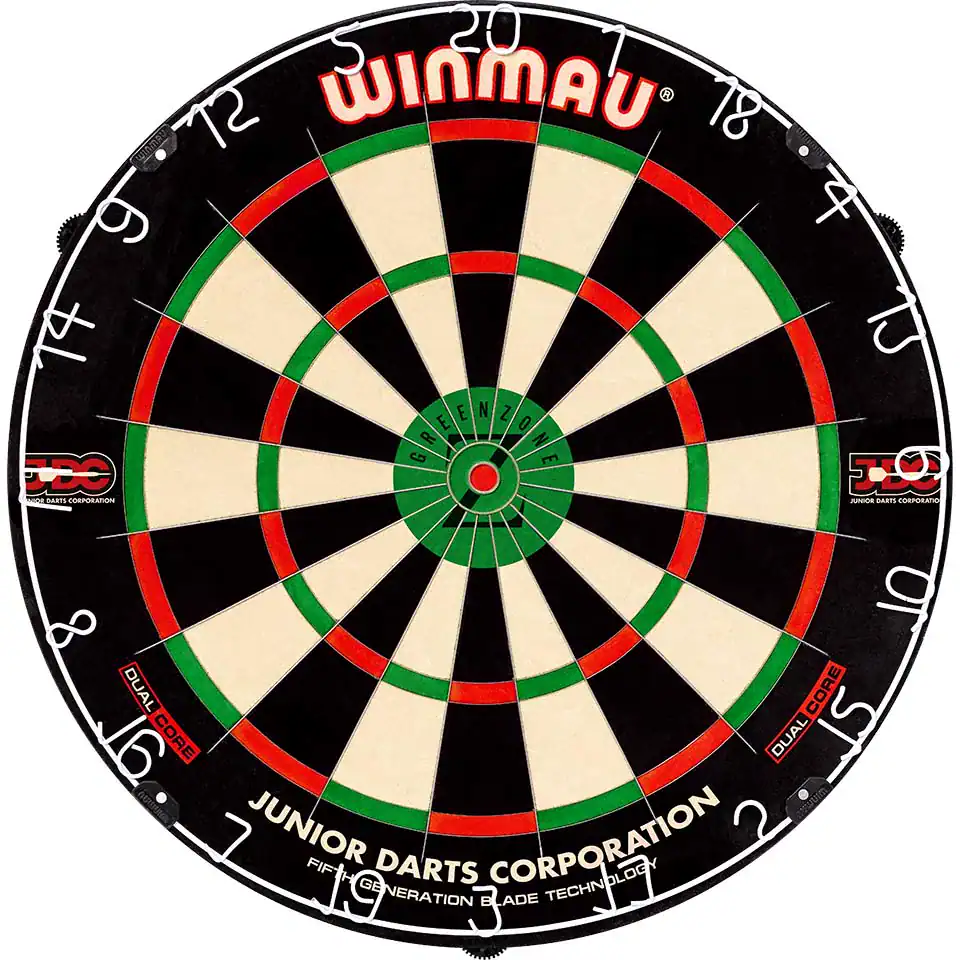
Winmau Blade 5 Dual Core
Previous gen blade wire, dual density sisal, Rota-Lock
The Blade 5 Dual Core is the previous generation board that refuses to go away – because it’s still genuinely good. The blade wire system gives you 9mm extra scoring area in the doubles and 6mm in the trebles compared to round-wire boards. Dynamic sector wires are 20% thinner and radial wires 10% thinner than the Blade 4 generation. The blade angle is the same 60-degree design used in the Blade 6.
The dual density sisal uses the same principle as the Blade 6: pure sisal outer layer for a clean surface, high-density inner core for dart retention. The Rota-Lock mounting is identical to the Blade 6 – same triple-wheel system, same easy rotation.
Where it falls short: the Blade 6’s Density Control wire technology and vein-free sisal are genuine improvements. The Blade 5 occasionally shows sisal veins (natural fibres that create slightly uneven patches). But at its current price point – often less than half the Blade 6 – it’s the board the community calls “90% of Blade 6 quality.”
What We Liked
- Same blade wire technology as Blade 6
- Rota-Lock mounting included
- Often available at half the Blade 6 price
- Proven reliability – millions sold worldwide
Watch Out For
- Occasional sisal veins (not vein-free like Blade 6)
- Previous generation – may be discontinued eventually
OUR VERDICT
The budget champion
Same blade wire. Same Rota-Lock. Same 60-degree angle. The Blade 5 DC gives you Winmau quality at a price that makes the Blade 6 hard to justify for casual home play.
Best Budget – Viper Shot King
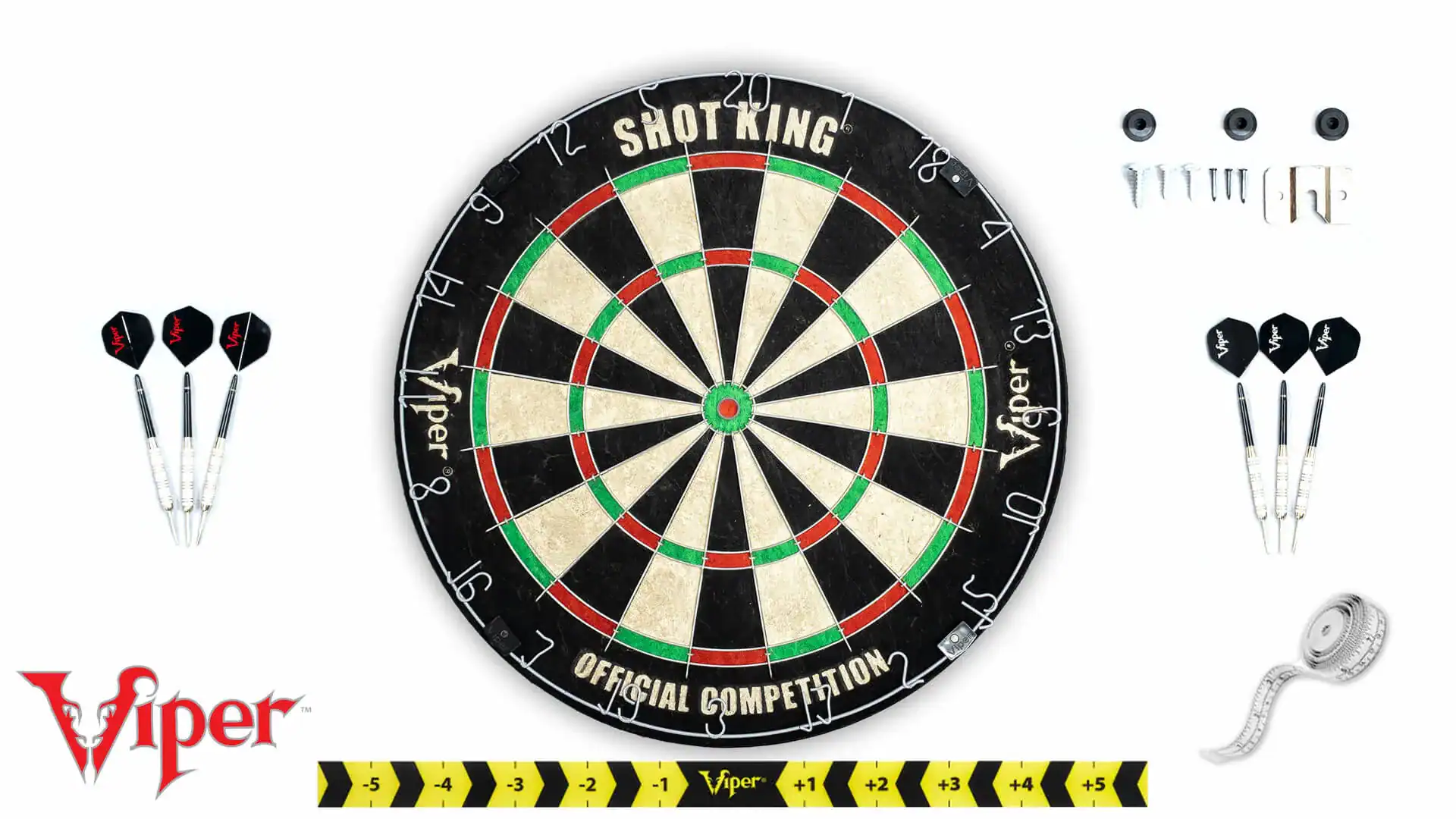
Viper Shot King
Round wire, compressed sisal, includes 6 darts
Let’s be upfront: the Viper Shot King uses round wire, not blade wire. Round wire sits on top of the sisal surface, which means darts that hit the wire bounce outward rather than deflecting into the scoring area. You will get more bounce-outs with this board than with any blade-wire board on this list. The staple-free bullseye helps in the centre, but the rest of the spider uses traditional round galvanised steel.
So why include it? Because it’s a genuine bristle board with self-healing compressed sisal, a rotating number ring, regulation 18-inch dimensions, and it comes with 6 starter steel-tip darts and mounting hardware – all at a price point well below any blade-wire board. If your budget genuinely can’t stretch to a Blade 5, the Shot King lets you play real darts on a real board. It’s a legitimate starting point, not a toy. The included darts are basic brass – functional for getting started but worth upgrading once you know you’ll keep playing. See our best darts for beginners guide for tungsten picks at every budget. But if you can spend a little more on the board itself, the Blade 5 DC is a better long-term investment. The jump from round wire to blade wire reduces bounce-outs in a way you’ll notice from the first session.
What We Liked
- Lowest price for a genuine bristle board
- Includes 6 darts and mounting hardware
- Rotating number ring extends board life
- Self-healing compressed sisal
Watch Out For
- Round wire – more bounce-outs than blade wire boards
- Sisal density lower than premium boards
- Included darts are basic brass
OUR VERDICT
The honest budget option
Round wire limits scoring potential, and we won’t pretend otherwise. But at its price with darts included, it’s the cheapest way to own a real bristle dartboard. Upgrade to blade wire when budget allows.
Best Alternative Brand – Shot Bandit Generation 4
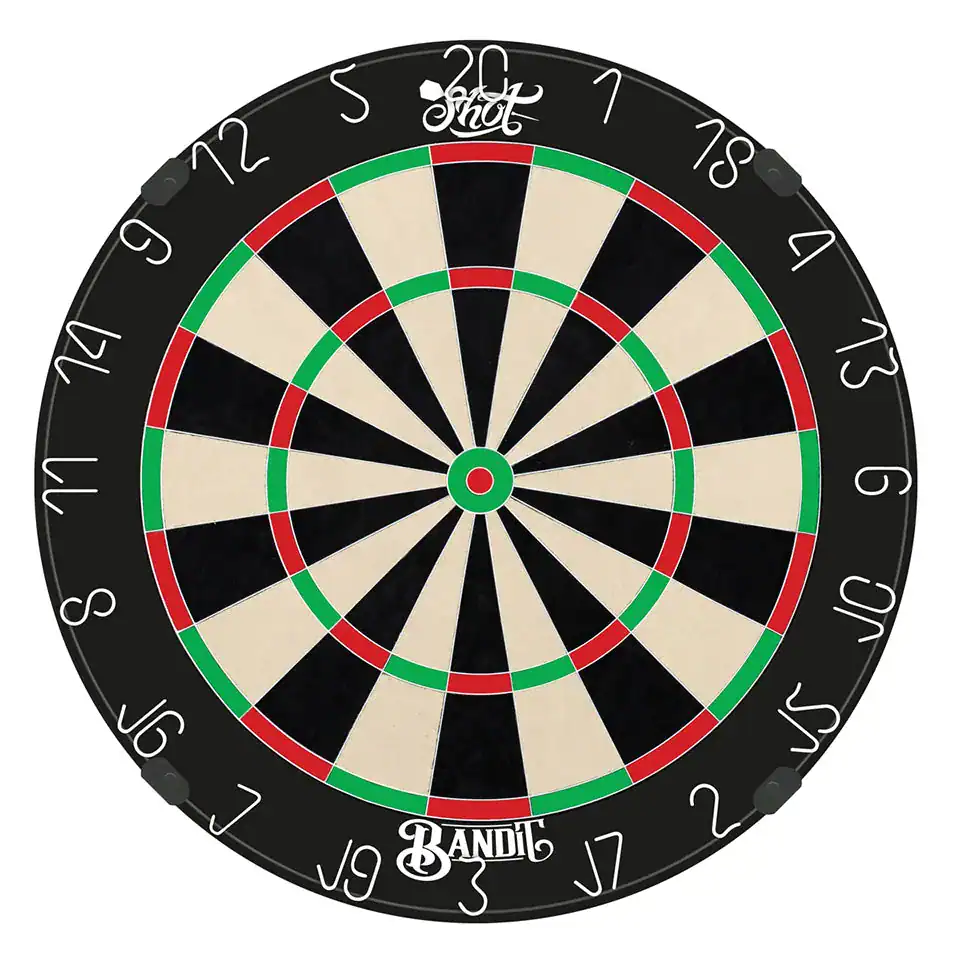
Shot Bandit Generation 4
0.8mm micro ribbon wire, African sisal, U bracket mount
Shot’s Bandit Gen 4 is the board for players who want quality without defaulting to Winmau. The stainless steel micro ribbon wire is 0.8mm thick – 50% thinner than traditional dartboard wire – and 59% stronger than traditional bladed wires. That thinness opens up 14% more playing area within each scoring segment. The precision-machined embedded bullseye uses chamfered edges to direct darts inward rather than deflecting them.
The African sisal has a medium firmness – softer than the Gladiator 3+’s Kenyan sisal, firmer than the Blade 6’s vein-free construction. Self-healing is reliable, and the medium density means most throw styles work well without a break-in period. Shot handcrafts these in New Zealand, which is unusual in a market dominated by UK and Chinese manufacturing. The patented U bracket system is a standout feature: you can hang the board, rotate it, and even swap the number ring without ever removing the board from the wall. No other mounting system on this list matches the U bracket for convenience. The set includes a tape measure for marking mounting height and throwing line, plus a checkout chart – practical extras that save you a trip to the hardware shop.
What We Liked
- 0.8mm micro ribbon wire – 14% more playing area
- Chamfered bullseye directs darts inward
- U bracket – rotate without removing from wall
- Includes tape measure and checkout chart
Watch Out For
- Less widely stocked than Winmau boards
- Medium sisal may feel unfamiliar to Blade users
OUR VERDICT
The non-Winmau contender
Shot’s micro ribbon wire and chamfered bullseye are genuine innovations. The U bracket is the best mounting system for hassle-free rotation. A strong mid-range pick if you want something different.
Most Durable – Target Aspar
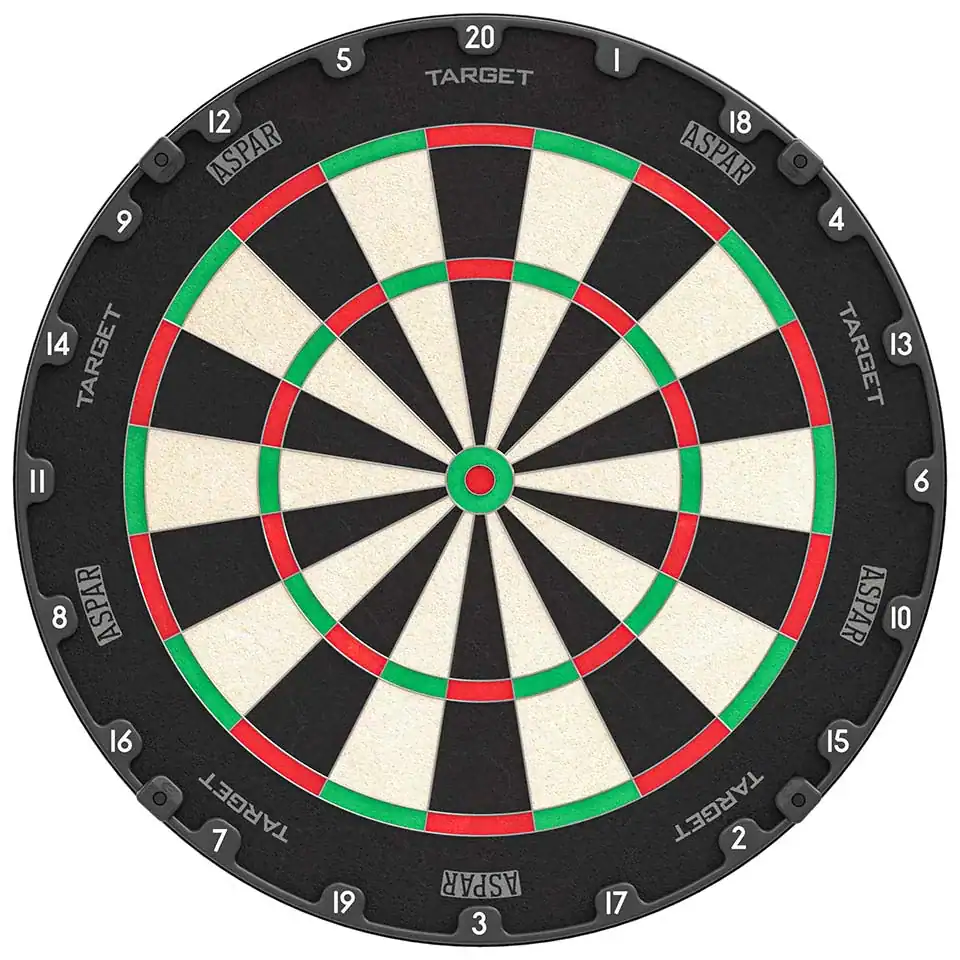
Target Aspar
Smart Edge ultra-thin wire, high-density African sisal
The Aspar is Target’s attempt to modernise the dartboard. Smart Edge Technology produces an ultra-fine wire that’s 35% thinner than conventional round wire, and the entire spider is 100% staple-free stainless steel. The symmetrical design means you can rotate the board up to 10 times without the graphics looking misaligned – a practical detail most boards ignore.
Here’s where honesty matters. The Aspar’s high-density African sisal is firm – very firm. Community feedback consistently reports that darts can fall out slowly, especially with lighter throws. The board needs a break-in period of several hours of play before the sisal loosens enough to grip reliably. If you throw hard and fast, this firmness is an advantage – the board will outlast softer alternatives. If you throw gently, the holding power may frustrate you. For the full comparison between board types, see our guide to electronic vs bristle dartboards.
What We Liked
- Smart Edge wire – 35% thinner than round wire
- Symmetrical design – 10x rotation without visual impact
- Very firm sisal – outlasts softer boards under heavy use
- Minimalist graphics reduce visual distraction
Watch Out For
- Darts fall out with lighter throws – holding power issue
- Needs break-in period (several sessions)
- Quality control inconsistency reported by some buyers
OUR VERDICT
Built for hard throwers
If you throw hard and want a board that outlasts everything else, the Aspar delivers. If you throw light, the holding power will frustrate you. Know your throw style before buying.
Razor Wire vs Round Wire vs Staple – Why It Matters
THE WIRE QUESTION
Wire type is the single biggest factor in bounce-outs.
Razor/blade wire (Winmau Blade series): Thin wire embedded at a 60-degree angle. When a dart hits the wire, it deflects downward into the sisal rather than bouncing outward. This is the technology used in every PDC and WDF tournament board. Boards with blade wire have the fewest bounce-outs.
Round wire (Viper, budget boards): Traditional galvanised steel wire sitting on top of the sisal surface. Darts that hit the wire bounce outward because there’s no angle directing them into the board. Round wire boards are cheaper but you’ll lose more darts to wire hits.
Staple construction (avoid): Older boards use metal staples to hold the wire spider to the number ring. Staples create raised bumps that cause bounce-outs and gradually damage the sisal around them. Every board on this list is staple-free except where noted.
How to Choose a Dartboard for Your Home
Three decisions matter. Everything else is preference.
1
Wire Type
Blade/razor wire boards reduce bounce-outs. Round wire is cheaper but you’ll lose darts to wire hits. This is the most impactful spec on any dartboard.
2
Sisal Quality
Dual core or high-grade African sisal heals faster and lasts longer. Single-layer compressed sisal is adequate for casual play but wears faster in the treble beds.
3
Mounting System
Rota-Lock and U bracket systems let you rotate the board without removing it. Standard clips work but require more effort. Easy rotation = longer board life.
The most common beginner mistake with dartboards is ignoring wall protection. Every dartboard needs a surround – a foam ring that catches stray darts. Without one, your wall will be full of holes within a week. A surround costs a fraction of the board and saves you from replastering. For the full guide, see dartboard surround and lighting. For exact mounting heights and distances, read how to set up a dartboard.
The second most common mistake: buying an electronic board when you want to play steel-tip darts. Electronic boards use plastic segments and soft-tip darts – they’re louder, less durable, and not used in any league or competition in the UK. If you want to play the same game you see on television, you need a bristle board. Every board on this list is bristle. For the full comparison, see electronic vs bristle dartboard.
Third: not rotating the board. The treble 20 bed absorbs more darts than any other segment because that’s where everyone aims. Without rotation, that segment wears out while the rest of the board stays fresh. Every board on this list has a rotating number ring. Use it every 1-2 weeks and your board will last several times longer.
5 Dartboard Mistakes That Cost You Money
1. Skipping the surround. A dartboard surround costs £8-15 (~$10-19). Wall repairs cost more. Every missed dart hits something – make sure it’s foam, not plaster.
2. Buying electronic when you mean bristle. Electronic boards are designed for soft-tip darts and automatic scoring. They’re louder on impact, have higher bounce-out rates, and aren’t used in any UK competition. If you want to throw steel-tip darts, buy bristle.
3. Mounting at the wrong height. The bullseye must sit at exactly 1.73m (5ft 8in) from the floor. The throwing line must be 2.37m (7ft 9.25in) from the board face. Getting these wrong means every practice session builds muscle memory for the wrong distances.
4. Never rotating the board. Rotate the number ring every 1-2 weeks. The treble 20 bed takes the most punishment. Without rotation, you’ll wear out one segment while the rest of the board stays fresh.
5. Choosing round wire to save money. The price gap between a round-wire budget board and a blade-wire Blade 5 is often less than £20 (~$25). That gap buys you meaningfully fewer bounce-outs for the life of the board. If your budget stretches at all, blade wire is the single most impactful upgrade.
Dartboard Maintenance – Make It Last
Do
Rotate regularly – turn the number ring every 1-2 weeks to distribute wear evenly across all segments.
Use a surround – catches stray darts and protects your wall. Worth every penny.
Pull darts straight out – twisting or angling tears the sisal fibres instead of letting them close naturally.
Keep it dry – moisture causes sisal to swell and deform. Indoor mounting only.
Don’t
Don’t get it wet – no cleaning with water or damp cloths. Brush loose fibres off with a dry cloth.
Don’t leave darts in the board – prolonged pressure compresses the sisal and slows self-healing.
Don’t mount in direct sunlight – UV fades the colours and dries out the sisal, making it brittle.
Don’t mount on an exterior wall – temperature changes and condensation damage the board from behind.
KEY TAKEAWAY
The Winmau Blade 6 Dual Core is the best dartboard for home for most players. If budget is tight, the Blade 5 Dual Core gives you the same wire technology and mounting system at a lower price. The One80 Gladiator 3+ is the best non-Winmau option. Avoid round wire boards unless you’re spending under £30 (~$40).
How We Picked These 7 Boards
We started with every bristle dartboard recommended across Reddit’s r/darts, the DartsNutz forum, and 10 retailer recommendation pages (Darts Corner, DartHelp, DartsGuide, Double Top, and others). The Winmau Blade 6 Dual Core appeared in every single source. The Gladiator 3+ appeared in 8 of 10. The Blade 5 and Viper Shot King in 6 each.
We then verified every spec against the manufacturer’s own product page. Wire type, sisal origin, mounting system, dimensions – all checked. Where community claims conflicted with manufacturer data, we used the manufacturer. Where community reported issues (like the Aspar’s holding power), we confirmed across multiple sources before including them.
What we excluded: electronic dartboards (different market, covered in our electronic vs bristle comparison). We also cut boards from brands without UK or US availability, discontinued models, and anything with fewer than 20 verified reviews.
SCOUT’S TAKE
If I could only recommend one board, it would be the Blade 6 Dual Core. But if someone told me their budget was tight, I’d point them to the Blade 5 Dual Core without hesitation. Same blade wire, same Rota-Lock, same 60-degree angle. The Blade 6’s improvements are real but they’re refinements, not reinventions.
Frequently Asked Questions
How long does a bristle dartboard last?
A quality bristle dartboard with blade wire and dual core sisal can last several years with regular home use, provided you rotate it every 1-2 weeks. Budget boards with lower-density sisal wear faster, particularly in the treble 20 bed where most darts land. The sisal eventually stops self-healing in heavily used segments – that’s when you know it’s time to replace.
Do I need a surround for my dartboard?
Yes, unless you don’t mind holes in your wall. Beginners miss the board frequently, and even experienced players throw stray darts. A foam surround catches them. It’s the cheapest accessory that makes the biggest practical difference. See our surround and lighting guide for options.
What’s the difference between Blade 5 and Blade 6?
The Blade 6 adds Density Control wire technology (25% thinner bullseye wires), vein-free sisal, and updated graphics. The core dual-density construction and Rota-Lock mounting are present in both. The Blade 5 occasionally shows sisal veins and has slightly thicker bullseye wires. For casual home play, the difference is marginal.
Can I use soft-tip darts on a bristle board?
Technically yes, but it’s not ideal. Plastic tips don’t grip sisal as well as steel tips, and they wear down faster against the fibrous surface. Bristle boards are designed for steel-tip darts. If you want to use soft-tip darts, get an electronic dartboard instead.
How often should I rotate my dartboard?
Every 1-2 weeks for regular home use. The treble 20 bed takes the heaviest punishment because most players aim there. Rotating the number ring distributes wear evenly. Boards with Rota-Lock or U bracket systems make this easy – just turn the ring without removing the board from the wall.
What wall type is best for mounting a dartboard?
Brick or concrete with wall plugs is most secure. Plasterboard works with heavy-duty wall anchors or by screwing into a stud. Rented properties with no-drilling rules need a freestanding dartboard stand. For the full mounting guide, see how to set up a dartboard.
Is the Triple Core worth the extra cost over Dual Core?
For most home players, no. The Triple Core’s carbon fibre base layer adds durability under heavy daily use, and the laser-cut anti-glare ring and Spirit Master are nice extras. But the wire system – which has the biggest impact on bounce-outs – is identical. The Dual Core handles typical home play volume well. The Triple Core earns its premium for daily multi-hour practice or hosting league nights.
For the complete decision framework, read how to choose a dartboard. For mounting heights and distances, see how to set up a dartboard. For budget planning, check our home darts setup guide. For wall protection and lighting, read dartboard surround and lighting. To pair your board with the right darts, see our best darts for beginners guide or take the dart recommendation quiz · Best dartboard cabinet guide. For equipment regulations, see the World Darts Federation rules.