QUICK ANSWER
162 checkout routes. One calculator that recalculates after every dart.
We built a checkout calculator. New to the sport? Read our beginner’s guide to darts that recalculates the best finish after every dart – including misses. The data behind it revealed patterns that static checkout charts never show.
Standard checkout charts give you one route per score. They work when every dart lands where you aim. They stop working the moment you miss – which, for most players, is the majority of throws. According to TheDartScout’s analysis of all 162 standard checkout routes, the optimal finishing path changes on roughly two thirds of scores after a single missed first dart. That is the gap our darts checkout calculator. New to the sport? Read our beginner’s guide to darts is built to fill.
This article breaks down the data behind the calculator. Which numbers appear most. Which doubles dominate. Which checkouts are traps. And what happens when your first dart misses.
What Do 162 Checkout Routes Actually Look Like?
Every score from 2 to 170 has a checkout route, except seven. The scores 159, 162, 163, 165, 166, 168, and 169 cannot be finished in three darts. They are called bogey numbers. If you land on one, the best strategy is to throw a dart that leaves you on a clean checkout for your next visit.
Of the 162 valid checkouts:
- 20 are one-dart finishes – any double from D1 (2) to D20 (40) plus D25 (Bull).
- 78 are two-dart finishes – scores from 41 to 100 that need a setup dart plus a double.
- 64 are three-dart finishes – scores from 101 to 170 that require two setup darts and a double.
The difficulty curve is not linear. A two-dart finish at 60 (S20 → D20) is straightforward. A three-dart finish at 121 (T17 → T10 → D20) requires two different treble segments before a double. Most players cannot name that route from memory.
Which Numbers Dominate the Checkout Chart?
Treble 20 is the most common first dart in checkout routes. It appears as the opening throw in 56 of 162 routes – over a third. Treble 19 is second with 19 routes. No other treble comes close.
| First Dart | Routes | Share |
|---|---|---|
| T20 | 56 | 34.6% |
| T19 | 19 | 11.7% |
| T18 | 6 | 3.7% |
| T17 | 6 | 3.7% |
| T15 | 4 | 2.5% |
| T16 | 4 | 2.5% |
This is why professional players spend most of their practice time on treble 20. It is not just the highest-scoring segment – it is the gateway to more than a third of all checkout routes.
Which Doubles Finish the Most Checkouts?
Double 20 and Double 16 are almost tied as the most common finishing doubles. Between them, they close 81 of 162 routes – exactly half of all checkouts.
| Double | Routes | Share |
|---|---|---|
| D20 | 41 | 25.3% |
| D16 | 40 | 24.7% |
| D8 | 18 | 11.1% |
| D12 | 12 | 7.4% |
| D18 | 12 | 7.4% |
| D4 | 9 | 5.6% |
| DBull | 4 | 2.5% |
The D20/D16 dominance is not a coincidence. Both are even numbers, which means missing them into the single leaves an even number – still finishable on the next double. D20 missed into S20 leaves 20 (D10). D16 missed into S16 leaves 16 (D8). The chart is engineered around forgiving misses.
KEY TAKEAWAY
If you only practise two doubles, make them D20 and D16. Together they finish half of all checkouts, and missing either leaves you on another even number.
What Happens When Your First Dart Misses?
Static charts fail here. A checkout chart assumes every dart lands where you aim. The calculator does not. It recalculates after every throw, including misses. According to TheDartScout’s analysis of the route data, the consequences of a single miss vary dramatically by score.
| Score | Standard Route | Miss | Left With | New Route |
|---|---|---|---|---|
| 170 | T20 → T20 → DBull | Hit S20 | 150 | T20 → T18 → D18 |
| 140 | T20 → T16 → D16 | Hit S20 | 120 | T20 → S20 → D20 |
| 121 | T17 → T10 → D20 | Hit S17 | 104 | T18 → S18 → D16 |
| 100 | T20 → D20 | Hit S20 | 80 | T16 → D16 |
| 81 | T15 → D18 | Hit S15 | 66 | T10 → D18 |
| 60 | S20 → D20 | Hit S1 | 59 | S19 → D20 |
| 40 | D20 | Hit S20 | 20 | D10 |
Look at 140. The standard route is T20 → T16 → D16. Miss the first treble and hit S20 – you are on 120. The new optimal path is T20 → S20 → D20. Your second dart changes from T16 to S20 – a completely different target on a different part of the board. Most pub players stubbornly aim T20 again, which leaves 60 and wastes a dart getting there.
Or take 121. It does not even start on T20. The correct first dart is T17. Most players default to T20 out of habit, which leaves 61 – a harder two-dart finish (T15 → D8) than the original route would have given them.
Which Checkouts Are Traps?
Fourteen checkouts above 100 do not start with T20. These are the scores that catch players who autopilot to the top of the board.
| Score | Correct First Dart | Why Not T20 |
|---|---|---|
| 104 | T18 | T20 leaves 44 (hard two-dart) |
| 105 | T19 | T20 leaves 45 (awkward) |
| 107 | T19 | T20 leaves 47 (no clean route) |
| 109 | T19 | T20 leaves 49 (no clean route) |
| 121 | T17 | T20 leaves 61 (T15 → D8) |
| 125 | S25 (Bull) | Only checkout that starts on Bull |
| 126 | T19 | T19 → T19 → D6 (avoids T20 entirely) |
Score 125 is unique. It is the only checkout in the entire chart that starts with the outer bull (S25). The route is S25 → T20 → D20. No other score requires you to aim at the bullseye as a first dart.
Why Double Bull Only Appears Four Times
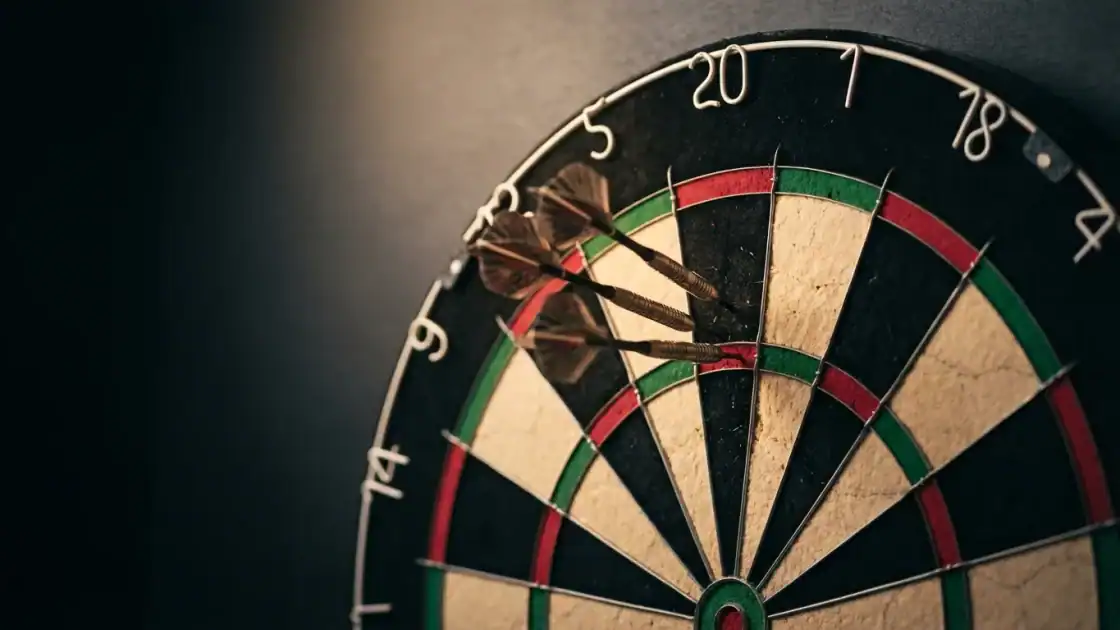
Double Bull (50) is the hardest finishing double on the board. It is a 12.7mm circle at the centre – far smaller than the 8mm-wide double segments on the outer ring. Despite this, it appears in four checkout routes: 170, 167, 164, and 161. All four are high-pressure scores that only arise late in a leg. The calculator treats DBull as a last resort, preferring D20 or D16 wherever mathematically possible.
How the Calculator Uses This Data
The TheDartScout checkout calculator. New to the sport? Read our beginner’s guide to darts stores all 162 pro-verified routes from three cross-referenced sources: Darts501.com, WhichDarts.com, and verified TV broadcast data. When you enter a score, it shows the standard route instantly.
The difference from a chart is what happens next. You throw your first dart and confirm whether you hit or missed. If you missed, you tap where the dart actually landed. The calculator recalculates the best route for your remaining darts and new score. It knows which segments neighbour your target, offers quick-tap shortcuts for the most likely misses, and recomputes in real time.
The routes are weighted by double preference. D20 and D16 are preferred over D12 or D8 when multiple routes exist for the same score. This mirrors professional practice – the doubles that appear most in the chart are the ones pros hit most reliably.
SCOUT’S TAKE
Memorising a checkout chart is useful. But darts is a game of misses. The moment your first dart lands somewhere unexpected, the chart cannot help you. The calculator can. Use the chart for practice. Use the calculator at the board.
Frequently Asked Questions
What is the highest checkout in darts?
170 – Treble 20, Treble 20, Double Bull. It is the only three-dart finish that requires the double bullseye, and hitting it in competition is considered one of the most prestigious achievements in the sport.
What are bogey numbers in darts?
Bogey numbers are scores that cannot be finished in three darts: 159, 162, 163, 165, 166, 168, and 169. If you land on one, throw a dart that leaves a clean three-dart checkout for your next visit.
Why do most checkouts finish on D20 or D16?
Because missing either leaves an even number. D20 missed into S20 leaves 20 (D10). D16 missed into S16 leaves 16 (D8). The chart is built around doubles whose misses still leave a finishable score.
Does the checkout calculator work for soft tip darts?
The routes are the same for soft tip – the scoring is identical. The calculator works for both formats. The only difference is that soft tip double segments may be slightly larger on electronic boards, making some finishes easier to hit.
Should I always aim for double 20 to finish?
No. The checkout chart routes to D20 on 41 scores and D16 on 40 scores. The correct double depends entirely on your remaining score. Aiming for D20 when the optimal route ends on D16 wastes darts on unnecessary setup throws.
Try the checkout calculator to look up any finish live. For game formats and scoring, read dart rules explained. To put these routes into practice, see how to practice darts alone.? Read our beginner’s guide to darts at your next practice session. For how dart weight affects your ability to hit these doubles consistently, see our dart weight guide. For the format differences that affect checkout strategy, see steel tip vs soft tip darts. For the thinking behind route selection, read our 501 checkout strategy guide. Try the checkout calculator to practise these routes live. And for barrel selection that matches your grip style, read our dart barrel shapes guide. For all game formats from 501 to Cricket, see dart rules explained.