QUICK ANSWER
More fingers means more control – but a harder release.
Pencil grips use 2‑3 fingers for the cleanest release. Claw grips use 3‑4 for more control. Palm grips use 4‑5 for maximum hold. Every additional contact point must disengage without deflecting the dart off-axis.
A dart weighs between 18 and 30 grams. It travels 2.37 metres in under half a second. The only thing connecting you to that projectile is the grip – a few square centimetres of fingertip contact. That contact must accelerate the dart, aim it, and release it without interference. Get the release wrong by a fraction of a degree and the dart lands in single 5 instead of treble 20. Understanding how dart grip styles work – mechanically, not just intuitively – is the first step toward understanding why your darts land where they do.
What Does a Dart Grip Actually Control?
Every grip solves the same problem: hold a small metal cylinder, accelerate it, then let go cleanly. The technical term for a bad release is the “kick”. It is a sideways force from a finger that releases late or at the wrong angle.
According to the grip mechanics reference on Dartbase, a dart grip needs at least three fingers (thumb plus two) for sufficient control. Two fingers lack enough guidance. You can use up to five, but each additional finger adds a release variable. More contact points give you more control during the throwing motion. They also make the release harder to coordinate.
Grip pressure matters as much as finger position. The consensus across DartsNutz forum discussions and coaching guides is consistent: hold the dart like you would hold an egg. Firm enough that it will not slip. Light enough that no forearm muscles are tensed. If your knuckles turn white, you are gripping too hard. Darts requires touch, not force.
How Does the Pencil Grip Work?
The pencil grip uses two to three fingers: thumb and index finger do the work, with the middle finger as an optional stabiliser underneath. It mirrors how you hold a pen – the most practised fine motor pattern in daily life. That familiarity is its greatest advantage.
With only two or three contact points, the pencil grip produces the cleanest release of any dart grip style. Fewer fingers means fewer variables at the moment of release. The thumb and index finger open almost simultaneously, and the dart slides forward with minimal interference. Phil Taylor used this grip throughout a career that produced 16 world championships.
The tradeoff is control during the acceleration phase. Two fingers provide less pushing force and less directional guidance than three or four. Players who throw with a slow, lobbing arc may find the pencil grip too unstable. Players with a fast, flat throw often find it ideal – the dart is in their hand for such a short time that extra control is unnecessary.
The pencil grip generally works best on straight barrels. The uniform diameter gives your fingers freedom to sit anywhere along the barrel without a forced position.
How Does the Claw Grip Work?
The claw grip uses three to four fingers. Thumb sits underneath. Index and middle fingers curve over the top like a claw. The ring finger may touch the point or front of the barrel for extra stability. The fingers form a structured cage around the barrel rather than resting on it lightly.
This structured hold gives the claw grip more control than the pencil during the acceleration phase. The dart is locked into a defined position between the fingers, which reduces wobble during the throwing motion. Michael van Gerwen uses a three-finger claw grip, holding the barrel at its centre with thumb, index, and middle finger.
The release is more complex. Three or four fingers must open in a coordinated sequence. If the middle finger lingers a fraction of a second longer than the index finger, it kicks the dart sideways. This is the primary failure mode of the claw grip – inconsistent finger sequencing during release.
The claw grip pairs naturally with torpedo and scalloped barrels. The widest point of a torpedo barrel gives the claw fingers a defined pinch zone. The concave groove of a scalloped barrel physically locks the fingers into a repeatable position.
How Does the Palm Grip Work?
The palm grip uses four to five fingers. The barrel sits deeper in the hand than the other two styles. All fingers wrap around it, and the palm itself may contact the barrel. It is less of a pinch and more of a hold.
Maximum contact surface means maximum control during the throw. The dart cannot shift or rotate in your hand. For players with large hands or a powerful throwing style, this security is the priority.
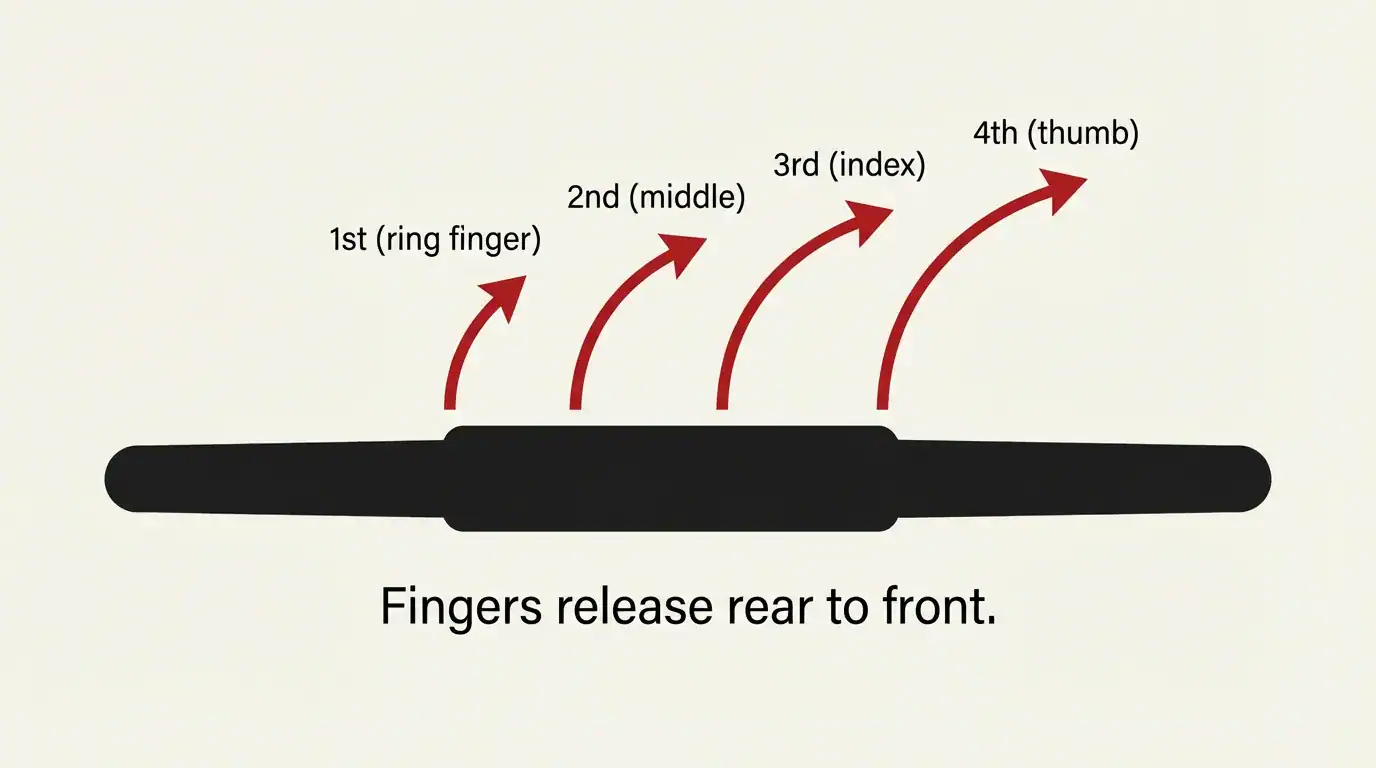
The cost is release complexity. Four or five fingers must disengage in sequence: ring and pinky first, then middle, then index, then thumb last. Each finger that lingers creates a potential kick. In forum discussions on grip consistency, players regularly report that the palm grip produces the most variation in entry angle. Darts land at different tilts because the complex release is hard to replicate.
The palm grip works on short, fat barrels – bomb shapes that provide enough width and surface area for the full hand to engage. Slim straight barrels are physically too narrow for this grip.
How Many Fingers Should You Use?
| Aspect | Pencil (2–3) | Claw (3–4) | Palm (4–5) |
|---|---|---|---|
| Control during throw | Moderate | High | Maximum |
| Release cleanliness | Maximum | Moderate | Low |
| “Kick” risk | Minimal | Moderate | High |
| Best barrel match | Straight | Torpedo / scallop | Bomb / wide |
| Pro example | Phil Taylor | Van Gerwen | – |
Across all three dart grip styles, the pattern is a curve, not a ladder. Adding fingers gives diminishing returns in control but increasing cost in release coordination. Most competitive players settle on three fingers – enough control to guide the dart, few enough to release it cleanly. The pencil and claw grips dominate professional play for exactly this reason.
Where on the Barrel Should You Grip?
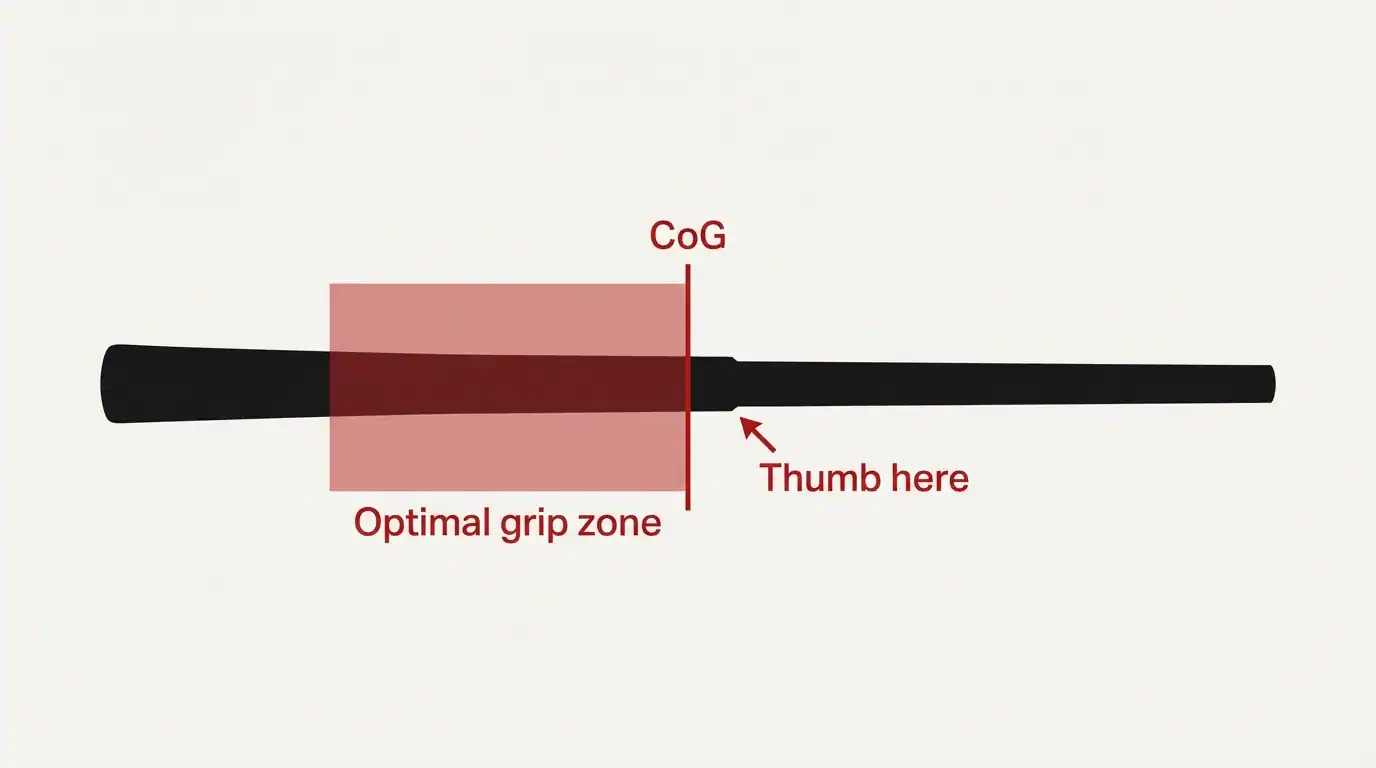
Grip position is dictated by the barrel’s centre of gravity. The Dartbase grip guide recommends a simple test: place the dart in your open palm, find the balance point, then roll it toward your fingertips. Your thumb should sit slightly behind the centre of gravity – not on it, not far ahead of it.
This position ensures the dart’s tip stays angled slightly upward throughout the throw. Gripping too far forward tips the rear down. Gripping too far back tips the nose down. Both create release problems that no amount of wrist adjustment can fix.
This is why barrel shape and grip style are inseparable. A front-loaded torpedo barrel has a forward centre of gravity, pulling your natural grip position toward the tip. A straight barrel has a centred balance point, giving your fingers freedom to sit anywhere. For a deeper look at how barrel geometry interacts with grip, see our dart barrel shapes guide.
SCOUT’S TAKE
Start with the pencil grip. It is the most forgiving, the most natural, and the easiest to release cleanly. If you find you need more control – especially on torpedo or scalloped barrels – move to a three-finger claw. Only consider a palm grip if you throw short, fat bomb barrels and need the extra hold. Change one variable at a time and give each change at least two weeks before judging it.
Frequently Asked Questions
Which dart grip style is best for beginners?
The pencil grip. It mirrors how you hold a pen – the most familiar fine motor pattern. It has the fewest contact points to coordinate during release, and it works on any barrel shape. Phil Taylor won 16 world titles with it.
Can I change my grip after years of playing?
Yes, but expect two to four weeks of reduced accuracy while the new motor pattern develops. Change one element at a time – finger count, then position, then pressure. Never change everything at once.
Does hand size determine which grip I should use?
Not directly, but it affects comfort. Larger hands may find three or four finger grips more natural. Smaller hands often prefer the pencil grip. The real determinant is barrel width – a slim 6mm barrel cannot physically accommodate a palm grip regardless of hand size.
Why do my darts wobble even though my grip feels consistent?
The grip may be consistent but the release may not. The most common cause is one finger releasing late, giving the dart a sideways kick. Film your throw in slow motion and watch for the last finger to leave the barrel. That finger is usually the problem.
Should I grip the dart at its centre of gravity?
Close to it, but slightly behind. Dartbase recommends placing the thumb just behind the balance point. This keeps the dart’s tip angled slightly upward throughout the throw, which is essential for a clean parabolic flight path.
For the practical beginner’s guide to picking up a dart for the first time, see how to hold a dart. To see how barrel geometry affects your grip options, read dart barrel shapes explained. For the throw mechanics behind each grip, see consistent dart throw. To pick the right weight for your grip style, check how to choose dart weight., see our dart barrel shapes guide. For the role of weight in grip feel, read how to choose dart weight. For how shaft length depends on your grip position, read how to choose dart shafts. For matching flight shape to your throw, see how to choose dart flights. To understand how tungsten percentage affects the grip texture you feel, see 80% vs 90% vs 95% tungsten. To see how professionals match grip to equipment, read how pro players choose darts. And for how your grip affects what happens after the release, our flights and shafts guide covers the aerodynamics. If you’re just starting out, our beginner’s guide to darts has the full picture. To build accuracy with structured drills, see how to improve dart accuracy. For game formats, see dart rules explained. To restore worn barrel grip, see how to re-grip a dart barrel. To put your grip to work, see our guide to a consistent dart throw. For barrel recommendations matched to grip style, see our best dart barrels 2026 guide. To see grip errors in the wider context of technique, read common darts mistakes.