Quick Answer
The double ring is 8mm wide — same as the treble. What makes doubles hard isn’t the ring size; it’s the position. At the outer edge of the board, a miss outward scores nothing. To get consistent: aim at the centre of the bed (not the wire), choose a double with a forgiving miss path (D16 over D20 under pressure), and practise the shot in isolation until it’s boring.
You’re on 32. D16 is the shot. First arrow clips the wire — single 16. Fine, you’ve left yourself on 8. Second arrow clips again — single 8. Still fine, you have D4. Third dart lands in the 4 bed. You’re still in the leg, but out of arrows, and you’ve just spent three visits not closing one you should have finished in one.
That’s the D16 cascade working against you. It’s also, if you’ve practised it properly, the safest finish structure in the game. The difference is the work you’ve put in before you got to the oche.
The ring is the same size — the position is the problem
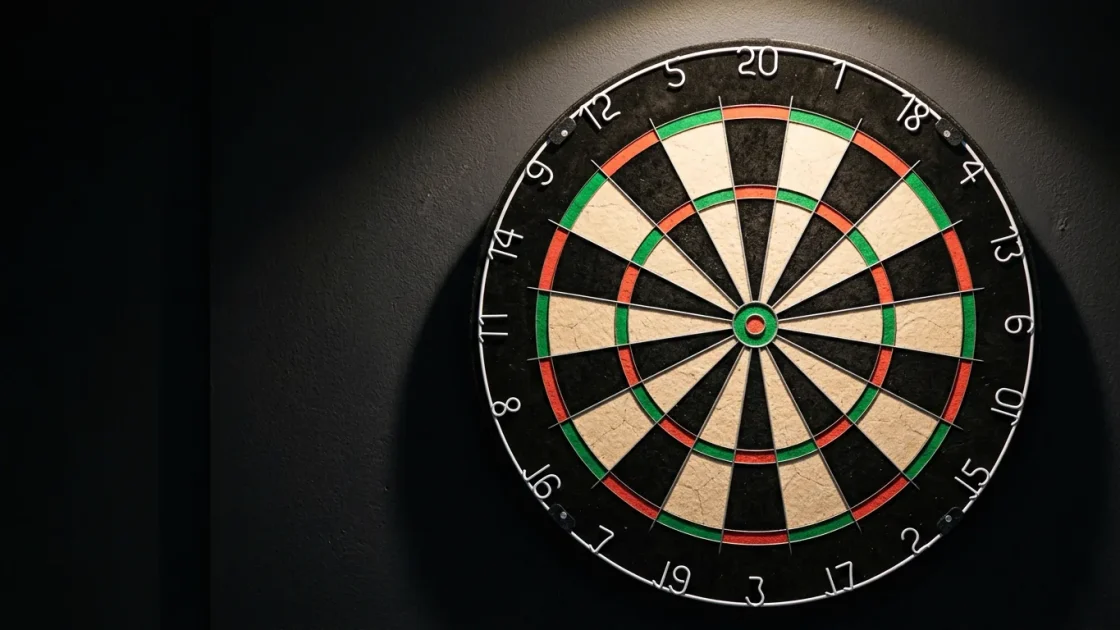
The WDF dartboard spec puts the double ring at 8mm wide. The treble ring is also 8mm. The difficulty on doubles doesn’t come from ring width — it comes from where the ring sits on the board.
The treble ring sits mid-board with single beds on both sides — miss inward, you’ve scored; miss outward, you’ve scored. The double ring sits at the very outer edge of the scoring area. Miss inward and you hit the single. Miss outward by even a millimetre and your dart is off the board, scoring nothing. One safe direction, and it’s inward.
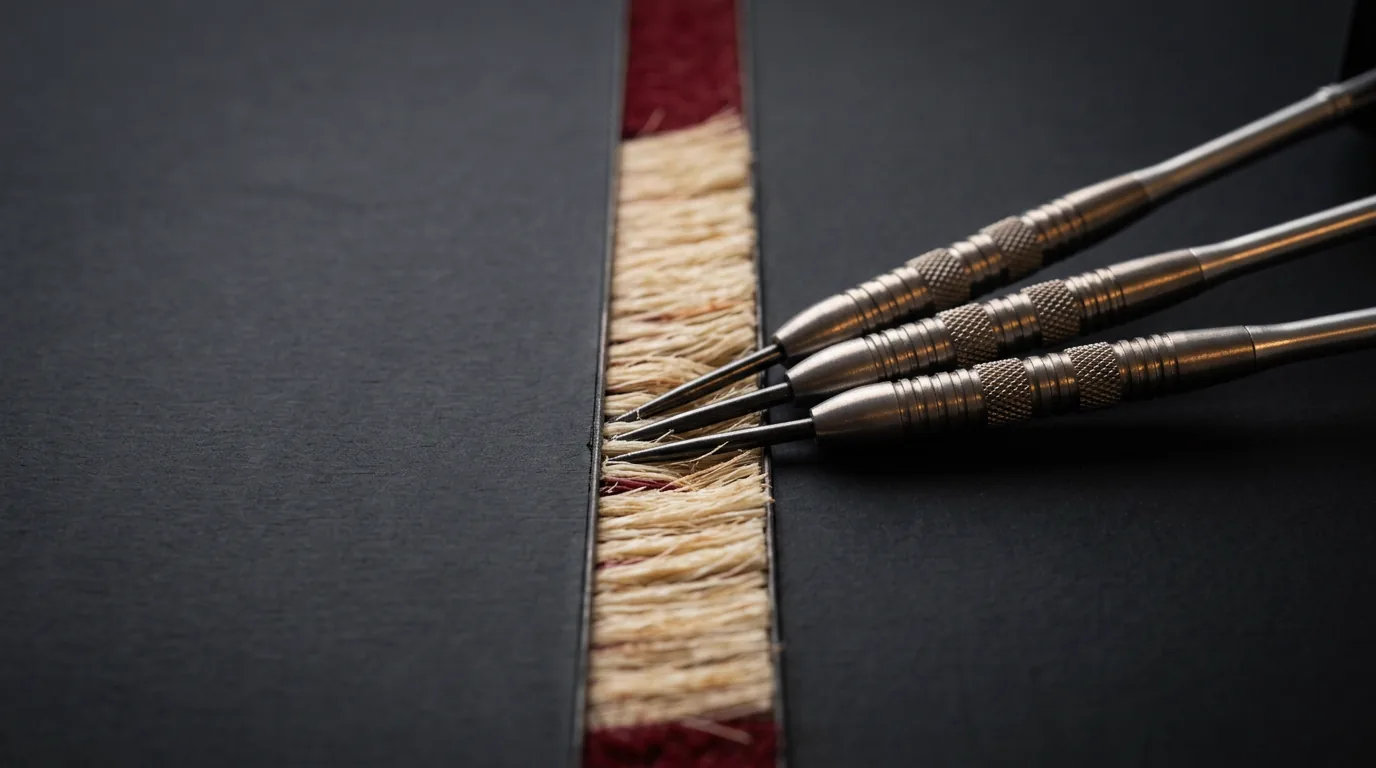
The wire makes it worse. When you’re aiming at a treble, your focal point is in the open sisal in the middle of the board. When you’re aiming at a double, the outer wire is right there, competing for your attention. Under match pressure it pulls the eye toward it — and the dart follows. You end up pitching into the wire rather than through the middle of the bed.
Then there’s the pressure layer. Trebles are thrown when a miss costs you one visit. Doubles are thrown when the leg is on the line. The mental load on a match-winning double is different from throwing at treble 20 in the second visit — and that difference shows up in your throw whether you want it to or not. The mental game article covers exactly how pressure changes the physical act of throwing, if you want to go into that in depth.
Where your eye is going wrong
On doubles, the technique problem that bites hardest isn’t grip, stance, or release — it’s focal point. Under pressure, players shift their eye to the wire rather than the centre of the bed, and it happens without them noticing.
If you aim at the wire, any dart that lands exactly where you aimed is at the outermost edge of the double — your margin is close to zero. Aim at the centre of the bed and a dart 3mm inward is still a double. A dart 3mm outward is still a double. You’ve used 6 of the available 8mm rather than scraping by on 1mm.
Practical Tip
Before each doubles session, find the exact centre stripe of the bed you’re targeting — not the wires on either side, the middle. Lock your eye there before you throw your first arrow. Under match pressure this is the first thing that drifts.
The other aiming issue is board angle. D20 at the top sits on your natural throwing line — the dart enters roughly straight-on. D4 or D11 on the far side of the board is physically rotated relative to where you’re standing. Your throw hasn’t changed but the target has swivelled, so the dart enters at an angle to the bed rather than through it. Stepping slightly toward the centre of the oche — shifting your throwing line a few degrees toward the double — helps the arrow go through the bed instead of skimming the edge. It takes a small step, not a whole stance change.
Three things that break on doubles but not trebles
The throw mechanics for doubles are the same as for scoring — what changes is the tolerance. On a treble, small inconsistencies don’t cost you; there’s scoring space on both sides. On a double there isn’t. Three habits that are harmless during scoring become leg-enders on a finish.
Grip pressure. Under pressure it tightens, and a tight grip kills your release arc. The shape of your hold should be identical to what you use for trebles — what loosens is the force. You want the dart to feel secure, not clamped. If you’ve never thought about grip in this way, the grip styles guide lays out the fundamentals.
Release timing. An early release tends to send the dart high — you catch the wire above rather than land in the bed. A late one drops it flat into the single below. On trebles you can get away with fractional variation; there’s scoring space on both sides. On a double there isn’t. Pick a release point in your arm’s arc and practise until hitting it is automatic.
Follow-through. After the dart leaves your fingers, your throwing hand should point at the target. The common failure is pulling the elbow back mid-throw, trying to redirect the dart because you can feel the throw going wrong. Steering always makes it worse. Throw the dart, let the follow-through finish, look where it landed, adjust for the next one. The common mistakes article covers steering in more detail — it’s one of the most damaging habits to fix once it’s ingrained.
D16 or D20?
Under match pressure, D16 is the better double to target — and it comes down to what happens when you miss.
Miss D16 into single 16 and you’re on 8 — double 8 sits almost directly below on the board. Miss that and you’re on double 4, nearly the same spot again. The whole halving chain — D16, D8, D4, D2, D1 — stays in roughly the same quadrant. You barely have to move your eye between throws.
Now trace the D20 cascade. Miss D20 and you’ve left 20 — double 10, on the completely opposite side of the board. Miss D10 and you’re on 10, which means double 5. Double 5 is one of the worst doubles on the board: awkward positioning, one of the lowest hit rates, and no compact cascade of its own. Two misses on D20 and you’re in territory you probably haven’t practised, at the worst possible moment of the leg.
| Double | Miss leaves | Next double | Next miss leaves | Chain quality |
|---|---|---|---|---|
| D16 | 16 (S16) | D8 | 8 → D4 → D2 → D1 | Excellent — stays in same area |
| D20 | 20 (S20) | D10 | 10 → D5 (awkward) | Poor — jumps across board |
| D18 | 18 (S18) | D9 | 9 → D4 (after S9+S1) | Moderate |
| D8 | 8 (S8) | D4 | 4 → D2 → D1 | Good — compact cascade |
| D12 | 12 (S12) | D6 | 6 → D3 | Good — clean even chain |
When is D20 the right call? When you arrive on 40 with D20 feeling reliable and the leg going well. That’s a legitimate shot. D16’s advantage shows up when there are misses in the leg and pressure in the room — it keeps you in familiar board territory when you can’t afford to be improvising. For full checkout route options across every common score, the checkout route data and the 501 checkout strategy guide cover the numbers.
What your misses are telling you
Before picking a drill, do this once: throw twenty arrows at D16 without adjusting between throws. Just throw and watch. Where your misses cluster tells you exactly what to work on.
Key Concept
A tight cluster that misses the target means your throw is repeatable — your aim point is just off. That’s the easier fix. Misses scattered all over the board mean multiple things are wrong at once, and you need to address the release before aim adjustments will do anything.
Left or right bias. If you’re right-handed and missing consistently left, check whether your elbow is pulling inward on the follow-through, dragging the dart line across. Also check your stance — if your body’s not lined up to the double, the bias will show up on every throw.
Missing high. Your arm’s arc is still swinging upward at the moment the dart leaves your fingers. The arrow overshoots the bed and hits the wire above or lands in the single above the double. Slow the throw slightly and release at the peak of your arm’s forward extension, not on the upswing.
Missing low. Late release combined with a dart that drops flat. Check grip pressure first — hold too tight and the dart can’t pivot cleanly off your fingertips, so it flies nose-heavy and falls short of where you’re aiming.
Scattered misses. Multiple things wrong at once, which means fixing aim won’t help. Go back to building a reliable throw before coming back to doubles work specifically. Doubles isolate whatever inconsistency is in your technique — they don’t create it.

Five drills that actually build the shot
These five cover different parts of the problem. Running the same drill every session gets you comfortable with one thing — rotating through them develops the full range.
Bob’s 27
The standard benchmark for doubles work. Start with 27 points. Work from D1 through D20, then finish on the bullseye. Three arrows at each double — hit one and add its value, miss all three and subtract it. Score reaches zero, the game’s over.
Your running score should stay odd throughout; if it goes even, you’ve made an arithmetic mistake somewhere. Perfect score is 1,437. Around 400 is solid for a league-level player; 600 is good. If you’re going negative before D8, skip the elimination rule for now — track how far below zero you finish and use that number as something to beat each session. The deduction system is the point: missing doubles costs you something, which is a much closer approximation of losing a leg than any amount of aimless finishing practice.
Doubles Lock
Start at D20 and work down to D1. Three arrows at each double. Hit any one and you advance. Miss all three and you stay until you hit. Track how many total visits it takes to complete the full board and try to beat your record. The lock mechanic means you can’t rush past your weak doubles — you’re stuck with D3 until you hit D3, which is the right kind of uncomfortable.
The Halving Drill
Three darts at D16, then D8, then D4, D2, D1 — whether you hit or miss, you move through the full cascade chain. Score one point per double hit across five complete runs. This builds muscle memory for the exact doubles you’ll need during a D16 recovery in a match, and keeps your eye moving through the same board geography each time.
Pressure Simulator
Two-minute countdown. Your job: hit D16 before the timer runs out, throwing one dart at a time. If you hit it, reset the timer and go to D8. If two minutes pass without hitting D16, note it — that’s your current pressure threshold. The goal isn’t speed. It’s hitting the double under the specific discomfort of a clock running, which is closer to match conditions than anything in a standard practice session. See the solo practice guide for a broader framework using this kind of threshold training.
Random Checkout
Generate a random number between 40 and 100. Nine darts to finish it. No chart, no pre-planning — calculate the route yourself, execute it. This closes the gap between hitting doubles in isolation and finishing a real leg, where you have to solve the route, throw the setup score, and then convert under pressure. It’s the drill that most closely resembles what actually happens in a match.
Building practice structure that holds up
Short focused sessions beat long aimless ones. Twenty minutes of Bob’s 27 with your scores logged will do more for your doubles than an hour of random finishing practice. Here’s a four-week structure that builds from isolation through to match context:
Week 1
Isolation
Bob’s 27 daily, 15–20 minutes. Log every score. After three or four sessions you’ll know which doubles are costing you the most. Those are your targets for Week 2.
Week 2
Chains
Bob’s 27 warm-up (10 min), then Doubles Lock and the Halving Drill. Focus time on the weak doubles you identified in Week 1. The chain work builds sequence confidence rather than just hitting individual doubles.
Week 3
Pressure
Pressure Simulator on D16, D8, and D20 (10 min). Then the Frustration drill — you have to score 60 or more with your first two darts to earn a shot at the double. The gate requirement puts weight on the finish attempt.
Week 4 — Integration
Play full 501 legs and track the checkout zone only. Every time you reach 100 or below: how many visits did it take to finish? Which doubles did you miss and where did the arrows land? Week 4 applies everything from the previous three weeks in the context that actually matters. The Bob’s 27 score you started tracking in Week 1 should already look different by now.
Why the double feels different in a match
You’ve hit D16 eight times running in practice. You step up in a league leg needing it to win and your arm goes stiff and the dart goes sideways. It’s not a technique failure — it’s what happens when pressure occupies the mental space that focus normally fills.
The best practical response is a pre-throw routine — something brief and identical whether you’re practising or playing. Step up, find the centre of the bed, one breath, throw. The routine itself matters less than the repetition: if the sequence is automatic, it runs whether you’re nervous or not.
The other thing worth getting clear before a match: once you’ve committed to a double, you’re committed. The moment mid-arm when you feel the throw going wrong is exactly when players try to steer — pull the elbow, twist the wrist, redirect. It always makes it worse. If the throw goes, it goes. Reset at the oche, locate the centre of the bed again, and go. Double 1 — the madhouse — is waiting at the end of every bad cascade. The only thing that makes it worse than it already is, is trying to steer your way out of it mid-arm.
The mental game guide covers all the pressure responses in depth — rushing, tightening, steering, avoidance. If doubles collapse in matches but feel fine in practice, that’s the piece to read next.
Frequently asked questions
What is the madhouse in darts?
Double 1 — the last numbered double on the board, smallest scoring bed of any double, and the one you end up on after multiple misses on D16, D8, and D4. The madhouse has a bad reputation partly from folklore and partly because by the time you’re on D1 in a match, you’ve already missed several doubles and you’re calculating whether you can still win. The bed itself is perfectly hittable in practice. In a tight match it becomes a head game.
Does dart weight affect how doubles feel?
It can, and it’s underappreciated. Heavier darts fly on a flatter arc — they don’t rise as much during the throw before falling. That changes your natural release point. If you switch barrel weight mid-season, expect your doubles timing to feel slightly off for a few sessions even if your treble game adjusts quickly. The double is more sensitive to this because you’re releasing at a specific moment in the arm’s arc — any change in flight trajectory moves when that moment arrives.
Should you practise all 20 doubles or just the ones you use most?
For most players, start with the D16 chain: D16, D8, D4, D2, D1. These are the doubles you’ll hit most under pressure, they sit in the same quadrant, and muscle memory transfers between them. Once your Bob’s 27 scores are improving, use the results to find your weakest doubles — usually the awkward ones like D3, D5, D7, D11 — and add targeted work there. Spreading across all 20 equally early on dilutes the practice. You end up mediocre everywhere rather than reliable on the doubles that actually end legs.
What’s a good Bob’s 27 score?
Finishing with any positive score is a real threshold for beginners — the deduction system can spiral quickly if you miss a run of doubles early on. Around 400 is solid for a regular league player. 600 puts you in good company. The perfect score is 1,437 and nobody reaches it regularly. The most useful way to use Bob’s 27 is as a session benchmark: log it, track the trend over weeks, and let it tell you whether the practice is working.
What’s the difference between the outer bull and inner bull for checkouts?
The outer bull (the green ring) scores 25 and does not count as a double. The inner bull (the small red centre) scores 50 and counts as a double — you can finish a leg on it. In practice: if you’re on 50, hitting the inner bull closes the leg. If you’re on 25, hitting the outer bull closes it. If you’re on 50 and hit the outer bull instead, you’ve scored 25 and now need 25 again. This distinction costs players legs more often than it should, especially at the social level where the rule isn’t drilled in.