QUICK ANSWER
The Blade 6 Dual Core is the right choice for home. The Triple Core Carbon is for league play and tournament use. The wire system is genuinely better than anything at a lower price point.
Winmau’s 60-degree angled blade wire deflects darts into the scoring area rather than back at you. The Dual Core has two layers of vein-free sisal. The Triple Core Carbon adds a third carbon fibre-reinforced layer and a laser-cut anti-glare number ring, and it was the PDC’s match board until 2026. Both boards have the same wire system; the sisal and the number ring are where the price difference sits.
The Winmau Blade 6 has long been one of the most recommended dartboards on r/darts and DartsNutz. That reputation is steady enough to treat as a genuine signal. But it makes the buying decision harder when Winmau sells three variants at three different prices, and most review sites explain the difference with one sentence before pointing to an affiliate link.
HOW THIS REVIEW WAS RESEARCHED
This review draws on two sources: Winmau’s official spec pages (manufacturer claims) and forum research across r/darts and DartsNutz (community experience). Where a claim comes from Winmau’s own data, we say so. Where it comes from forum consensus, we say so. We have not run formal bounce-out counts or standardised lifespan logs. Estimates of lifespan and relative performance should be read as informed approximations, not lab results.
This review goes through the wire system, sisal construction, and durability claims with specifics rather than adjectives. It also covers what forums actually say, including the legitimate complaints that don’t appear on manufacturer pages. For context on how the Blade 6 compares to alternatives like the One80 Gladiator 3+ and the Blade 5, see TheDartScout’s roundup of the best dartboards for home. For the decision framework behind board selection generally, see how to choose a dartboard.
The three Blade 6 variants: what actually differs
Winmau makes three current Blade 6 boards. The naming gets confusing because “Triple Core Carbon” is a specific product, not a description of the standard Blade 6 line. Here is what each version is:
| Variant | Sisal layers | Number ring | Tournament status | Best for |
|---|---|---|---|---|
| Blade 6 (standard) | Single layer | Standard | WDF approved | Casual play, budget entry |
| Blade 6 Dual Core | Two layers (outer soft, inner firm) | Standard | WDF approved | Home practice, intermediate players |
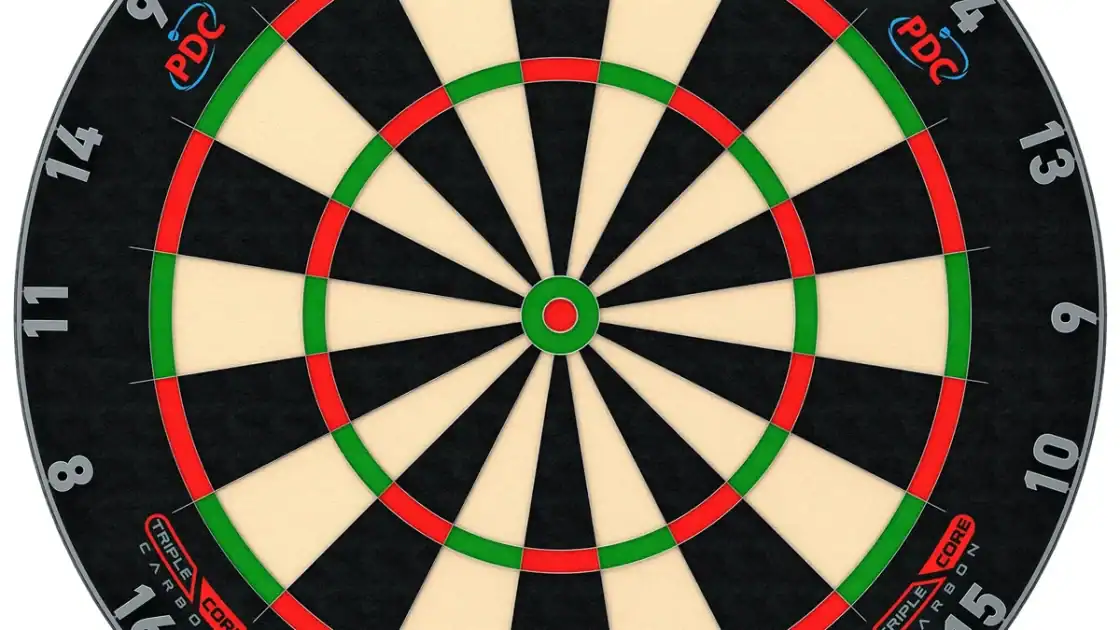
| Blade 6 Triple Core Carbon | Three layers (carbon fibre inner) | Laser-cut anti-glare | PDC match board 2022-2025 | League, club, tournament, heavy use |
All three use the same 60-degree blade wire system and the same Rota-Lock mounting. The differences are entirely in the sisal construction, the number ring, and the tournament pedigree. For most home players, the standard Blade 6 or the Dual Core covers every realistic need. The Triple Core Carbon is worth the price difference for players who throw daily or compete in organised league play where board performance genuinely affects results.
The wire system: what blade wire actually does
Every Blade 6 variant uses staple-free 60-degree angled blade wire. Understanding what that means is worth a minute, because it’s the single biggest reason the Blade 6 outperforms cheaper boards at preventing bounce-outs.
On a standard round-wire board, the wire sits on top of the sisal surface. When a dart hits wire, the tip deflects outward and the dart bounces back. The wire is both wider and positioned so that deflection sends the dart away from the board. On a blade wire board, the wire is thin, hardened, and angled at 60 degrees into the sisal. A dart that strikes blade wire is deflected downward into the scoring area rather than outward. The angle matters as much as the thinness.
KEY CONCEPT
Winmau’s Density Control makes the bullseye and outer bull wires 25% thinner than the previous generation. The bull is where bounce-outs happen most on any board, so thinner wire there matters more than thinner wire around the trebles.
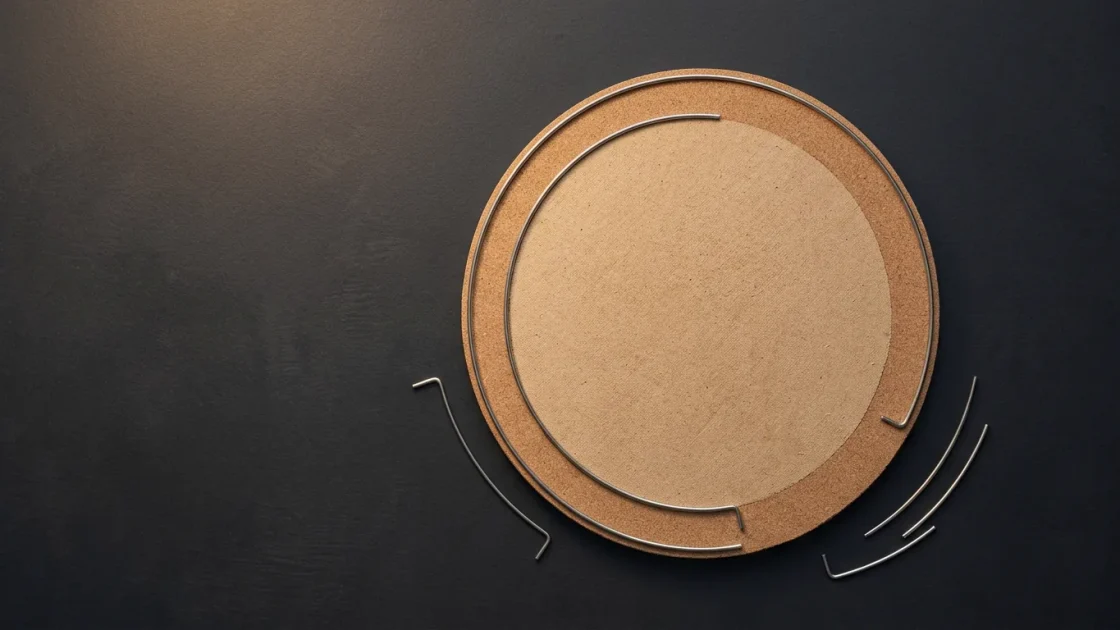
The “staple-free” part matters for a separate reason. On cheaper boards, the wire is attached to a metal spider using small staples that sit proud of the surface. A dart landing near a staple hits a hard raised point and bounces cleanly. Staple-free boards embed the wire directly into the board, removing that secondary deflection point. The combination of angled blade wire, Density Control at the bull zones, and no staples is why bounce-outs on the Blade 6 are noticeably fewer than on standard round-wire boards – the mechanical reason is clear even without formal counts.
Sisal construction and how long the board lasts
Winmau uses East African sisal on both the Dual Core and Triple Core Carbon. The “vein-free” designation refers to the removal of natural sisal fibres that run in a different direction to the main fibre pack. Veins create inconsistent density pockets that cause bounce-outs independent of where the dart lands relative to wire. Vein-free processing removes these. It’s a genuine spec improvement over unprocessed sisal, not a marketing term.
The Dual Core uses two sisal layers. The outer layer has lower compression, letting darts penetrate with minimal resistance. The inner layer is higher compression: it absorbs the dart’s kinetic energy and holds it in place. The Triple Core Carbon adds a third layer with carbon fibre-reinforced sisal at the board’s core, increasing density further and extending lifespan under high-volume throwing.
Realistic lifespan depends on throw volume, dart weight, and whether you rotate the board. Forum players report a Dual Core lasting 12 to 18 months with daily use and weekly rotation before the sisal loses retention in the treble 20 bed. A Triple Core Carbon under the same conditions is reported to extend that to 18 to 24 months. Players who throw infrequently can get three or four years from either board. Winmau notes that actual lifespan varies with dart weight, point sharpness, and throwing force.
PRACTICAL TIP
Remove the number ring and rotate the board by one segment every week if you throw daily, or every two to three weeks for casual use. The treble 20 bed takes a disproportionate share of throws compared to any other segment. Rotation is the single most effective maintenance action on any sisal board. It extends lifespan more than any product or treatment.
One honest caveat: a minority of players with very hard throwing styles find the Blade 6 sisal “too soft.” The physics here are real. Softer sisal allows easy dart entry but provides less grip for a dart that hits with high force. The One80 Gladiator 3+ is described consistently in forum comparisons as “much firmer” than the Blade 6. If you throw with significant power and the dart feels like it’s wobbling on entry, a firmer board may suit you better regardless of brand reputation.
Rota-Lock mounting system
The Rota-Lock system uses a triple-wheel lock mechanism that lets you rotate the board without removing it from the wall bracket. You release the wheels, rotate to the next position, and lock them again. The process takes about 30 seconds once the bracket is installed.
This is a practical improvement over older bracket mounts where rotating required fully detaching the board, which most players skipped because of the effort. Rotation now has no friction cost, so players actually do it. The Triple Core Carbon includes Winmau’s Spirit Master levelling tool in the box. The Dual Core doesn’t include this tool, but the bracket mechanism is otherwise identical on both boards.
Blade 6 Dual Core: detailed review
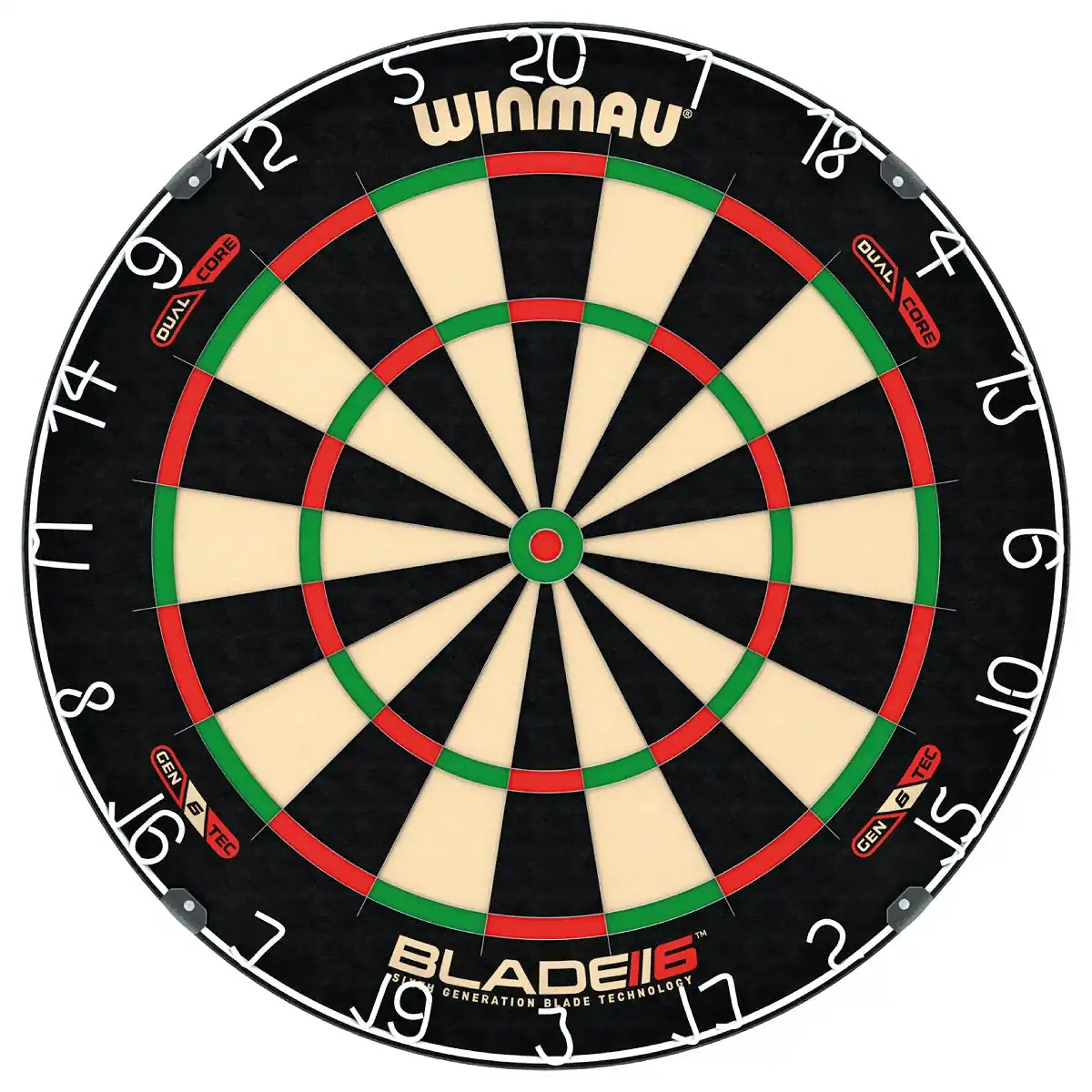
Winmau Blade 6 Dual Core
Two-layer vein-free sisal, 60-degree blade wire, Rota-Lock
The Dual Core covers everything a home player needs. Two layers of vein-free sisal, the full Density Control wire system, and Rota-Lock mounting. It meets WDF tournament specifications. Winmau designs the softer outer layer to let darts in easily and the firmer inner layer to grip them, and owners on the forums regularly describe better dart retention in the trebles and doubles than on single-layer boards.
Like any bristle board, it’s quiet in the room – a steel dart going into sisal is a muted thud. If you share a wall with neighbours, the noise to worry about is vibration through the mounting, which a stand or decoupled mount solves. See keeping a dartboard quiet.
What We Liked
- 60-degree Density Control wire: genuine bounce-out reduction
- Dual layer sisal: smooth entry, firm retention
- Vein-free sisal: no dead spots across the surface
- Rota-Lock mounting: rotation takes 30 seconds
- WDF approved: tournament spec
Watch Out For
- Sisal feels soft for high-force throwers
- Noticeably more expensive than budget alternatives
- Spirit Master levelling tool not included (TC Carbon only)
OUR VERDICT
The home dartboard benchmark
Blade wire, dual-layer sisal, Rota-Lock, and WDF tournament approval. No board in this price range pairs blade wire with dual-layer sisal at this spec level, based on current forum consensus and published specs. For home practice from beginner to competitive club level, the Dual Core is the answer.
Blade 6 Triple Core Carbon: detailed review
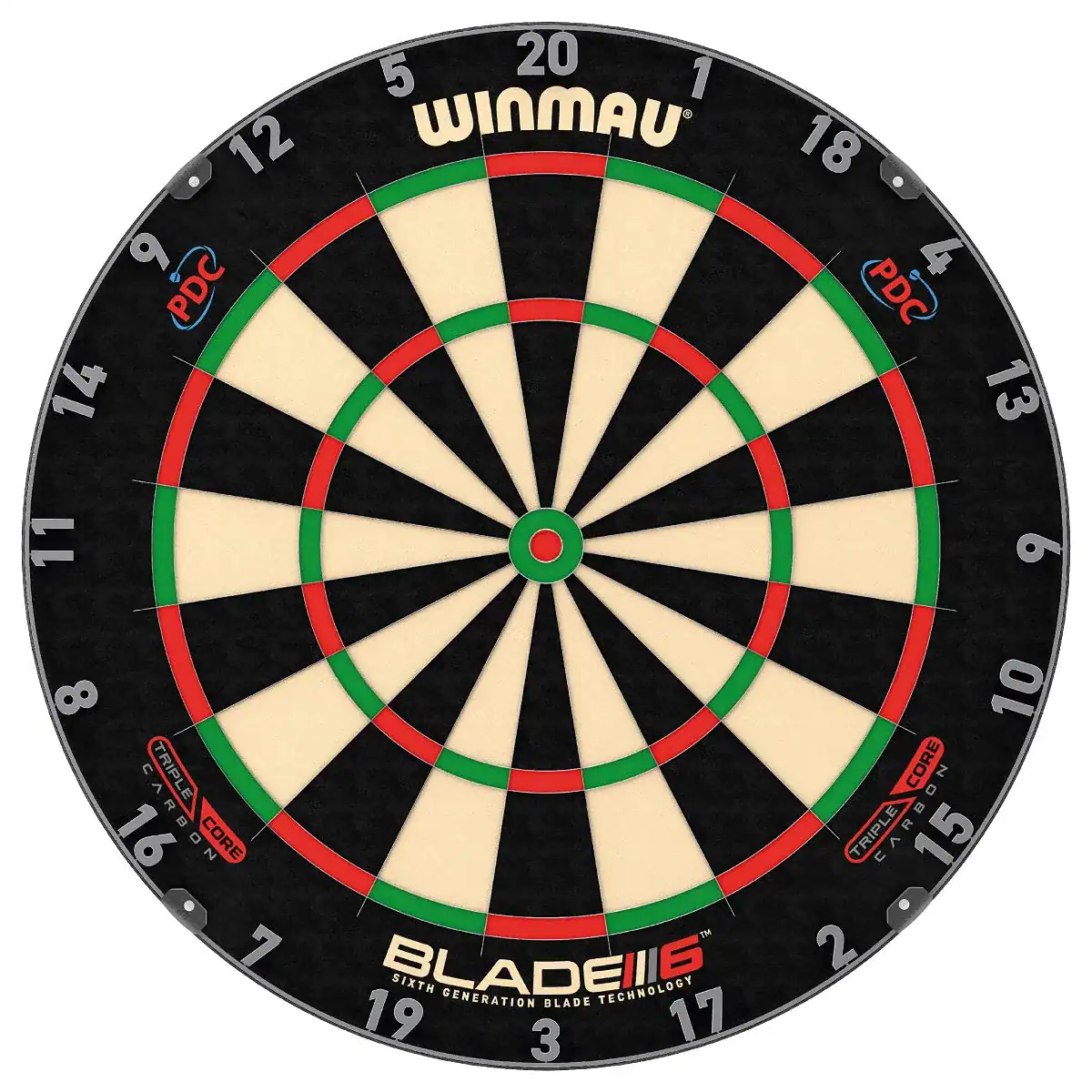
Blade 6 Triple Core Carbon
Three-layer carbon fibre sisal, laser-cut number ring, PDC match board 2022-2025
For four years, the Triple Core Carbon was the PDC’s match board. The world’s best players competed on it until Winmau’s new Blade X and Blade 360 took over in January 2026. It was built for a heavy tournament schedule, which is also why it holds up so well to daily home practice.
The third layer adds carbon fibre-reinforced sisal at the board’s core, making the inner section denser than the Dual Core’s. Owners report slightly better dart retention in the trebles and doubles, but the bigger difference is longevity: the carbon layer keeps its density under heavy throwing for longer. Forum reports from high-volume players suggest the gap starts to matter at around three or more hours of daily throwing.
The laser-cut anti-glare number ring is a genuine functional improvement, not a cosmetic one. Under overhead lighting, standard printed number rings reflect and create visibility issues at certain angles. The laser-cut ring reduces this. For home play with controlled lighting, the difference is minor. For club or venue boards with variable overhead light, it matters.
What We Liked
- Three-layer carbon fibre sisal: maximum density and longevity
- Same Density Control wire system as Dual Core
- Laser-cut anti-glare number ring
- PDC match board from 2022 to 2025
- Spirit Master levelling tool included
Watch Out For
- Significant price premium over Dual Core for marginal performance gain
- Overkill for casual or irregular home use
- Same sisal softness profile as Dual Core: power throwers will have the same feedback
OUR VERDICT
Tournament standard, priced accordingly
The Triple Core Carbon is the best dartboard Winmau makes, and the performance difference over the Dual Core is real at high volumes of play. The value score reflects the price premium rather than any deficiency in the board itself. If you play daily or run a darts night, it earns the cost difference.
What players on Reddit and DartsNutz actually say
The Blade 6 Dual Core is the single most recommended board in r/darts threads asking “which board should I buy?” That consensus has held consistently across threads going back several years. The community recommendation carries weight because r/darts skews toward players who own multiple boards and have opinions based on direct experience.
The real complaints that appear repeatedly are worth taking seriously:
Sisal softness for power throwers. The Gladiator 3+ is described in direct comparisons as “much firmer” than the Blade 6. Players who throw with significant force find the Blade 6 sisal provides less resistance. This isn’t a defect, softer sisal is a deliberate design choice that makes dart entry smoother and reduces bounce-outs for the majority of throwing styles. But if you’re in the minority who throw hard and find the board “too forgiving,” this is a legitimate concern.
Price. The primary complaint across all sources is price. The Blade 6 costs meaningfully more than the Gladiator 3+ and significantly more than budget options. Forum consensus is that the price is justified if you throw regularly, but it’s a real obstacle for casual players who throw once a week.
QC variance on the Triple Core Carbon. Early DartsNutz threads from the TC Carbon launch period flagged some unit-level variance. No systematic defect was reported, but the threads exist and are worth acknowledging. The current production run has not generated significant complaint volume on this point.
SCOUT TAKE
The forum consensus on the Blade 6 is unusually stable. Most board recommendations generate disagreement. The Blade 6 Dual Core recommendation generates very little. The closest legitimate challenge is the Gladiator 3+, which is cheaper and firmer, but firm sisal suits a minority throwing style, not the majority.
Blade 6 vs Blade 5: is the upgrade worth it?
The Blade 6 has replaced the Blade 5 as Winmau’s current line, and new Blade 5 stock is increasingly limited. If you’re buying a new board, the Dual Core is the practical replacement for the Blade 5 Dual Core at a similar price point. The specific improvements in the Blade 6 generation are:
Density Control wire at the bull zones. The Blade 5 uses blade wire throughout, but without the Density Control thinning at the bullseye and outer bull. The Blade 6’s 25% thinner wire at these zones is a measurable improvement in bounce-out reduction at the highest-frequency landing area for most players.
Vein-free sisal. The Blade 5 uses high-quality sisal but doesn’t carry the vein-free designation. Whether this creates a noticeable playing difference depends on the specific fibres in a given unit. But vein-free processing removes a source of random dead spots.
Rota-Lock mounting. The Blade 5 uses a standard bracket. The Rota-Lock is a genuine convenience improvement.
The honest verdict: if you own a Blade 5 that’s performing well, the upgrade isn’t justified. The improvements are incremental rather than categorical. If you’re buying new, the Dual Core is the right choice because Blade 5 stock is increasingly limited and the price gap between remaining Blade 5 stock and the Blade 6 Dual Core is minimal.
What about the Blade 360 and Blade X?
In January 2026, the PDC moved on from the Blade 6 Triple Core. Stage events such as the World Championship and Premier League now use Winmau’s Blade X, and floor events such as the Players Championships use the Blade 360, according to the PDC. The Blade 360 keeps the Triple Core sisal, carbon-reinforced base, and blade wire, and adds a symmetrical design built around 10 balanced rotation points to spread wear evenly, according to Winmau.
Does that make the Blade 6 obsolete for home play? No. The wire system and sisal technology are the same family, and the Blade 6 Dual Core remains the better-value home board. The Blade 360 makes sense if you want the current PDC floor board and are happy to pay for it.
Which Blade 6 should you buy?
HOME PRACTICE
Blade 6 Dual Core
You throw a few times a week to a few hours daily. You want a board that lasts 12 to 18 months, produces fewer bounce-outs, and doesn’t require explanation when guests throw. This is that board.
LEAGUE AND CLUB
Triple Core Carbon
You play in organised competition, throw daily, or run a darts night. The carbon fibre inner layer extends lifespan under sustained use. The laser-cut number ring handles variable lighting better. The price premium earns back over time through durability.
HARD THROWERS
Consider Alternatives
If you throw with high force and consistently find sisal boards feel too soft, look at the One80 Gladiator 3+. It uses firmer Kenyan sisal at a lower price. The wire system isn’t as advanced as the Blade 6, but the sisal density suits power throwing styles better.
At the Blade 6 price point, the Dual Core is worth the small premium over the standard single-layer model in almost every case. The Dual Core’s second sisal layer costs relatively little above the standard variant and meaningfully improves both performance and longevity. For bounce-out issues on any sisal board, see TheDartScout’s guide to why darts bounce out and how to fix it.
Frequently asked questions
Is the Winmau Blade 6 worth it?
For regular home players, yes. The 60-degree blade wire with Density Control at the bull zones keeps bounce-outs low, and forum players report the Dual Core lasting 12 to 18 months of daily use with weekly rotation. The price premium over budget boards is real, but so is the difference in bounce-outs and sisal longevity.
What is the difference between the Blade 6 Dual Core and Triple Core Carbon?
The Dual Core has two layers of vein-free sisal. The Triple Core Carbon adds a third carbon fibre-reinforced layer for greater density and a longer lifespan. It also has a laser-cut anti-glare number ring and was the PDC’s match board from 2022 to 2025, before the Blade X and Blade 360 took over in 2026. Both variants use the same wire system. The Dual Core suits home practice. The Triple Core Carbon suits daily play, league use, and tournament venues.
How long does a Winmau Blade 6 last?
Forum players report a Dual Core lasting 12 to 18 months with daily use and weekly rotation before the treble 20 sisal loses retention. The Triple Core Carbon is reported to extend that to 18 to 24 months under the same conditions. Casual players throwing two to three times per week can get three to four years from either board. Actual lifespan varies with dart weight, point sharpness, and throwing force. The treble 20 bed always degrades first. Rotation is the most effective way to extend lifespan.
Is the Blade 6 still the PDC dartboard?
No. The Blade 6 Triple Core was the PDC’s match board for four years, but since January 2026 PDC stage events use Winmau’s Blade X and floor events use the Blade 360. The Blade 6 remains a WDF-approved board and one of the best choices for home practice.
Why does my Blade 6 have bounce-outs?
Three causes: dart point geometry, throwing angle, or wire contact. If the dart tip is blunt or has a burr, it deflects off wire rather than pushing through it. If your throw has side-angle, the dart enters the sisal at a shallow angle and the wire catches the barrel. If you’re genuinely hitting wire, the solution is either sharpening the dart point or adjusting your throw angle. The Blade 6 wire system reduces bounce-outs significantly versus standard boards, but no wire system eliminates them entirely.
For a full comparison of the Blade 6 against seven other bristle boards including budget and mid-range options, see TheDartScout’s best dartboard for home guide. For the complete decision framework on board selection, wire types, and sisal grades, see how to choose a dartboard.