QUICK ANSWER
Luke Littler throws the 23g Target Luke Littler G1, a 90% tungsten straight barrel.
His match darts pair that barrel with Target K-Flex No.6 integrated flights and extended 42mm Swiss SLK points. The retail G1 set you can buy uses shorter Pro Grip shafts and standard 26mm points, so the box is close to his spec but not identical. Every figure here is verified for 2026 against Target’s own product pages.
Luke Littler went from teenage debutant to two-time World Champion in barely two years, and the darts under his fingers barely changed along the way. That’s the interesting part. The setup isn’t exotic. It’s a mid-weight, mid-grip barrel that almost any club player could pick up and throw.
Below is every component, named and sourced. You’ll get the barrel model, the exact weight, and the tungsten percentage. You’ll also get the flights, shafts, and points he actually uses on stage. And we separate the retail signature set from his true match config, because they aren’t the same thing.
Luke Littler’s darts at a glance
Here is the full stage spec in one place. If you only came for the numbers, this is the box you were looking for.
| Component | Luke Littler’s spec |
|---|---|
| Barrel | Target Luke Littler G1 (Generation One) |
| Weight | 23g |
| Tungsten | 90% |
| Barrel shape | Straight, 52.0mm long, 6.5mm wide |
| Grip | Dual Pixel front and centre, radial groove rear, Black PVD coating |
| Flights | Target K-Flex No.6 integrated, short |
| Shafts | Built into the K-Flex system |
| Points | Target Swiss SLK, 42mm |
Two details stand out. The weight is unremarkable, sitting almost exactly on the tour average. The points are not. We will come back to why he runs points nearly twice the standard length.
The barrel: model, weight, and why it suits him
Littler throws the Target Luke Littler G1, a barrel Target built to his match specification rather than a name stamped on an existing shape. It’s 90% tungsten, which matters more than the headline weight. Tungsten density lets the maker hit 23g while keeping the barrel slim, and a slim barrel takes up less room in the treble bed. That’s the whole point of paying for high tungsten: three darts fit in a tighter space.
The 23g weight is a deliberate middle ground. His throw is fast but smooth, and 23g gives him the momentum of a heavier dart without the slower, loopier flight that 24g and up can bring. Drop to 20g and a pacy thrower tends to over-power the dart. Push to 26g and the same thrower fights the mass. Littler’s weight sits in the pocket where his speed does the work.
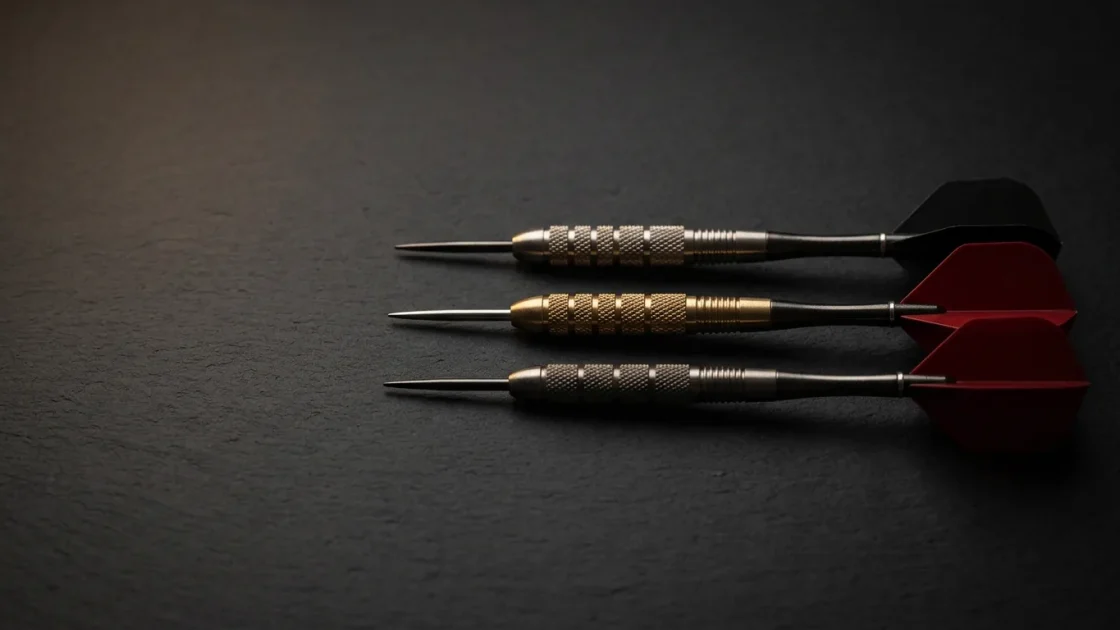
The barrel measures 52.0mm long and 6.5mm wide in the 23g version. The shape is straight, with no torpedo bulge or bomb taper. A straight barrel gives the same grip feel wherever your fingers land, so a slightly high or low grip does not change the release. The grip itself is layered: a Dual Pixel texture at the front and centre for traction, then a finer radial groove at the rear for a softer feel, all under a Black PVD coating that is re-machined to expose the pixel detail.
What you won’t find is anything fancy. There’s no aggressive shark-fin cut, no ringed torpedo, no exotic weight forward of the grip. The G1 is a quiet design, and that suits how he plays. His release is clean and repeatable, so he doesn’t need a barrel screaming with grip to hold the dart. A calmer texture lets it leave the hand the same way every time, which is exactly what a fast thrower needs.
KEY CONCEPT
Tungsten percentage is about barrel diameter, not weight. A 90% barrel is slimmer than an 80% barrel of the same weight, which is why pros chase the higher figure. It buys space in the treble, nothing more glamorous than that.

Flights, shafts, and points
This is where his real setup drifts away from the box, and where most guides stop short. The barrel is the easy part. The fittings are where Littler has made specific choices.
Flights and shafts: the K-Flex system
On stage he uses Target K-Flex No.6 integrated flights in the short length. K-Flex moulds the flight and stem into a single piece, so there is no shaft to unscrew separately. Two things come from that. First, the flight holds a true 90-degree angle for its whole life instead of slowly opening up the way loose flights do. Second, when an incoming dart clips it, the stem section flexes and bends rather than kicking the dart out of the board. For a player who groups this tightly, fewer bounce-outs is a real scoring edge.
Points: the 42mm detail
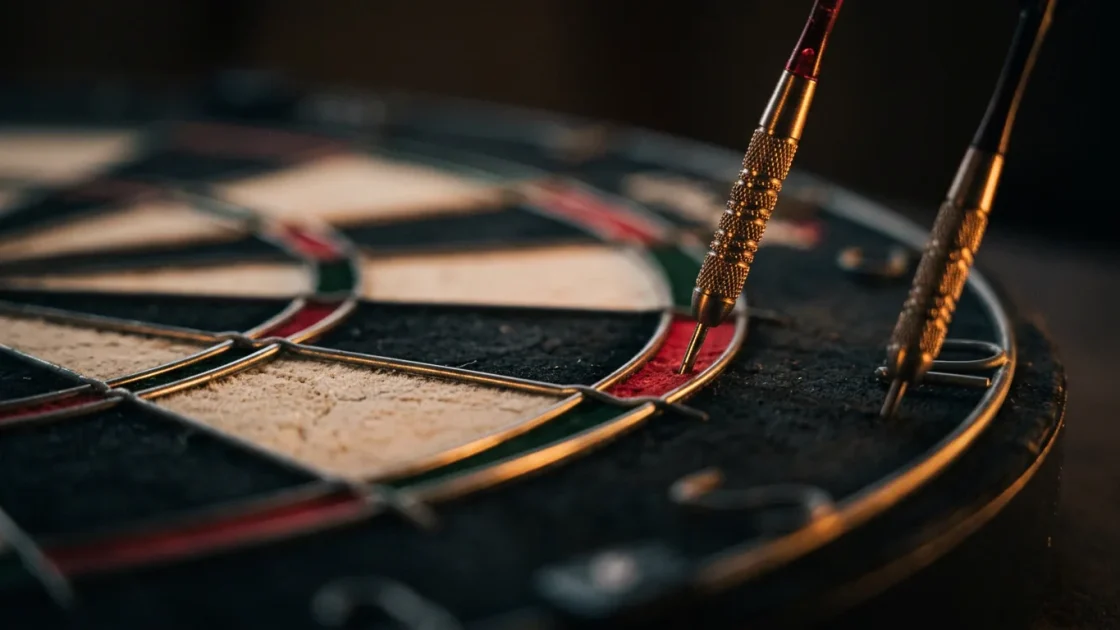
The standout choice is his points. Littler swaps the standard 26mm Swiss points for extended Target Swiss SLK points at 42mm, a full 16mm longer. That is not a small tweak. The rough-textured tip bites into the sisal to cut bounce-outs, and the extra length shifts the dart’s centre of gravity forward, nudging the nose down in flight.
There’s a second reason a long point helps a heavy scorer. A longer point sits deeper and covers less of the segment, so when he’s already sitting on a treble there’s more room to squeeze the next dart in beside it. When you’re chasing three treble 20s a visit, that clearance adds up.
SCOUT TAKE
The points are the one part of Littler’s kit worth copying blind. Longer Swiss-style points reduce bounce-outs for almost everyone, and they are a cheap swap that does not touch your barrel or your throw.
How his setup compares to other pros
Littler’s spec looks even more ordinary next to his rivals. The weights across the top of the game cluster tightly, and his sits right in the middle of the pack.
| Player | Weight | Brand and model |
|---|---|---|
| Luke Littler | 23g | Target Luke Littler G1 |
| Luke Humphries | 22g | Red Dragon Luke Humphries TX1 |
| Michael van Gerwen | 21.5g | Winmau MvG EVO-X |
The tour average across 128 professionals lands near 22.77g, so all three men throw within a gram or so of the mean. The lesson is not that 23g is a magic number. It’s that elite players converge on a narrow weight band and then win or lose on technique, not equipment. Humphries runs a short torpedo barrel with ring grip; van Gerwen favours a grippier, worked feel. Littler picked a plain straight barrel. Three very different profiles, three world-class results.
For the full field, our guide to what darts pros use in 2026 lists every current setup, and the PDC world rankings for 2026 show where each of these players sits.
Can you buy Luke Littler’s darts?
Yes, with one caveat. You can buy the exact barrel. You can’t buy the exact darts off the shelf, because his stage fittings differ from the retail box.
The retail Target Luke Littler G1 set comes in 22g, 23g, and 24g and typically sells for around £45 to £60 in the UK. Open the box and you get three barrels, three Pro Grip short shafts, three No.2 Pro.Ultra flights, three 26mm Swiss points, and a point tool. That’s the same barrel Littler throws, dressed in different fittings.
G1 (the match barrel)
90% tungsten, Dual Pixel grip, the exact barrel Littler uses. Around £45 to £60. Start here if you want his actual dart.
Loadout (budget)
90% tungsten with a simpler radial groove grip, roughly £55. Same DNA, gentler on the wallet.
Edge (premium)
95% tungsten, CNC-milled multi-grip with a DLC blue coating. The slimmest, most aggressive option in the range.
To match his stage darts exactly, buy the G1 barrel and then swap two things: fit Target K-Flex No.6 short integrated flights, and change the 26mm points for 42mm Swiss SLK points. Barrel plus two cheap upgrades gets you his precise configuration.
What beginners can learn from his setup
The temptation with any pro dart is to copy the whole thing and expect the results to follow. They won’t. But Littler’s setup does teach three things worth borrowing.
First, copy the template, not the person. A 23g, 90% tungsten, straight barrel is a proven starting shape that suits a wide range of throws. That’s a smart place to begin. The grip pattern and flight shape, though, need to fit your hand and your release, not his.
Second, weight is not where games are won. Littler throws a gram above the tour average and a gram and a half above van Gerwen. Nobody is beating him on weight. If you’re stuck choosing a number, our guide to choosing dart weight gives you a diagnostic instead of a guess, and how pro players choose darts shows the process the best throwers actually follow.
Third, small fittings punch above their price. His most distinctive choice isn’t a £200 barrel, it’s a set of longer points that cost a few pounds. Cheap upgrades to points and flights often do more for a returning player than a whole new set of darts.
23g
match weight, right on the tour average
90%
tungsten, for a slim treble-friendly barrel
42mm
Swiss SLK points, 16mm over standard
Frequently asked questions
What weight darts does Luke Littler use?
Luke Littler uses 23g darts. That sits almost exactly on the PDC tour average of about 22.77g, so despite his reputation as a big scorer his weight is completely standard. The G1 barrel is also sold in 22g and 24g for players who want to go slightly lighter or heavier.
What brand does Luke Littler throw?
Target. He throws the Target Luke Littler G1, a 90% tungsten barrel designed with Target to his match specification. He also has budget (Loadout) and premium (Edge) models in the same signature range.
Can I buy Luke Littler’s exact darts?
You can buy his exact barrel, but the retail box is not his exact stage setup. The G1 set ships with Pro Grip shafts and 26mm points. To match his real config, add Target K-Flex No.6 short flights and swap in 42mm Swiss SLK points.
Why does Luke Littler use such long points?
His 42mm Swiss SLK points do two jobs. The rough tip grips the board to cut bounce-outs, and the extra length moves the centre of gravity forward for a nose-down flight. A longer point also sits deeper and leaves more room to land the next dart beside it in the treble.
How much do Luke Littler’s darts cost?
The retail G1 set usually costs around £45 to £60 in the UK. The Loadout budget model is roughly £55, and the 95% tungsten Edge sits above the G1. Points and flights to match his stage spec add only a few pounds on top.
Is 90% tungsten better than 80%?
For fitting three darts in the treble, yes. A 90% barrel is slimmer than an 80% barrel of the same weight, so it takes up less space on the board. It costs more, which is why 80% and 90% both have their place depending on budget and how tightly you group.
Strip away the World Championship shine and Luke Littler throws a plain 23g barrel that any player could buy for the price of a night out. The teenager did not win two world titles on exotic equipment. He won on a slim straight barrel, a sensible weight, and one clever choice of longer points, thrown thousands of times until the motion held. The darts are ordinary. What he does with them is not.