QUICK ANSWER
Throw 22g if you release fast and flat and want the dart to react to your hand. Throw 24g if your release is slower or streaky and you want the extra mass to smooth out small errors.
Two grams sounds like nothing, but it shifts three things you feel on every throw: how much the dart arcs, how quickly you have to time the release, and how wide the barrel sits in your fingers. With 22g vs 24g darts, most players land better on one than the other within a single practice session. This guide shows you which, and why.
Pick up a 22g dart and a 24g dart of the same model and your hand barely registers the difference. Throw fifty of each and the difference is obvious. The lighter dart wants to be thrown faster and punishes a lazy release. The heavier dart sits down in your hand and forgives the odd bad throw, but it drops fast if you don’t put enough behind it. Neither is better. One will just suit the way you already throw.
The pro band runs from 21g to 24g, and the average across 128 tour players is 22.766g, so both weights in this comparison sit right in the middle of what the best players in the world actually use. Luke Humphries throws 22g. Michael Smith throws 24g. Both are world champions. The choice isn’t about skill level. It’s about matching the weight to your release.
What actually changes with two grams
Three things move when you go from 22g to 24g. Understanding each one is what turns “try both and see” into a decision you can reason about.
Trajectory and arc
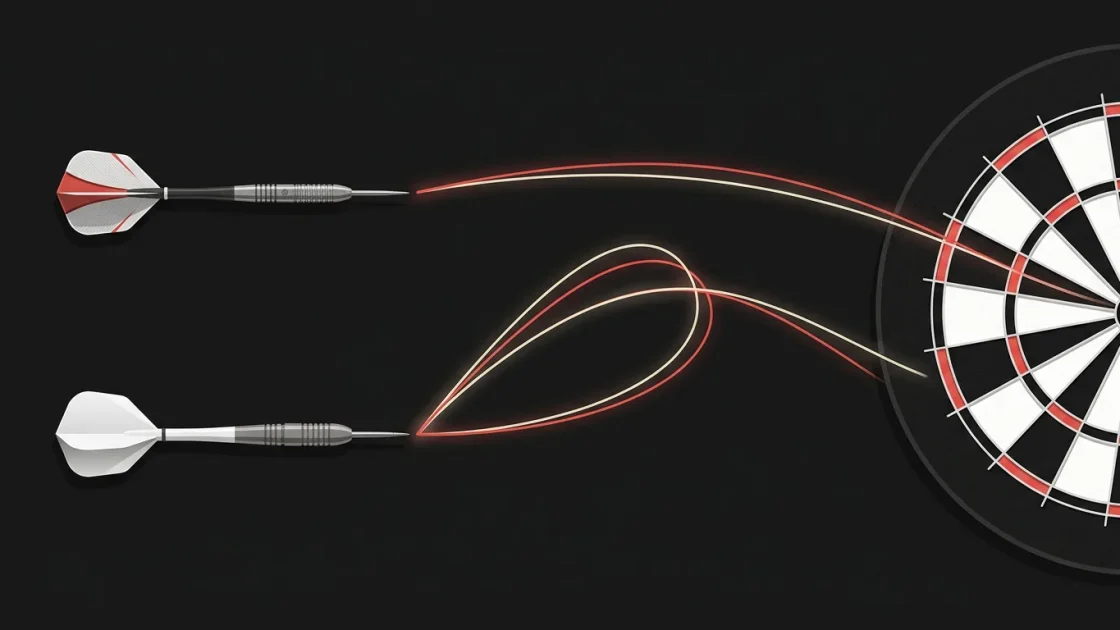
Here’s the part most articles get wrong. Gravity pulls every dart down at the same rate no matter what it weighs, so weight doesn’t directly decide the arc. Release speed does, which the aerodynamics of dart flight lays out in detail. A dart thrown faster spends less time in the air and drops less, so it flies flatter. A slower dart has to loop up and over to reach the same spot.
Weight matters because it changes how fast you can throw. For the same arm, a lighter 22g dart accelerates to a higher release speed, so it tends to fly flatter for you. The 24g dart is harder to whip up to speed, so it usually leaves your hand a touch slower and arcs a little more. If you already throw with a big loop, adding that extra arc can push your darts low.

Release timing and grip pressure
A 24g dart carries more momentum, which means more inertia. In plain terms, it resists small wobbles in your hand. If your release is slightly early or slightly late, the extra mass carries the dart through on its line anyway. That’s why heavier darts feel more forgiving and why a lot of beginners drift toward 24g and up.
The 22g dart does the opposite. It reacts to your hand more directly, so a clean release lands sweetly and a scrappy one shows up on the board straight away. That sensitivity is a gift once your throw is repeatable and a headache while it isn’t.
KEY CONCEPT
Lighter darts translate both good technique and bad technique more clearly. Heavier darts blur the difference. If your throw is still settling, the blur is help. If it’s grooved, the clarity is feedback you want.
Barrel diameter at the same tungsten grade
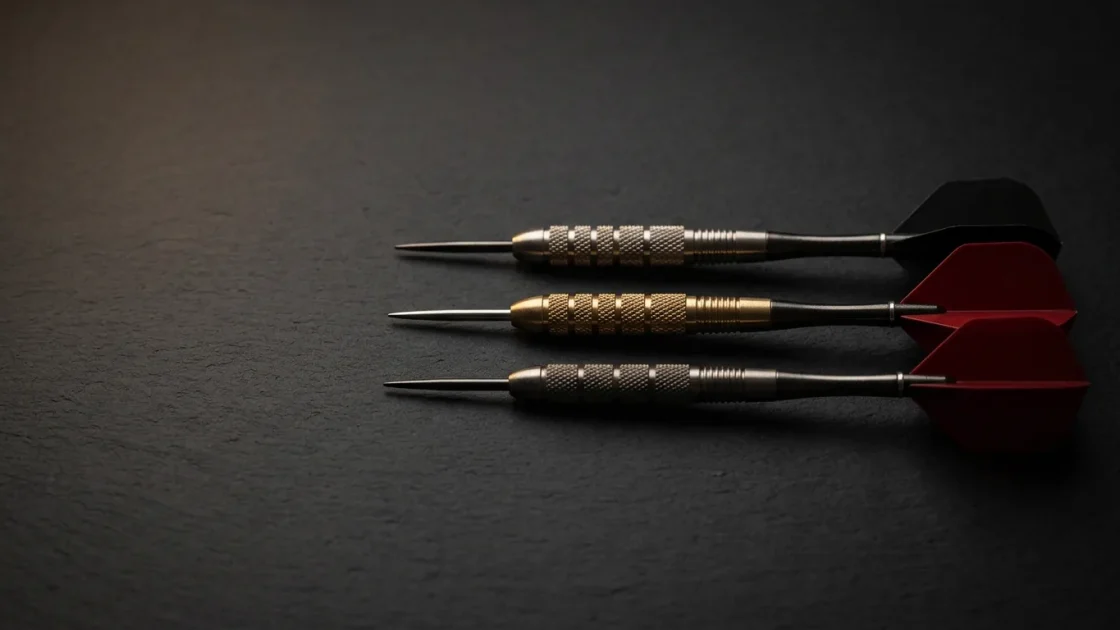
This is the side effect nobody mentions. Add two grams to a barrel at the same tungsten percentage and the length usually stays fixed, so the extra mass goes into width. The barrel gets fatter. On the Luke Humphries TX1 at 90% tungsten, the 22g barrel is 7.05mm wide and the 24g is 7.5mm wide, both 43.2mm long. That’s nearly half a millimetre of extra girth for the same length.
Half a millimetre sounds tiny. Your fingertips disagree. A wider barrel changes how the dart seats between your fingers and can force a small grip adjustment you didn’t ask for. The Winmau MvG ExAct shows the same creep: 6.25mm at 23g, 6.4mm at 24g, both 53mm long. If you love the exact feel of a 22g barrel, jumping to 24g in the same range isn’t only a weight change. It’s a slightly thicker dart too. Buying a higher tungsten percentage keeps the barrel slimmer at a given weight, which is the whole point of paying for more tungsten. Our guide to 80% vs 90% vs 95% tungsten breaks down that trade-off.
Who should throw 22g
Reach for 22g if you throw fast and flat, release with a firm flick, and want the dart to respond to fine changes in your hand. Lighter darts in the 18g to 22g band reward precise technique with finer control over exactly where the dart lands. If you can already group your darts tightly, the sensitivity of 22g lets you place them rather than just push them at the treble.
It’s also the most popular single weight among top players, because it balances control and speed better than anything heavier. Luke Humphries wins majors with 22g and Rob Cross throws 21g, so the lighter end of the band is hardly a beginner compromise. If your natural throw is quick and your darts fly on a flat line, 22g will feel like it disappears out of your hand, which is exactly what you want.
Who should throw 24g
Go with 24g if your release is slower, smoother, or still a bit streaky. The extra momentum carries the dart through minor timing errors and keeps your groupings tighter while your technique is still coming together. Heavier darts forgive the small inconsistencies that wreck a lighter dart’s flight, which is why so many newer players settle here first.
The heavier weight also suits a firmer, more measured push toward the board. Michael Smith and Gerwyn Price both throw 24g at the top of the game, and neither is short of pace. What links most 24g throwers is a preference for a dart that stays planted and predictable rather than lively. If you find lighter darts sail on you or feel twitchy, the added mass of 24g settles everything down.
TRADE-OFF
You’re trading forgiveness for feedback. 24g hides small errors so your average holds up on an off night. 22g exposes them so you can fix them. Pick the one that matches whether you’re chasing stability or sharpening a throw you already trust.
What weight do the pros throw
The vast majority of PDC professionals throw between 21g and 24g, and the average lands at 22.766g. That tight band is the single most useful fact in the 22g vs 24g darts debate, because it tells you both 22g and 24g are proven at the highest level. You’re not choosing between a good weight and a bad one. You’re choosing your spot inside the range the best players already live in.
The 22g side
Luke Humphries throws 22g and Rob Cross 21g. Michael van Gerwen sits just under at 21.5g. Fast, flat, control-first throwers cluster here.
The 23g middle
Luke Littler throws 23g, and it’s the most popular weight in the world top 16, used by five of them. It’s the natural fallback if you’re torn.
The 24g side
Michael Smith and Gerwyn Price throw 24g. Momentum-led throwers who want the dart to stay planted favour the heavier end.
Look outside the band and you’ll find Stephen Bunting on a 12g dart and Ryan Searle on a 32g, proof that a repeatable throw beats any rule about weight. But those are outliers. For almost everyone, the answer sits between 22g and 24g, and Littler’s 23g is why so many players who can’t decide simply split the difference. If you want the full picture of tour setups, see what darts the pros use in 2026.
How to test and switch between weights
You don’t need to guess. Your miss pattern tells you which way to move. If your darts keep landing below where you aimed, your throw probably isn’t carrying the dart on a flat line, and going 1g to 2g heavier can hold the trajectory up. If your darts overshoot or feel hard to rein in, the dart may be too heavy for your natural speed, and dropping 1g to 2g lighter gives you back control.
Test properly by throwing at least a hundred darts at the same target with each weight before you judge. The first few throws with a new weight always feel wrong because your timing is calibrated to the old one. Give your hand time to adjust, then look at the grouping, not the feeling. Weight distribution matters too: front-weighted barrels suit faster throwers with a firm release, while rear-weighted barrels favour a smoother, slower throw with more arc. Our dart barrel shapes guide covers how that balance point interacts with your weight choice.
PRACTICAL TIP
When you switch, change one variable at a time. New weight with new flights and new shafts gives you nothing to learn from. Keep everything else identical, move only the weight, and you’ll actually know what the two grams did.
If you’re starting from scratch and have no throw to match yet, our full guide to choosing dart weight walks through picking a first weight from the ground up rather than switching between two.
Frequently asked questions
Is 24g too heavy for a beginner?
No. 24g is one of the most common starting weights precisely because the extra mass forgives the timing errors every beginner makes. It carries the dart through a scrappy release and keeps your groupings tighter while you build a repeatable throw. Many players start at 24g and only move lighter once their technique settles.
Do heavier darts actually fly straighter?
Not straighter in the strict sense, but more forgiving. Gravity pulls every dart down at the same rate, so weight doesn’t flatten the path by itself. What a 24g dart does is carry more momentum, so it resists small wobbles in your hand and holds its line through a slightly off release. That reads as straighter on the board even though the physics is really about inertia.
Can changing two grams really affect my throw?
Yes, more than most players expect. Two grams changes your release speed, the amount your dart arcs, and even the barrel width in your fingers at the same tungsten grade. Pros obsess over half-gram differences for a reason. If two grams didn’t matter, Michael van Gerwen wouldn’t have his darts match-weighed to 21.5g.
Should I throw 23g if I can’t decide between 22g and 24g?
It’s a sensible move. 23g sits exactly between the two and is the most popular weight in the world top 16, used by five of them including Luke Littler. If both 22g and 24g feel almost right in different ways, 23g often captures the control of the lighter dart with a little more of the heavier dart’s stability.
Does a 24g dart need a fatter barrel than a 22g?
At the same tungsten percentage, usually yes. Makers keep the barrel length fixed and add the extra weight as width, so a 24g barrel is fractionally wider than a 22g in the same range. The Humphries TX1 goes from 7.05mm at 22g to 7.5mm at 24g. To keep the barrel slim at a heavier weight, you pay for a higher tungsten percentage.
How long should I test a new dart weight before judging it?
At least a hundred throws at the same target, ideally across a few sessions. A new weight always feels wrong for the first dozen darts because your timing is set to the old one. Judge by the grouping once your hand has adjusted, not by the feeling in the first few throws.
Two grams isn’t a rounding error. It’s the difference between a dart that reacts to your hand and one that covers for it. If your throw is fast and grooved, 22g gives you the feedback to place darts. If it’s slower or still settling, 24g gives you the forgiveness to keep scoring while it comes together. Throw a hundred of each, read the grouping, and let the board decide.