QUICK ANSWER
Higher tungsten percentage means a slimmer barrel at the same weight.
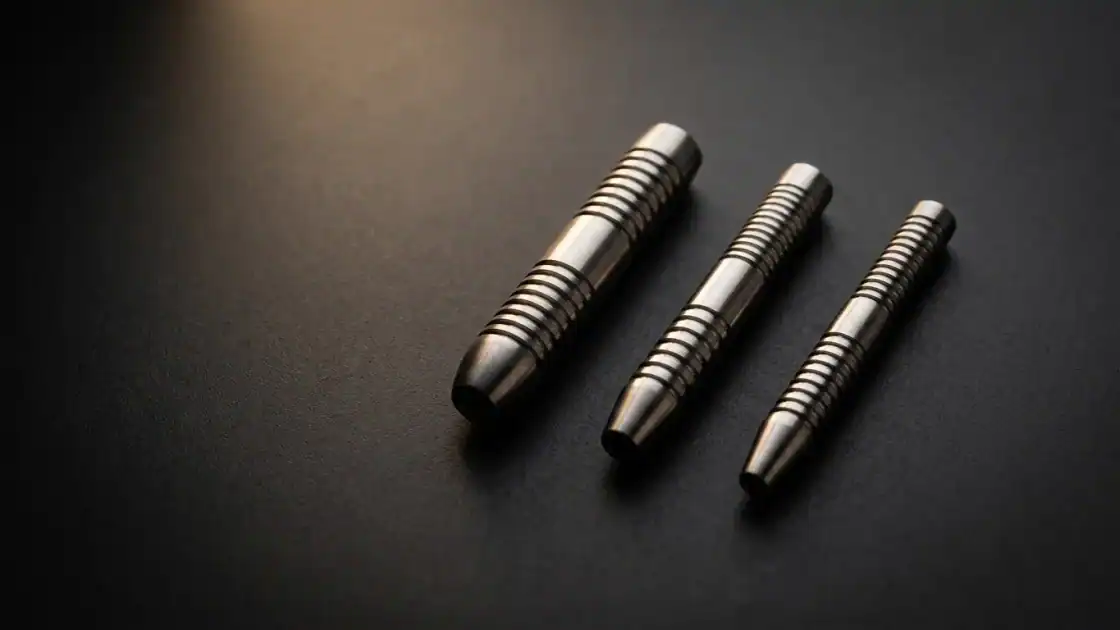
The percentage tells you how much tungsten is in the alloy versus nickel binder. More tungsten means higher density, which means the barrel can be slimmer without losing weight. At 23g, an 80% barrel measures roughly 8.0 mm. A 90% barrel drops to 6.8 mm. A 95% barrel reaches 6.3 mm.
But the gains shrink at each step. The jump from 80% to 90% is large. From 90% to 95%, it is small. Above 95%, you pay more for fractions of a millimetre and a more brittle barrel. This guide breaks down what the numbers actually mean.
Every tungsten dart has a percentage on the box. 80%. 90%. 95%. The number gets treated like a quality score – higher is better, buy the most you can afford. That framing is misleading. The percentage is a material composition, not a performance rating. It tells you how much tungsten is in the alloy and how much is nickel binder. That ratio controls density. Density controls barrel width. Barrel width controls grouping. But the relationship is not linear, and the price certainly is not.
The practical difference shrinks dramatically as the percentage climbs. Understanding where the returns stop is more useful than chasing the highest number.
What Does the Percentage Actually Mean?
A “90% tungsten” dart is an alloy containing 90% tungsten and approximately 10% nickel. The nickel acts as a binder – pure tungsten is too brittle to machine into a dart barrel. Without nickel, the barrel would crack on the first bounce-out. The more nickel in the mix, the tougher the barrel but the lower the density.
The alloy compositions follow ASTM B777 specifications for tungsten heavy alloys. The standard defines classes by tungsten content: Class 1 at 90%, Class 3 at 95%, Class 4 at 97%. Dart manufacturers use these same metallurgical standards.
How Does Density Change Between 80%, 90%, and 95%?
Density is the property that matters. A denser alloy packs more mass into less volume. That means a slimmer barrel at the same weight.
| Tungsten % | Approx. Density | Barrel Diameter at 23g | Nickel Content |
|---|---|---|---|
| 80% | 15.6 g/cm³ | ~8.0 mm | ~20% |
| 90% | 17.0 g/cm³ | ~6.8 mm | ~10% |
| 95% | 18.0 g/cm³ | ~6.3 mm | ~5% |
| 97% | 18.5 g/cm³ | ~6.1 mm | ~3% |
The density jump from 80% to 90% is 1.4 g/cm³. From 90% to 95%, it drops to 1.0 g/cm³. From 95% to 97%, just 0.5 g/cm³. Each step up buys you less density than the last.
KEY TAKEAWAY
The barrel width difference between 80% and 90% tungsten at 23g is roughly 1.2 mm. Between 90% and 95%, it is roughly 0.5 mm. Between 95% and 97%, it is roughly 0.2 mm. You pay progressively more for progressively less slimness.
Does Barrel Width Actually Affect Grouping?
Yes – but less than most players think. The treble 20 bed is approximately 10 mm tall wire-to-wire. Three 6.3 mm barrels (95% tungsten at 23g) fit side by side with 5.1 mm of clearance. Three 8.0 mm barrels (80% tungsten at 23g) fit with only 2.0 mm of clearance. That 3 mm difference means the third dart is more likely to deflect off an existing barrel at 80% than at 95%.
But here is the caveat: most recreational players do not group tightly enough for barrel width to be the limiting factor. If your three darts land across a 30 mm spread, the 1.2 mm difference between 80% and 90% barrels is irrelevant. Barrel width matters when your grouping is already tight. For most players, that means it matters less than they assume.
What Happens to Durability at Higher Percentages?
Nickel is the binder that holds the tungsten particles together. Less nickel means a more brittle alloy. At 80% tungsten, the barrel is tough – it absorbs bounce-outs and board impacts without damage. At 95%+, the barrel becomes more prone to micro-fractures on the surface, especially around thin grip sections.
Forum discussions on DartsNutz consistently report that 97%+ darts develop hairline cracks or chipped ring grooves after heavy use. One experienced player summarised: “anything above 90% is usually for marketing, not performance.” That overstates it – 95% does produce a measurably slimmer barrel. But the durability tradeoff is real.
Does Higher Percentage Mean Better Grip?
No. Grip is determined by CNC machining – ring cuts, knurling, scallops, micro-grooves – not by tungsten percentage. An 80% barrel with aggressive ring cuts will grip better than a 95% barrel with a polished smooth finish. The material percentage affects density and barrel width. The grip texture is a separate manufacturing decision.
What does change is that higher-percentage barrels are slimmer, which means the grip area has less surface contact with your fingers. Some players find slim 95% barrels harder to hold securely. Others prefer the precision feel. This is a grip-style interaction, not a material advantage. For how grip style pairs with barrel width, see our grip styles guide.
Where Should You Stop on the Tungsten Ladder?
The DartsNutz community consensus is blunt: “for most people the percentage above around 70% isn’t going to make any difference whatsoever.” That is directionally correct. The biggest practical jump is from brass to 80% tungsten – covered in our tungsten vs brass comparison. Within tungsten tiers, the gains diminish sharply.
Based on published density data and manufacturer barrel dimensions for 80 vs 90 vs 95 tungsten darts:
- 80% tungsten is the best value. Barrel is wider but tough. Ideal if you throw 22g+ and do not group in the treble bed consistently.
- 90% tungsten is the sweet spot for most players. Measurably slimmer than 80%, durable, and priced reasonably.
- 95% tungsten makes sense if you group tightly and want every fraction of a millimetre. The barrel is noticeably slimmer than 90% but the price premium is significant and the barrel is less forgiving on impact.
- 97%+ tungsten is for players who specifically need the slimmest possible barrel. The 0.2 mm gain over 95% is real but marginal. The durability cost is not.
SCOUT’S TAKE
Buy 90%. It is the point where density gains are still meaningful, the barrel is slim enough for serious grouping, and the alloy is tough enough to survive years of use. Move to 95% only if you are consistently landing three darts in the treble bed and need the clearance. Do not buy 97% unless you have a specific reason and accept the durability tradeoff.
Frequently Asked Questions
Can you get 100% tungsten darts?
No. Pure tungsten is too brittle to machine into a dart barrel. It would crack on the first impact. Every tungsten dart uses a tungsten-nickel alloy. The highest commercially available percentage is 97%.
Is 80% tungsten good enough for league play?
Yes. Some professional players throw 80% tungsten. The barrel is wider but tough. The lower price lets you invest in a barrel shape and grip texture that matches your throw. That matters more than the tungsten percentage.
Why do higher percentage darts feel heavier at the same weight?
They do not weigh more – the sensation is psychological. A 23g 95% dart is denser and slimmer than a 23g 80% dart. The concentrated mass in a smaller volume creates a perception of heaviness. Players on the DartsNutz forum consistently report this effect.
Does tungsten percentage affect the dart’s flight?
Indirectly. A slimmer barrel has less air resistance, which marginally reduces drag. But the effect is tiny compared to flight and shaft selection, which control the dart’s aerodynamic behaviour directly. Barrel width affects grouping geometry far more than it affects flight physics.
What is the best tungsten percentage for beginners?
80% or 90%. Beginners benefit more from a well-shaped barrel with good grip texture than from a slim profile. An 80% tungsten dart with aggressive knurling teaches grip consistency better than a smooth 95% barrel that slips on imprecise finger placement. For specific recommendations, see our dart weight guide.
For the full material comparison, read tungsten vs brass darts. To pick the right weight at your chosen percentage, see how to choose dart weight. For how barrel shape affects feel, check dart barrel shapes explained., see our tungsten vs brass darts guide. For how flight choice pairs with your barrel, see how to choose dart flights. For shaft selection that matches your setup, read how to choose dart shafts. To see which tungsten grades PDC pros use, read what darts do pros use in 2026. To maintain your tungsten barrels, see how to clean tungsten darts. For how barrel width interacts with grip and throw style, read our dart barrel shapes breakdown. For a complete starting point, see our beginner’s guide to darts. For game rules and scoring, see dart rules explained.