QUICK ANSWER
Start with standard-shaped, 100-micron nylon flights.
Standard flights have the largest surface area of the common shapes. That means maximum drag and the most forgiving correction when your release is off. A 100-micron thickness strikes the best balance between durability and flexibility. Once your throw settles, experiment with smaller shapes and thinner or thicker options – but start here. Shape, size, thickness, material, and when to replace worn flights are all covered below.
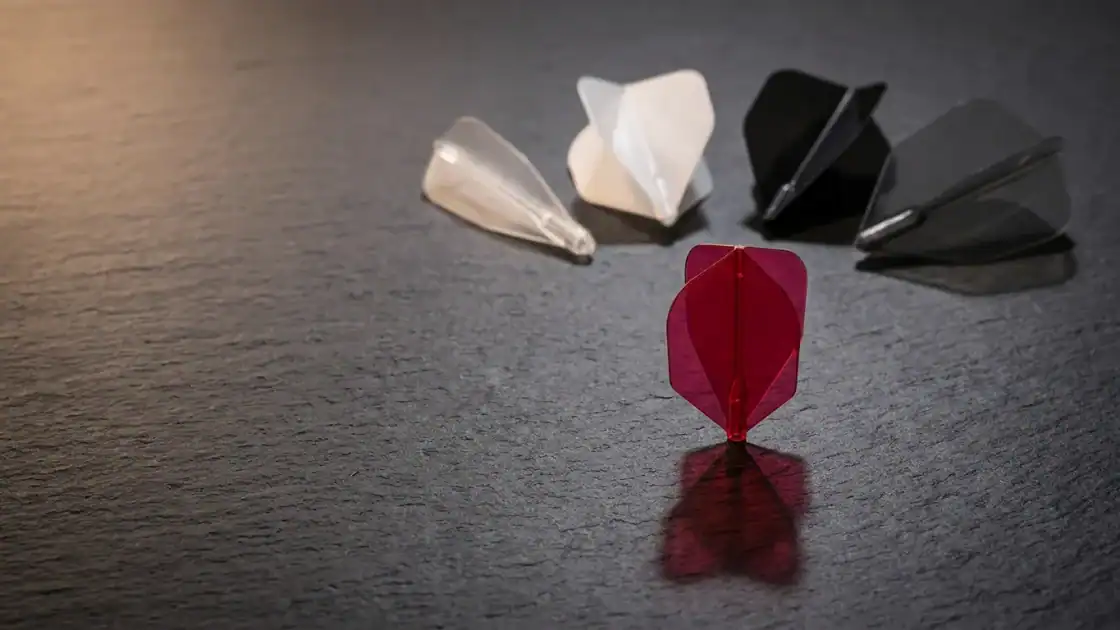
Dart flights are the four fins at the back of your dart. Their only job is to create aerodynamic drag behind the dart’s centre of gravity, generating a restoring torque that keeps the point facing the board. Without flights, every slight wobble in your release would amplify across 2.37 metres and the dart would tumble sideways into the board – or miss it entirely.
The problem is that flights come in at least four shapes, three common thicknesses, and several materials. If you choose wrong, your darts wobble, deflect off each other, or arc unpredictably. This guide explains how to choose dart flights by breaking down each variable, showing you what the numbers actually mean, and giving you a troubleshooting framework when something feels off.
How Does Flight Shape Affect Stability and Grouping?
Flight shape determines surface area. Surface area determines drag. Drag determines how aggressively the dart self-corrects in flight. The relationship is direct: double the surface area and you roughly double the restoring torque that straightens the dart after a wobbly release.
But there is a tradeoff. More surface area also means the dart decelerates faster and presents a larger target for your second and third darts to collide with. Every shape sits somewhere on the spectrum between maximum stability and tight grouping.
| Shape | Relative Size | Drag | Stability | Grouping Space |
|---|---|---|---|---|
| Standard | Largest | High | Maximum | Wide – flights may deflect |
| Kite | Slightly smaller than standard | Medium-high | Good | Moderate |
| Pear | Between standard and slim | Medium | Moderate | Moderate-narrow |
| Slim | Smallest | Low | Minimal | Narrow – least deflection |
Standard Flights
Standard flights are the largest common shape. They produce the most drag, which makes them the most forgiving for beginners. If your release is inconsistent – and every beginner’s is – standard flights give the dart the longest window to self-correct before hitting the board.
The downside is grouping. When three darts are clustered in treble 20, standard flights occupy significant space. Your second and third darts are more likely to strike the first dart’s flights and deflect. This is a real problem at higher skill levels, but for a beginner still working on grouping, it’s rarely the limiting factor.
Kite Flights
Kite flights taper toward the top, giving a little less surface area than a standard flight. They offer a genuine middle ground: enough drag to forgive minor release errors, but a smaller physical profile that reduces deflection when grouping. If you find standard flights too bulky but slim flights too unforgiving, kite is the logical next step.
Slim Flights
Slim flights are tall but narrow, the smallest of the four common shapes. They produce noticeably less drag than standard flights. The dart travels faster and flatter, and the narrow profile means incoming darts are far less likely to collide with the flights already in the board.
For many experienced players, the deciding factor is deflection, not aerodynamics. Not knocking your own darts out of treble 20 can matter more than the extra speed.
Pear Flights
Pear (teardrop) flights sit between standard and slim in size. Their rounded profile gives moderate drag with a smaller footprint than a standard flight, so they suit players who want a little less correction and a little more room in the treble bed without jumping straight to slims.
KEY TAKEAWAY
Standard flights give beginners maximum forgiveness. Each step down in size – kite, pear, slim – trades stability for tighter grouping and faster flight. Don’t downsize until your throw is steady enough to need less correction.
What Flight Thickness Should a Beginner Choose?
Flight thickness is measured in microns (µm). The three common options are 75, 100, and 150 micron. Thickness affects three things: durability, stiffness (which influences how the dart behaves in flight), and how flights interact with incoming darts at the board.
| Thickness | Durability | Flexibility | Deflection Behaviour | Best For |
|---|---|---|---|---|
| 75 µm | Low | High – bends easily | Bends out of the way, reducing deflections | Budget players, casual sessions |
| 100 µm | Medium | Moderate | Balanced – some deflection, some flex | Most players (recommended) |
| 150 µm | High | Low – stiff | Rigid, can cause incoming darts to bounce off | Durability priority, longer stems |
75 Micron – Thin and Cheap
75-micron flights are the thinnest you’ll commonly find. They are inexpensive – typically under £2 for a set of three – and very flexible. That flexibility is both their strength and weakness. When an incoming dart strikes a 75-micron flight, the flight bends out of the way rather than causing a deflection. But that same flexibility means the flight warps and loses its 90-degree angle after a few sessions, reducing its aerodynamic effectiveness.
For beginners who are still learning to group consistently, 75-micron flights aren’t ideal. The rapid shape loss means the dart’s correction changes from session to session as the flights degrade.
100 Micron – The Sweet Spot
100-micron flights are the industry standard for good reason. They hold their shape much longer than 75-micron flights. They’re stiff enough to give steady drag, and still flexible enough not to cause lots of deflections.
If you’re a beginner wondering how to choose dart flights, 100-micron standard flights are the single best starting point. They give you a stable baseline against which to measure every other variable in your setup.
150 Micron – Tough but Divisive
150-micron flights are built to last. Ranges like Pentathlon’s HD150 are marketed specifically for durability, and a set lasts far longer than thin nylon. The tradeoff is stiffness: 150-micron flights don’t bend out of the way when struck. Subsequent darts are more likely to bounce off or deflect, which can be frustrating during competitive legs.
There is a counterintuitive argument that thinner flights actually last longer in practice because they flex rather than absorb impact. The data on this is mixed. What is clear is that 150-micron flights suit players who pair them with longer shafts and don’t yet group tightly enough for deflection to be an issue.
How Do Flight Materials Compare?
Material primarily affects durability and shape retention. The aerodynamic performance difference between nylon and polyester at dart-throwing speeds is negligible – what matters is how long the flight holds its 90-degree cross-section and resists tearing.
| Material | Typical Thickness | Durability | Shape Retention | Notes |
|---|---|---|---|---|
| Nylon | 75–100 µm | Low–Medium | Poor – warps after a few sessions | Most common, cheapest, disposable |
| Polyester | 100–150 µm | Medium–High | Good – holds shape weeks | Better value long-term |
| Moulded (L-Style) | Rigid moulded | Very High | Excellent – rigid 90° | Champagne ring lock, no folding |
| Moulded (Condor AXE) | Thin moulded wings | Very High | Excellent – spring-flex recovery | Integrated flight + shaft system |
Nylon – Cheap and Disposable
Nylon flights are what most beginners encounter first. They come bundled with starter dart sets, they cost almost nothing to replace, and they work well enough for casual play. The problem is longevity. Nylon warps quickly, losing its 90-degree angle after a handful of sessions. Once the fins collapse inward, the flight generates uneven drag and the dart starts landing at inconsistent angles.
If you’re practising regularly, plan to replace nylon flights weekly. Or invest in a slightly better material from the start.
Polyester – The Practical Upgrade
Polyester flights (often marketed as “poly” or “extra strong”) use a stiffer polymer that resists warping. Thicker, stiffer ranges such as Pentathlon’s HD150 fall into this category. They cost slightly more than nylon but last substantially longer. For a beginner investing in regular practice, polyester 100-micron flights offer the best value.
Moulded Systems – L-Style and Condor
Moulded flights are rigid, one-piece constructions that don’t fold. L-Style flights use a champagne ring lock to attach to a proprietary shaft, maintaining a perfect 90-degree angle throughout their lifespan. Condor AXE flights go further: the flight and shaft are a single moulded unit with thin wings that flex on impact and spring back to 90 degrees. Condor also offers a three-winged variant (the AXE 120) that reduces the chance of incoming darts striking the flights.
Both systems cost more upfront but last far longer than disposable flights. The practical benefit is reliability: your flights perform identically on day one and day sixty, which removes one variable from your game.
SCOUT’S TAKE
If you’re just starting out, don’t overthink material. Buy 100-micron polyester flights in a standard shape and replace them when the fins stop springing back to 90 degrees. Moulded systems like L-Style and Condor are worth considering once you know your preferred shape and shaft length – they remove the “degrading flight” variable entirely, but they lock you into a proprietary ecosystem.
How Do You Know When Your Flights Are Wrong for Your Throw?
The symptoms of a flight mismatch are predictable. If you can identify the pattern, you can diagnose the problem. Most flight problems fall into one of five categories.

Darts Wobble in Flight
Likely cause: Flights are too small for your throw speed, or your shafts are too short. The restoring torque is insufficient to damp the oscillation before the dart reaches the board.
Fix: Move up one flight size (e.g., slim to kite, or kite to standard). If wobble persists, try a longer shaft – the increased lever arm amplifies the corrective force without changing the flight.
Darts Land at Steep, Inconsistent Angles
Likely cause: Flights are too large for your throw, overcorrecting the dart and producing a high, looping arc. The dart arrives pointing downward because it has been pulled upright too aggressively.
Fix: Move down one flight size (e.g., standard to kite). Alternatively, shorten your shafts to reduce the lever arm.
Second and Third Darts Deflect Off the First
Likely cause: Flights are too wide (standard shape) or too thick (150 micron), creating a physical barrier for incoming darts.
Fix: Switch to a narrower shape (slim or kite) or drop to 100-micron thickness. Flight protectors – small caps fitted over the rear of the flight – can also help by shielding the exposed edges.
Flights Lose Shape After Every Session
Likely cause: Material is too thin (75 micron nylon) or flights are simply worn out. Once fins no longer spring back to a 90-degree cross-section, drag becomes asymmetric and the dart lands unpredictably.
Fix: Upgrade to 100-micron polyester or consider a moulded system. Check your flights before every session – if you can fold a fin flat and it doesn’t spring back, replace it.
Darts Fishtail or Spiral in Flight
Likely cause: One or more fins are damaged or bent, creating uneven drag on opposite sides of the dart. Even a small crease in one fin produces asymmetric forces that make the dart rotate around its axis.
Fix: Replace the flights immediately. No amount of reshaping a creased flight will restore symmetric drag. Use a flight punch and spring rings to secure flights to the shaft and reduce the chance of split fins.
KEY TAKEAWAY
Knowing how to choose dart flights means diagnosing one symptom at a time. Wobble means more stability needed (bigger flights or longer shafts). Steep angles mean less stability needed (smaller flights or shorter shafts). Deflection means smaller profile or thinner material. Change one variable, throw fifty darts, and reassess.
Does Flight Size Need to Match Your Dart Weight?
Yes, but indirectly. Heavier darts carry more momentum and are less affected by drag. A 26-gram tungsten dart can get away with smaller flights because its mass resists the destabilising forces that would wobble a lighter dart. A 20-gram brass dart needs more corrective drag to stay stable, which means larger flights.
The general guideline is straightforward. Lighter darts (18–22 g) pair well with standard or kite flights. Heavier darts (23–26 g) can handle slim or even pear flights because their mass provides inherent stability. But weight alone doesn’t determine the answer – your throw speed and shaft length matter equally.
How Do Flights Interact with Shaft Length?
The flight and shaft form a single aerodynamic system. The restoring torque that straightens your dart is the product of the drag force (controlled by flight size) and the lever arm distance (controlled by shaft length). Changing one without adjusting the other can make performance worse.
A practical tuning rule: if you downsize your flights, consider lengthening your shafts to compensate for the reduced drag. If you shorten your shafts, consider upsizing your flights to maintain adequate corrective force. Our shaft selection guide covers this interaction in detail.
Want the physics? The restoring torque equation and how oscillation damping works are covered in our article on how flights and shafts affect your throw.
What About Flight Protectors and Punched Flights?
Flight protectors are small aluminium or plastic caps that clip over the trailing edge of the flight. They shield the exposed fin edges from incoming darts, reducing splits and extending flight life. They add a small amount of weight to the rear of the dart, and some players find that incoming darts glance off a protector instead of sliding in alongside the first dart.
Punched flights use a small hole cut at the base of the flight to accept a spring ring that locks the flight onto the shaft. This prevents the most common failure mode: flights popping off the shaft after impact. If you use standard foldable flights, a £2 flight punch is one of the best investments you can make. It eliminates mid-session interruptions from loose flights and ensures the fins stay at a consistent 90-degree angle.
When Should You Replace Dart Flights?
Replace a flight as soon as it’s torn, creased, or no longer holds its shape. Damage builds up gradually, so it’s easy to keep throwing with a flight that has been hurting your accuracy for weeks. Check your flights before every session – it takes ten seconds.
Five signs a flight needs replacing
- Torn or split vanes. Any tear, however small, changes the drag on one side of the dart.
- Creases or bends. The vanes should sit at 90 degrees to each other. A crease tilts one vane and gives uneven drag.
- Frayed or rough edges. Ragged edges disturb the airflow and make the dart less stable.
- A loose fit on the shaft. If the flight spins, falls out, or needs re-seating between throws, the slot has worn and the flight is moving independently of the dart.
- Vanes that don’t spring back. Squeeze two vanes together and let go. A healthy flight snaps straight back to its cross shape; a worn one stays compressed or returns slowly.
A crease can be worse than a tear because it’s harder to spot. It pushes the dart the same way on every throw, so you adjust your aim without realising it – and then have to readjust when you finally fit a fresh flight. Replacing early keeps that variable out of your game.
What makes flights wear out faster
- Thickness. Thin 75-micron flights lose their shape fastest; 150-micron flights hold it much longer.
- Shape. Larger standard flights are a bigger target for your following darts, so they take more hits than slimmer shapes.
- Shaft length. Short shafts put the flight closer to the board face, where tightly grouped darts are more likely to strike it.
- Grouping. The tighter you group, the more often darts hit each other. Spinning shafts such as Target’s Pro Grip Spin or Harrows Supergrip Spin let the flight rotate out of the way, and protectors help against splits from incoming darts – though not against creases from handling.
- Heat and storage. Keep spare flights flat in a dart wallet or their packet, not crushed at the bottom of a case, and never leave them in a hot car – heat warps the plastic.
Replacing thin flights every week? Thicker flights or a moulded system like Condor AXE or L-Style usually cost less over a year, even at a higher price per set. You also spend fewer sessions throwing with damaged flights. Carry at least one spare set of three in your case, and two for league nights or tournaments.
Frequently Asked Questions
What are the best dart flights for beginners?
Standard-shaped, 100-micron polyester flights. They offer maximum stability, good durability, and a forgiving correction that compensates for inconsistent releases. For specific product picks, see our best dart flights guide. Start here, and only change when you can identify a specific problem with your current setup.
Do professional darts players use standard flights?
Many do. Standard-shaped flights are common at the top of the game – Luke Humphries, Michael van Gerwen, and Gerwyn Price all use them. Others choose a smaller or differently shaped flight to suit a faster, flatter throw or to reduce deflections when grouping tightly in the treble bed.
How often should I replace my dart flights?
Replace flights when they are torn or creased, or when the fins no longer spring back to a 90-degree cross-section. Thin nylon flights can need replacing after only a few sessions, thicker polyester flights last considerably longer, and moulded systems like L-Style or Condor last longest of all. See when to replace dart flights above for the five warning signs.
Can I straighten a bent flight instead of replacing it?
You can try, but it rarely lasts. Once a flight has creased, the material along the crease is weakened, so it tends to bend again at the same point during your next session. Flights are cheap – replace rather than repair.
Can I mix different flight shapes on the same set of darts?
You can, but you should not. Each dart in a set should behave identically. Mixing shapes means each dart has different drag, correction, and trajectory characteristics, which makes consistent grouping nearly impossible. Always use the same shape, thickness, and material across all three darts.
Do dart flights come in different colours for a reason?
Colour is purely cosmetic. It doesn’t affect aerodynamics, durability, or performance. Some players use different colours to distinguish their darts from an opponent’s set during practice, but there is no functional benefit to any specific colour.
What is a Condor AXE flight system?
Condor AXE is an integrated flight-and-shaft system moulded from a single piece of resin. The flight and shaft can’t separate, eliminating the most common point of failure. The thin wings flex on impact before returning to a 90-degree position, and a three-winged version, the AXE 120, is also available. They are available in three shaft lengths (21.5 mm, 27.5 mm, 33.5 mm) and multiple flight shapes.
For the aerodynamic theory, read how flights and shafts affect your throw. For what flights PDC pros choose, see what darts do pros use in 2026. To pair your flights with the right shaft, see how to choose shafts. If your darts wobble, check why darts wobble in flight. For how barrel shape interacts with flight selection, read dart barrel shapes, and for product picks, see the best dart flights. New to darts? Start with the beginner’s guide.