Straight barrels suit the widest range of players. Start there.
The straight barrel is the slimmest profile at any weight, offers full grip-position freedom, and is used by several top PDC players, including Michael van Gerwen, Gerwyn Price, and Rob Cross. Torpedo, bomb, scallop, pear, and stealth shapes exist to solve specific grip-to-balance alignment problems – not to be “upgrades.”
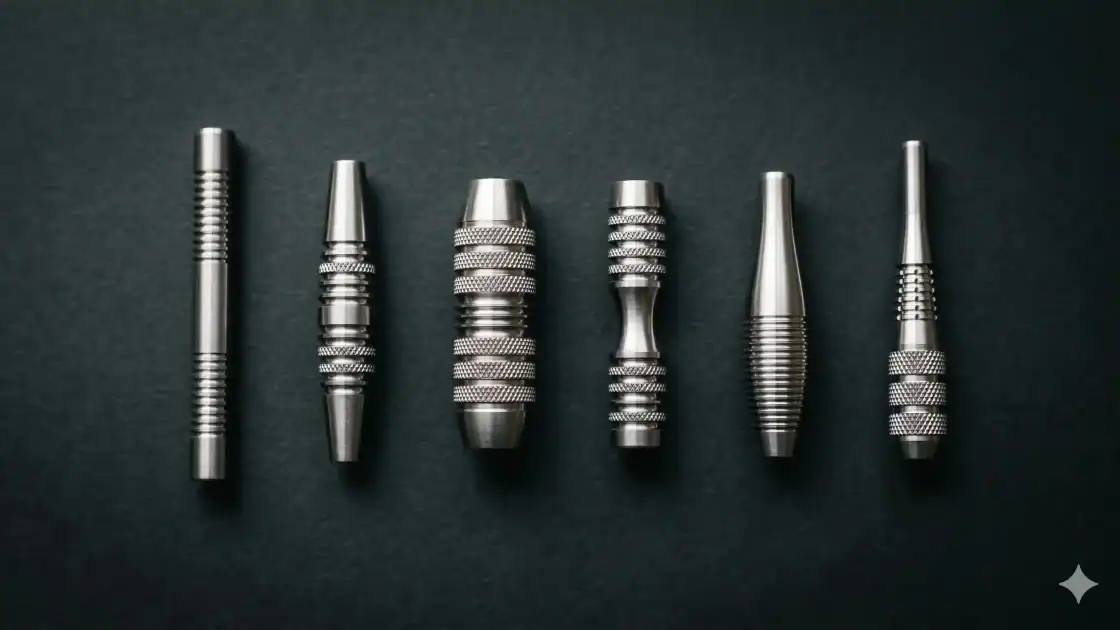
Below: six shapes, real dimensions, real products, grip matching, pro player data, material interactions, and the misconceptions that cost beginners money.
Dart barrel shapes are the most misunderstood equipment decision in darts. Most guides list three or four profiles, describe them in vague terms, and move on. But barrel geometry dictates where your fingers naturally sit, how stable the dart is during release, and how much physical space the dart occupies in the board – which directly affects whether your second and third darts can land in the same treble bed.
We synthesised data from manufacturer specifications, CNC engineering references, PDC player equipment databases, and thousands of forum posts across DartsNutz, r/darts, and dedicated coaching sites. This guide covers six distinct dart barrel shapes with real dimensions, real products, and real tradeoffs. If you already know your grip style, skip to the shape-matching section. If you’re still figuring out what weight to throw, read that first – weight and shape interact in ways that matter.
Why barrel shape is a physics problem, not a preference
A dart barrel is the primary mass-carrying component and the sole tactile interface between your hand and the projectile. Its shape controls three things simultaneously:
1
Grip Surface
Where your fingers naturally land and how the barrel feels during the acceleration phase of your throw.
2
Balance Point
Where the mass concentrates along the barrel’s length – the center of gravity (CoG) that governs flight stability.
3
Board Footprint
How much physical space the dart occupies once embedded – the radial diameter that determines grouping potential.
Your natural grip position must align with the barrel’s center of gravity. Gripping ahead of the CoG causes the rear to sag. Gripping behind it causes nose-up instability. This is projectile physics, not marketing.
Every shape in this guide exists to solve a specific version of that alignment problem. A torpedo puts mass where front-grippers hold. A stealth barrel puts mass where rear-grippers hold. A straight barrel distributes mass evenly so any grip position works. Understanding this single principle makes the entire barrel-shape conversation simple.
One note on terminology: manufacturers and retailers use barrel shape names inconsistently. “Torpedo” and “bomb” overlap in some catalogues. “Scallop” is listed as a shape when it is actually a grip modification applied to other shapes. This guide uses strict definitions based on geometry and center of gravity position, not brand marketing.
Every dart barrel shape explained
Each shape below is defined by its geometry, center of gravity (CoG) position, and dimensional envelope at standard competition weight (22g, 90% tungsten). We include real measured products so you can compare how these numbers play out in barrels you can actually buy.
Straight (cylindrical)
~6.3mm
Diameter
50–53mm
Length
Center
CoG Position
Even
Weight Dist.
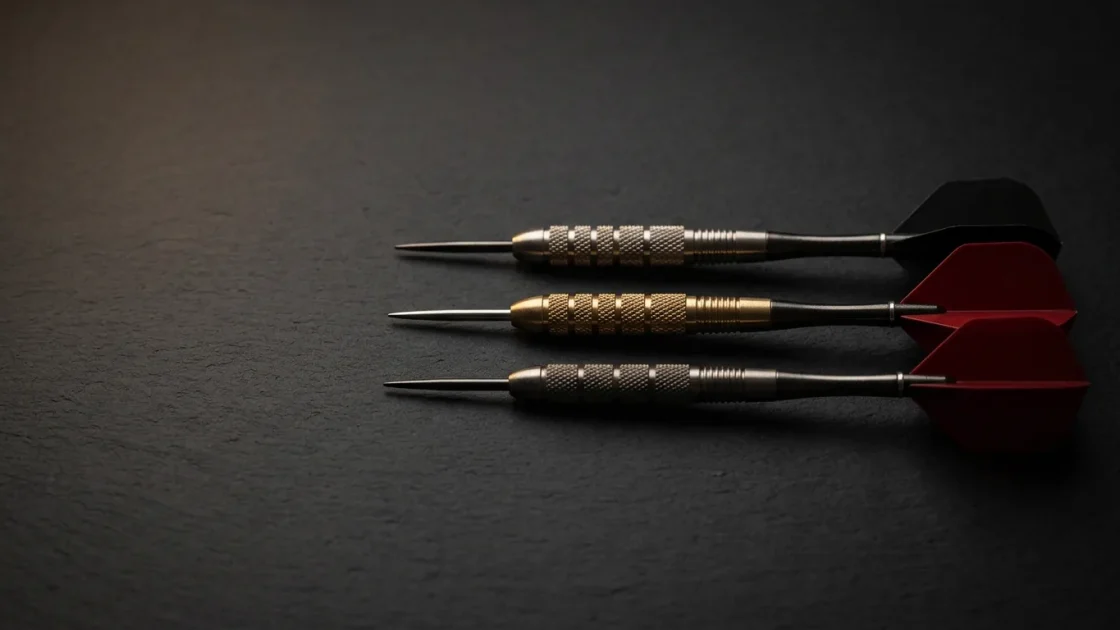
A straight barrel maintains a uniform diameter from point to stem – no taper, no bulge. Weight distributes evenly, placing the center of gravity at the geometric midpoint. The Designa Patriot X at 22g measures 6.3mm × 51.5mm. The Unicorn Gary Anderson Phase 5 at 23g measures 6.4mm × 52.3mm.
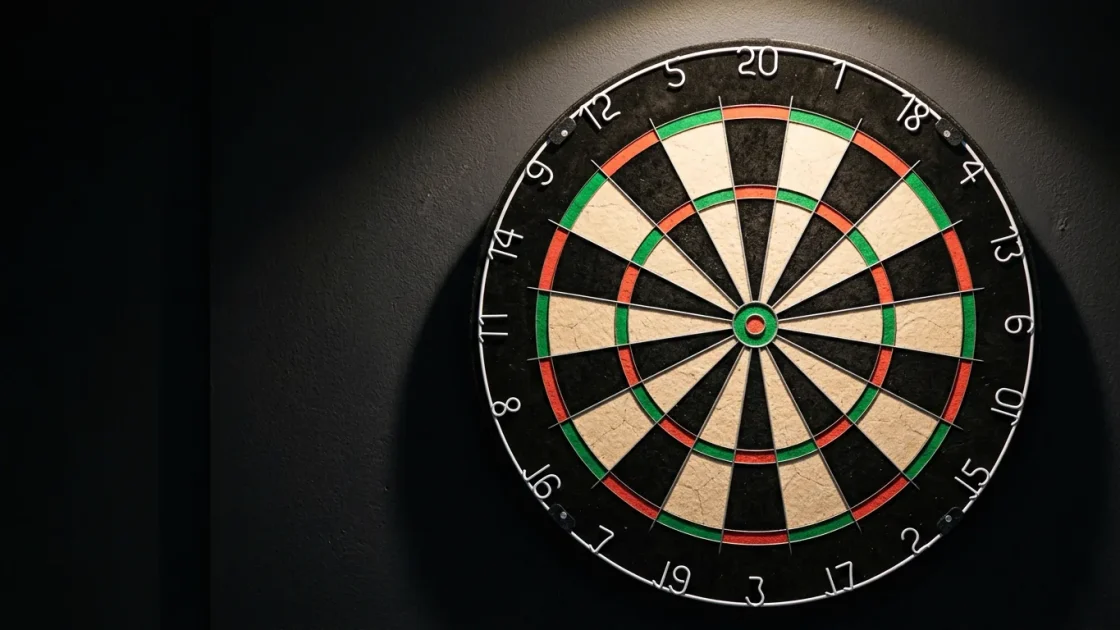
This is the slimmest achievable profile at competition weight. The treble-20 bed is only about 8mm deep wire-to-wire. At 6.3mm per dart, three straight barrels fit with maximum clearance between them. Every other shape is wider at the same weight – which is why straight barrels suit players who group tightly.
The uniform diameter accommodates pencil, claw, and multi-finger grips at any position along the barrel. A rear gripper can hold the back third without nose-heaviness. A front gripper can choke up without rear-weight pulling the trajectory off-line. This grip flexibility is why coaching sites recommend straight barrels as the default starting shape – they do not force a grip style, so you discover your natural hand position through practice rather than being channelled by the barrel.
What works
Slimmest profile at any weight – best theoretical grouping
Works with pencil, claw, and palm grips at any barrel position
Even weight distribution produces predictable, forgiving trajectories
Compatible with flat, parabolic, and lob throw arcs
Watch out for
Featureless surface can allow unnoticed grip-position drift between throws
Players who need a hard tactile anchor may find the barrel feels “vague”
Longer length can feel cramped for palm grippers with shorter fingers
Products. Designa Patriot X (90% W, 22g, 51.5mm × 6.3mm, ~£15–25 (~$20–30) – the value benchmark). Unicorn Gary Anderson Phase 5 (90% W, 23g, 52.3mm × 6.4mm, ~£50–90 (~$65–110)). Target Bolide Void 04 (90% W, 21–25g, 51mm × 6.6mm, Swiss Point, ~£57–85 (~$70–110)). Winmau MvG EVO-X (90% W, 23g – Michael van Gerwen’s signature).
Torpedo
~7.5mm
Max Diameter
38–48mm
Length
Center
CoG Position
Center
Weight Dist.
A torpedo barrel is widest at or near the midpoint, tapering toward both the point and stem – resembling a rugby ball. The Target Bolide 05 at 22g measures 7.5mm max diameter × 44mm length – substantially shorter and wider than a straight barrel at the same weight. The Red Dragon Torpedo Flightmasters (brass) at 22g hit 7.9mm × 38.1mm.
The pronounced belly creates a natural cradle. Your thumb and index finger settle at the fattest point, which sits near the center of gravity. This self-centering property is the torpedo’s main advantage: consistent finger placement without conscious effort. The shape is also well-suited to players with shorter fingers – the reduced barrel length means less span needed for a comfortable hold.
The tradeoff is board real estate. The 7.5mm mid-section is roughly 19% wider than a straight barrel at the same weight. In the treble-20 bed, that extra width means the second and third darts have measurably less room. One experienced equipment designer puts it plainly: bomb and torpedo barrels are very efficient at hitting 100 after 100, but not renowned for hitting 180 after 180.
Suits shorter fingers – less barrel length to span
Aerodynamic taper at both ends reduces drag for efficient board penetration
Growing PDC validation – Luke Humphries throws a torpedo profile
Watch out for
19% wider than straight at same weight – reduced grouping clearance
Gripping more than ~10mm off-center from CoG creates noticeable instability
Less grip-position flexibility than straight barrels
Products. Target Bolide 05 SP (90% W, 22g, 44mm × 7.5mm, Swiss Point, ~£55 (~$70)). Red Dragon Luke Humphries TX1 (90% W, 22g – the current World Champion’s signature dart). Winmau Paradym Torpedo (90% W, 24–26g, sabre grip, ~£65 (~$85)). Bull’s Martin Schindler G2 (90% W, 27g, 50.9mm × 7.7mm, explicitly tagged “Torpedo / Front loaded”).
Bomb (bomber)
8.0mm+
Max Diameter
35–45mm
Length
Forward
CoG Position
Front
Weight Dist.
The bomb barrel is short, fat, and front-loaded. The widest point sits at or toward the front third. At 26g in brass, bomb barrels reach 8.7mm diameter × 38.1mm length. Even in 90% tungsten, they typically exceed 8mm at competition weights. The center of gravity sits well forward (roughly 35–40% from the tip), driving the dart nose-down into the board.John Lowe achieved the first televised nine-dart finish in 1984 using short, front-weighted darts. Phil Taylor’s early career also featured bomb-derived barrels. The short length enables “stacking” – darts that land above each other rather than beside each other in the board.
The short, fat, front-loaded profile essentially demands a front grip or palm grip. Pencil grips at the rear are mechanically impractical – the CoG sits too far forward, and the barrel is too short for fingers to spread. Players with larger hands often find the wider diameter more comfortable than slim straight barrels.
What works
Wider diameter suits players with larger hands or thick fingers
A scallop is not a standalone shape. It is an ergonomic modification – a concave indentation (typically 1–3mm deep and 5–15mm long) CNC-milled into an existing barrel shape exactly where a finger naturally sits. Weight distribution depends entirely on the parent shape. The scallop’s function is purely tactile: it creates a physical index point that locks your grip into a repeatable position.
When scallops help
Your slow-motion footage shows finger placement shifting between throws. The groove locks your fingers into the same position every time – a consistency correction tool that addresses one of the most common accuracy killers.
When scallops hurt
The groove doesn’t match your natural grip position. Your fingers are forced into an unnatural spot that disrupts release rather than improving it. Some players also report the groove edge creating an unwanted “catch” during release.
Gary Anderson – one of the most decorated players in darts history – switched from the straight Phase 5 to the scalloped Phase 6 well into his competitive prime. The Phase 6 measures 50.7mm × 7.2mm at 23g with a centre scallop on a front-weighted barrel. This is not a concession – it is a precision tool.
The pear barrel is widest toward the tip and tapers toward the stem – the inverse of a stealth barrel. The center of gravity sits roughly 60–65% forward from the tip, creating strong front-loading. Width at the front matches torpedo dimensions, but the rear tapers to a narrow 5.5–6mm.
Simon Whitlock built his career on this shape – his early Winmau signature darts featured a classic teardrop profile optimised for his extreme front grip. One manufacturer guide states it plainly: if you grip the dart barrel very far to the front, a teardrop shape is the recommendation.
Gripping behind the forward-biased CoG creates severe tail-heavy instability – the rear sags during flight and the dart fishtails. The narrow rear limits multi-finger grips. This is a specialist shape: front-grippers who throw with a lob arc will find the extreme front-loading produces strong, nose-down board penetration. Everyone else should look elsewhere.
Stealth / tapered (rear-loaded)
5.45mm
Front Width
7.4mm
Rear Width
46–52mm
Length
Rearward
CoG Position
The stealth barrel is thin at the front and thick at the rear – the reverse of a pear. The Winmau Sniper 3 at 21g varies from 5.45mm at the front to 7.4mm at the rear across 48.6mm. The slim nose is specifically designed to “cheat” into tight spaces, sliding past darts already embedded in a treble bed.
This is the grouping specialist’s shape. Darryl Fitton – known for exceptional treble-bed accuracy – throws stealth-style barrels. One equipment writer notes he can hit 180 after 180 in configurations that would be physically impossible with bomber or torpedo shapes.
The tradeoff is demanding technique. The abrupt taper creates inconsistent finger feel along the barrel length – your thumb and index finger sit at different diameters. Rear-loaded weight can produce unstable trajectories if your release timing is not precise. This is a barrel for players who already know their grip and want to maximise the physics of grouping.
Your grip style is the bridge between barrel shape and throw accuracy. If you’re unsure which grip you use, film yourself throwing in slow motion – your natural finger placement will be immediately obvious.
Pencil grip
Holds the barrel like a pen – thumb and one or two fingers in a light, precise hold. Straight barrels are the natural partner because the uniform diameter allows placement anywhere without a balance shift. Torpedo barrels work if the pencil grip naturally falls at the belly. Scalloped barrels add a physical reference point for pencil grippers who micro-shift between throws.
Claw grip
A structured fingertip clamp – index and middle fingers curled with the thumb stabilising underneath. The claw benefits from barrels that provide a consistent “pinch zone.” Torpedo shapes self-centre the claw at the belly. Scalloped barrels lock the claw into a repeatable pocket. Straight barrels work if the grip texture provides enough tactile feedback at the claw position.
Palm grip (hammer grip)
Wraps more fingers around the barrel – a secure hold that benefits from wider diameters and shorter lengths. Bomb barrels are the natural fit: the short, wide profile gives multiple fingers adequate contact surface. Torpedo barrels work if the belly is wide enough. The general rule from coaching sites: the more fingers you use with your grip, the longer and wider the barrel you need.
Throw arc pairing
Community discussion associates front-weighted barrels (bomb, pear) with softer, lob-like parabolic throws, and center/rear-weighted barrels (straight, stealth) with harder, flatter throws. This is directionally consistent with physics – forward mass concentration drives the dart nose-down, producing a steeper descent – but throw arc is in the end driven by release speed and angle. The barrel influences how comfortable an arc feels, not which arc is “correct.”
Grip Style
Best Match
Workable
Avoid
Pencil (front)
Torpedo, Pear
Straight, Scalloped straight
Bomb (too short)
Pencil (mid/rear)
Straight
Scalloped straight, Stealth
Bomb, Pear (CoG mismatch)
Claw
Torpedo, Scalloped
Straight with textured grip zone
Bomb (width overwhelms fingertips)
Palm / Hammer
Bomb, wide Torpedo
Short straight, Scalloped bomb
Stealth, Pear (too narrow)
How material and weight change the shape equation
Barrel shape does not exist independently of material. Tungsten is approximately twice as dense as brass, so a tungsten barrel of equal weight can be roughly 30% smaller in diameter. One manufacturer quantifies it further: barrel diameter decreases by approximately 0.5mm for every 5% increase in tungsten content.
At 90% tungsten, a 22g straight barrel achieves ~6.3mm diameter. In brass at the same weight, the diameter can exceed 8.5mm – approaching bomb-barrel territory. This is why the tungsten vs brass decision matters so much: it determines whether the shape advantages you’re paying for can actually express themselves.
WHY THIS MATTERS
A brass straight barrel can be wider than a tungsten bomb
At 22g, a brass straight barrel may hit 8.7mm diameter. A tungsten bomb at 24g may sit at 8.0mm. If you buy a “straight barrel” in brass expecting slim grouping, you’re getting bomb-barrel width at straight-barrel length. Material determines whether shape advantages are real or theoretical.
Weight also changes the equation within the same material. At 18g in 90% tungsten, a straight barrel is exceptionally slim. At 26g+, even straight barrels exceed 7mm – narrowing the gap with torpedo profiles. This is why the heaviest throwers in professional darts are precise about barrel profile: at their accuracy level, every tenth of a millimetre matters. For guidance on where weight and shape intersect, see how to choose dart weight.
What the professionals actually throw
The PDC circuit provides the clearest data on which shapes work at the highest level. The pattern is overwhelming.
Player
Barrel Shape
Signature Dart
Weight
Michael van Gerwen
Straight (parallel)
Winmau MvG EVO-X
23g
Gary Anderson
Straight → Scalloped straight
Unicorn Phase 5 → Phase 6
23g
Luke Humphries
Torpedo (front-weighted)
Red Dragon TX1
22g
Darryl Fitton
Stealth (rear-loaded)
Custom rear-taper
~22g
Simon Whitlock
Pear/teardrop → Scalloped
Winmau Whitlock signature
22–24g
Phil Taylor
Torpedo/bomb → Straight
Target Power 9Five G-series
24–26g
The common thread: elite players choose the slimmest barrel profile compatible with their natural grip. Nobody at the top of the sport throws bomb barrels. The treble-20 bed is 8mm (the regulation treble ring width) – at that scale, every tenth of a millimetre of barrel diameter is a measurable competitive disadvantage.
KEY TAKEAWAY
Plenty of top players throw straight barrels – Michael van Gerwen, Gerwyn Price, and Rob Cross among them – while others, like Luke Humphries with his torpedo, chose a shape to serve a specific grip need. The common beginner assumption that shaped barrels are upgrades over straight barrels is backwards.
How to match your barrel shape – a practical framework
The coaching consensus across DartsNutz, DartHelp, and manufacturer guides converges on a six-step process.
1
Start Straight
90% tungsten, 20–22g, moderate ringed grip. Eliminates shape as a variable while you develop your throw.
2
Film Your Throw
Slow motion. Identify where your fingers land (front, mid, rear) and which grip type you use.
3
Assess Consistency
If your grip point is stable and grouping improves, the straight barrel is working. Stay with it.
4
Fix Grip Drift
If your fingers shift between throws, try a scalloped version. The groove locks your fingers where they should be.
5
Fix Balance Mismatch
If the dart wobbles in flight, try a different weight distribution. Front gripper? Torpedo or pear. Rear gripper? Stealth.
6
Consider Hand Size
Thick fingers or palm grip? Try a wider torpedo or bomb – but understand the grouping tradeoff at competitive level.
The physical constraint that overrides everything else: the more fingers you use, the longer the barrel you need. The longer the barrel, the slimmer it must be (at a given weight) to maintain grouping potential. Grip style, barrel length, barrel shape, and material are a package – not independent decisions.
WHO SHOULD CHANGE FROM STRAIGHT?
✓Your slow-motion footage shows grip position shifting between throws → try scalloped
✓You naturally grip the front third and the barrel feels rear-heavy → try torpedo or pear
✓You have larger hands and slim barrels feel insecure → try wider torpedo or bomb
✗You’re not grouping well yet → shape is unlikely to be the problem
✗You want to buy what a pro uses → their barrel matches their grip, not yours
✗You assume shaped barrels are “better” → most are wider, reducing grouping potential
Common misconceptions that cost beginners money
“Straight barrels are for beginners.” The most damaging myth in darts equipment. Straight barrels are recommended for beginners because they are the most versatile and forgiving shape – but they are also the shape used by the majority of professional players. Straight is not a stepping stone. For most players, it is the destination.
“Front-loaded barrels are better for accuracy.” Front-loading helps if your natural grip is at the front. If you grip mid-barrel or rear-barrel, front-loading creates instability because the CoG sits ahead of your control point. The barrel’s balance must match where you grip – not where marketing suggests you should grip.
“Heavier darts need shaped barrels.” The opposite is closer to the truth. As weight increases, barrel diameter increases. Shaped barrels are already wider than straight barrels – adding weight widens them further. At 26g+ in tungsten, a shaped barrel can exceed 8mm. Heavier throwers benefit most from straight barrels where the slim profile partially offsets the weight-driven diameter increase.
“Scalloped barrels are a crutch.” Gary Anderson switched to a scalloped barrel well into his competitive prime. Scallops are a precision tool, not a compromise. They solve a specific problem – grip-position variability – and do nothing else. If you have that problem, a scallop is the most targeted solution available.
“Shape matters more than weight.” Weight determines barrel diameter more than shape does. A 22g straight in brass (8.7mm) is wider than a 24g bomb in 90% tungsten (8.0mm). Get the material and weight right first; shape refinement comes after. For the weight decision, see how to choose dart weight.
SCOUT’S TAKE
The barrel shape conversation is overcomplicated by marketing and undercomplicated by most guides. Start straight. Film your grip. Only change shape if slow-motion footage shows a specific problem that a different profile solves. Torpedo is not an upgrade. Bomb is not more forgiving. Scallop is not a crutch. Each shape exists to align a barrel’s center of gravity with a specific grip position – and if yours already aligns with a straight barrel’s center, which it does for most players, changing shape makes things worse.
Frequently asked questions
What dart barrel shape is best for beginners?
Straight. The even weight distribution forgives inconsistent releases, the slim profile teaches good grouping habits, and the uniform diameter lets you discover your natural grip position. Every coaching source and forum community we surveyed converges on this recommendation. A straight barrel in 90% tungsten at 20–22g with moderate ringed grip is the standard starting point.
Does barrel shape affect accuracy?
Yes, but not the way most people assume. Shape does not make a dart “more accurate.” It affects whether the barrel’s center of gravity aligns with your grip position. When grip point and CoG align, the dart flies stable. When they do not, the dart wobbles, fishtails, or droops. The right shape is the one that puts the mass where your fingers are.
Why do most pros use straight barrels?
The treble-20 bed is 9.53mm wide. Three darts need to fit inside it simultaneously. At 90% tungsten and competition weight, a straight barrel is ~6.3mm in diameter – the slimmest available. Every other shape is wider at the same weight, reducing clearance. Professionals choose the slimmest barrel compatible with their grip because at their accuracy level, barrel width is the binding constraint.
What is the difference between torpedo and bomb barrels?
Torpedo barrels are widest at the center and taper toward both ends, with center-weighted balance. Bomb barrels are widest in the front third, shorter, fatter, with forward-biased balance. Torpedoes suit mid-grip players; bombs suit front-grip players with larger hands. Bombs have the worst grouping potential of any shape due to their wide front profile.
Should I switch barrel shape if I’m not grouping well?
Film your throw first. Poor grouping is more often caused by inconsistent grip position, release timing, or follow-through than by barrel shape. If footage shows your fingers shifting between throws, try a scallop. If your grip is consistent but the dart wobbles, try a different weight distribution. If grouping is tight but darts deflect each other, try a slimmer profile. Shape is rarely the first thing to change.
Can I use a torpedo barrel for league play?
Absolutely. Luke Humphries won the PDC World Championship with a torpedo barrel (Red Dragon TX1). The shape is viable at every level. The question is whether the torpedo’s self-centering grip advantage outweighs its 19% wider profile compared to straight. For most league players, if the torpedo matches your natural grip, the consistency gain is worth more than the theoretical grouping loss.
Anass Hassoun writes and edits TheDartScout, an independent darts gear research site. He compares darts, dartboards and accessories using manufacturer specifications, verified professional player setups and the consensus of experienced league players. He does not run a testing lab and says so on every page.