QUICK ANSWER
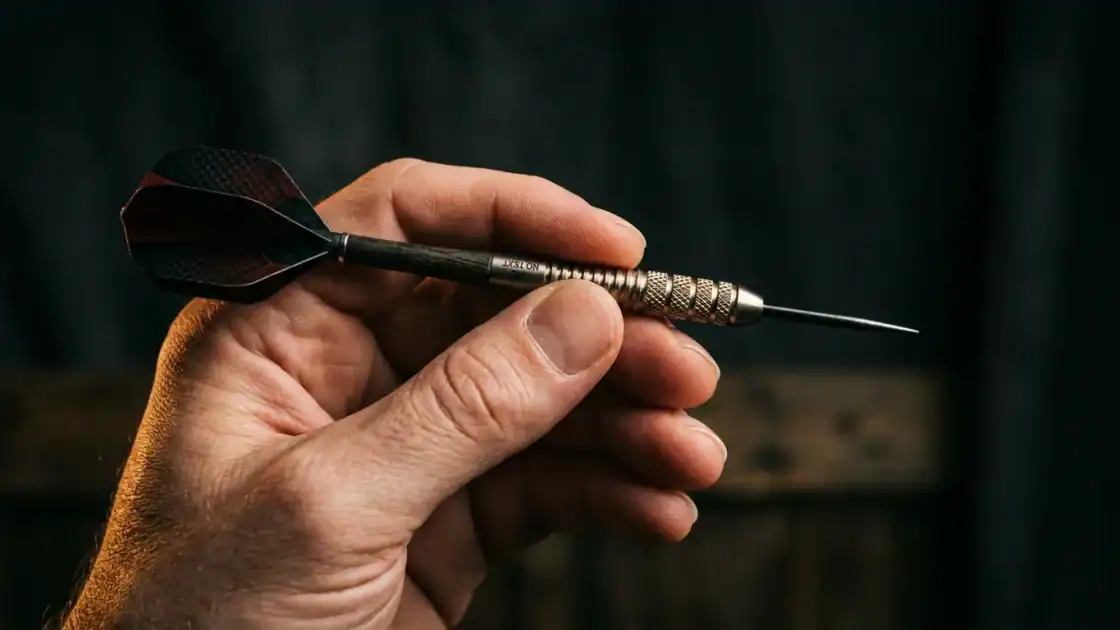
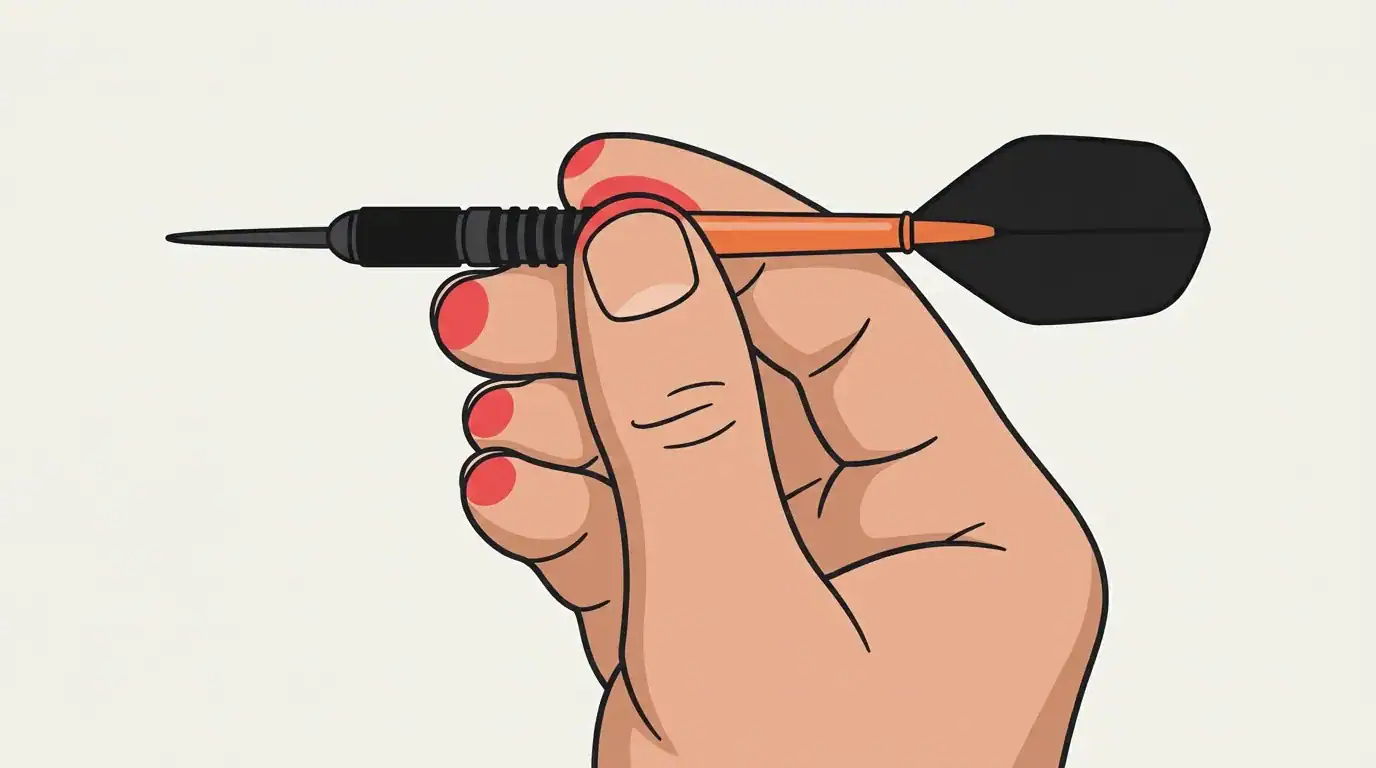
Hold the dart like a pen – thumb underneath, two fingers on top of the barrel.
Keep the point angled slightly upward. Grip firm enough that the dart won’t slip, light enough that your knuckles don’t turn white. That’s it. Everything else is personal preference built through practice.
Pick up a pen right now. Look at your fingers. Thumb underneath, index finger on top, middle finger supporting from the side. That motor pattern – the one you’ve used since primary school – is the foundation of how to hold a dart. You don’t need to learn something new. You need to adapt something you already know.
The grip is the only connection between your hand and a 22-gram tungsten barrel travelling 2.37 metres in under half a second. According to Dartbase’s grip mechanics guide, a minimum of three contact points (thumb plus two fingers) is needed for directional control. Fewer than that and the dart drifts. More than four and the release becomes a coordination problem.
Learning how to hold a dart comes down to four principles that every good grip shares – finger count, pressure, barrel position, and release coordination. TheDartScout’s own grip styles breakdown covers the biomechanics in detail. This guide focuses on the practical side. Getting the dart in your hand correctly, today, with no guesswork.
How Should You Hold a Dart for the First Time?
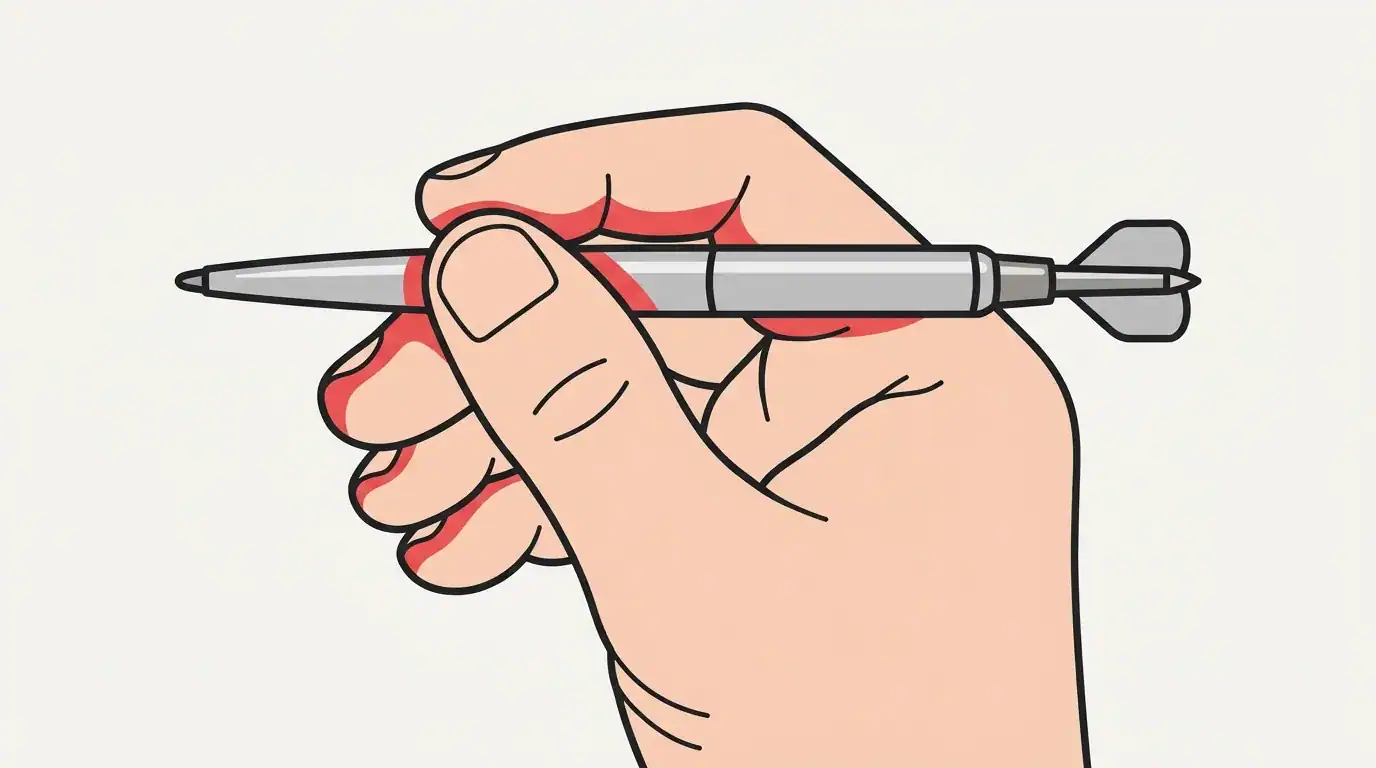
Start with the pen grip. Place the dart across your open palm, find the spot where it balances level, and roll it toward your fingertips. Your thumb should sit just behind that balance point – not on it, not far ahead of it. Rest your index finger on top and your middle finger on the side for support.
The dart’s point should tilt slightly upward. If the rear droops, your thumb is too far forward. If the nose dives, shift your thumb back toward the shaft. This upward angle matters because the dart follows a parabolic arc to the board – it rises, peaks, and drops. A downward starting angle fights that natural flight path.
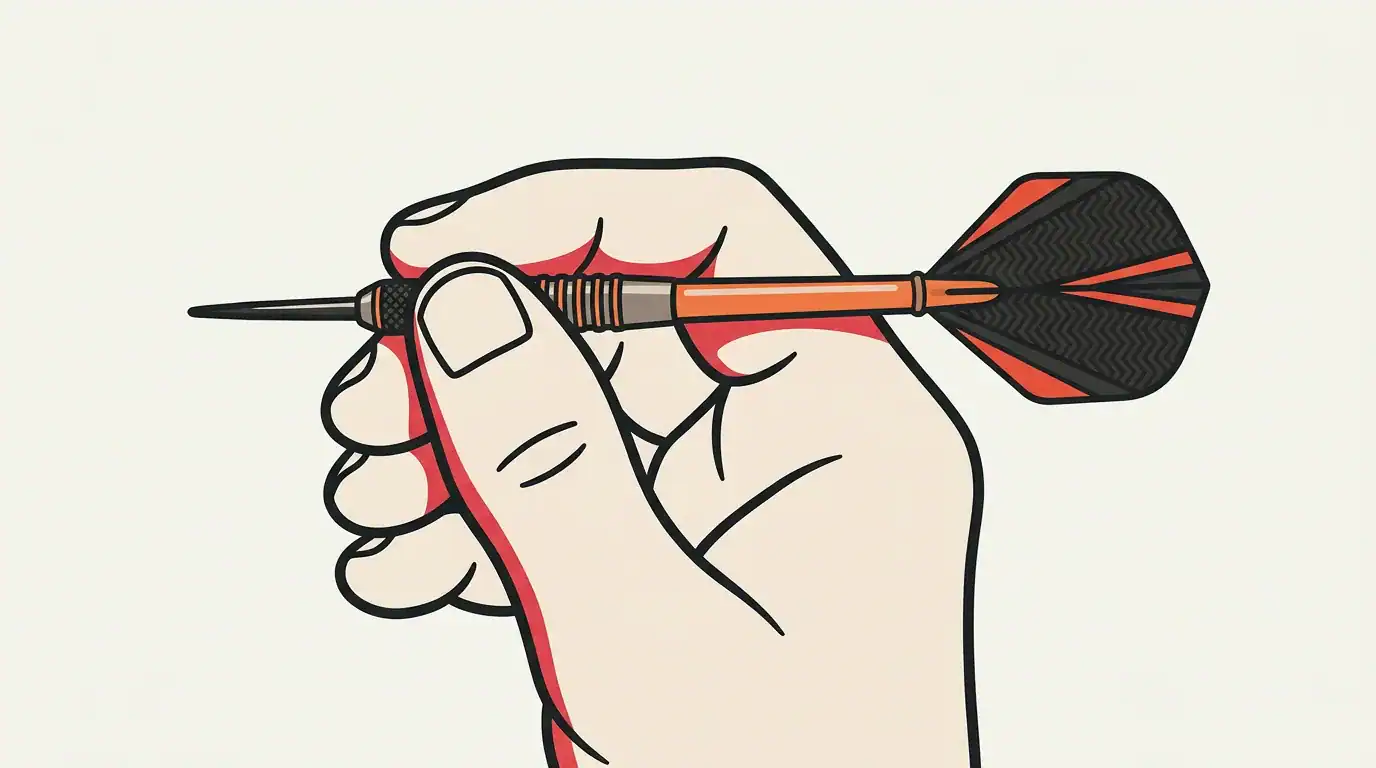
Don’t curl your unused fingers into your palm. Let them sit naturally, relaxed and out of the way. The pinky and ring finger should float – not pressed against the barrel, not clenched into a fist. Clenching creates tension that travels up your forearm and ruins the release.
KEY TAKEAWAY
Find the balance point first, then build your grip around it. Thumb behind centre of gravity, two fingers on top, point angled up. Everything else follows from that starting position.
What Are the Three Main Dart Grip Styles?
Every dart grip is a variation of three core styles. The difference is how many fingers touch the barrel – and each extra finger is a tradeoff between control during the throw and cleanliness at release.
| Grip Style | Fingers | Control | Release | Best For |
|---|---|---|---|---|
| Pencil | 2-3 (thumb + index + middle) | Moderate | Cleanest | Beginners, fast throwers |
| Claw | 3-4 (fingers curve over barrel) | High | Moderate | Intermediate, torpedo barrels |
| Palm | 4-5 (barrel sits deep in hand) | Maximum | Hardest | Short fat barrels only |
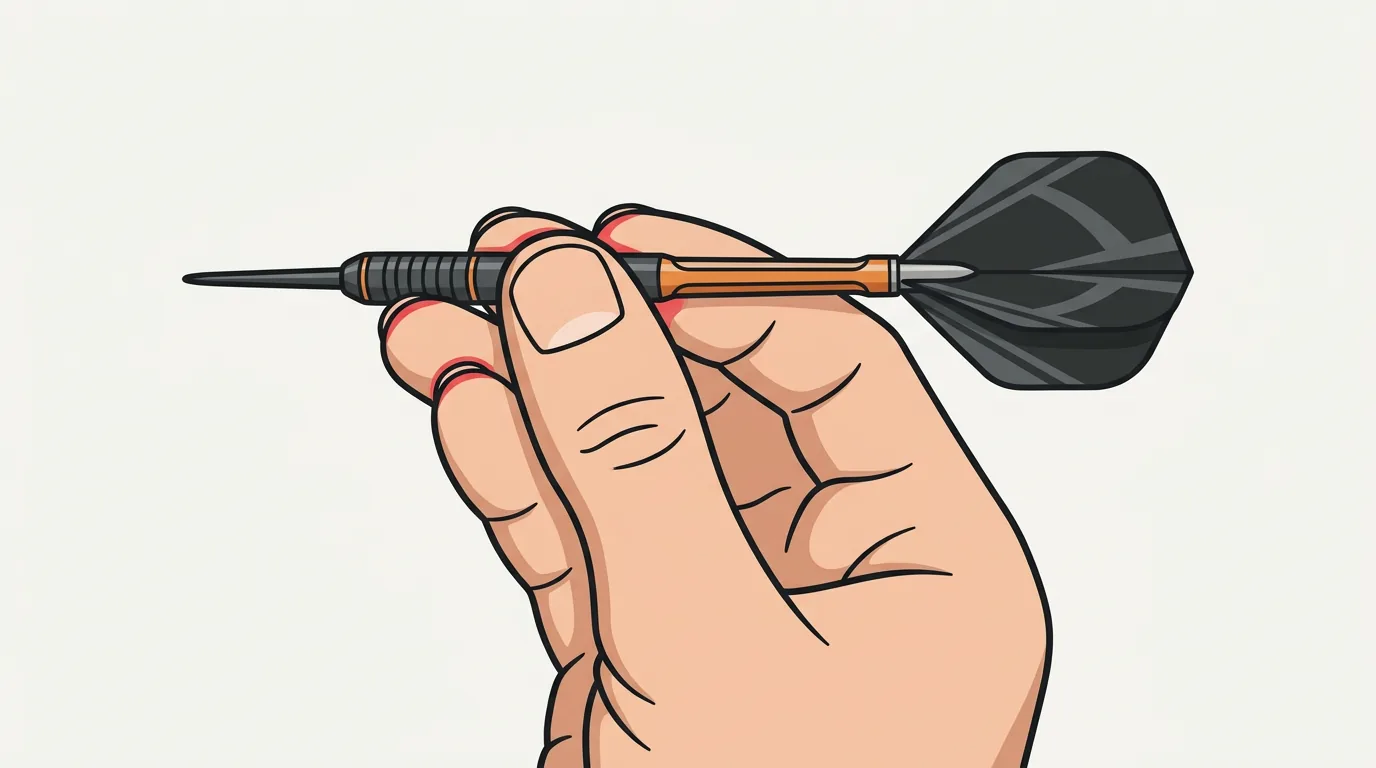
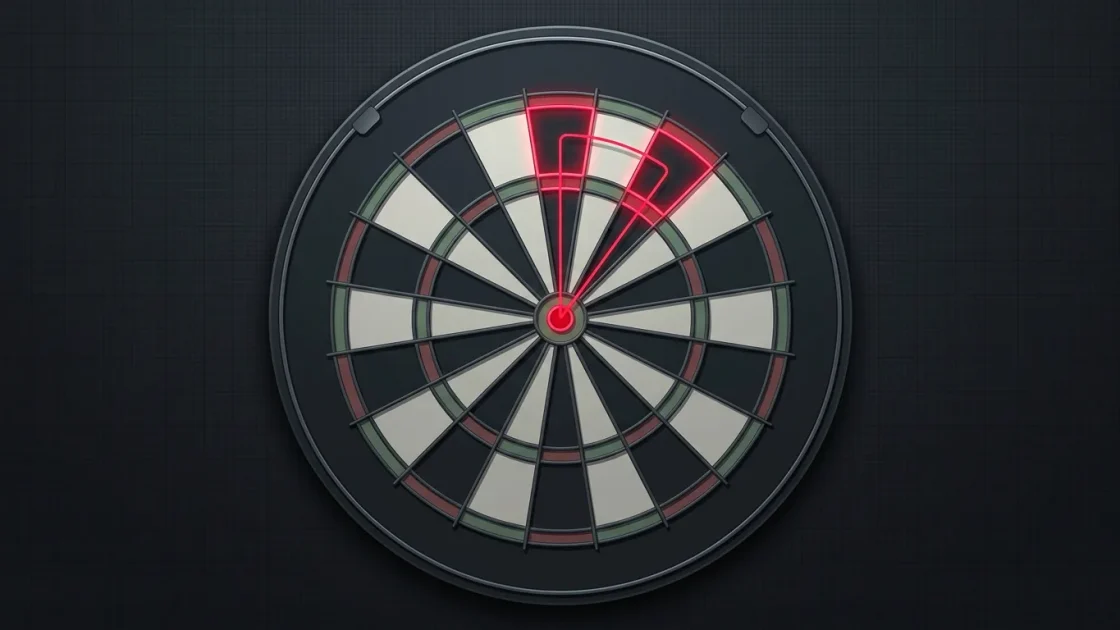
The pencil grip is where most players start and where many stay. Phil Taylor won 16 world championships with a pencil grip on a thin, straight barrel. Two to three fingers, clean release, minimal interference. It mirrors holding a pen – the most practised fine motor skill you have.
The claw grip adds a third or fourth finger curving over the top of the barrel like a cage. More contact surface means more guidance during the throwing motion. Michael van Gerwen uses a three-finger claw, gripping at the barrel’s centre. The tradeoff: each extra finger must disengage in sequence during release. If one lingers, the dart kicks sideways.
The palm grip wraps four or five fingers around the barrel. Maximum hold, but the release sequence is complex – ring and pinky first, then middle, then index, then thumb. This grip only works on short, wide bomb-shaped barrels. Slim barrels are physically too narrow for it.
How Tight Should You Hold a Dart?
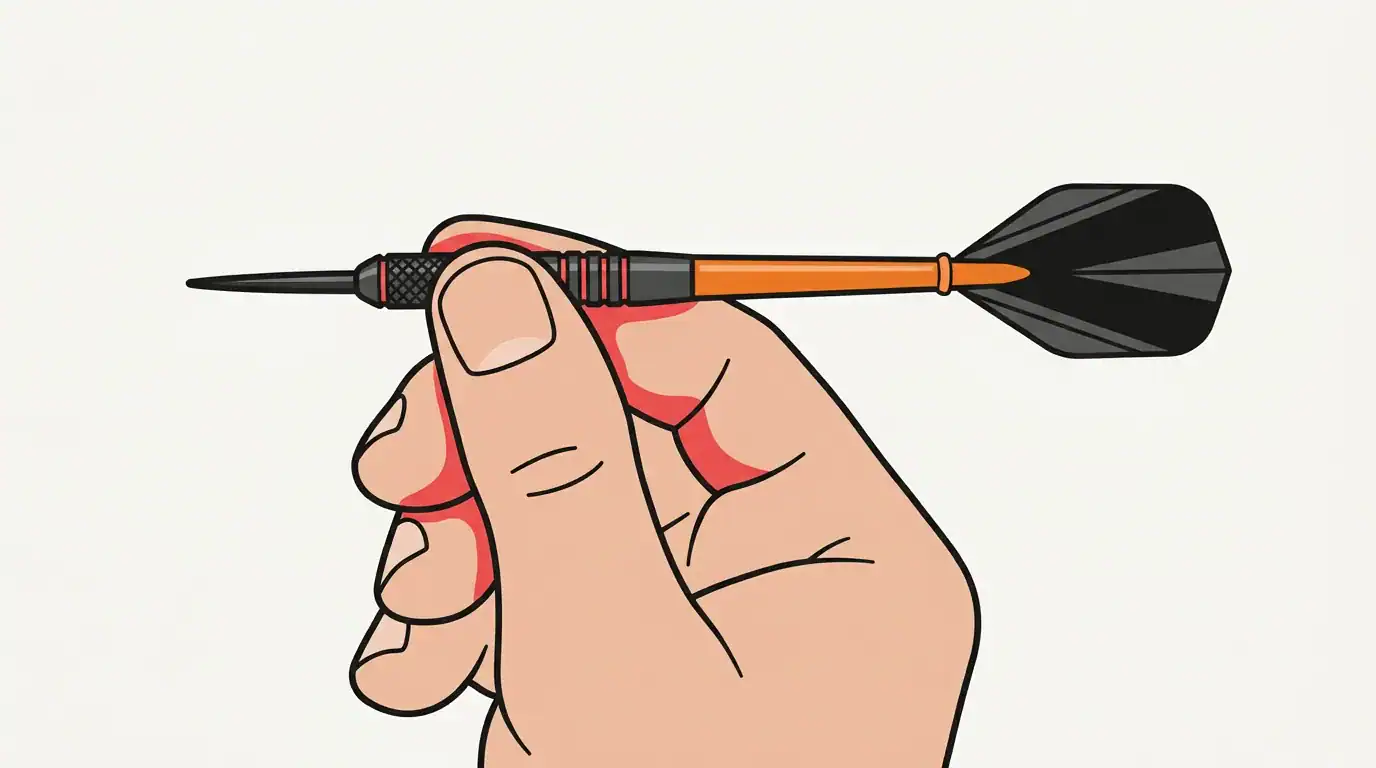
Light. Lighter than you think. The classic test: if your fingertips turn white or you can see knuckle tension, you’re gripping too hard. Dartbase recommends holding the dart “solid but not tensed” – firm enough it won’t slip during acceleration, light enough that no forearm muscles engage. If your grip only tightens in matches, that’s pressure rather than technique – see the mental game of darts.
Think of holding a feather. There’s a historical connection here – the original dart flights were actual feathers, and the whole throwing motion was designed around a light, effortless release. Modern nylon flights changed the material but not the principle. The dart should leave your fingers, not be pushed out.
Watch Michael van Gerwen throw in slow motion. His fingers barely seem to hold the dart at all. The barrel sits between his fingertips almost weightlessly. And his release is one of the cleanest on the PDC circuit – the dart slides forward with zero sideways interference. That’s the feather principle in action.
PLAYER FIT MATCH
Grip: Pencil ✓ · Claw ✓ · Palm ○
Arc: Flat ✓ · Parabolic ✓ · Lob ○
Level: Beginner ✓ · Intermediate ✓ · Pro ✓
Where on the Barrel Should You Grip?
Barrel position splits players into three camps: front grippers, middle grippers, and rear grippers. Each position changes the dart’s behaviour in flight.
Front Grip
Fingers near the point. Gives a flatter throw arc and more forward drive. Common with straight barrels. Bob Anderson used this style – holding near the tip with a fast, direct throw.
Rear Grip
Fingers near the shaft. Creates a higher arc and more lob. Works well with front-loaded torpedo barrels where the weight pulls the point down naturally. Rod Harrington gripped near the back.
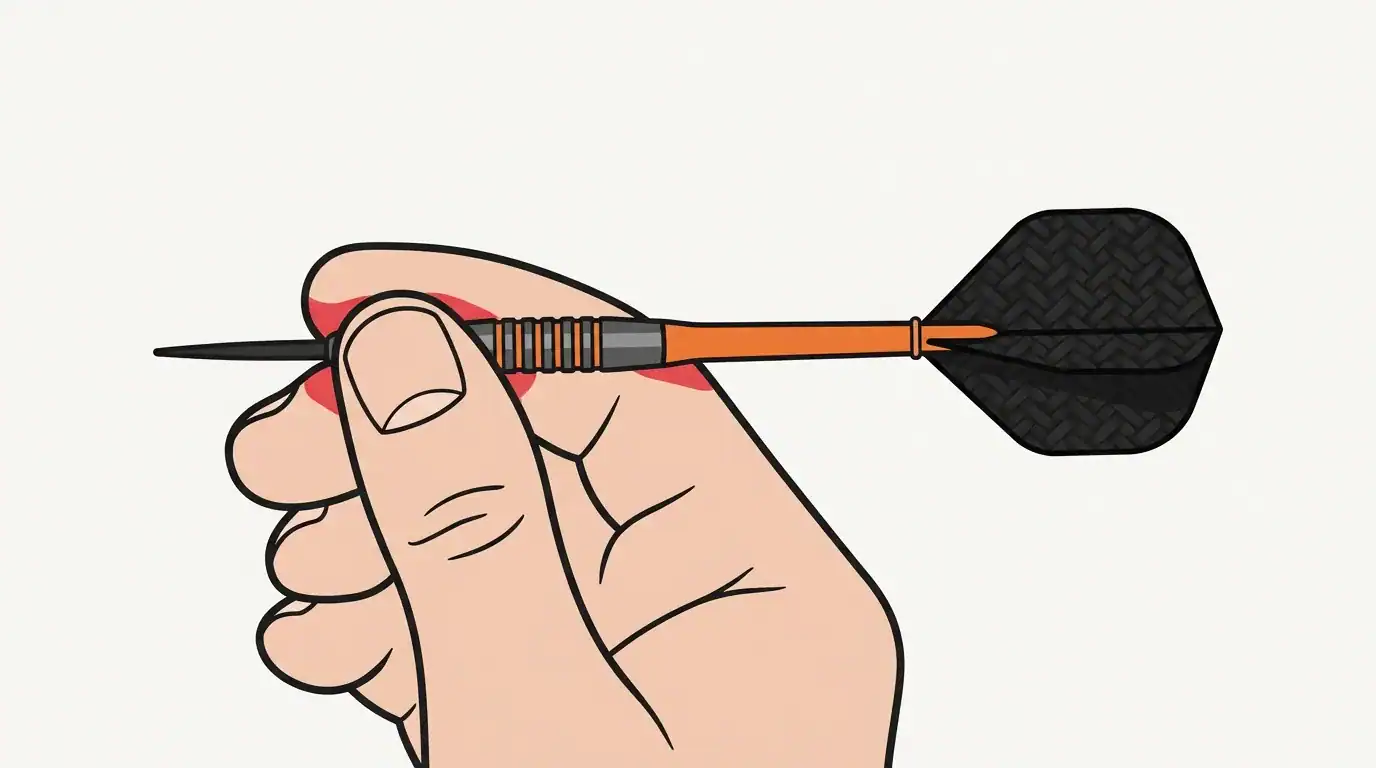
The simplest way to find your natural position: balance the dart on your open palm, roll it to your fingertips, and grip where it lands. That’s your starting point. You’ll drift forward or backward over weeks of practice, and that drift is fine – it’s your throw finding its rhythm.
How Does Phil Taylor Hold His Dart?
Phil Taylor uses a pencil grip with two fingers and a thumb on a 26g straight-barrel Target dart. His thumb sits underneath, slightly behind the centre of gravity. Index finger on top. Middle finger provides light side support. The ring and pinky fingers stay completely clear of the barrel.
What makes Taylor’s grip distinctive is how far forward he holds the barrel – closer to the point than most players. Combined with his flat, fast throwing arc, the dart reaches the board with minimal time in the air. Less air time means less chance for error to accumulate.
It’s a grip built for precision over power. Taylor’s straight barrel has no scallops, no rings, no forced finger positions – just a uniform cylinder that lets the pencil grip sit anywhere along its length. That simplicity delivered 16 World Championship titles, 16 World Grand Prix titles, and 85 major tournament wins across a 30-year career. Dennis Priestley used a similar approach with a thicker barrel and even fewer finger contact points. Eric Bristow went the other direction – his pinky finger rested near the point, adding a fourth contact for extra forward drive on a long, thin barrel.
SCOUT’S TAKE
Don’t copy Taylor’s grip because he’s Phil Taylor. Copy it because the pencil grip is mechanically the simplest – fewest fingers, cleanest release, works on any barrel. If you’re starting out, it’s the lowest-risk choice. You can always add fingers later. Taking them away is harder.
What Are the Most Common Grip Mistakes?
1
Death Grip
Squeezing the barrel so hard your knuckles turn white. Causes forearm tension, late release, and darts spraying left and right.
2
Curled Pinky
Pressing your little finger into the barrel or curling it into your palm. Creates asymmetric tension that pulls the dart off-line during release.
3
Gripping the Shaft
Fingers touching the shaft or flight instead of the barrel. You lose all directional control and the dart wobbles through the air.
A fourth mistake is changing your grip between throws. Every dart in a set of three should leave your hand from the same finger positions, with the same pressure, at the same barrel location. Inconsistency here is the single biggest cause of grouping problems. If your first dart hits treble 20 but the second and third land in single 1 and single 5, your grip is shifting between throws.
How to Build Grip Muscle Memory
OFF-BOARD TRAINING
You don’t need a dartboard to train your grip.
Keep a dart on your desk or sofa. Pick it up during TV ad breaks, phone calls, or waiting for the kettle. The goal is 50-100 pick-up-and-grip repetitions per day. Within two weeks your fingers will find the same position every time without thinking about it.
Here’s a structured drill that works. Hold the dart in your throwing grip. Close your eyes. Put the dart down on the table. Pick it up again without looking. Check if your fingers landed in the same position. Repeat 20 times. When you can pick up the dart blind and hit the same grip position 18 out of 20, your muscle memory is locked in.
Another approach: hold the dart at arm’s length in your grip, then slowly rotate your wrist left and right. If the dart stays stable between your fingers through the rotation, your pressure is correct. If it shifts or nearly drops, you’re holding too loosely. If your fingers ache after 30 seconds, too tight. This rotation test takes 10 seconds and gives you instant feedback on grip pressure without needing a board.
Watch pro matches with a dart in your hand. When you see a player throw, mimic their grip. Feel how a van Gerwen three-finger claw differs from a Taylor two-finger pencil. This isn’t about copying – it’s about understanding what different finger positions feel like so you can make informed choices about your own grip. TheDartScout’s guide to practising darts alone covers more structured solo drills beyond grip work.
Frequently Asked Questions
Does hand size affect how to hold a dart?
Not as much as barrel width. Large hands may find three or four finger grips more comfortable. Small hands often prefer the pencil grip. But a slim 6mm barrel physically cannot accommodate a palm grip regardless of hand size. Match your grip to your barrel, not your hand. Our beginner dart recommendations include grip-friendly picks for every budget.
Can I change my dart grip after years of playing?
Yes, but expect 2-4 weeks of reduced accuracy while the new motor pattern develops. Change one thing at a time – finger count first, then position, then pressure. Never change everything at once.
Why do my darts wobble even with a consistent grip?
The grip may be consistent but the release might not. The most common cause is one finger releasing late, giving the dart a sideways kick. Film your throw in slow motion and watch which finger leaves the barrel last. That finger is usually the problem.
What should I do if my hands get sweaty?
Grip wax (like Winmau Grip Wax, around 3 for a tin) solves this. Apply a thin layer to your fingertips before a session. Some players prefer chalk or a dry towel between throws. Avoid lotions – they make the barrel slippery.
Is the grip different for soft-tip vs steel-tip darts?
The grip technique is identical. Soft-tip darts are lighter (16-20g vs 22-30g for steel-tip), so you may naturally grip a touch firmer to compensate. But the finger positions, barrel placement, and pressure principles are the same.
If any term here was new, check the darts glossary. For a deeper look at the biomechanics behind each grip style, read our dart grip styles guide. To understand how barrel shape influences your grip choice, see dart barrel shapes explained. And if your grip is sorted but your throw still needs work, our accuracy guide covers stance, follow-through, and aiming technique.