QUICK ANSWER
120+ darts terms from A to W, defined the way players actually use them.
This darts glossary covers every term you’ll hear during a PDC broadcast, at your local league, or while shopping for new darts. Scoring, equipment, board anatomy, game formats, slang – all alphabetical, all in one place.
Bookmark this page. You’ll come back to it.
Darts has its own language. Watch five minutes of a PDC major and you’ll hear “tops,” “madhouse,” “big fish,” and “Shanghai” – none of which mean what you’d expect. At TheDartScout, we’ve compiled every term worth knowing into one searchable darts glossary, organised alphabetically so you can find what you need fast.
Whether you’re a beginner decoding commentary or a regular player who just heard something new at the oche, this darts glossary has you covered. We’ve included the formal definitions, the slang, and the context you actually need. And unlike flat lists elsewhere, we link directly to our TheDartScout guides where relevant so you can go deeper on any topic.
A
180 – The maximum score in a single visit. Three treble 20s (60+60+60). The crowd shouts it. The commentator shouts it. You’ll shout it too.
301 – A shorter game format starting at 301. Sometimes played with “double in” (must hit a double to start scoring). Common in American bar leagues.
501 – The standard game. Both players start on 501 and count down to zero. Must finish on a double. The format used in all PDC and WDF televised events.
9-darter – A perfect leg of 501, completed in the minimum 9 darts. The most common route is two 180s (360 total) followed by a 141 checkout (T20+T19+D12). The rarest and most celebrated achievement in darts – equivalent to a 147 break in snooker.
Anchor point – The fixed position where you draw the dart back to before throwing. Usually the cheek, chin, or eye. A consistent anchor point is the foundation of accurate throwing.
Annie’s room – Slang for double 1. Same as “madhouse.” The smallest double on the board and nobody wants to be there.
Arrows – Slang for darts. “Nice arrows” means nice set of darts or nice throwing.
B
Baby ton – A score between 95 and 99 in a single visit. Close to a ton, but not quite.
Bag of nuts – A score of 45 in a single visit.
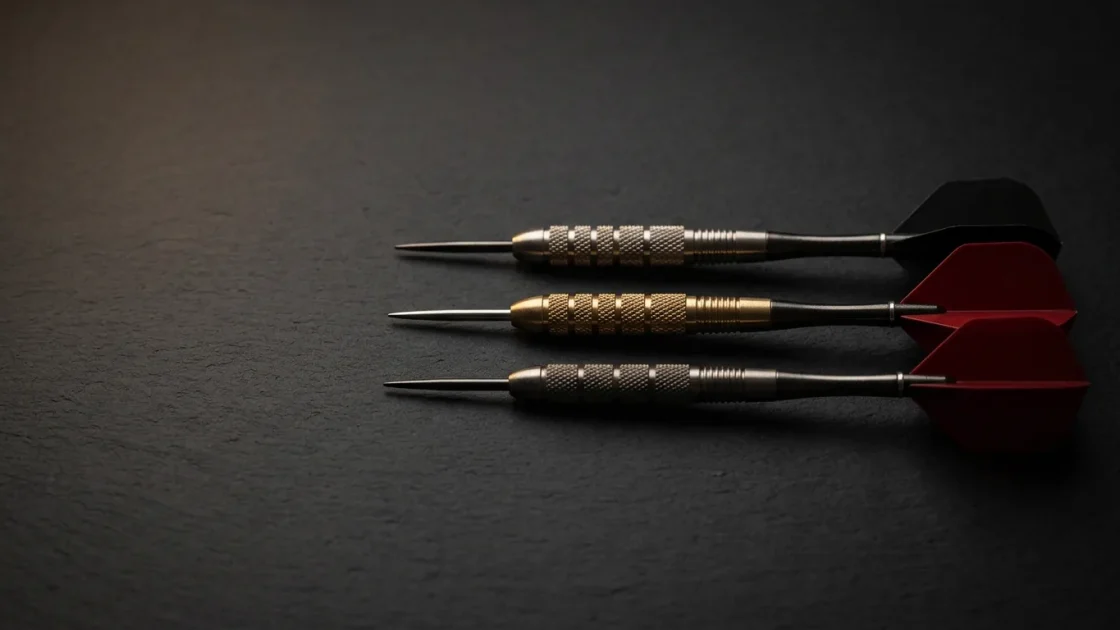
Barrel – The main body of the dart that you grip. Made from tungsten, brass, or nickel-silver. The barrel’s shape, weight, and grip pattern determine how the dart feels and flies. See our guide on dart barrel shapes.
Barrel diameter – The thickness of the barrel in millimetres. Higher tungsten percentages produce slimmer barrels at the same weight. A 90% tungsten 24g barrel is typically around 6.3mm; a 97% version might be 5.8mm.
Barrel length – Measured in millimetres. Short barrels (under 45mm) suit front grippers. Long barrels (50mm+) suit rear grippers. Most standard barrels are 48-52mm.
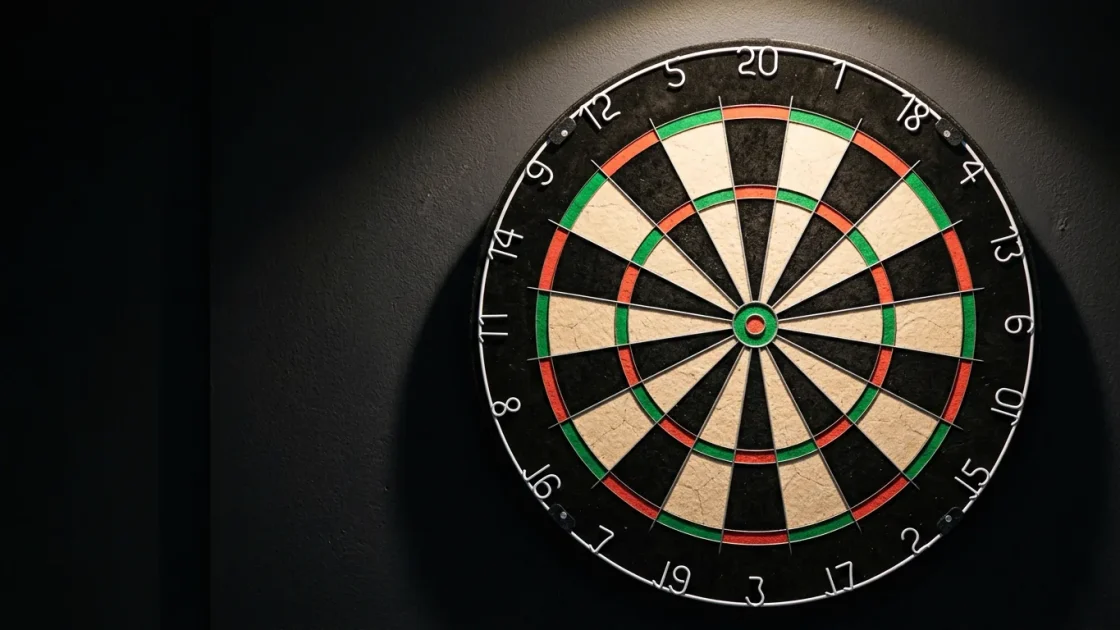
Bed – Any individual scoring area on the board. There are 82 beds in total: 20 singles, 20 doubles, 20 trebles, the outer bull, and the bullseye.
Bed and Breakfast – A score of 26, typically S1+S5+S20. Named after the old British B&B price of 2 shillings and sixpence (2/6). Also called “chips” or just “breakfast.”
Big Fish – The 170 checkout – T20, T20, bullseye. The highest possible checkout in darts. Also called a “champagne finish.”
Bogey number – A score that cannot be checked out in three darts. The seven bogey numbers are 159, 162, 163, 165, 166, 168, and 169. Our checkout calculator suggests the best setup shot when you’re on one.
Bomb barrel – A short, front-loaded barrel shape. Concentrates mass near the point. Self-correcting in flight – the dart naturally drops nose-first. Suits lobbed throwing styles.
Bounce out – When a dart hits the wire or a flat surface and bounces off the board. Does not score. Thinner wires and movable point systems reduce bounce-outs.
Brass – A cheaper, less dense metal used in budget darts. Brass barrels are fatter than tungsten at the same weight, which can make tight grouping harder. See tungsten vs brass darts.
Break of throw – Winning a leg when your opponent threw first. Similar to breaking serve in tennis. A sign of dominance.
Bucket of nails – A poor grouping where darts are scattered all over the board. The opposite of tight arrows.
Bull / Outer bull / 25 – The ring surrounding the bullseye. Worth 25 points. Does not count as a double in standard rules.
Bullseye – The small circle at the centre of the board. Worth 50 points. Also called the “inner bull” or “double bull.” Counts as a double for checkout purposes.
Bull-up – Both players throw one dart at the bull to decide who throws first. Closest to the centre goes first. Also called “middle for diddle” or “diddle for middle.”
Bust / Busted – When a player scores more than their remaining total, reaches exactly 1, or hits zero without finishing on a double. The score reverts to what it was before that visit.
KEY TAKEAWAY
The seven bogey numbers (159, 162, 163, 165, 166, 168, 169) are worth memorising. If you’re on one, don’t aim for a checkout – aim to leave a clean number like 40 (tops) or 32 (D16) for your next visit.
C
Caller / Scorer – The person who announces scores during a match. In PDC events, callers like Russ Bray (“The Voice”) are famous for their distinctive calls of “one hundred and eighty!”
Case / Wallet – A protective carrier for your darts and accessories. Ranges from simple nylon wallets to rigid aluminium boxes.
Centre of gravity (CoG) – The balance point of the dart. Where you grip relative to the CoG affects the dart’s flight arc and stability.
Champagne finish – A 170 checkout. Same as Big Fish. Used by commentators to mark the occasion.
Checkout – The final dart of a leg, which must land in a double (or bullseye) to win. Also refers to the remaining score that can be finished. Use our checkout calculator to find the optimal route.
Checkout chart – A reference showing the best route to finish any score from 2 to 170. Most players memorise the common ones.
Checkout percentage – The percentage of double attempts that are successful. A 40%+ checkout percentage is considered strong at professional level.
Clean finish – Checking out exactly as planned – hitting the intended route without needing to scramble or use a cover shot.
Clickety-click – A score of 66. From bingo calling.
Conversion kit – A set of soft-tip points that screw into steel-tip barrels, letting you use the same darts on electronic boards.
Cover shot – A deliberate miss aimed at a useful number. D16 covers well because missing into S16 leaves D8, which covers to D4, then D2, then D1. The most underrated concept in darts.
Cricket – A game focused on numbers 15-20 and the bull. Players must “close” each number by hitting it three times. Popular in the US and Asia.
D
Dart at a double – Any attempt to hit a double to finish a leg. “He’s had 12 darts at a double” means 12 attempts to check out without success.
Dartitis – A psychological condition where a player physically cannot release the dart. The yips of darts. Notable sufferers include Eric Bristow and Mensur Suljovic.
Deflection – When a dart hits another dart already in the board and is pushed off course. Can work for or against you.
Double – The narrow outer ring of the board. Worth twice the number’s face value. Required to finish in most game formats.
Double in – A rule variant where a player must hit a double before they can start scoring. Not used in standard PDC/WDF 501.
Double out – The standard rule: you must finish on a double to win the leg. The last dart must land in the double ring or bullseye.
Double ring – The narrow outer ring of the board. Every segment’s double lives here.
Double top – Double 20 (40 points). The most common finishing double. Also called “tops.”
Downstairs – The bottom section of the board, around the 19 and 3 segments.
Dramatic dart – A dart that changes the outcome of a match – a match-winning double or a crucial 180 under pressure.
BOARD DIMENSIONS
Standard dartboard: 451mm diameter, bullseye at 1.73m from the floor.
The throwing distance (oche to board face) is 2.37m for steel tip darts and 2.44m for soft tip. These measurements are standardised worldwide by the WDF and PDC.
F
Fat – Hitting the large single area instead of the treble or double you were aiming for. “Gone fat” means you missed the thin segment.
Favourite double – The double a player prefers to finish on. Most players favour D20 (tops), D16, or D10. The checkout route is often planned to leave a favourite double.
Feathers – Another name for flights. “Check your feathers” means make sure your flights aren’t damaged.
Flight – The fin at the rear of the dart that stabilises it in the air. Standard (largest), slim, kite, and pear are the most common shapes. Larger flights provide more drag and stability.
Follow-through – The motion of your arm after releasing the dart. A clean follow-through with fingers pointing at the target improves consistency.
Front-loaded – A barrel with weight concentrated near the point. Suits arc throwers and lobbed styles. See also: bomb barrel, torpedo barrel.
Frozen – When a player can’t hit their double despite repeated attempts. A mental block at the finishing line.
G
Game on – The call from the referee/caller at the start of a leg, signalling play can begin.
Game shot – The call when a player checks out and wins the leg. Often followed by “and the leg” or “and the match.”
Garden gate – Double 8 (16 points). From rhyming slang: “garden gate” = eight.
Grouping – How tightly your three darts cluster together on the board. Tight grouping means consistent throwing, even if the group isn’t on the target yet.
H
Heinz – A score of 57 in a single visit. From Heinz’s “57 varieties.”
High finish – A checkout of 100 or more. Anything that takes real skill and nerve to pull off.
Hold of throw – Winning the leg when you threw first. Expected but not guaranteed – holding throw is the baseline.
K
Killer – A pub game where each player is assigned a double. Hit your own double three times to become a “killer,” then eliminate other players by hitting their doubles.
Knurling – A textured grip pattern cut into the barrel surface. Fine knurling is subtle; aggressive knurling bites into your fingers. The most common grip type on darts.
L
Leave – The score remaining after your visit. “He’s left himself 40” means 40 points remaining, finishable on D20.
Leg – A single game of 501. Matches are made up of multiple legs. A “best of 5 legs” match means first to win 3.
Leg before wicket – A humorous term borrowed from cricket. Used when a dart hits the player’s own body before reaching the board.
Lipstick / Red bit – Slang for the treble 20 segment, which is red on a standard board.
M
Madhouse – Double 1 (2 points). Called madhouse because it’s so small it’ll drive you mad trying to hit it.
Married man’s side – The left side of the board (looking at it). When aiming at T20 and drifting left, you hit 5 and 1 – low scores. The right side (T19 territory) is more forgiving.
Match dart – A dart that, if it lands, wins the entire match. Not just the leg or set – the whole match.
Maximum – Another name for a 180. Three treble 20s. The highest possible three-dart score.
Micro grip – Very fine texture cut into the barrel surface. Less aggressive than full knurling but still provides purchase. Suits players who prefer a clean release.
Middle for diddle – Both players throw one dart at the bull to decide who throws first. Closest to the centre goes first. Also called “bull-up.”
Movable point – A point system where the tip retracts slightly on impact, reducing bounce-outs. Used in premium darts (e.g. Winmau Vecta Point, Unicorn Volute Point).
Mugs away – The loser of the previous leg throws first in the next one. Standard in most pub and league darts.
N
Nelson – A score of 111. From Admiral Nelson – one eye, one arm, one leg (1-1-1). Borrowed from cricket scoring.
Number ring – The removable wire ring around the outside of the board that holds the numbers 1-20. Can be rotated to spread wear evenly across the board.
SCOUT’S TAKE
The cover shot is the most underrated concept in this glossary. D16 is popular for a reason – missing inside gives you S16, leaving D8. Miss that inside and you’re on S8, leaving D4. That’s three attempts at a double from one starting position. If you only learn one tactical term from this page, learn the D16 cover chain.
O
O-ring – A small rubber ring placed between the barrel and shaft to prevent the shaft from loosening during play.
Oche – The line behind which a player must stand when throwing. Pronounced “OCK-ee.” The front edge is 2.37m from the board face for steel tip. Stepping over the oche is a foul.
Outer bull – See “Bull / Outer bull / 25.”
P
PDC – Professional Darts Corporation. The world’s premier darts organisation, running the World Championship, Premier League, World Matchplay, and more. Founded in 1992.
Pie – A full numbered wedge of the board, including its single, double, and treble sections.
Point / Tip – The sharp front end of the dart. Fixed points are permanent. Movable point systems (Swiss Point, Vecta Point, Quick Point) let you swap points without tools.
PVD coating – Physical Vapour Deposition – a coating applied to some barrels for colour and grip texture. Black, gold, and rainbow PVD coatings are common.
R
Radial grip – Grip lines cut across the barrel width rather than along its length. Creates a subtle “speed bump” feel under your fingers.
Rear-loaded – A barrel with weight concentrated near the back. Suits flat, powerful throwers who grip near the rear of the dart.
Release point – The exact moment the dart leaves your fingers. Earlier release = higher arc. Later release = flatter trajectory.
Right church, wrong pew – Hitting the right number but the wrong section – for example, hitting single 20 when aiming for double 20.
Ring grip – Concentric grooves cut around the barrel. Gives a consistent feel regardless of where you place your fingers.
Robin Hood – When a dart embeds itself in the shaft or flight of a dart already on the board. Looks impressive but doesn’t score – the dart isn’t in the board. Ruins shafts and flights.
Round the World – A practice game where you must hit each number 1-20 in order, then the bull. Good for beginners learning the board layout. Also called “round the clock.”
S
Scallop – Concave indentations cut into the barrel that guide your fingers into the same position every throw. Popular with players who want repeatable grip placement.
Scoring power – A player’s ability to hit consistent high scores. “Serious scoring power” means regularly hitting 140s and 180s.
Segment – See “Bed.”
Set – A group of legs. In the PDC World Championship, a set is best of 5 legs. Not all tournaments use sets – many are legs-only.
Setup shot – A dart thrown deliberately to leave a specific checkout for your next visit when you can’t finish in the current turn.
Shaft / Stem – The piece connecting barrel to flight. Available in short, medium, and long. Longer shafts add stability but increase overall dart length.
Shanghai – Hitting a single, treble, and double of the same number in one visit. In the game “Shanghai,” this is an instant win.
Shark grip / Shark cut – Angled grooves cut into the barrel that catch your fingers in one direction. Provides aggressive grip for players who want maximum purchase.
Single – The large scoring area of any number on the board. Worth face value (1-20 points).
Sisal / Bristle – The compressed sisal fibre that makes up the playing surface of a quality dartboard. Self-healing – the fibres close up after you pull your dart out.
Slop – A lucky dart that lands in a high-scoring area by accident.
Spider / Wire – The metal dividers separating each segment. Thinner wires mean fewer bounce-outs. Premium boards use “blade” wire systems as thin as 0.5mm.
Stacking – When darts land so close together they’re physically touching or resting on each other. Good stacking in the treble 20 means tight grouping.
Stance – How you position your body at the oche. Front-facing, side-on, and angled are the three main stances. Most PDC pros use an angled stance with their dominant foot forward.
Staple-free – A board where the wire is embedded directly into the sisal without staples. Reduces bounce-outs at the bull and segment edges.
Straight barrel – A barrel with no taper – same diameter from front to back. Even weight distribution. The most common barrel shape.
Straight in – No requirement to hit a double before scoring begins. Standard in PDC 501.
Surround / Catchring – The protective ring placed around the dartboard to catch stray darts and protect the wall.
Swiss Point – Target’s interchangeable point system. Points screw in and out, letting you swap between different lengths and styles without changing the barrel.
T
Three in a bed – All three darts landing in the same segment. Three treble 20s for a 180 is the most celebrated example.
Three-dart average – The average score per visit. Total points scored divided by darts thrown, multiplied by 3. A 100+ average is elite. Luke Littler averaged 102 in his 2025 World Championship final win over Michael van Gerwen.
Titanium nitride – A hard coating applied to premium barrels. Adds a distinctive gold/black colour and reduces surface wear.
Ton – Any score of 100 or more in a single visit.
Ton-40 – A score of 140. Usually T20+T20+S20. A common strong visit.
Ton-60 – A score of 160. The third-highest possible visit (T20+T20+D20). Also a common checkout route.
Ton-80 – A score of 180. See “180.”
Tops – Double 20 (40 points). The most popular finishing double in the game.
Torpedo barrel – A barrel that tapers from wider to narrower. Shifts the centre of gravity depending on direction.
Treble – The narrow inner ring, roughly halfway between bull and outer edge. Worth three times face value. Treble 20 (60) is the highest single-dart score.
Treble ring – The narrow inner ring where all treble segments sit.
Trombones – A score of 76. From “76 Trombones” (The Music Man).
Tungsten – The metal used in quality dart barrels. Measured by percentage (80%, 90%, 95%, 97%). Higher tungsten = slimmer barrel at the same weight. Most PDC players use 90-95%. See tungsten vs brass darts and how to choose dart weight.
U
Upstairs – The top section of the board, around the 20 segment. “He’s going upstairs” means aiming at the treble 20 area.
V
Visit / Turn – Your go at the oche. Each visit consists of up to three darts.
W
WDF – World Darts Federation. The international governing body, organising the Lakeside World Championship and grassroots darts worldwide. Took over from the BDO in 2020.
Wet feet – Standing too close to the oche or with feet over the line. A foul in competitive play.
Wiring – When a dart hits the wire dividing two segments. Usually a near-miss. “Wired the double” means you just missed the finishing segment.
“One hundred and eighty!” – the most famous two words in darts, shouted by callers and crowds every time a player lands three treble 20s. It never gets old.
How many terms are there in darts?
There are well over 100 established darts terms covering scoring, equipment, board anatomy, game formats, throwing technique, and slang. This darts glossary covers the most important ones. The Wikipedia glossary of darts lists even more obscure regional terms.
What does “oche” mean and how do you pronounce it?
The oche (pronounced “OCK-ee”) is the throwing line. The front edge must be 2.37 metres (7 feet 9.25 inches) from the face of the board for steel tip darts. The origin of the word is debated – it may come from the Old English for a notch or groove.
What are the bogey numbers in darts?
The bogey numbers are 159, 162, 163, 165, 166, 168, and 169. These cannot be checked out in three darts because no combination of three darts (where the last must be a double) adds up to these totals. Use a setup shot to leave a finishable score.
What is a 9-darter in darts?
A 9-darter is a perfect leg of 501 completed in 9 darts. The most common route is two rounds of 180 followed by a 141 checkout (T20+T19+D12).
What does “bust” mean in darts?
A bust occurs when you score more than your remaining total, reach exactly 1, or hit zero without your final dart landing in a double. Your score reverts to the start of that visit.
Found a term that’s missing? Let us know and we’ll add it. Ready to put your knowledge into practice? Try our checkout calculator for the best route on any score, or take the dart recommendation quiz to find darts that match your throw. For more guides, see dart barrel shapes, how to choose dart weight, and tungsten vs brass darts.