After the stopper closes all numbers (or both players agree to end the round), you swap roles. Highest scorer across both rounds wins. A typical game takes 10-15 minutes.

The stopper’s strategy is to close the high-value segments first (20, 19, 18) while the scorer races to pile up points before they disappear. The scorer’s strategy: hammer treble 20 while it’s open, then drop to treble 19, then treble 18. The game becomes a frantic race between closing and scoring, and both roles are equally fun.

Noughts and Crosses (Tic-Tac-Toe on a dartboard) is the most fun two-player casual game. Draw a 3×3 grid on paper or a whiteboard. Fill each square with a board segment – a common setup is:

122018
11Bull16
81419

Players take turns throwing 3 darts. Hit a segment to claim that square. Three in a row wins. The bullseye in the centre is the hardest square to claim but also the most powerful – it connects to 4 lines. The strategy is identical to regular noughts and crosses (take the centre, then the corners) but your ability to execute depends on whether you can actually hit the segment you’re aiming at. That gap between strategy and execution is what makes it brilliant for two players of different skill levels.

Legs is the tournament format – best of 5, 7, 9, or 11 legs of 501. The first player to win the majority wins the match. This is how the PDC structures every televised event. At pub level, best of 5 legs takes 30-40 minutes between two average players. Best of 7 takes 45-60 minutes. For a proper match feel without the time commitment of a full PDC-style set, best of 5 is the sweet spot.

Tennis (described in the advanced section below) is the best option for two experienced players who want something that lasts a full evening. It simulates a tennis match with games, sets, and match points, and it demands consistent scoring across dozens of mini-rounds.

Scram doesn’t get the attention it deserves. If you’ve never played it, try it tonight. Two completely different roles, both equally fun, and the game is over in 15 minutes.

The Best Games for Parties and Groups

Three or more players, probably some drinks involved, and you need a game where everyone stays engaged even when it’s not their turn. These dart games solve that problem.

THE PARTY STARTER

Start with Killer. Always.

If you have 4+ people and a dartboard, Killer is the answer. The non-dominant-hand number selection gets everyone laughing before a single competitive dart is thrown. The elimination format keeps tension high. And the “attack anyone you want” mechanic creates alliances, betrayals, and grudge matches that fuel the entire night.

Shanghai works well after Killer. The format is simple: aim at the round number. And the instant-win Shanghai possibility keeps everyone watching even when it’s not their turn.

Sudden Death is the quickest elimination game. Each round, every player throws 3 darts. The player with the lowest score is eliminated. Last person standing wins. With 4 players, the game is over in 3 rounds (5-8 minutes). With 8 players, it’s 7 rounds but still under 20 minutes because each round is just one throw per person. The elimination format keeps everyone watching because you’re only one bad round from going home. And unlike Killer where you can avoid attention by staying quiet, Sudden Death has nowhere to hide – your score is public every round.

Halve-It raises the stakes. Before the game, agree on a list of targets – a good sequence is: 20, 19, 18, any double, treble 20, 17, 16, any treble, 15, bullseye. Each round, everyone throws 3 darts at that round’s target. Hit it at least once and add the score. Miss all three and your total score is halved.

The swings are brutal. A player sitting on 200 can drop to 100 in one bad round. A player on 50 who hits treble 20 jumps to 110. Nobody is safe, nobody is out of it, and every round feels like a final. TheDartScout considers Halve-It the best dart game for groups of competitive players who want pressure without elimination.

Halve-It strategy: Don’t aim for maximums early. Just hit the target once per round to avoid the halving. Build a safe score, then take risks in the treble and bullseye rounds when the potential reward justifies the risk. The player who avoids being halved usually wins, even if their total score per round is modest.

A common Halve-It sequence for intermediate players: 20, 19, 18, any double, treble 20, 17, 16, any treble, 15, bullseye. That’s 10 rounds. For beginners, drop the treble 20 and bullseye rounds – replace them with “any single in the top half” and “outer bull.” For advanced players, make it harder: specific doubles (double 16, double 8), specific trebles (treble 19, treble 18), and finish with inner bull only. The flexibility of Halve-It is its greatest strength. You can calibrate the difficulty to any group by changing the target list.

Cutthroat Cricket is cricket for 3+ players where the twist is that you SCORE ON YOUR OPPONENTS. Close a number, and your subsequent hits add points to everyone else’s score. Lowest score wins. This inverts the normal cricket strategy and creates a constantly shifting landscape of alliances.

Drinking darts rules (house rules)

Any dart game becomes a drinking game with a few additions. The most common house rules:

Miss the board entirely: drink. Hit a 1 or a 5 (the “rubbish” segments next to 20): drink. Hit a bullseye: choose someone else to drink. Bust in 501 (go over zero): drink. Get eliminated in Killer: finish your drink. These work with any game. Calibrate to your group’s tolerance.

For the home setup to make this work, see our home darts setup guide.

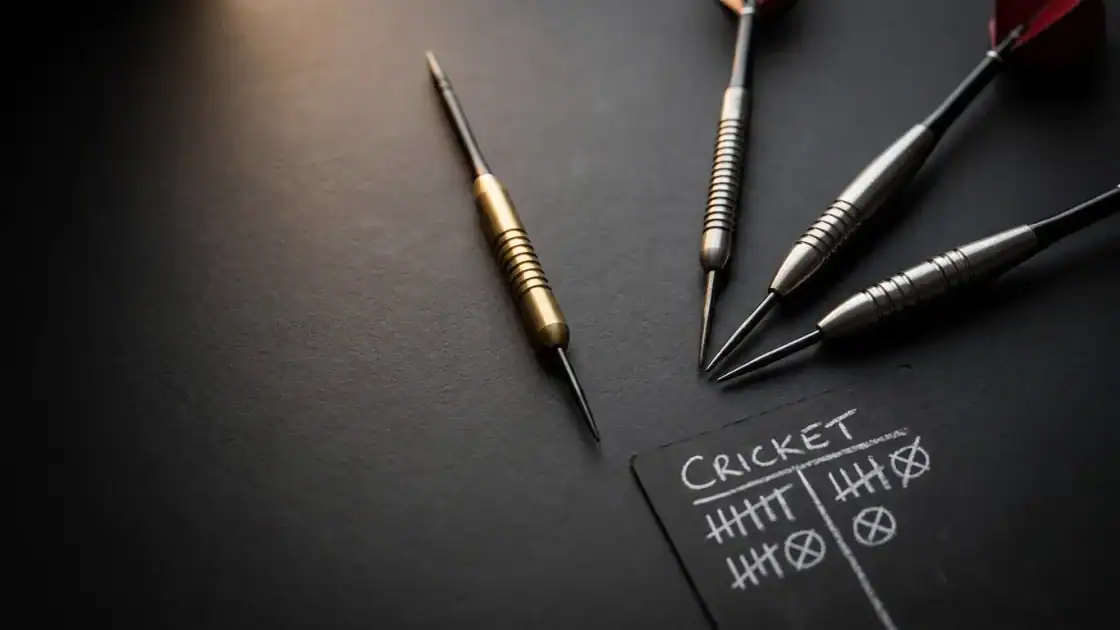
Chalkboard cricket scorer next to a dartboard in a warm pub setting

Solo Dart Games and Practice Games

You’re alone, you have a board, and you want something more structured than aimlessly throwing at treble 20. These games track your progress and expose your weaknesses.

Bob’s 27

The best solo dart game ever invented. Created by Bob Anderson, former world champion. Start with 27 points. Throw 3 darts at double 1. Hit at least one? Add the double’s value (2) to your score for each hit. Miss all three? Subtract the double’s value (2). Move to double 2. Then double 3. All the way to double 20, then the bullseye.

Your score swings wildly. Hit two double 18s and you’re up 36 points. Miss all three at double 19 and you lose 38 points. A good score is anything positive. A great score is above 200. Tour-level players score 400+. Most pub players go negative before reaching double 10.

Bob’s 27 is the single best measure of your doubles ability. Track your score weekly and you’ll see improvement faster than with any other practice method.

121 Checkout Practice

Start at 121. You have 3 darts to check it out (treble 17, treble 10, double 16 is the standard route). Miss? Back to 121 and try again. Hit it? Move to 122. Or pick random starting numbers between 41 and 170 for variety.

This is targeted practice for the skill that wins matches: finishing. Pair it with our checkout strategy guide to learn WHY certain routes are better than others, or use the checkout calculator for instant route lookup.

Around the Clock (timed)

The same game as the group version, but against a stopwatch. Record how long it takes to complete 1-20 plus bull. Track your time across sessions. Sub-10 minutes is solid for a pub player. Sub-5 minutes is competitive level.

Structured practice sessions using dart games

The mistake most players make is picking one practice game and grinding it for an hour. That’s how you build frustration, not skill. A better approach: rotate between games that target different weaknesses in 15-20 minute blocks.

1

Warm Up (10 min)

Around the Clock or High Score. Get your arm loose. Don’t aim for perfection – aim for rhythm.

2

Weakness Drill (20 min)

Bob’s 27 for doubles. Chase the Dragon for trebles. 121 Checkout for finishing. Pick the one you’re worst at.

3

Match Play (20 min)

Solo legs of 501 counting your darts-per-leg average. This simulates the pressure of a real game.

Track your scores. Write down your Bob’s 27 total, your Around the Clock time, and your darts-per-leg in 501 after every session. A spreadsheet works. A notebook works. The DartCounter app works. What doesn’t work is playing without recording anything and hoping you’ll magically improve. Numbers don’t lie – if your Bob’s 27 score hasn’t increased in three weeks, you need to change something about your doubles technique, not just play more Bob’s 27.

For more structured solo practice routines and drills, see our guide to practising darts alone.

Close-up of a tungsten dart embedded in a double segment on a bristle dartboard

Short on Time? These Finish in Under 10 Minutes

Short on time? These games fit into a lunch break, a warmup, or the gap between arriving at the pub and your league match starting.

2 min

Nearest the Bull

One dart each. Closest to the bullseye wins. Used to decide who throws first in competitive matches. Also a decent bet game.

5 min

High Score

3 rounds, 3 darts each. Highest single-round total wins. No strategy, no rules to learn. Pure throwing.

5-10 min

301

Half the length of 501. Must double-in and double-out. Faster-paced, more double pressure. The warmup game of choice for league players.

Sudden Death (described in the party section) also fits here – with 3-4 players, games can finish in 5-8 minutes since someone is eliminated every round.

Advanced and Unusual Dart Games

These games are for players who’ve exhausted the standard options and want something different. Most are harder than they sound.

Chase the Dragon

Hit treble 10, then treble 11, then treble 12 – all the way to treble 20, then outer bullseye, then inner bullseye. In sequence. Three darts per turn. First to complete the sequence wins. Sounds straightforward. It’s brutal. The treble beds are roughly 8mm wide and you have to hit 13 of them in order. Most pub players can’t finish this game in under 30 minutes.

Strategy: The treble segments from 10-14 are the hardest for most players because they’re in unfamiliar board positions. Trebles 15-20 are in more natural throwing zones, so the game usually speeds up after the halfway point. The real bottleneck is the bullseye finish – even after hitting 11 trebles, many players spend 5-10 turns trying to land the outer then inner bull. If you can hit the bullseye consistently, you’ll win Chase the Dragon games against players with better treble accuracy.

Golf

18 “holes” (usually segments 1-18). Each hole, throw 3 darts at the target segment. Scoring works like real golf but in reverse: treble = 1 (birdie), double = 2 (par), single = 3 (bogey), big single (outer ring) = 4 (double bogey), miss = 5 (triple bogey). Lowest total after 18 holes wins.

A decent score is under 54 (par). Under 45 is genuinely good. Sub-36 means you’re hitting mostly trebles and doubles – tour-level accuracy. The game takes 20-30 minutes and it’s surprisingly engaging because every hole has its own character. The 12 and 20 segments feel easy from most throwing angles. The 6 and 14 feel like they’re in another postcode. You’ll discover board geography you never noticed in 501.

Strategy: Don’t aim for the treble on every hole. Aim for the fat single to guarantee a 3 and avoid the 5. Only go for trebles on segments you’re confident hitting. One triple bogey (5) wipes out two birdies (1+1). Consistency beats ambition in Golf.

Baseball

Nine innings. In inning 1, aim at the 1 segment. Inning 2, the 2 segment. Through to 9. Singles score 1 run, doubles 2, trebles 3. Highest total runs after 9 innings wins. Tied? Extra innings on segments 10, 11, 12 until someone pulls ahead.

Baseball is huge in the USA, particularly on electronic boards where the scoring is automatic. The game has a natural rhythm: innings 1-5 are low-scoring warmups (even a treble 3 only scores 9 runs) while innings 6-9 decide the outcome. A treble 9 in the final inning scores 27 runs and can flip the entire game.

Strategy: Save your concentration for innings 7-9. The maths is simple – inning 9 is worth 3x inning 3 per hit. A mediocre first five innings followed by a strong finish beats a hot start that fizzles. Also consider that inning 7 is right next to treble 20 on the board – if you’re comfortable with your T20 line, inning 7 is your best scoring opportunity.

Tennis

Simulates a tennis match on the dartboard. Each “point” is decided by who scores highest with 3 darts. Points follow tennis scoring: 15, 30, 40, game. Deuce at 40-40 requires a 2-point lead. First to 6 games wins a set. First to 2 sets wins the match.

Tennis is the marathon of dart games. A full match between two evenly matched players can last 60-90 minutes and feature 50+ mini-rounds. The format rewards consistency over one-off brilliance because a single high score only wins one point. You need to win roughly 24 points to take a straight-sets match. That’s 72 darts minimum where every throw matters.

The “serve” mechanic adds another layer. The serving player throws first each point, which is a slight disadvantage because the returner knows what score they need to beat. In real tennis, serving is an advantage. In dart tennis, it’s the opposite. Holding serve (winning your service game) means consistently outscoring your opponent even when they throw second with knowledge of your total. Breaking serve is easier than in real tennis, which makes the game feel closer and more dramatic.

Prisoner

A race game with a capture mechanic. Players move around the board hitting segments in sequence (1, 2, 3, etc.) but if two players land on the same segment, the second player “captures” the first and sends them back to segment 1. First to reach 20 and then hit the bullseye wins.

Think Sorry! on a dartboard. The capture mechanic means nobody is safe regardless of their position. A player on segment 18 can get sent back to 1 if someone lands on their spot. This creates an interesting strategic choice: do you rush ahead and risk being an isolated target, or do you hang back in a crowd where captures are more chaotic? With 3-5 players, games last 15-20 minutes and produce more dramatic reversals than any other group dart game on this list.

For board setup and the official regulations behind all these dart games, the PDC official rules page covers the competitive formats. For casual games, house rules are king.

Extreme close-up of the treble 20 bed showing sisal fibre texture and wire dividers

How Does Scoring Work Across Different Dart Games?

One reason dart games feel confusing to newcomers is that different games use completely different scoring systems. Understanding the six main types makes every game on this list click faster.

SCORING SYSTEMS

Six ways to keep score in darts.

Every dart game uses one of these systems. Learn all six and you can pick up any new game in seconds.

Subtraction (countdown). Start with a number. Subtract your score each turn. Reach exactly zero. This is 501, 301, 701, and every “01” variant. The catch: you must finish on a double (or bullseye in most rulesets). If your remaining score drops below 2, or you go past zero, your turn is “bust” and your score resets to what it was before that turn. This is the most common scoring system in competitive darts and the reason checkout calculations matter.

Addition (accumulation). Throw darts. Add up what you hit. Highest total wins. Count-Up, High Score, and the scoring phase of Baseball all use this. It’s the simplest system and the best for beginners because every dart that hits the board contributes something positive.

Closing and marks (territory). Hit a number a set number of times to “own” it. Cricket is the prime example – 3 marks (hits) to close a number, then score on it until your opponent closes it too. This system creates strategic depth because you’re choosing between expanding your territory and defending against your opponent’s scoring.

Elimination (lives). Start with a set number of lives. Lose them through specific actions. Last player standing wins. Killer uses this – you lose a life when an opponent hits your double. Sudden Death eliminates the lowest scorer each round. These systems keep late-game tension high because every dart could end your game.

Sequential (progression). Hit targets in a specific order. Can’t advance until you’ve hit the current one. Around the Clock (1-20-bull), Chase the Dragon (trebles 10-20-bull), and the numbered rounds of Shanghai all use this. Sequential games test your ability to aim at specific segments rather than just maximising your score.

Risk-reward (halving/penalty). Hit the target and gain points. Miss completely and lose points (or have your score halved). Bob’s 27 and Halve-It both use this system. The tension comes from the asymmetric risk – a miss in Halve-It can cost you 200 points while a hit only gains 40. These games test your nerve as much as your accuracy, which is why they’re brilliant practice for competitive darts where pressure is constant.

KEY TAKEAWAY

Most confusion about dart games comes from mixing up the scoring systems. Once you know whether a game is subtraction, addition, closing, elimination, sequential, or risk-reward, the rules make sense immediately.

What Do You Need to Play?

Every game on this list works on a standard bristle dartboard with steel tip darts. You don’t need special equipment for any of them. A board, a set of darts, and something to keep score (phone, chalkboard, or a scrap of paper) covers every game.

For scoring, a phone app like DartCounter or My Dart Training handles 501, cricket, and most standard formats automatically. DartCounter is free and covers over 15 game modes. For casual dart games like Killer, Shanghai, or Halve-It, a whiteboard or a notepad works better because the scoring is game-specific and most apps don’t support them natively. Some players use a chalkboard scorer mounted next to the board – they cost around £15 (~$19) and add pub atmosphere to a home setup.

If you’re setting up a board for the first time, the throwing distance is 2.37 metres from the board face (7 feet 9.25 inches) and the bullseye height is 1.73 metres (5 feet 8 inches) from the floor. Get these right and every dart game on this list plays properly. For the full setup guide, see how to set up a dartboard.

For dart recommendations by skill level and budget, see our dart weight guide. For board options, see how to choose a dartboard.

Three darts clustered near the bullseye of a well-used bristle dartboard under warm light

Most dart games have house-rule variations that change the game meaningfully. These are the ones TheDartScout hears about most.

Double-In 501 (301 style)

Must hit a double before your score starts counting down. Common in American pub leagues and all standard 301 games. Adds 2-3 turns to the opening phase. Tests your doubles from the very first dart rather than saving that pressure for the finish.

Cutthroat Cricket

For 3+ players. Once you close a number, your hits score on ALL other players’ totals. Lowest score wins. Completely inverts the strategy. You want to close numbers fast to stop scoring on yourself, but you also want to pile points on whoever’s in the lead.

Blind Killer

Everyone’s number is secret. Hit a double and someone loses a life – but you don’t know whose. The room erupts every time. Nobody knows who to target, who to trust, or who just assassinated them. Best party variation of any dart game.

Doubles Around the Clock

Hit double 1, then double 2, then double 3 – all the way to double 20 plus bull. The difficulty jumps massively. Even good players take 30+ minutes. It’s one of the best doubles practice games and it exposes weaknesses on specific doubles you’d never notice in 501.

No-score cricket strips away the point-scoring element entirely. First player to close all 7 numbers (15-20 plus bull) wins. No scoring on opponents, no maths, just close faster. It’s quicker than standard cricket and works better for beginners who find the scoring mechanic confusing.

Handicap 501 lets mixed-skill groups play competitive 501. The weaker player starts at 301, the stronger player starts at 501 (or 601). Adjust the handicap until games are close. This is common in pub leagues where a county-level player might face a casual once-a-week thrower. It keeps both players engaged because the finish is competitive even if the skill gap is wide.

Master Out (double/treble only). In this 501 variation, you must finish on a double OR a treble. Treble 20 finishes 60, treble 19 finishes 57, and so on. This opens up far more checkout routes and rewards players who can hit trebles under pressure. Some Asian leagues use master out as standard. It’s worth trying if you find standard double-out too restrictive.

Which Games Help You Improve Fastest?

Not all dart games are equal for improvement. Some are pure fun. Some actively build skills. And a few do both – which is exactly what you want for practice sessions that don’t feel like a chore.

The key insight is that each game trains a different skill. If you only play 501, you’ll develop scoring and checkout ability but your board coverage (aiming at segments other than treble 20) will stay weak. If you only play Cricket, your strategy will sharpen but your raw scoring won’t improve because cricket doesn’t reward maximising every throw. The best players rotate between dart games that target their weakest areas.

Here’s what each game trains and why it works:

SkillBest gameWhy it works
Doubles accuracyBob’s 27Every dart is aimed at a double. Your score directly reflects your doubles ability.
Board coverageAround the ClockForces you to aim at all 20 segments, not just treble 20.
Checkout finishing121 Checkout PracticeSimulates the pressure moment of finishing a leg.
Scoring consistency501 (solo legs)Tracks your average per visit over full legs.
Pressure handlingHalve-ItOne bad round halves your score. Teaches you to perform when it matters.
Strategic thinkingCricketEvery round requires decisions about closing vs scoring.
Treble accuracyChase the Dragon13 trebles in sequence. The hardest accuracy drill disguised as a game.

The pattern is clear: games that punish failure (Bob’s 27, Halve-It) build mental toughness alongside physical skill. Games that force you into unfamiliar positions (Around the Clock, Chase the Dragon) expose weaknesses you didn’t know you had. And games with strategic decisions (Cricket, 501 checkout routes) develop the thinking side of darts that separates a good thrower from a good player.

TheDartScout recommends rotating between 2-3 of these dart games per week rather than playing the same one every time. A common mistake is grinding Bob’s 27 every session because you want to improve your doubles. After 10 sessions, you’ll have memorised the difficulty curve but stopped making meaningful progress. Switch to Doubles Around the Clock for a week. Your Bob’s 27 score will jump when you return because you’ve challenged your doubles from a different angle.

For a complete practice framework that combines several of these games into structured sessions, see our guide to practising darts alone.

How Do You Choose the Right Dart Game?

Three questions. That’s all you need.

?

How many players?

Solo: Bob’s 27, Around the Clock, 121. Two players: 501, Cricket, Scram. Three+: Killer, Shanghai, Sudden Death.

?

What skill level?

Beginners: Count-Up, High Score, Around the Clock. Intermediate: 501, Cricket, Killer. Advanced: Bob’s 27, Chase the Dragon, Tennis.

?

How much time?

Under 5 min: Nearest the Bull, High Score. Under 15 min: 301, Scram, Count-Up. Under 30 min: 501, Cricket, Killer, Shanghai.

And if the answer to all three is “I don’t know,” start with Killer. It works for any number of players above 2, any skill level, and any amount of time. It’s the Swiss Army knife of dart games.

What Can You Play on an Electronic Board?

All of them. Every game on this list works on both bristle and electronic dartboards. The only difference is that electronic boards handle the scoring automatically for standard games like 501 and cricket – you don’t need to calculate anything. For casual games like Killer or Shanghai, you’ll still need to keep score manually (or use a phone app) even on an electronic board because they’re not built into the software.

Some electronic boards include games you won’t find anywhere else – “count down” variants where the board assigns random targets, “elimination” modes with automatic scoring, and cricket variations with different number sets. These are fun but they’re proprietary to specific board manufacturers. The Viper, Gran Board, and Arachnid brands each have exclusive game modes that don’t translate to bristle boards. If you’re choosing between electronic and bristle, pick based on your main use case: electronic for automated scoring and house convenience, bristle for pub/league compatibility and durability. The dart games themselves are the same on either surface.

Most electronic boards come pre-loaded with 30-80 game modes, but the core dart games played worldwide are the same ones described here. The board doesn’t change the game – it just changes how you keep score. For the full comparison between board types, see our electronic vs bristle dartboard guide.

Dart Game Etiquette and Unwritten Rules

Every pub, club, and league has unwritten rules about dart games. Break them and you won’t get invited back. Here are the ones that matter.

Stand behind the oche when it’s not your turn. Never stand beside the board, beside the thrower, or anywhere in their peripheral vision. The standard position is 2-3 metres behind and to the side of the throwing line. This applies to all dart games, competitive or casual.

Don’t pull darts until both players agree on the score. In 501 and cricket, the scorer confirms the total before the thrower removes their darts from the board. Pulling darts before the score is agreed is considered poor form and, in league play, can result in the turn being voided. In casual games, just announce your score clearly before walking up to the board.

Shake hands before and after. In competitive darts – from pub league matches to PDC events – players shake hands (or fist-bump) before the first dart and after the final dart. Skip this in Killer or party dart games where the vibe is different, but for any 501 or cricket match, it’s expected.

Don’t celebrate a miss. If your opponent misses a match-winning double, stay quiet. Cheering an opponent’s miss is the fastest way to earn a reputation as someone nobody wants to play. Celebrate your own good darts, not their bad ones. This rule is taken seriously in every darts community worldwide.

Call your own busts. In 501, if you go past zero or leave a score of 1, your turn is bust and you should call it immediately. Waiting for the scorer to notice is poor etiquette. In casual dart games without a dedicated scorer, everyone is expected to track honestly. Darts is a self-policing sport. Take advantage of that trust and you’ll find yourself playing alone.

SCOUT’S TAKE

Most people know 501 and nothing else. They play the same game every time, get bored, and the dartboard collects dust. The cure is variety. Killer on a Friday night. Bob’s 27 for solo practice on Tuesday. Cricket when your mate comes over. Shanghai when the family visits. The board is the same – the games are what keep it interesting.

Three sets of tungsten darts arranged on a dark surface ready for a practice session

Frequently Asked Questions

501. It’s the standard format for all professional darts – PDC, WDF, and every organised league worldwide. If someone says “fancy a game of darts,” they mean 501 unless they specify otherwise.

What dart game do professionals play?

501 double-out in legs and sets format. A typical PDC match is best of 11 or 13 legs, with longer formats (best of 13 sets) used in major tournaments like the World Championship. Cricket is not played professionally in the UK or Europe but has professional leagues in Asia (DARTSLIVE) and the USA.

Can you play darts by yourself?

Yes. Bob’s 27 is the best solo dart game (doubles practice with scoring). Around the Clock (timed) tests your accuracy across the board. 121 Checkout Practice drills your finishing. And solo legs of 501 counting your darts to finish is good general practice. For structured routines, see how to practice darts alone.

What is the easiest dart game for beginners?

Count-Up. Throw 8 rounds of 3 darts, add up the total. Highest wins. No doubles, no closing numbers, no checkout maths. Just throw at the board and add. High Score is even simpler (3 rounds, highest single round wins) but Count-Up gives a better sense of playing a “real” game.

What are the best dart games for a group of 5-6 people?

Killer (elimination, works with any number), Sudden Death (quick elimination rounds), and Shanghai (everyone throws each round, nobody waits long). Avoid 501 or cricket with more than 4 people – the waiting between turns kills the momentum.

What is 301 in darts?

301 is a shorter version of 501. Each player starts at 301, subtracts their score per turn, and must finish on a double. The key difference: most 301 rulesets require a “double-in” – you must hit a double before any of your scores count. This makes the opening phase harder and the total game faster (5-10 minutes vs 10-15 for 501). It’s popular in American pub leagues and as a warmup game before longer 501 sessions.

What are the best dart games for kids?

Count-Up and High Score. Both use simple addition, no complex rules, and every dart that hits the board scores something positive. Around the Clock is the next step because it teaches aiming at specific segments without any maths harder than counting to 20. If using a bristle board, consider soft-tip darts for safety – or an electronic board with plastic tips. Magnetic dartboards work for very young children (under 8) but the darts don’t stick reliably enough for games that require hitting specific segments.

How many dart games exist?

At least 50 if you count regional variations and house rules. The Darts501 database lists over 30 named games with full rules. This guide covers the 22 that are actually played regularly – the rest are either regional curiosities (popular in one country or one pub) or slight modifications of games already on the list. You could spend a lifetime inventing dart games because any combination of targets, scoring, and elimination mechanics creates something new. But the 22 here cover every playing situation you’ll encounter.

What is the difference between cricket and 501?

Different games entirely. 501 is a countdown – start at 501, subtract your score, finish on a double. The whole board is in play. Cricket uses only 15-20 plus the bullseye. You “close” numbers by hitting them 3 times, then score points on closed numbers.

501 rewards raw scoring power and checkout ability. Cricket rewards strategy – choosing when to close vs when to score. Most players prefer one over the other based on personality: if you like maths and precision, 501; if you like tactical decisions and reading your opponent, cricket. For the full breakdown, see our cricket darts rules guide.

What dart games can you play with 3 players?

Killer is the best 3-player dart game – the elimination mechanic works perfectly with 3 because alliances shift constantly. Shanghai works well because all players throw each round with no long waits. Cutthroat Cricket was designed specifically for 3+ players: you score points on your opponents and the lowest score wins.

501 works with 3 players but the wait between turns slows the pace. Halve-It is excellent with 3 because the halving mechanic creates wild swings regardless of player count.

Ground-level view of a wooden oche line with a dartboard glowing under a warm light in the background

For cricket rules and strategy, read the full cricket darts rules guide. For 501 rules and scoring, see dart rules explained. For checkout finishing tactics, read 501 checkout strategy. To calculate any checkout instantly, use the checkout calculator. For solo drills, see how to practice darts alone. New to darts? Start with the beginner’s guide.

Quick strategy: Don’t gain all 5 lives immediately. Once you have 5 lives, you become the biggest target. Gain 3 lives, then start attacking the player with the fewest lives – they’re closest to elimination and the easiest to finish off.

Alliances form naturally. Two players attacking a third is common and legitimate. The endgame between the last two players is pure tension.

Variation – Blind Killer: Nobody reveals their number. You don’t know who you’re attacking when you hit a double. The room erupts every time someone loses a life and nobody knows who threw the dart. This version is chaotic, hilarious, and the best dart game for a party where most people don’t play darts regularly.

Shanghai

Round 1: aim at the 1 segment. Round 2: aim at the 2 segment. Round 3: the 3. And so on through 20. Only darts in that round’s target segment count. Doubles and trebles multiply as normal. Highest cumulative score at the end wins.

But here’s the twist: hit a single, double, AND treble of the same number in one round and you win instantly – that’s a “Shanghai.” It rarely happens before round 10 because the segments are small, but from round 15 onwards, every round has the threat of an instant-win upset. That tension is what makes Shanghai great for mixed-skill groups.

Players: 2+. Time: 15-20 minutes. Best for: mixed skill levels, casual competition.

Quick strategy: The early rounds (1-7) are low-value warmups. Don’t stress about them. The real game starts at round 10 when the segments get valuable enough for a Shanghai to matter. From round 15 onwards, throw your first dart at the single, second at the double, third at the treble – that’s your best Shanghai attempt. Most Shanghais happen on 17, 18, or 19 because players are warmed up and the segments are in comfortable aiming positions.

Scoring tip: Treble 20 in round 20 scores 60 points. Treble 1 in round 1 scores 3 points. The late rounds are worth 20x the early ones. If you’re behind after round 10, you’re not out – a single big treble in rounds 15-20 can erase a 50-point deficit.

KEY TAKEAWAY

501 for competition. Cricket for strategy. Around the Clock for practice. Killer for parties. Shanghai for mixed groups. Learn these five and you’ll never be stuck for a game.

Starting Out: Best Games for New Players

If you’re new to darts, you don’t want a game that requires checkout calculations or knowledge of scoring zones. You want something where hitting the board anywhere is progress. These four games are ordered from easiest to slightly-less-easy.

Count-Up

8 rounds of 3 darts. Add up your total score. Highest wins. That’s it. No doubles, no closing, no strategy. Just throw and add. Perfect first game.

2+ players. 10 minutes. Difficulty: 1/5.

High Score

3 rounds of 3 darts. Highest single-round score wins. Even simpler than Count-Up – you only need to remember one number. Good for warmups or when someone asks “how do you even play darts?”

2+ players. 5 minutes. Difficulty: 1/5.

Around the Clock (covered above) is the best step up from Count-Up. It teaches you to aim at specific segments rather than just throwing at the board. And 301 is the entry point to competitive darts – it’s a shorter version of 501 where you must double-in (hit a double before you can start scoring) and double-out. The double-in rule adds an extra challenge but it teaches the most important skill in darts: hitting doubles.

If you’re completely new to the sport, start with our beginner’s guide to darts which covers the basics of stance, grip, and throwing before you worry about games.

The progression path: Count-Up for your first few sessions. Around the Clock once you can hit the board reliably. 301 when you’re ready to learn doubles. 501 when you can check out without looking up every route. Cricket when you want something strategic. That’s roughly 2-6 months of development depending on how often you play.

TheDartScout’s recommendation for absolute beginners is to skip 501 entirely for the first month. Play Count-Up and Around the Clock until your accuracy is consistent enough that you can hit a specific segment more often than not. Then jump to 301 (the shorter format forces you to practise doubles without the frustration of a long game). Once you’re comfortable with doubles, 501 becomes natural because it’s the same finish with a longer scoring phase before it.

Best Dart Games for 2 Players

Two players, one board, and you want something competitive. These are ranked by how good they are as two-player games specifically – not overall popularity.

501 head-to-head is the default and for good reason. Two players racing to zero with the pressure building as both approach a finish. Every professional match is 501 for a reason – it tests scoring, finishing, and nerve equally.

Cricket is the best alternative when 501 feels stale. The strategic layer – close vs score, attack vs defend – makes every round a decision point. Two evenly matched cricket players will produce close, tense games every time.

Scram is criminally underrated for two players. One player is the “stopper” who throws to close numbers (all 20 segments plus the bullseye are in play). The other is the “scorer” who tries to score as many points as possible on numbers that are still open. The stopper hits a segment once to close it permanently. The scorer scores normally on any open segment – singles, doubles, and trebles all count.

After the stopper closes all numbers (or both players agree to end the round), you swap roles. Highest scorer across both rounds wins. A typical game takes 10-15 minutes.

The stopper’s strategy is to close the high-value segments first (20, 19, 18) while the scorer races to pile up points before they disappear. The scorer’s strategy: hammer treble 20 while it’s open, then drop to treble 19, then treble 18. The game becomes a frantic race between closing and scoring, and both roles are equally fun.

Noughts and Crosses (Tic-Tac-Toe on a dartboard) is the most fun two-player casual game. Draw a 3×3 grid on paper or a whiteboard. Fill each square with a board segment – a common setup is:

122018
11Bull16
81419

Players take turns throwing 3 darts. Hit a segment to claim that square. Three in a row wins. The bullseye in the centre is the hardest square to claim but also the most powerful – it connects to 4 lines. The strategy is identical to regular noughts and crosses (take the centre, then the corners) but your ability to execute depends on whether you can actually hit the segment you’re aiming at. That gap between strategy and execution is what makes it brilliant for two players of different skill levels.

Legs is the tournament format – best of 5, 7, 9, or 11 legs of 501. The first player to win the majority wins the match. This is how the PDC structures every televised event. At pub level, best of 5 legs takes 30-40 minutes between two average players. Best of 7 takes 45-60 minutes. For a proper match feel without the time commitment of a full PDC-style set, best of 5 is the sweet spot.

Tennis (described in the advanced section below) is the best option for two experienced players who want something that lasts a full evening. It simulates a tennis match with games, sets, and match points, and it demands consistent scoring across dozens of mini-rounds.

Scram doesn’t get the attention it deserves. If you’ve never played it, try it tonight. Two completely different roles, both equally fun, and the game is over in 15 minutes.

The Best Games for Parties and Groups

Three or more players, probably some drinks involved, and you need a game where everyone stays engaged even when it’s not their turn. These dart games solve that problem.

THE PARTY STARTER

Start with Killer. Always.

If you have 4+ people and a dartboard, Killer is the answer. The non-dominant-hand number selection gets everyone laughing before a single competitive dart is thrown. The elimination format keeps tension high. And the “attack anyone you want” mechanic creates alliances, betrayals, and grudge matches that fuel the entire night.

Shanghai works well after Killer. The format is simple: aim at the round number. And the instant-win Shanghai possibility keeps everyone watching even when it’s not their turn.

Sudden Death is the quickest elimination game. Each round, every player throws 3 darts. The player with the lowest score is eliminated. Last person standing wins. With 4 players, the game is over in 3 rounds (5-8 minutes). With 8 players, it’s 7 rounds but still under 20 minutes because each round is just one throw per person. The elimination format keeps everyone watching because you’re only one bad round from going home. And unlike Killer where you can avoid attention by staying quiet, Sudden Death has nowhere to hide – your score is public every round.

Halve-It raises the stakes. Before the game, agree on a list of targets – a good sequence is: 20, 19, 18, any double, treble 20, 17, 16, any treble, 15, bullseye. Each round, everyone throws 3 darts at that round’s target. Hit it at least once and add the score. Miss all three and your total score is halved.

The swings are brutal. A player sitting on 200 can drop to 100 in one bad round. A player on 50 who hits treble 20 jumps to 110. Nobody is safe, nobody is out of it, and every round feels like a final. TheDartScout considers Halve-It the best dart game for groups of competitive players who want pressure without elimination.

Halve-It strategy: Don’t aim for maximums early. Just hit the target once per round to avoid the halving. Build a safe score, then take risks in the treble and bullseye rounds when the potential reward justifies the risk. The player who avoids being halved usually wins, even if their total score per round is modest.

A common Halve-It sequence for intermediate players: 20, 19, 18, any double, treble 20, 17, 16, any treble, 15, bullseye. That’s 10 rounds. For beginners, drop the treble 20 and bullseye rounds – replace them with “any single in the top half” and “outer bull.” For advanced players, make it harder: specific doubles (double 16, double 8), specific trebles (treble 19, treble 18), and finish with inner bull only. The flexibility of Halve-It is its greatest strength. You can calibrate the difficulty to any group by changing the target list.

Cutthroat Cricket is cricket for 3+ players where the twist is that you SCORE ON YOUR OPPONENTS. Close a number, and your subsequent hits add points to everyone else’s score. Lowest score wins. This inverts the normal cricket strategy and creates a constantly shifting landscape of alliances.

Drinking darts rules (house rules)

Any dart game becomes a drinking game with a few additions. The most common house rules:

Miss the board entirely: drink. Hit a 1 or a 5 (the “rubbish” segments next to 20): drink. Hit a bullseye: choose someone else to drink. Bust in 501 (go over zero): drink. Get eliminated in Killer: finish your drink. These work with any game. Calibrate to your group’s tolerance.

For the home setup to make this work, see our home darts setup guide.

Chalkboard cricket scorer next to a dartboard in a warm pub setting

Solo Dart Games and Practice Games

You’re alone, you have a board, and you want something more structured than aimlessly throwing at treble 20. These games track your progress and expose your weaknesses.

Bob’s 27

The best solo dart game ever invented. Created by Bob Anderson, former world champion. Start with 27 points. Throw 3 darts at double 1. Hit at least one? Add the double’s value (2) to your score for each hit. Miss all three? Subtract the double’s value (2). Move to double 2. Then double 3. All the way to double 20, then the bullseye.

Your score swings wildly. Hit two double 18s and you’re up 36 points. Miss all three at double 19 and you lose 38 points. A good score is anything positive. A great score is above 200. Tour-level players score 400+. Most pub players go negative before reaching double 10.

Bob’s 27 is the single best measure of your doubles ability. Track your score weekly and you’ll see improvement faster than with any other practice method.

121 Checkout Practice

Start at 121. You have 3 darts to check it out (treble 17, treble 10, double 16 is the standard route). Miss? Back to 121 and try again. Hit it? Move to 122. Or pick random starting numbers between 41 and 170 for variety.

This is targeted practice for the skill that wins matches: finishing. Pair it with our checkout strategy guide to learn WHY certain routes are better than others, or use the checkout calculator for instant route lookup.

Around the Clock (timed)

The same game as the group version, but against a stopwatch. Record how long it takes to complete 1-20 plus bull. Track your time across sessions. Sub-10 minutes is solid for a pub player. Sub-5 minutes is competitive level.

Structured practice sessions using dart games

The mistake most players make is picking one practice game and grinding it for an hour. That’s how you build frustration, not skill. A better approach: rotate between games that target different weaknesses in 15-20 minute blocks.

1

Warm Up (10 min)

Around the Clock or High Score. Get your arm loose. Don’t aim for perfection – aim for rhythm.

2

Weakness Drill (20 min)

Bob’s 27 for doubles. Chase the Dragon for trebles. 121 Checkout for finishing. Pick the one you’re worst at.

3

Match Play (20 min)

Solo legs of 501 counting your darts-per-leg average. This simulates the pressure of a real game.

Track your scores. Write down your Bob’s 27 total, your Around the Clock time, and your darts-per-leg in 501 after every session. A spreadsheet works. A notebook works. The DartCounter app works. What doesn’t work is playing without recording anything and hoping you’ll magically improve. Numbers don’t lie – if your Bob’s 27 score hasn’t increased in three weeks, you need to change something about your doubles technique, not just play more Bob’s 27.

For more structured solo practice routines and drills, see our guide to practising darts alone.

Close-up of a tungsten dart embedded in a double segment on a bristle dartboard

Short on Time? These Finish in Under 10 Minutes

Short on time? These games fit into a lunch break, a warmup, or the gap between arriving at the pub and your league match starting.

2 min

Nearest the Bull

One dart each. Closest to the bullseye wins. Used to decide who throws first in competitive matches. Also a decent bet game.

5 min

High Score

3 rounds, 3 darts each. Highest single-round total wins. No strategy, no rules to learn. Pure throwing.

5-10 min

301

Half the length of 501. Must double-in and double-out. Faster-paced, more double pressure. The warmup game of choice for league players.

Sudden Death (described in the party section) also fits here – with 3-4 players, games can finish in 5-8 minutes since someone is eliminated every round.

Advanced and Unusual Dart Games

These games are for players who’ve exhausted the standard options and want something different. Most are harder than they sound.

Chase the Dragon

Hit treble 10, then treble 11, then treble 12 – all the way to treble 20, then outer bullseye, then inner bullseye. In sequence. Three darts per turn. First to complete the sequence wins. Sounds straightforward. It’s brutal. The treble beds are roughly 8mm wide and you have to hit 13 of them in order. Most pub players can’t finish this game in under 30 minutes.

Strategy: The treble segments from 10-14 are the hardest for most players because they’re in unfamiliar board positions. Trebles 15-20 are in more natural throwing zones, so the game usually speeds up after the halfway point. The real bottleneck is the bullseye finish – even after hitting 11 trebles, many players spend 5-10 turns trying to land the outer then inner bull. If you can hit the bullseye consistently, you’ll win Chase the Dragon games against players with better treble accuracy.

Golf

18 “holes” (usually segments 1-18). Each hole, throw 3 darts at the target segment. Scoring works like real golf but in reverse: treble = 1 (birdie), double = 2 (par), single = 3 (bogey), big single (outer ring) = 4 (double bogey), miss = 5 (triple bogey). Lowest total after 18 holes wins.

A decent score is under 54 (par). Under 45 is genuinely good. Sub-36 means you’re hitting mostly trebles and doubles – tour-level accuracy. The game takes 20-30 minutes and it’s surprisingly engaging because every hole has its own character. The 12 and 20 segments feel easy from most throwing angles. The 6 and 14 feel like they’re in another postcode. You’ll discover board geography you never noticed in 501.

Strategy: Don’t aim for the treble on every hole. Aim for the fat single to guarantee a 3 and avoid the 5. Only go for trebles on segments you’re confident hitting. One triple bogey (5) wipes out two birdies (1+1). Consistency beats ambition in Golf.

Baseball

Nine innings. In inning 1, aim at the 1 segment. Inning 2, the 2 segment. Through to 9. Singles score 1 run, doubles 2, trebles 3. Highest total runs after 9 innings wins. Tied? Extra innings on segments 10, 11, 12 until someone pulls ahead.

Baseball is huge in the USA, particularly on electronic boards where the scoring is automatic. The game has a natural rhythm: innings 1-5 are low-scoring warmups (even a treble 3 only scores 9 runs) while innings 6-9 decide the outcome. A treble 9 in the final inning scores 27 runs and can flip the entire game.

Strategy: Save your concentration for innings 7-9. The maths is simple – inning 9 is worth 3x inning 3 per hit. A mediocre first five innings followed by a strong finish beats a hot start that fizzles. Also consider that inning 7 is right next to treble 20 on the board – if you’re comfortable with your T20 line, inning 7 is your best scoring opportunity.

Tennis

Simulates a tennis match on the dartboard. Each “point” is decided by who scores highest with 3 darts. Points follow tennis scoring: 15, 30, 40, game. Deuce at 40-40 requires a 2-point lead. First to 6 games wins a set. First to 2 sets wins the match.

Tennis is the marathon of dart games. A full match between two evenly matched players can last 60-90 minutes and feature 50+ mini-rounds. The format rewards consistency over one-off brilliance because a single high score only wins one point. You need to win roughly 24 points to take a straight-sets match. That’s 72 darts minimum where every throw matters.

The “serve” mechanic adds another layer. The serving player throws first each point, which is a slight disadvantage because the returner knows what score they need to beat. In real tennis, serving is an advantage. In dart tennis, it’s the opposite. Holding serve (winning your service game) means consistently outscoring your opponent even when they throw second with knowledge of your total. Breaking serve is easier than in real tennis, which makes the game feel closer and more dramatic.

Prisoner

A race game with a capture mechanic. Players move around the board hitting segments in sequence (1, 2, 3, etc.) but if two players land on the same segment, the second player “captures” the first and sends them back to segment 1. First to reach 20 and then hit the bullseye wins.

Think Sorry! on a dartboard. The capture mechanic means nobody is safe regardless of their position. A player on segment 18 can get sent back to 1 if someone lands on their spot. This creates an interesting strategic choice: do you rush ahead and risk being an isolated target, or do you hang back in a crowd where captures are more chaotic? With 3-5 players, games last 15-20 minutes and produce more dramatic reversals than any other group dart game on this list.

For board setup and the official regulations behind all these dart games, the PDC official rules page covers the competitive formats. For casual games, house rules are king.

Extreme close-up of the treble 20 bed showing sisal fibre texture and wire dividers

How Does Scoring Work Across Different Dart Games?

One reason dart games feel confusing to newcomers is that different games use completely different scoring systems. Understanding the six main types makes every game on this list click faster.

SCORING SYSTEMS

Six ways to keep score in darts.

Every dart game uses one of these systems. Learn all six and you can pick up any new game in seconds.

Subtraction (countdown). Start with a number. Subtract your score each turn. Reach exactly zero. This is 501, 301, 701, and every “01” variant. The catch: you must finish on a double (or bullseye in most rulesets). If your remaining score drops below 2, or you go past zero, your turn is “bust” and your score resets to what it was before that turn. This is the most common scoring system in competitive darts and the reason checkout calculations matter.

Addition (accumulation). Throw darts. Add up what you hit. Highest total wins. Count-Up, High Score, and the scoring phase of Baseball all use this. It’s the simplest system and the best for beginners because every dart that hits the board contributes something positive.

Closing and marks (territory). Hit a number a set number of times to “own” it. Cricket is the prime example – 3 marks (hits) to close a number, then score on it until your opponent closes it too. This system creates strategic depth because you’re choosing between expanding your territory and defending against your opponent’s scoring.

Elimination (lives). Start with a set number of lives. Lose them through specific actions. Last player standing wins. Killer uses this – you lose a life when an opponent hits your double. Sudden Death eliminates the lowest scorer each round. These systems keep late-game tension high because every dart could end your game.

Sequential (progression). Hit targets in a specific order. Can’t advance until you’ve hit the current one. Around the Clock (1-20-bull), Chase the Dragon (trebles 10-20-bull), and the numbered rounds of Shanghai all use this. Sequential games test your ability to aim at specific segments rather than just maximising your score.

Risk-reward (halving/penalty). Hit the target and gain points. Miss completely and lose points (or have your score halved). Bob’s 27 and Halve-It both use this system. The tension comes from the asymmetric risk – a miss in Halve-It can cost you 200 points while a hit only gains 40. These games test your nerve as much as your accuracy, which is why they’re brilliant practice for competitive darts where pressure is constant.

KEY TAKEAWAY

Most confusion about dart games comes from mixing up the scoring systems. Once you know whether a game is subtraction, addition, closing, elimination, sequential, or risk-reward, the rules make sense immediately.

What Do You Need to Play?

Every game on this list works on a standard bristle dartboard with steel tip darts. You don’t need special equipment for any of them. A board, a set of darts, and something to keep score (phone, chalkboard, or a scrap of paper) covers every game.

For scoring, a phone app like DartCounter or My Dart Training handles 501, cricket, and most standard formats automatically. DartCounter is free and covers over 15 game modes. For casual dart games like Killer, Shanghai, or Halve-It, a whiteboard or a notepad works better because the scoring is game-specific and most apps don’t support them natively. Some players use a chalkboard scorer mounted next to the board – they cost around £15 (~$19) and add pub atmosphere to a home setup.

If you’re setting up a board for the first time, the throwing distance is 2.37 metres from the board face (7 feet 9.25 inches) and the bullseye height is 1.73 metres (5 feet 8 inches) from the floor. Get these right and every dart game on this list plays properly. For the full setup guide, see how to set up a dartboard.

For dart recommendations by skill level and budget, see our dart weight guide. For board options, see how to choose a dartboard.

Three darts clustered near the bullseye of a well-used bristle dartboard under warm light

Most dart games have house-rule variations that change the game meaningfully. These are the ones TheDartScout hears about most.

Double-In 501 (301 style)

Must hit a double before your score starts counting down. Common in American pub leagues and all standard 301 games. Adds 2-3 turns to the opening phase. Tests your doubles from the very first dart rather than saving that pressure for the finish.

Cutthroat Cricket

For 3+ players. Once you close a number, your hits score on ALL other players’ totals. Lowest score wins. Completely inverts the strategy. You want to close numbers fast to stop scoring on yourself, but you also want to pile points on whoever’s in the lead.

Blind Killer

Everyone’s number is secret. Hit a double and someone loses a life – but you don’t know whose. The room erupts every time. Nobody knows who to target, who to trust, or who just assassinated them. Best party variation of any dart game.

Doubles Around the Clock

Hit double 1, then double 2, then double 3 – all the way to double 20 plus bull. The difficulty jumps massively. Even good players take 30+ minutes. It’s one of the best doubles practice games and it exposes weaknesses on specific doubles you’d never notice in 501.

No-score cricket strips away the point-scoring element entirely. First player to close all 7 numbers (15-20 plus bull) wins. No scoring on opponents, no maths, just close faster. It’s quicker than standard cricket and works better for beginners who find the scoring mechanic confusing.

Handicap 501 lets mixed-skill groups play competitive 501. The weaker player starts at 301, the stronger player starts at 501 (or 601). Adjust the handicap until games are close. This is common in pub leagues where a county-level player might face a casual once-a-week thrower. It keeps both players engaged because the finish is competitive even if the skill gap is wide.

Master Out (double/treble only). In this 501 variation, you must finish on a double OR a treble. Treble 20 finishes 60, treble 19 finishes 57, and so on. This opens up far more checkout routes and rewards players who can hit trebles under pressure. Some Asian leagues use master out as standard. It’s worth trying if you find standard double-out too restrictive.

Which Games Help You Improve Fastest?

Not all dart games are equal for improvement. Some are pure fun. Some actively build skills. And a few do both – which is exactly what you want for practice sessions that don’t feel like a chore.

The key insight is that each game trains a different skill. If you only play 501, you’ll develop scoring and checkout ability but your board coverage (aiming at segments other than treble 20) will stay weak. If you only play Cricket, your strategy will sharpen but your raw scoring won’t improve because cricket doesn’t reward maximising every throw. The best players rotate between dart games that target their weakest areas.

Here’s what each game trains and why it works:

SkillBest gameWhy it works
Doubles accuracyBob’s 27Every dart is aimed at a double. Your score directly reflects your doubles ability.
Board coverageAround the ClockForces you to aim at all 20 segments, not just treble 20.
Checkout finishing121 Checkout PracticeSimulates the pressure moment of finishing a leg.
Scoring consistency501 (solo legs)Tracks your average per visit over full legs.
Pressure handlingHalve-ItOne bad round halves your score. Teaches you to perform when it matters.
Strategic thinkingCricketEvery round requires decisions about closing vs scoring.
Treble accuracyChase the Dragon13 trebles in sequence. The hardest accuracy drill disguised as a game.

The pattern is clear: games that punish failure (Bob’s 27, Halve-It) build mental toughness alongside physical skill. Games that force you into unfamiliar positions (Around the Clock, Chase the Dragon) expose weaknesses you didn’t know you had. And games with strategic decisions (Cricket, 501 checkout routes) develop the thinking side of darts that separates a good thrower from a good player.

TheDartScout recommends rotating between 2-3 of these dart games per week rather than playing the same one every time. A common mistake is grinding Bob’s 27 every session because you want to improve your doubles. After 10 sessions, you’ll have memorised the difficulty curve but stopped making meaningful progress. Switch to Doubles Around the Clock for a week. Your Bob’s 27 score will jump when you return because you’ve challenged your doubles from a different angle.

For a complete practice framework that combines several of these games into structured sessions, see our guide to practising darts alone.

How Do You Choose the Right Dart Game?

Three questions. That’s all you need.

?

How many players?

Solo: Bob’s 27, Around the Clock, 121. Two players: 501, Cricket, Scram. Three+: Killer, Shanghai, Sudden Death.

?

What skill level?

Beginners: Count-Up, High Score, Around the Clock. Intermediate: 501, Cricket, Killer. Advanced: Bob’s 27, Chase the Dragon, Tennis.

?

How much time?

Under 5 min: Nearest the Bull, High Score. Under 15 min: 301, Scram, Count-Up. Under 30 min: 501, Cricket, Killer, Shanghai.

And if the answer to all three is “I don’t know,” start with Killer. It works for any number of players above 2, any skill level, and any amount of time. It’s the Swiss Army knife of dart games.

What Can You Play on an Electronic Board?

All of them. Every game on this list works on both bristle and electronic dartboards. The only difference is that electronic boards handle the scoring automatically for standard games like 501 and cricket – you don’t need to calculate anything. For casual games like Killer or Shanghai, you’ll still need to keep score manually (or use a phone app) even on an electronic board because they’re not built into the software.

Some electronic boards include games you won’t find anywhere else – “count down” variants where the board assigns random targets, “elimination” modes with automatic scoring, and cricket variations with different number sets. These are fun but they’re proprietary to specific board manufacturers. The Viper, Gran Board, and Arachnid brands each have exclusive game modes that don’t translate to bristle boards. If you’re choosing between electronic and bristle, pick based on your main use case: electronic for automated scoring and house convenience, bristle for pub/league compatibility and durability. The dart games themselves are the same on either surface.

Most electronic boards come pre-loaded with 30-80 game modes, but the core dart games played worldwide are the same ones described here. The board doesn’t change the game – it just changes how you keep score. For the full comparison between board types, see our electronic vs bristle dartboard guide.

Dart Game Etiquette and Unwritten Rules

Every pub, club, and league has unwritten rules about dart games. Break them and you won’t get invited back. Here are the ones that matter.

Stand behind the oche when it’s not your turn. Never stand beside the board, beside the thrower, or anywhere in their peripheral vision. The standard position is 2-3 metres behind and to the side of the throwing line. This applies to all dart games, competitive or casual.

Don’t pull darts until both players agree on the score. In 501 and cricket, the scorer confirms the total before the thrower removes their darts from the board. Pulling darts before the score is agreed is considered poor form and, in league play, can result in the turn being voided. In casual games, just announce your score clearly before walking up to the board.

Shake hands before and after. In competitive darts – from pub league matches to PDC events – players shake hands (or fist-bump) before the first dart and after the final dart. Skip this in Killer or party dart games where the vibe is different, but for any 501 or cricket match, it’s expected.

Don’t celebrate a miss. If your opponent misses a match-winning double, stay quiet. Cheering an opponent’s miss is the fastest way to earn a reputation as someone nobody wants to play. Celebrate your own good darts, not their bad ones. This rule is taken seriously in every darts community worldwide.

Call your own busts. In 501, if you go past zero or leave a score of 1, your turn is bust and you should call it immediately. Waiting for the scorer to notice is poor etiquette. In casual dart games without a dedicated scorer, everyone is expected to track honestly. Darts is a self-policing sport. Take advantage of that trust and you’ll find yourself playing alone.

SCOUT’S TAKE

Most people know 501 and nothing else. They play the same game every time, get bored, and the dartboard collects dust. The cure is variety. Killer on a Friday night. Bob’s 27 for solo practice on Tuesday. Cricket when your mate comes over. Shanghai when the family visits. The board is the same – the games are what keep it interesting.

Three sets of tungsten darts arranged on a dark surface ready for a practice session

Frequently Asked Questions

501. It’s the standard format for all professional darts – PDC, WDF, and every organised league worldwide. If someone says “fancy a game of darts,” they mean 501 unless they specify otherwise.

What dart game do professionals play?

501 double-out in legs and sets format. A typical PDC match is best of 11 or 13 legs, with longer formats (best of 13 sets) used in major tournaments like the World Championship. Cricket is not played professionally in the UK or Europe but has professional leagues in Asia (DARTSLIVE) and the USA.

Can you play darts by yourself?

Yes. Bob’s 27 is the best solo dart game (doubles practice with scoring). Around the Clock (timed) tests your accuracy across the board. 121 Checkout Practice drills your finishing. And solo legs of 501 counting your darts to finish is good general practice. For structured routines, see how to practice darts alone.

What is the easiest dart game for beginners?

Count-Up. Throw 8 rounds of 3 darts, add up the total. Highest wins. No doubles, no closing numbers, no checkout maths. Just throw at the board and add. High Score is even simpler (3 rounds, highest single round wins) but Count-Up gives a better sense of playing a “real” game.

What are the best dart games for a group of 5-6 people?

Killer (elimination, works with any number), Sudden Death (quick elimination rounds), and Shanghai (everyone throws each round, nobody waits long). Avoid 501 or cricket with more than 4 people – the waiting between turns kills the momentum.

What is 301 in darts?

301 is a shorter version of 501. Each player starts at 301, subtracts their score per turn, and must finish on a double. The key difference: most 301 rulesets require a “double-in” – you must hit a double before any of your scores count. This makes the opening phase harder and the total game faster (5-10 minutes vs 10-15 for 501). It’s popular in American pub leagues and as a warmup game before longer 501 sessions.

What are the best dart games for kids?

Count-Up and High Score. Both use simple addition, no complex rules, and every dart that hits the board scores something positive. Around the Clock is the next step because it teaches aiming at specific segments without any maths harder than counting to 20. If using a bristle board, consider soft-tip darts for safety – or an electronic board with plastic tips. Magnetic dartboards work for very young children (under 8) but the darts don’t stick reliably enough for games that require hitting specific segments.

How many dart games exist?

At least 50 if you count regional variations and house rules. The Darts501 database lists over 30 named games with full rules. This guide covers the 22 that are actually played regularly – the rest are either regional curiosities (popular in one country or one pub) or slight modifications of games already on the list. You could spend a lifetime inventing dart games because any combination of targets, scoring, and elimination mechanics creates something new. But the 22 here cover every playing situation you’ll encounter.

What is the difference between cricket and 501?

Different games entirely. 501 is a countdown – start at 501, subtract your score, finish on a double. The whole board is in play. Cricket uses only 15-20 plus the bullseye. You “close” numbers by hitting them 3 times, then score points on closed numbers.

501 rewards raw scoring power and checkout ability. Cricket rewards strategy – choosing when to close vs when to score. Most players prefer one over the other based on personality: if you like maths and precision, 501; if you like tactical decisions and reading your opponent, cricket. For the full breakdown, see our cricket darts rules guide.

What dart games can you play with 3 players?

Killer is the best 3-player dart game – the elimination mechanic works perfectly with 3 because alliances shift constantly. Shanghai works well because all players throw each round with no long waits. Cutthroat Cricket was designed specifically for 3+ players: you score points on your opponents and the lowest score wins.

501 works with 3 players but the wait between turns slows the pace. Halve-It is excellent with 3 because the halving mechanic creates wild swings regardless of player count.

Ground-level view of a wooden oche line with a dartboard glowing under a warm light in the background

For cricket rules and strategy, read the full cricket darts rules guide. For 501 rules and scoring, see dart rules explained. For checkout finishing tactics, read 501 checkout strategy. To calculate any checkout instantly, use the checkout calculator. For solo drills, see how to practice darts alone. New to darts? Start with the beginner’s guide.

Different games entirely. 501 is a countdown – start at 501, subtract your score, finish on a double. The whole board is in play. Cricket uses only 15-20 plus the bullseye. You “close” numbers by hitting them 3 times, then score points on closed numbers.

501 rewards raw scoring power and checkout ability. Cricket rewards strategy – choosing when to close vs when to score. Most players prefer one over the other based on personality: if you like maths and precision, 501; if you like tactical decisions and reading your opponent, cricket. For the full breakdown, see our cricket darts rules guide.

What dart games can you play with 3 players?

Killer is the best 3-player dart game – the elimination mechanic works perfectly with 3 because alliances shift constantly. Shanghai works well because all players throw each round with no long waits. Cutthroat Cricket was designed specifically for 3+ players: you score points on your opponents and the lowest score wins.

501 works with 3 players but the wait between turns slows the pace. Halve-It is excellent with 3 because the halving mechanic creates wild swings regardless of player count.

Ground-level view of a wooden oche line with a dartboard glowing under a warm light in the background

For cricket rules and strategy, read the full cricket darts rules guide. For 501 rules and scoring, see dart rules explained. For checkout finishing tactics, read 501 checkout strategy. To calculate any checkout instantly, use the checkout calculator. For solo drills, see how to practice darts alone. New to darts? Start with the beginner’s guide.

Quick strategy: Don’t gain all 5 lives immediately. Once you have 5 lives, you become the biggest target. Gain 3 lives, then start attacking the player with the fewest lives – they’re closest to elimination and the easiest to finish off.

Alliances form naturally. Two players attacking a third is common and legitimate. The endgame between the last two players is pure tension.

Variation – Blind Killer: Nobody reveals their number. You don’t know who you’re attacking when you hit a double. The room erupts every time someone loses a life and nobody knows who threw the dart. This version is chaotic, hilarious, and the best dart game for a party where most people don’t play darts regularly.

Shanghai

Round 1: aim at the 1 segment. Round 2: aim at the 2 segment. Round 3: the 3. And so on through 20. Only darts in that round’s target segment count. Doubles and trebles multiply as normal. Highest cumulative score at the end wins.

But here’s the twist: hit a single, double, AND treble of the same number in one round and you win instantly – that’s a “Shanghai.” It rarely happens before round 10 because the segments are small, but from round 15 onwards, every round has the threat of an instant-win upset. That tension is what makes Shanghai great for mixed-skill groups.

Players: 2+. Time: 15-20 minutes. Best for: mixed skill levels, casual competition.

Quick strategy: The early rounds (1-7) are low-value warmups. Don’t stress about them. The real game starts at round 10 when the segments get valuable enough for a Shanghai to matter. From round 15 onwards, throw your first dart at the single, second at the double, third at the treble – that’s your best Shanghai attempt. Most Shanghais happen on 17, 18, or 19 because players are warmed up and the segments are in comfortable aiming positions.

Scoring tip: Treble 20 in round 20 scores 60 points. Treble 1 in round 1 scores 3 points. The late rounds are worth 20x the early ones. If you’re behind after round 10, you’re not out – a single big treble in rounds 15-20 can erase a 50-point deficit.

KEY TAKEAWAY

501 for competition. Cricket for strategy. Around the Clock for practice. Killer for parties. Shanghai for mixed groups. Learn these five and you’ll never be stuck for a game.

Starting Out: Best Games for New Players

If you’re new to darts, you don’t want a game that requires checkout calculations or knowledge of scoring zones. You want something where hitting the board anywhere is progress. These four games are ordered from easiest to slightly-less-easy.

Count-Up

8 rounds of 3 darts. Add up your total score. Highest wins. That’s it. No doubles, no closing, no strategy. Just throw and add. Perfect first game.

2+ players. 10 minutes. Difficulty: 1/5.

High Score

3 rounds of 3 darts. Highest single-round score wins. Even simpler than Count-Up – you only need to remember one number. Good for warmups or when someone asks “how do you even play darts?”

2+ players. 5 minutes. Difficulty: 1/5.

Around the Clock (covered above) is the best step up from Count-Up. It teaches you to aim at specific segments rather than just throwing at the board. And 301 is the entry point to competitive darts – it’s a shorter version of 501 where you must double-in (hit a double before you can start scoring) and double-out. The double-in rule adds an extra challenge but it teaches the most important skill in darts: hitting doubles.

If you’re completely new to the sport, start with our beginner’s guide to darts which covers the basics of stance, grip, and throwing before you worry about games.

The progression path: Count-Up for your first few sessions. Around the Clock once you can hit the board reliably. 301 when you’re ready to learn doubles. 501 when you can check out without looking up every route. Cricket when you want something strategic. That’s roughly 2-6 months of development depending on how often you play.

TheDartScout’s recommendation for absolute beginners is to skip 501 entirely for the first month. Play Count-Up and Around the Clock until your accuracy is consistent enough that you can hit a specific segment more often than not. Then jump to 301 (the shorter format forces you to practise doubles without the frustration of a long game). Once you’re comfortable with doubles, 501 becomes natural because it’s the same finish with a longer scoring phase before it.

Best Dart Games for 2 Players

Two players, one board, and you want something competitive. These are ranked by how good they are as two-player games specifically – not overall popularity.

501 head-to-head is the default and for good reason. Two players racing to zero with the pressure building as both approach a finish. Every professional match is 501 for a reason – it tests scoring, finishing, and nerve equally.

Cricket is the best alternative when 501 feels stale. The strategic layer – close vs score, attack vs defend – makes every round a decision point. Two evenly matched cricket players will produce close, tense games every time.

Scram is criminally underrated for two players. One player is the “stopper” who throws to close numbers (all 20 segments plus the bullseye are in play). The other is the “scorer” who tries to score as many points as possible on numbers that are still open. The stopper hits a segment once to close it permanently. The scorer scores normally on any open segment – singles, doubles, and trebles all count.

After the stopper closes all numbers (or both players agree to end the round), you swap roles. Highest scorer across both rounds wins. A typical game takes 10-15 minutes.

The stopper’s strategy is to close the high-value segments first (20, 19, 18) while the scorer races to pile up points before they disappear. The scorer’s strategy: hammer treble 20 while it’s open, then drop to treble 19, then treble 18. The game becomes a frantic race between closing and scoring, and both roles are equally fun.

Noughts and Crosses (Tic-Tac-Toe on a dartboard) is the most fun two-player casual game. Draw a 3×3 grid on paper or a whiteboard. Fill each square with a board segment – a common setup is:

122018
11Bull16
81419

Players take turns throwing 3 darts. Hit a segment to claim that square. Three in a row wins. The bullseye in the centre is the hardest square to claim but also the most powerful – it connects to 4 lines. The strategy is identical to regular noughts and crosses (take the centre, then the corners) but your ability to execute depends on whether you can actually hit the segment you’re aiming at. That gap between strategy and execution is what makes it brilliant for two players of different skill levels.

Legs is the tournament format – best of 5, 7, 9, or 11 legs of 501. The first player to win the majority wins the match. This is how the PDC structures every televised event. At pub level, best of 5 legs takes 30-40 minutes between two average players. Best of 7 takes 45-60 minutes. For a proper match feel without the time commitment of a full PDC-style set, best of 5 is the sweet spot.

Tennis (described in the advanced section below) is the best option for two experienced players who want something that lasts a full evening. It simulates a tennis match with games, sets, and match points, and it demands consistent scoring across dozens of mini-rounds.

Scram doesn’t get the attention it deserves. If you’ve never played it, try it tonight. Two completely different roles, both equally fun, and the game is over in 15 minutes.

The Best Games for Parties and Groups

Three or more players, probably some drinks involved, and you need a game where everyone stays engaged even when it’s not their turn. These dart games solve that problem.

THE PARTY STARTER

Start with Killer. Always.

If you have 4+ people and a dartboard, Killer is the answer. The non-dominant-hand number selection gets everyone laughing before a single competitive dart is thrown. The elimination format keeps tension high. And the “attack anyone you want” mechanic creates alliances, betrayals, and grudge matches that fuel the entire night.

Shanghai works well after Killer. The format is simple: aim at the round number. And the instant-win Shanghai possibility keeps everyone watching even when it’s not their turn.

Sudden Death is the quickest elimination game. Each round, every player throws 3 darts. The player with the lowest score is eliminated. Last person standing wins. With 4 players, the game is over in 3 rounds (5-8 minutes). With 8 players, it’s 7 rounds but still under 20 minutes because each round is just one throw per person. The elimination format keeps everyone watching because you’re only one bad round from going home. And unlike Killer where you can avoid attention by staying quiet, Sudden Death has nowhere to hide – your score is public every round.

Halve-It raises the stakes. Before the game, agree on a list of targets – a good sequence is: 20, 19, 18, any double, treble 20, 17, 16, any treble, 15, bullseye. Each round, everyone throws 3 darts at that round’s target. Hit it at least once and add the score. Miss all three and your total score is halved.

The swings are brutal. A player sitting on 200 can drop to 100 in one bad round. A player on 50 who hits treble 20 jumps to 110. Nobody is safe, nobody is out of it, and every round feels like a final. TheDartScout considers Halve-It the best dart game for groups of competitive players who want pressure without elimination.

Halve-It strategy: Don’t aim for maximums early. Just hit the target once per round to avoid the halving. Build a safe score, then take risks in the treble and bullseye rounds when the potential reward justifies the risk. The player who avoids being halved usually wins, even if their total score per round is modest.

A common Halve-It sequence for intermediate players: 20, 19, 18, any double, treble 20, 17, 16, any treble, 15, bullseye. That’s 10 rounds. For beginners, drop the treble 20 and bullseye rounds – replace them with “any single in the top half” and “outer bull.” For advanced players, make it harder: specific doubles (double 16, double 8), specific trebles (treble 19, treble 18), and finish with inner bull only. The flexibility of Halve-It is its greatest strength. You can calibrate the difficulty to any group by changing the target list.

Cutthroat Cricket is cricket for 3+ players where the twist is that you SCORE ON YOUR OPPONENTS. Close a number, and your subsequent hits add points to everyone else’s score. Lowest score wins. This inverts the normal cricket strategy and creates a constantly shifting landscape of alliances.

Drinking darts rules (house rules)

Any dart game becomes a drinking game with a few additions. The most common house rules:

Miss the board entirely: drink. Hit a 1 or a 5 (the “rubbish” segments next to 20): drink. Hit a bullseye: choose someone else to drink. Bust in 501 (go over zero): drink. Get eliminated in Killer: finish your drink. These work with any game. Calibrate to your group’s tolerance.

For the home setup to make this work, see our home darts setup guide.

Chalkboard cricket scorer next to a dartboard in a warm pub setting

Solo Dart Games and Practice Games

You’re alone, you have a board, and you want something more structured than aimlessly throwing at treble 20. These games track your progress and expose your weaknesses.

Bob’s 27

The best solo dart game ever invented. Created by Bob Anderson, former world champion. Start with 27 points. Throw 3 darts at double 1. Hit at least one? Add the double’s value (2) to your score for each hit. Miss all three? Subtract the double’s value (2). Move to double 2. Then double 3. All the way to double 20, then the bullseye.

Your score swings wildly. Hit two double 18s and you’re up 36 points. Miss all three at double 19 and you lose 38 points. A good score is anything positive. A great score is above 200. Tour-level players score 400+. Most pub players go negative before reaching double 10.

Bob’s 27 is the single best measure of your doubles ability. Track your score weekly and you’ll see improvement faster than with any other practice method.

121 Checkout Practice

Start at 121. You have 3 darts to check it out (treble 17, treble 10, double 16 is the standard route). Miss? Back to 121 and try again. Hit it? Move to 122. Or pick random starting numbers between 41 and 170 for variety.

This is targeted practice for the skill that wins matches: finishing. Pair it with our checkout strategy guide to learn WHY certain routes are better than others, or use the checkout calculator for instant route lookup.

Around the Clock (timed)

The same game as the group version, but against a stopwatch. Record how long it takes to complete 1-20 plus bull. Track your time across sessions. Sub-10 minutes is solid for a pub player. Sub-5 minutes is competitive level.

Structured practice sessions using dart games

The mistake most players make is picking one practice game and grinding it for an hour. That’s how you build frustration, not skill. A better approach: rotate between games that target different weaknesses in 15-20 minute blocks.

1

Warm Up (10 min)

Around the Clock or High Score. Get your arm loose. Don’t aim for perfection – aim for rhythm.

2

Weakness Drill (20 min)

Bob’s 27 for doubles. Chase the Dragon for trebles. 121 Checkout for finishing. Pick the one you’re worst at.

3

Match Play (20 min)

Solo legs of 501 counting your darts-per-leg average. This simulates the pressure of a real game.

Track your scores. Write down your Bob’s 27 total, your Around the Clock time, and your darts-per-leg in 501 after every session. A spreadsheet works. A notebook works. The DartCounter app works. What doesn’t work is playing without recording anything and hoping you’ll magically improve. Numbers don’t lie – if your Bob’s 27 score hasn’t increased in three weeks, you need to change something about your doubles technique, not just play more Bob’s 27.

For more structured solo practice routines and drills, see our guide to practising darts alone.

Close-up of a tungsten dart embedded in a double segment on a bristle dartboard

Short on Time? These Finish in Under 10 Minutes

Short on time? These games fit into a lunch break, a warmup, or the gap between arriving at the pub and your league match starting.

2 min

Nearest the Bull

One dart each. Closest to the bullseye wins. Used to decide who throws first in competitive matches. Also a decent bet game.

5 min

High Score

3 rounds, 3 darts each. Highest single-round total wins. No strategy, no rules to learn. Pure throwing.

5-10 min

301

Half the length of 501. Must double-in and double-out. Faster-paced, more double pressure. The warmup game of choice for league players.

Sudden Death (described in the party section) also fits here – with 3-4 players, games can finish in 5-8 minutes since someone is eliminated every round.

Advanced and Unusual Dart Games

These games are for players who’ve exhausted the standard options and want something different. Most are harder than they sound.

Chase the Dragon

Hit treble 10, then treble 11, then treble 12 – all the way to treble 20, then outer bullseye, then inner bullseye. In sequence. Three darts per turn. First to complete the sequence wins. Sounds straightforward. It’s brutal. The treble beds are roughly 8mm wide and you have to hit 13 of them in order. Most pub players can’t finish this game in under 30 minutes.

Strategy: The treble segments from 10-14 are the hardest for most players because they’re in unfamiliar board positions. Trebles 15-20 are in more natural throwing zones, so the game usually speeds up after the halfway point. The real bottleneck is the bullseye finish – even after hitting 11 trebles, many players spend 5-10 turns trying to land the outer then inner bull. If you can hit the bullseye consistently, you’ll win Chase the Dragon games against players with better treble accuracy.

Golf

18 “holes” (usually segments 1-18). Each hole, throw 3 darts at the target segment. Scoring works like real golf but in reverse: treble = 1 (birdie), double = 2 (par), single = 3 (bogey), big single (outer ring) = 4 (double bogey), miss = 5 (triple bogey). Lowest total after 18 holes wins.

A decent score is under 54 (par). Under 45 is genuinely good. Sub-36 means you’re hitting mostly trebles and doubles – tour-level accuracy. The game takes 20-30 minutes and it’s surprisingly engaging because every hole has its own character. The 12 and 20 segments feel easy from most throwing angles. The 6 and 14 feel like they’re in another postcode. You’ll discover board geography you never noticed in 501.

Strategy: Don’t aim for the treble on every hole. Aim for the fat single to guarantee a 3 and avoid the 5. Only go for trebles on segments you’re confident hitting. One triple bogey (5) wipes out two birdies (1+1). Consistency beats ambition in Golf.

Baseball

Nine innings. In inning 1, aim at the 1 segment. Inning 2, the 2 segment. Through to 9. Singles score 1 run, doubles 2, trebles 3. Highest total runs after 9 innings wins. Tied? Extra innings on segments 10, 11, 12 until someone pulls ahead.

Baseball is huge in the USA, particularly on electronic boards where the scoring is automatic. The game has a natural rhythm: innings 1-5 are low-scoring warmups (even a treble 3 only scores 9 runs) while innings 6-9 decide the outcome. A treble 9 in the final inning scores 27 runs and can flip the entire game.

Strategy: Save your concentration for innings 7-9. The maths is simple – inning 9 is worth 3x inning 3 per hit. A mediocre first five innings followed by a strong finish beats a hot start that fizzles. Also consider that inning 7 is right next to treble 20 on the board – if you’re comfortable with your T20 line, inning 7 is your best scoring opportunity.

Tennis

Simulates a tennis match on the dartboard. Each “point” is decided by who scores highest with 3 darts. Points follow tennis scoring: 15, 30, 40, game. Deuce at 40-40 requires a 2-point lead. First to 6 games wins a set. First to 2 sets wins the match.

Tennis is the marathon of dart games. A full match between two evenly matched players can last 60-90 minutes and feature 50+ mini-rounds. The format rewards consistency over one-off brilliance because a single high score only wins one point. You need to win roughly 24 points to take a straight-sets match. That’s 72 darts minimum where every throw matters.

The “serve” mechanic adds another layer. The serving player throws first each point, which is a slight disadvantage because the returner knows what score they need to beat. In real tennis, serving is an advantage. In dart tennis, it’s the opposite. Holding serve (winning your service game) means consistently outscoring your opponent even when they throw second with knowledge of your total. Breaking serve is easier than in real tennis, which makes the game feel closer and more dramatic.

Prisoner

A race game with a capture mechanic. Players move around the board hitting segments in sequence (1, 2, 3, etc.) but if two players land on the same segment, the second player “captures” the first and sends them back to segment 1. First to reach 20 and then hit the bullseye wins.

Think Sorry! on a dartboard. The capture mechanic means nobody is safe regardless of their position. A player on segment 18 can get sent back to 1 if someone lands on their spot. This creates an interesting strategic choice: do you rush ahead and risk being an isolated target, or do you hang back in a crowd where captures are more chaotic? With 3-5 players, games last 15-20 minutes and produce more dramatic reversals than any other group dart game on this list.

For board setup and the official regulations behind all these dart games, the PDC official rules page covers the competitive formats. For casual games, house rules are king.

Extreme close-up of the treble 20 bed showing sisal fibre texture and wire dividers

How Does Scoring Work Across Different Dart Games?

One reason dart games feel confusing to newcomers is that different games use completely different scoring systems. Understanding the six main types makes every game on this list click faster.

SCORING SYSTEMS

Six ways to keep score in darts.

Every dart game uses one of these systems. Learn all six and you can pick up any new game in seconds.

Subtraction (countdown). Start with a number. Subtract your score each turn. Reach exactly zero. This is 501, 301, 701, and every “01” variant. The catch: you must finish on a double (or bullseye in most rulesets). If your remaining score drops below 2, or you go past zero, your turn is “bust” and your score resets to what it was before that turn. This is the most common scoring system in competitive darts and the reason checkout calculations matter.

Addition (accumulation). Throw darts. Add up what you hit. Highest total wins. Count-Up, High Score, and the scoring phase of Baseball all use this. It’s the simplest system and the best for beginners because every dart that hits the board contributes something positive.

Closing and marks (territory). Hit a number a set number of times to “own” it. Cricket is the prime example – 3 marks (hits) to close a number, then score on it until your opponent closes it too. This system creates strategic depth because you’re choosing between expanding your territory and defending against your opponent’s scoring.

Elimination (lives). Start with a set number of lives. Lose them through specific actions. Last player standing wins. Killer uses this – you lose a life when an opponent hits your double. Sudden Death eliminates the lowest scorer each round. These systems keep late-game tension high because every dart could end your game.

Sequential (progression). Hit targets in a specific order. Can’t advance until you’ve hit the current one. Around the Clock (1-20-bull), Chase the Dragon (trebles 10-20-bull), and the numbered rounds of Shanghai all use this. Sequential games test your ability to aim at specific segments rather than just maximising your score.

Risk-reward (halving/penalty). Hit the target and gain points. Miss completely and lose points (or have your score halved). Bob’s 27 and Halve-It both use this system. The tension comes from the asymmetric risk – a miss in Halve-It can cost you 200 points while a hit only gains 40. These games test your nerve as much as your accuracy, which is why they’re brilliant practice for competitive darts where pressure is constant.

KEY TAKEAWAY

Most confusion about dart games comes from mixing up the scoring systems. Once you know whether a game is subtraction, addition, closing, elimination, sequential, or risk-reward, the rules make sense immediately.

What Do You Need to Play?

Every game on this list works on a standard bristle dartboard with steel tip darts. You don’t need special equipment for any of them. A board, a set of darts, and something to keep score (phone, chalkboard, or a scrap of paper) covers every game.

For scoring, a phone app like DartCounter or My Dart Training handles 501, cricket, and most standard formats automatically. DartCounter is free and covers over 15 game modes. For casual dart games like Killer, Shanghai, or Halve-It, a whiteboard or a notepad works better because the scoring is game-specific and most apps don’t support them natively. Some players use a chalkboard scorer mounted next to the board – they cost around £15 (~$19) and add pub atmosphere to a home setup.

If you’re setting up a board for the first time, the throwing distance is 2.37 metres from the board face (7 feet 9.25 inches) and the bullseye height is 1.73 metres (5 feet 8 inches) from the floor. Get these right and every dart game on this list plays properly. For the full setup guide, see how to set up a dartboard.

For dart recommendations by skill level and budget, see our dart weight guide. For board options, see how to choose a dartboard.

Three darts clustered near the bullseye of a well-used bristle dartboard under warm light

Most dart games have house-rule variations that change the game meaningfully. These are the ones TheDartScout hears about most.

Double-In 501 (301 style)

Must hit a double before your score starts counting down. Common in American pub leagues and all standard 301 games. Adds 2-3 turns to the opening phase. Tests your doubles from the very first dart rather than saving that pressure for the finish.

Cutthroat Cricket

For 3+ players. Once you close a number, your hits score on ALL other players’ totals. Lowest score wins. Completely inverts the strategy. You want to close numbers fast to stop scoring on yourself, but you also want to pile points on whoever’s in the lead.

Blind Killer

Everyone’s number is secret. Hit a double and someone loses a life – but you don’t know whose. The room erupts every time. Nobody knows who to target, who to trust, or who just assassinated them. Best party variation of any dart game.

Doubles Around the Clock

Hit double 1, then double 2, then double 3 – all the way to double 20 plus bull. The difficulty jumps massively. Even good players take 30+ minutes. It’s one of the best doubles practice games and it exposes weaknesses on specific doubles you’d never notice in 501.

No-score cricket strips away the point-scoring element entirely. First player to close all 7 numbers (15-20 plus bull) wins. No scoring on opponents, no maths, just close faster. It’s quicker than standard cricket and works better for beginners who find the scoring mechanic confusing.

Handicap 501 lets mixed-skill groups play competitive 501. The weaker player starts at 301, the stronger player starts at 501 (or 601). Adjust the handicap until games are close. This is common in pub leagues where a county-level player might face a casual once-a-week thrower. It keeps both players engaged because the finish is competitive even if the skill gap is wide.

Master Out (double/treble only). In this 501 variation, you must finish on a double OR a treble. Treble 20 finishes 60, treble 19 finishes 57, and so on. This opens up far more checkout routes and rewards players who can hit trebles under pressure. Some Asian leagues use master out as standard. It’s worth trying if you find standard double-out too restrictive.

Which Games Help You Improve Fastest?

Not all dart games are equal for improvement. Some are pure fun. Some actively build skills. And a few do both – which is exactly what you want for practice sessions that don’t feel like a chore.

The key insight is that each game trains a different skill. If you only play 501, you’ll develop scoring and checkout ability but your board coverage (aiming at segments other than treble 20) will stay weak. If you only play Cricket, your strategy will sharpen but your raw scoring won’t improve because cricket doesn’t reward maximising every throw. The best players rotate between dart games that target their weakest areas.

Here’s what each game trains and why it works:

SkillBest gameWhy it works
Doubles accuracyBob’s 27Every dart is aimed at a double. Your score directly reflects your doubles ability.
Board coverageAround the ClockForces you to aim at all 20 segments, not just treble 20.
Checkout finishing121 Checkout PracticeSimulates the pressure moment of finishing a leg.
Scoring consistency501 (solo legs)Tracks your average per visit over full legs.
Pressure handlingHalve-ItOne bad round halves your score. Teaches you to perform when it matters.
Strategic thinkingCricketEvery round requires decisions about closing vs scoring.
Treble accuracyChase the Dragon13 trebles in sequence. The hardest accuracy drill disguised as a game.

The pattern is clear: games that punish failure (Bob’s 27, Halve-It) build mental toughness alongside physical skill. Games that force you into unfamiliar positions (Around the Clock, Chase the Dragon) expose weaknesses you didn’t know you had. And games with strategic decisions (Cricket, 501 checkout routes) develop the thinking side of darts that separates a good thrower from a good player.

TheDartScout recommends rotating between 2-3 of these dart games per week rather than playing the same one every time. A common mistake is grinding Bob’s 27 every session because you want to improve your doubles. After 10 sessions, you’ll have memorised the difficulty curve but stopped making meaningful progress. Switch to Doubles Around the Clock for a week. Your Bob’s 27 score will jump when you return because you’ve challenged your doubles from a different angle.

For a complete practice framework that combines several of these games into structured sessions, see our guide to practising darts alone.

How Do You Choose the Right Dart Game?

Three questions. That’s all you need.

?

How many players?

Solo: Bob’s 27, Around the Clock, 121. Two players: 501, Cricket, Scram. Three+: Killer, Shanghai, Sudden Death.

?

What skill level?

Beginners: Count-Up, High Score, Around the Clock. Intermediate: 501, Cricket, Killer. Advanced: Bob’s 27, Chase the Dragon, Tennis.

?

How much time?

Under 5 min: Nearest the Bull, High Score. Under 15 min: 301, Scram, Count-Up. Under 30 min: 501, Cricket, Killer, Shanghai.

And if the answer to all three is “I don’t know,” start with Killer. It works for any number of players above 2, any skill level, and any amount of time. It’s the Swiss Army knife of dart games.

What Can You Play on an Electronic Board?

All of them. Every game on this list works on both bristle and electronic dartboards. The only difference is that electronic boards handle the scoring automatically for standard games like 501 and cricket – you don’t need to calculate anything. For casual games like Killer or Shanghai, you’ll still need to keep score manually (or use a phone app) even on an electronic board because they’re not built into the software.

Some electronic boards include games you won’t find anywhere else – “count down” variants where the board assigns random targets, “elimination” modes with automatic scoring, and cricket variations with different number sets. These are fun but they’re proprietary to specific board manufacturers. The Viper, Gran Board, and Arachnid brands each have exclusive game modes that don’t translate to bristle boards. If you’re choosing between electronic and bristle, pick based on your main use case: electronic for automated scoring and house convenience, bristle for pub/league compatibility and durability. The dart games themselves are the same on either surface.

Most electronic boards come pre-loaded with 30-80 game modes, but the core dart games played worldwide are the same ones described here. The board doesn’t change the game – it just changes how you keep score. For the full comparison between board types, see our electronic vs bristle dartboard guide.

Dart Game Etiquette and Unwritten Rules

Every pub, club, and league has unwritten rules about dart games. Break them and you won’t get invited back. Here are the ones that matter.

Stand behind the oche when it’s not your turn. Never stand beside the board, beside the thrower, or anywhere in their peripheral vision. The standard position is 2-3 metres behind and to the side of the throwing line. This applies to all dart games, competitive or casual.

Don’t pull darts until both players agree on the score. In 501 and cricket, the scorer confirms the total before the thrower removes their darts from the board. Pulling darts before the score is agreed is considered poor form and, in league play, can result in the turn being voided. In casual games, just announce your score clearly before walking up to the board.

Shake hands before and after. In competitive darts – from pub league matches to PDC events – players shake hands (or fist-bump) before the first dart and after the final dart. Skip this in Killer or party dart games where the vibe is different, but for any 501 or cricket match, it’s expected.

Don’t celebrate a miss. If your opponent misses a match-winning double, stay quiet. Cheering an opponent’s miss is the fastest way to earn a reputation as someone nobody wants to play. Celebrate your own good darts, not their bad ones. This rule is taken seriously in every darts community worldwide.

Call your own busts. In 501, if you go past zero or leave a score of 1, your turn is bust and you should call it immediately. Waiting for the scorer to notice is poor etiquette. In casual dart games without a dedicated scorer, everyone is expected to track honestly. Darts is a self-policing sport. Take advantage of that trust and you’ll find yourself playing alone.

SCOUT’S TAKE

Most people know 501 and nothing else. They play the same game every time, get bored, and the dartboard collects dust. The cure is variety. Killer on a Friday night. Bob’s 27 for solo practice on Tuesday. Cricket when your mate comes over. Shanghai when the family visits. The board is the same – the games are what keep it interesting.

Three sets of tungsten darts arranged on a dark surface ready for a practice session

Frequently Asked Questions

501. It’s the standard format for all professional darts – PDC, WDF, and every organised league worldwide. If someone says “fancy a game of darts,” they mean 501 unless they specify otherwise.

What dart game do professionals play?

501 double-out in legs and sets format. A typical PDC match is best of 11 or 13 legs, with longer formats (best of 13 sets) used in major tournaments like the World Championship. Cricket is not played professionally in the UK or Europe but has professional leagues in Asia (DARTSLIVE) and the USA.

Can you play darts by yourself?

Yes. Bob’s 27 is the best solo dart game (doubles practice with scoring). Around the Clock (timed) tests your accuracy across the board. 121 Checkout Practice drills your finishing. And solo legs of 501 counting your darts to finish is good general practice. For structured routines, see how to practice darts alone.

What is the easiest dart game for beginners?

Count-Up. Throw 8 rounds of 3 darts, add up the total. Highest wins. No doubles, no closing numbers, no checkout maths. Just throw at the board and add. High Score is even simpler (3 rounds, highest single round wins) but Count-Up gives a better sense of playing a “real” game.

What are the best dart games for a group of 5-6 people?

Killer (elimination, works with any number), Sudden Death (quick elimination rounds), and Shanghai (everyone throws each round, nobody waits long). Avoid 501 or cricket with more than 4 people – the waiting between turns kills the momentum.

What is 301 in darts?

301 is a shorter version of 501. Each player starts at 301, subtracts their score per turn, and must finish on a double. The key difference: most 301 rulesets require a “double-in” – you must hit a double before any of your scores count. This makes the opening phase harder and the total game faster (5-10 minutes vs 10-15 for 501). It’s popular in American pub leagues and as a warmup game before longer 501 sessions.

What are the best dart games for kids?

Count-Up and High Score. Both use simple addition, no complex rules, and every dart that hits the board scores something positive. Around the Clock is the next step because it teaches aiming at specific segments without any maths harder than counting to 20. If using a bristle board, consider soft-tip darts for safety – or an electronic board with plastic tips. Magnetic dartboards work for very young children (under 8) but the darts don’t stick reliably enough for games that require hitting specific segments.

How many dart games exist?

At least 50 if you count regional variations and house rules. The Darts501 database lists over 30 named games with full rules. This guide covers the 22 that are actually played regularly – the rest are either regional curiosities (popular in one country or one pub) or slight modifications of games already on the list. You could spend a lifetime inventing dart games because any combination of targets, scoring, and elimination mechanics creates something new. But the 22 here cover every playing situation you’ll encounter.

What is the difference between cricket and 501?

Different games entirely. 501 is a countdown – start at 501, subtract your score, finish on a double. The whole board is in play. Cricket uses only 15-20 plus the bullseye. You “close” numbers by hitting them 3 times, then score points on closed numbers.

501 rewards raw scoring power and checkout ability. Cricket rewards strategy – choosing when to close vs when to score. Most players prefer one over the other based on personality: if you like maths and precision, 501; if you like tactical decisions and reading your opponent, cricket. For the full breakdown, see our cricket darts rules guide.

What dart games can you play with 3 players?

Killer is the best 3-player dart game – the elimination mechanic works perfectly with 3 because alliances shift constantly. Shanghai works well because all players throw each round with no long waits. Cutthroat Cricket was designed specifically for 3+ players: you score points on your opponents and the lowest score wins.

501 works with 3 players but the wait between turns slows the pace. Halve-It is excellent with 3 because the halving mechanic creates wild swings regardless of player count.

Ground-level view of a wooden oche line with a dartboard glowing under a warm light in the background

For cricket rules and strategy, read the full cricket darts rules guide. For 501 rules and scoring, see dart rules explained. For checkout finishing tactics, read 501 checkout strategy. To calculate any checkout instantly, use the checkout calculator. For solo drills, see how to practice darts alone. New to darts? Start with the beginner’s guide.

After the stopper closes all numbers (or both players agree to end the round), you swap roles. Highest scorer across both rounds wins. A typical game takes 10-15 minutes.

The stopper’s strategy is to close the high-value segments first (20, 19, 18) while the scorer races to pile up points before they disappear. The scorer’s strategy: hammer treble 20 while it’s open, then drop to treble 19, then treble 18. The game becomes a frantic race between closing and scoring, and both roles are equally fun.

Noughts and Crosses (Tic-Tac-Toe on a dartboard) is the most fun two-player casual game. Draw a 3×3 grid on paper or a whiteboard. Fill each square with a board segment – a common setup is:

122018
11Bull16
81419

Players take turns throwing 3 darts. Hit a segment to claim that square. Three in a row wins. The bullseye in the centre is the hardest square to claim but also the most powerful – it connects to 4 lines. The strategy is identical to regular noughts and crosses (take the centre, then the corners) but your ability to execute depends on whether you can actually hit the segment you’re aiming at. That gap between strategy and execution is what makes it brilliant for two players of different skill levels.

Legs is the tournament format – best of 5, 7, 9, or 11 legs of 501. The first player to win the majority wins the match. This is how the PDC structures every televised event. At pub level, best of 5 legs takes 30-40 minutes between two average players. Best of 7 takes 45-60 minutes. For a proper match feel without the time commitment of a full PDC-style set, best of 5 is the sweet spot.

Tennis (described in the advanced section below) is the best option for two experienced players who want something that lasts a full evening. It simulates a tennis match with games, sets, and match points, and it demands consistent scoring across dozens of mini-rounds.

Scram doesn’t get the attention it deserves. If you’ve never played it, try it tonight. Two completely different roles, both equally fun, and the game is over in 15 minutes.

The Best Games for Parties and Groups

Three or more players, probably some drinks involved, and you need a game where everyone stays engaged even when it’s not their turn. These dart games solve that problem.

THE PARTY STARTER

Start with Killer. Always.

If you have 4+ people and a dartboard, Killer is the answer. The non-dominant-hand number selection gets everyone laughing before a single competitive dart is thrown. The elimination format keeps tension high. And the “attack anyone you want” mechanic creates alliances, betrayals, and grudge matches that fuel the entire night.

Shanghai works well after Killer. The format is simple: aim at the round number. And the instant-win Shanghai possibility keeps everyone watching even when it’s not their turn.

Sudden Death is the quickest elimination game. Each round, every player throws 3 darts. The player with the lowest score is eliminated. Last person standing wins. With 4 players, the game is over in 3 rounds (5-8 minutes). With 8 players, it’s 7 rounds but still under 20 minutes because each round is just one throw per person. The elimination format keeps everyone watching because you’re only one bad round from going home. And unlike Killer where you can avoid attention by staying quiet, Sudden Death has nowhere to hide – your score is public every round.

Halve-It raises the stakes. Before the game, agree on a list of targets – a good sequence is: 20, 19, 18, any double, treble 20, 17, 16, any treble, 15, bullseye. Each round, everyone throws 3 darts at that round’s target. Hit it at least once and add the score. Miss all three and your total score is halved.

The swings are brutal. A player sitting on 200 can drop to 100 in one bad round. A player on 50 who hits treble 20 jumps to 110. Nobody is safe, nobody is out of it, and every round feels like a final. TheDartScout considers Halve-It the best dart game for groups of competitive players who want pressure without elimination.

Halve-It strategy: Don’t aim for maximums early. Just hit the target once per round to avoid the halving. Build a safe score, then take risks in the treble and bullseye rounds when the potential reward justifies the risk. The player who avoids being halved usually wins, even if their total score per round is modest.

A common Halve-It sequence for intermediate players: 20, 19, 18, any double, treble 20, 17, 16, any treble, 15, bullseye. That’s 10 rounds. For beginners, drop the treble 20 and bullseye rounds – replace them with “any single in the top half” and “outer bull.” For advanced players, make it harder: specific doubles (double 16, double 8), specific trebles (treble 19, treble 18), and finish with inner bull only. The flexibility of Halve-It is its greatest strength. You can calibrate the difficulty to any group by changing the target list.

Cutthroat Cricket is cricket for 3+ players where the twist is that you SCORE ON YOUR OPPONENTS. Close a number, and your subsequent hits add points to everyone else’s score. Lowest score wins. This inverts the normal cricket strategy and creates a constantly shifting landscape of alliances.

Drinking darts rules (house rules)

Any dart game becomes a drinking game with a few additions. The most common house rules:

Miss the board entirely: drink. Hit a 1 or a 5 (the “rubbish” segments next to 20): drink. Hit a bullseye: choose someone else to drink. Bust in 501 (go over zero): drink. Get eliminated in Killer: finish your drink. These work with any game. Calibrate to your group’s tolerance.

For the home setup to make this work, see our home darts setup guide.

Chalkboard cricket scorer next to a dartboard in a warm pub setting

Solo Dart Games and Practice Games

You’re alone, you have a board, and you want something more structured than aimlessly throwing at treble 20. These games track your progress and expose your weaknesses.

Bob’s 27

The best solo dart game ever invented. Created by Bob Anderson, former world champion. Start with 27 points. Throw 3 darts at double 1. Hit at least one? Add the double’s value (2) to your score for each hit. Miss all three? Subtract the double’s value (2). Move to double 2. Then double 3. All the way to double 20, then the bullseye.

Your score swings wildly. Hit two double 18s and you’re up 36 points. Miss all three at double 19 and you lose 38 points. A good score is anything positive. A great score is above 200. Tour-level players score 400+. Most pub players go negative before reaching double 10.

Bob’s 27 is the single best measure of your doubles ability. Track your score weekly and you’ll see improvement faster than with any other practice method.

121 Checkout Practice

Start at 121. You have 3 darts to check it out (treble 17, treble 10, double 16 is the standard route). Miss? Back to 121 and try again. Hit it? Move to 122. Or pick random starting numbers between 41 and 170 for variety.

This is targeted practice for the skill that wins matches: finishing. Pair it with our checkout strategy guide to learn WHY certain routes are better than others, or use the checkout calculator for instant route lookup.

Around the Clock (timed)

The same game as the group version, but against a stopwatch. Record how long it takes to complete 1-20 plus bull. Track your time across sessions. Sub-10 minutes is solid for a pub player. Sub-5 minutes is competitive level.

Structured practice sessions using dart games

The mistake most players make is picking one practice game and grinding it for an hour. That’s how you build frustration, not skill. A better approach: rotate between games that target different weaknesses in 15-20 minute blocks.

1

Warm Up (10 min)

Around the Clock or High Score. Get your arm loose. Don’t aim for perfection – aim for rhythm.

2

Weakness Drill (20 min)

Bob’s 27 for doubles. Chase the Dragon for trebles. 121 Checkout for finishing. Pick the one you’re worst at.

3

Match Play (20 min)

Solo legs of 501 counting your darts-per-leg average. This simulates the pressure of a real game.

Track your scores. Write down your Bob’s 27 total, your Around the Clock time, and your darts-per-leg in 501 after every session. A spreadsheet works. A notebook works. The DartCounter app works. What doesn’t work is playing without recording anything and hoping you’ll magically improve. Numbers don’t lie – if your Bob’s 27 score hasn’t increased in three weeks, you need to change something about your doubles technique, not just play more Bob’s 27.

For more structured solo practice routines and drills, see our guide to practising darts alone.

Close-up of a tungsten dart embedded in a double segment on a bristle dartboard

Short on Time? These Finish in Under 10 Minutes

Short on time? These games fit into a lunch break, a warmup, or the gap between arriving at the pub and your league match starting.

2 min

Nearest the Bull

One dart each. Closest to the bullseye wins. Used to decide who throws first in competitive matches. Also a decent bet game.

5 min

High Score

3 rounds, 3 darts each. Highest single-round total wins. No strategy, no rules to learn. Pure throwing.

5-10 min

301

Half the length of 501. Must double-in and double-out. Faster-paced, more double pressure. The warmup game of choice for league players.

Sudden Death (described in the party section) also fits here – with 3-4 players, games can finish in 5-8 minutes since someone is eliminated every round.

Advanced and Unusual Dart Games

These games are for players who’ve exhausted the standard options and want something different. Most are harder than they sound.

Chase the Dragon

Hit treble 10, then treble 11, then treble 12 – all the way to treble 20, then outer bullseye, then inner bullseye. In sequence. Three darts per turn. First to complete the sequence wins. Sounds straightforward. It’s brutal. The treble beds are roughly 8mm wide and you have to hit 13 of them in order. Most pub players can’t finish this game in under 30 minutes.

Strategy: The treble segments from 10-14 are the hardest for most players because they’re in unfamiliar board positions. Trebles 15-20 are in more natural throwing zones, so the game usually speeds up after the halfway point. The real bottleneck is the bullseye finish – even after hitting 11 trebles, many players spend 5-10 turns trying to land the outer then inner bull. If you can hit the bullseye consistently, you’ll win Chase the Dragon games against players with better treble accuracy.

Golf

18 “holes” (usually segments 1-18). Each hole, throw 3 darts at the target segment. Scoring works like real golf but in reverse: treble = 1 (birdie), double = 2 (par), single = 3 (bogey), big single (outer ring) = 4 (double bogey), miss = 5 (triple bogey). Lowest total after 18 holes wins.

A decent score is under 54 (par). Under 45 is genuinely good. Sub-36 means you’re hitting mostly trebles and doubles – tour-level accuracy. The game takes 20-30 minutes and it’s surprisingly engaging because every hole has its own character. The 12 and 20 segments feel easy from most throwing angles. The 6 and 14 feel like they’re in another postcode. You’ll discover board geography you never noticed in 501.

Strategy: Don’t aim for the treble on every hole. Aim for the fat single to guarantee a 3 and avoid the 5. Only go for trebles on segments you’re confident hitting. One triple bogey (5) wipes out two birdies (1+1). Consistency beats ambition in Golf.

Baseball

Nine innings. In inning 1, aim at the 1 segment. Inning 2, the 2 segment. Through to 9. Singles score 1 run, doubles 2, trebles 3. Highest total runs after 9 innings wins. Tied? Extra innings on segments 10, 11, 12 until someone pulls ahead.

Baseball is huge in the USA, particularly on electronic boards where the scoring is automatic. The game has a natural rhythm: innings 1-5 are low-scoring warmups (even a treble 3 only scores 9 runs) while innings 6-9 decide the outcome. A treble 9 in the final inning scores 27 runs and can flip the entire game.

Strategy: Save your concentration for innings 7-9. The maths is simple – inning 9 is worth 3x inning 3 per hit. A mediocre first five innings followed by a strong finish beats a hot start that fizzles. Also consider that inning 7 is right next to treble 20 on the board – if you’re comfortable with your T20 line, inning 7 is your best scoring opportunity.

Tennis

Simulates a tennis match on the dartboard. Each “point” is decided by who scores highest with 3 darts. Points follow tennis scoring: 15, 30, 40, game. Deuce at 40-40 requires a 2-point lead. First to 6 games wins a set. First to 2 sets wins the match.

Tennis is the marathon of dart games. A full match between two evenly matched players can last 60-90 minutes and feature 50+ mini-rounds. The format rewards consistency over one-off brilliance because a single high score only wins one point. You need to win roughly 24 points to take a straight-sets match. That’s 72 darts minimum where every throw matters.

The “serve” mechanic adds another layer. The serving player throws first each point, which is a slight disadvantage because the returner knows what score they need to beat. In real tennis, serving is an advantage. In dart tennis, it’s the opposite. Holding serve (winning your service game) means consistently outscoring your opponent even when they throw second with knowledge of your total. Breaking serve is easier than in real tennis, which makes the game feel closer and more dramatic.

Prisoner

A race game with a capture mechanic. Players move around the board hitting segments in sequence (1, 2, 3, etc.) but if two players land on the same segment, the second player “captures” the first and sends them back to segment 1. First to reach 20 and then hit the bullseye wins.

Think Sorry! on a dartboard. The capture mechanic means nobody is safe regardless of their position. A player on segment 18 can get sent back to 1 if someone lands on their spot. This creates an interesting strategic choice: do you rush ahead and risk being an isolated target, or do you hang back in a crowd where captures are more chaotic? With 3-5 players, games last 15-20 minutes and produce more dramatic reversals than any other group dart game on this list.

For board setup and the official regulations behind all these dart games, the PDC official rules page covers the competitive formats. For casual games, house rules are king.

Extreme close-up of the treble 20 bed showing sisal fibre texture and wire dividers

How Does Scoring Work Across Different Dart Games?

One reason dart games feel confusing to newcomers is that different games use completely different scoring systems. Understanding the six main types makes every game on this list click faster.

SCORING SYSTEMS

Six ways to keep score in darts.

Every dart game uses one of these systems. Learn all six and you can pick up any new game in seconds.

Subtraction (countdown). Start with a number. Subtract your score each turn. Reach exactly zero. This is 501, 301, 701, and every “01” variant. The catch: you must finish on a double (or bullseye in most rulesets). If your remaining score drops below 2, or you go past zero, your turn is “bust” and your score resets to what it was before that turn. This is the most common scoring system in competitive darts and the reason checkout calculations matter.

Addition (accumulation). Throw darts. Add up what you hit. Highest total wins. Count-Up, High Score, and the scoring phase of Baseball all use this. It’s the simplest system and the best for beginners because every dart that hits the board contributes something positive.

Closing and marks (territory). Hit a number a set number of times to “own” it. Cricket is the prime example – 3 marks (hits) to close a number, then score on it until your opponent closes it too. This system creates strategic depth because you’re choosing between expanding your territory and defending against your opponent’s scoring.

Elimination (lives). Start with a set number of lives. Lose them through specific actions. Last player standing wins. Killer uses this – you lose a life when an opponent hits your double. Sudden Death eliminates the lowest scorer each round. These systems keep late-game tension high because every dart could end your game.

Sequential (progression). Hit targets in a specific order. Can’t advance until you’ve hit the current one. Around the Clock (1-20-bull), Chase the Dragon (trebles 10-20-bull), and the numbered rounds of Shanghai all use this. Sequential games test your ability to aim at specific segments rather than just maximising your score.

Risk-reward (halving/penalty). Hit the target and gain points. Miss completely and lose points (or have your score halved). Bob’s 27 and Halve-It both use this system. The tension comes from the asymmetric risk – a miss in Halve-It can cost you 200 points while a hit only gains 40. These games test your nerve as much as your accuracy, which is why they’re brilliant practice for competitive darts where pressure is constant.

KEY TAKEAWAY

Most confusion about dart games comes from mixing up the scoring systems. Once you know whether a game is subtraction, addition, closing, elimination, sequential, or risk-reward, the rules make sense immediately.

What Do You Need to Play?

Every game on this list works on a standard bristle dartboard with steel tip darts. You don’t need special equipment for any of them. A board, a set of darts, and something to keep score (phone, chalkboard, or a scrap of paper) covers every game.

For scoring, a phone app like DartCounter or My Dart Training handles 501, cricket, and most standard formats automatically. DartCounter is free and covers over 15 game modes. For casual dart games like Killer, Shanghai, or Halve-It, a whiteboard or a notepad works better because the scoring is game-specific and most apps don’t support them natively. Some players use a chalkboard scorer mounted next to the board – they cost around £15 (~$19) and add pub atmosphere to a home setup.

If you’re setting up a board for the first time, the throwing distance is 2.37 metres from the board face (7 feet 9.25 inches) and the bullseye height is 1.73 metres (5 feet 8 inches) from the floor. Get these right and every dart game on this list plays properly. For the full setup guide, see how to set up a dartboard.

For dart recommendations by skill level and budget, see our dart weight guide. For board options, see how to choose a dartboard.

Three darts clustered near the bullseye of a well-used bristle dartboard under warm light

Most dart games have house-rule variations that change the game meaningfully. These are the ones TheDartScout hears about most.

Double-In 501 (301 style)

Must hit a double before your score starts counting down. Common in American pub leagues and all standard 301 games. Adds 2-3 turns to the opening phase. Tests your doubles from the very first dart rather than saving that pressure for the finish.

Cutthroat Cricket

For 3+ players. Once you close a number, your hits score on ALL other players’ totals. Lowest score wins. Completely inverts the strategy. You want to close numbers fast to stop scoring on yourself, but you also want to pile points on whoever’s in the lead.

Blind Killer

Everyone’s number is secret. Hit a double and someone loses a life – but you don’t know whose. The room erupts every time. Nobody knows who to target, who to trust, or who just assassinated them. Best party variation of any dart game.

Doubles Around the Clock

Hit double 1, then double 2, then double 3 – all the way to double 20 plus bull. The difficulty jumps massively. Even good players take 30+ minutes. It’s one of the best doubles practice games and it exposes weaknesses on specific doubles you’d never notice in 501.

No-score cricket strips away the point-scoring element entirely. First player to close all 7 numbers (15-20 plus bull) wins. No scoring on opponents, no maths, just close faster. It’s quicker than standard cricket and works better for beginners who find the scoring mechanic confusing.

Handicap 501 lets mixed-skill groups play competitive 501. The weaker player starts at 301, the stronger player starts at 501 (or 601). Adjust the handicap until games are close. This is common in pub leagues where a county-level player might face a casual once-a-week thrower. It keeps both players engaged because the finish is competitive even if the skill gap is wide.

Master Out (double/treble only). In this 501 variation, you must finish on a double OR a treble. Treble 20 finishes 60, treble 19 finishes 57, and so on. This opens up far more checkout routes and rewards players who can hit trebles under pressure. Some Asian leagues use master out as standard. It’s worth trying if you find standard double-out too restrictive.

Which Games Help You Improve Fastest?

Not all dart games are equal for improvement. Some are pure fun. Some actively build skills. And a few do both – which is exactly what you want for practice sessions that don’t feel like a chore.

The key insight is that each game trains a different skill. If you only play 501, you’ll develop scoring and checkout ability but your board coverage (aiming at segments other than treble 20) will stay weak. If you only play Cricket, your strategy will sharpen but your raw scoring won’t improve because cricket doesn’t reward maximising every throw. The best players rotate between dart games that target their weakest areas.

Here’s what each game trains and why it works:

SkillBest gameWhy it works
Doubles accuracyBob’s 27Every dart is aimed at a double. Your score directly reflects your doubles ability.
Board coverageAround the ClockForces you to aim at all 20 segments, not just treble 20.
Checkout finishing121 Checkout PracticeSimulates the pressure moment of finishing a leg.
Scoring consistency501 (solo legs)Tracks your average per visit over full legs.
Pressure handlingHalve-ItOne bad round halves your score. Teaches you to perform when it matters.
Strategic thinkingCricketEvery round requires decisions about closing vs scoring.
Treble accuracyChase the Dragon13 trebles in sequence. The hardest accuracy drill disguised as a game.

The pattern is clear: games that punish failure (Bob’s 27, Halve-It) build mental toughness alongside physical skill. Games that force you into unfamiliar positions (Around the Clock, Chase the Dragon) expose weaknesses you didn’t know you had. And games with strategic decisions (Cricket, 501 checkout routes) develop the thinking side of darts that separates a good thrower from a good player.

TheDartScout recommends rotating between 2-3 of these dart games per week rather than playing the same one every time. A common mistake is grinding Bob’s 27 every session because you want to improve your doubles. After 10 sessions, you’ll have memorised the difficulty curve but stopped making meaningful progress. Switch to Doubles Around the Clock for a week. Your Bob’s 27 score will jump when you return because you’ve challenged your doubles from a different angle.

For a complete practice framework that combines several of these games into structured sessions, see our guide to practising darts alone.

How Do You Choose the Right Dart Game?

Three questions. That’s all you need.

?

How many players?

Solo: Bob’s 27, Around the Clock, 121. Two players: 501, Cricket, Scram. Three+: Killer, Shanghai, Sudden Death.

?

What skill level?

Beginners: Count-Up, High Score, Around the Clock. Intermediate: 501, Cricket, Killer. Advanced: Bob’s 27, Chase the Dragon, Tennis.

?

How much time?

Under 5 min: Nearest the Bull, High Score. Under 15 min: 301, Scram, Count-Up. Under 30 min: 501, Cricket, Killer, Shanghai.

And if the answer to all three is “I don’t know,” start with Killer. It works for any number of players above 2, any skill level, and any amount of time. It’s the Swiss Army knife of dart games.

What Can You Play on an Electronic Board?

All of them. Every game on this list works on both bristle and electronic dartboards. The only difference is that electronic boards handle the scoring automatically for standard games like 501 and cricket – you don’t need to calculate anything. For casual games like Killer or Shanghai, you’ll still need to keep score manually (or use a phone app) even on an electronic board because they’re not built into the software.

Some electronic boards include games you won’t find anywhere else – “count down” variants where the board assigns random targets, “elimination” modes with automatic scoring, and cricket variations with different number sets. These are fun but they’re proprietary to specific board manufacturers. The Viper, Gran Board, and Arachnid brands each have exclusive game modes that don’t translate to bristle boards. If you’re choosing between electronic and bristle, pick based on your main use case: electronic for automated scoring and house convenience, bristle for pub/league compatibility and durability. The dart games themselves are the same on either surface.

Most electronic boards come pre-loaded with 30-80 game modes, but the core dart games played worldwide are the same ones described here. The board doesn’t change the game – it just changes how you keep score. For the full comparison between board types, see our electronic vs bristle dartboard guide.

Dart Game Etiquette and Unwritten Rules

Every pub, club, and league has unwritten rules about dart games. Break them and you won’t get invited back. Here are the ones that matter.

Stand behind the oche when it’s not your turn. Never stand beside the board, beside the thrower, or anywhere in their peripheral vision. The standard position is 2-3 metres behind and to the side of the throwing line. This applies to all dart games, competitive or casual.

Don’t pull darts until both players agree on the score. In 501 and cricket, the scorer confirms the total before the thrower removes their darts from the board. Pulling darts before the score is agreed is considered poor form and, in league play, can result in the turn being voided. In casual games, just announce your score clearly before walking up to the board.

Shake hands before and after. In competitive darts – from pub league matches to PDC events – players shake hands (or fist-bump) before the first dart and after the final dart. Skip this in Killer or party dart games where the vibe is different, but for any 501 or cricket match, it’s expected.

Don’t celebrate a miss. If your opponent misses a match-winning double, stay quiet. Cheering an opponent’s miss is the fastest way to earn a reputation as someone nobody wants to play. Celebrate your own good darts, not their bad ones. This rule is taken seriously in every darts community worldwide.

Call your own busts. In 501, if you go past zero or leave a score of 1, your turn is bust and you should call it immediately. Waiting for the scorer to notice is poor etiquette. In casual dart games without a dedicated scorer, everyone is expected to track honestly. Darts is a self-policing sport. Take advantage of that trust and you’ll find yourself playing alone.

SCOUT’S TAKE

Most people know 501 and nothing else. They play the same game every time, get bored, and the dartboard collects dust. The cure is variety. Killer on a Friday night. Bob’s 27 for solo practice on Tuesday. Cricket when your mate comes over. Shanghai when the family visits. The board is the same – the games are what keep it interesting.

Three sets of tungsten darts arranged on a dark surface ready for a practice session

Frequently Asked Questions

501. It’s the standard format for all professional darts – PDC, WDF, and every organised league worldwide. If someone says “fancy a game of darts,” they mean 501 unless they specify otherwise.

What dart game do professionals play?

501 double-out in legs and sets format. A typical PDC match is best of 11 or 13 legs, with longer formats (best of 13 sets) used in major tournaments like the World Championship. Cricket is not played professionally in the UK or Europe but has professional leagues in Asia (DARTSLIVE) and the USA.

Can you play darts by yourself?

Yes. Bob’s 27 is the best solo dart game (doubles practice with scoring). Around the Clock (timed) tests your accuracy across the board. 121 Checkout Practice drills your finishing. And solo legs of 501 counting your darts to finish is good general practice. For structured routines, see how to practice darts alone.

What is the easiest dart game for beginners?

Count-Up. Throw 8 rounds of 3 darts, add up the total. Highest wins. No doubles, no closing numbers, no checkout maths. Just throw at the board and add. High Score is even simpler (3 rounds, highest single round wins) but Count-Up gives a better sense of playing a “real” game.

What are the best dart games for a group of 5-6 people?

Killer (elimination, works with any number), Sudden Death (quick elimination rounds), and Shanghai (everyone throws each round, nobody waits long). Avoid 501 or cricket with more than 4 people – the waiting between turns kills the momentum.

What is 301 in darts?

301 is a shorter version of 501. Each player starts at 301, subtracts their score per turn, and must finish on a double. The key difference: most 301 rulesets require a “double-in” – you must hit a double before any of your scores count. This makes the opening phase harder and the total game faster (5-10 minutes vs 10-15 for 501). It’s popular in American pub leagues and as a warmup game before longer 501 sessions.

What are the best dart games for kids?

Count-Up and High Score. Both use simple addition, no complex rules, and every dart that hits the board scores something positive. Around the Clock is the next step because it teaches aiming at specific segments without any maths harder than counting to 20. If using a bristle board, consider soft-tip darts for safety – or an electronic board with plastic tips. Magnetic dartboards work for very young children (under 8) but the darts don’t stick reliably enough for games that require hitting specific segments.

How many dart games exist?

At least 50 if you count regional variations and house rules. The Darts501 database lists over 30 named games with full rules. This guide covers the 22 that are actually played regularly – the rest are either regional curiosities (popular in one country or one pub) or slight modifications of games already on the list. You could spend a lifetime inventing dart games because any combination of targets, scoring, and elimination mechanics creates something new. But the 22 here cover every playing situation you’ll encounter.

What is the difference between cricket and 501?

Different games entirely. 501 is a countdown – start at 501, subtract your score, finish on a double. The whole board is in play. Cricket uses only 15-20 plus the bullseye. You “close” numbers by hitting them 3 times, then score points on closed numbers.

501 rewards raw scoring power and checkout ability. Cricket rewards strategy – choosing when to close vs when to score. Most players prefer one over the other based on personality: if you like maths and precision, 501; if you like tactical decisions and reading your opponent, cricket. For the full breakdown, see our cricket darts rules guide.

What dart games can you play with 3 players?

Killer is the best 3-player dart game – the elimination mechanic works perfectly with 3 because alliances shift constantly. Shanghai works well because all players throw each round with no long waits. Cutthroat Cricket was designed specifically for 3+ players: you score points on your opponents and the lowest score wins.

501 works with 3 players but the wait between turns slows the pace. Halve-It is excellent with 3 because the halving mechanic creates wild swings regardless of player count.

Ground-level view of a wooden oche line with a dartboard glowing under a warm light in the background

For cricket rules and strategy, read the full cricket darts rules guide. For 501 rules and scoring, see dart rules explained. For checkout finishing tactics, read 501 checkout strategy. To calculate any checkout instantly, use the checkout calculator. For solo drills, see how to practice darts alone. New to darts? Start with the beginner’s guide.

Quick strategy: Don’t gain all 5 lives immediately. Once you have 5 lives, you become the biggest target. Gain 3 lives, then start attacking the player with the fewest lives – they’re closest to elimination and the easiest to finish off.

Alliances form naturally. Two players attacking a third is common and legitimate. The endgame between the last two players is pure tension.

Variation – Blind Killer: Nobody reveals their number. You don’t know who you’re attacking when you hit a double. The room erupts every time someone loses a life and nobody knows who threw the dart. This version is chaotic, hilarious, and the best dart game for a party where most people don’t play darts regularly.

Shanghai

Round 1: aim at the 1 segment. Round 2: aim at the 2 segment. Round 3: the 3. And so on through 20. Only darts in that round’s target segment count. Doubles and trebles multiply as normal. Highest cumulative score at the end wins.

But here’s the twist: hit a single, double, AND treble of the same number in one round and you win instantly – that’s a “Shanghai.” It rarely happens before round 10 because the segments are small, but from round 15 onwards, every round has the threat of an instant-win upset. That tension is what makes Shanghai great for mixed-skill groups.

Players: 2+. Time: 15-20 minutes. Best for: mixed skill levels, casual competition.

Quick strategy: The early rounds (1-7) are low-value warmups. Don’t stress about them. The real game starts at round 10 when the segments get valuable enough for a Shanghai to matter. From round 15 onwards, throw your first dart at the single, second at the double, third at the treble – that’s your best Shanghai attempt. Most Shanghais happen on 17, 18, or 19 because players are warmed up and the segments are in comfortable aiming positions.

Scoring tip: Treble 20 in round 20 scores 60 points. Treble 1 in round 1 scores 3 points. The late rounds are worth 20x the early ones. If you’re behind after round 10, you’re not out – a single big treble in rounds 15-20 can erase a 50-point deficit.

KEY TAKEAWAY

501 for competition. Cricket for strategy. Around the Clock for practice. Killer for parties. Shanghai for mixed groups. Learn these five and you’ll never be stuck for a game.

Starting Out: Best Games for New Players

If you’re new to darts, you don’t want a game that requires checkout calculations or knowledge of scoring zones. You want something where hitting the board anywhere is progress. These four games are ordered from easiest to slightly-less-easy.

Count-Up

8 rounds of 3 darts. Add up your total score. Highest wins. That’s it. No doubles, no closing, no strategy. Just throw and add. Perfect first game.

2+ players. 10 minutes. Difficulty: 1/5.

High Score

3 rounds of 3 darts. Highest single-round score wins. Even simpler than Count-Up – you only need to remember one number. Good for warmups or when someone asks “how do you even play darts?”

2+ players. 5 minutes. Difficulty: 1/5.

Around the Clock (covered above) is the best step up from Count-Up. It teaches you to aim at specific segments rather than just throwing at the board. And 301 is the entry point to competitive darts – it’s a shorter version of 501 where you must double-in (hit a double before you can start scoring) and double-out. The double-in rule adds an extra challenge but it teaches the most important skill in darts: hitting doubles.

If you’re completely new to the sport, start with our beginner’s guide to darts which covers the basics of stance, grip, and throwing before you worry about games.

The progression path: Count-Up for your first few sessions. Around the Clock once you can hit the board reliably. 301 when you’re ready to learn doubles. 501 when you can check out without looking up every route. Cricket when you want something strategic. That’s roughly 2-6 months of development depending on how often you play.

TheDartScout’s recommendation for absolute beginners is to skip 501 entirely for the first month. Play Count-Up and Around the Clock until your accuracy is consistent enough that you can hit a specific segment more often than not. Then jump to 301 (the shorter format forces you to practise doubles without the frustration of a long game). Once you’re comfortable with doubles, 501 becomes natural because it’s the same finish with a longer scoring phase before it.

Best Dart Games for 2 Players

Two players, one board, and you want something competitive. These are ranked by how good they are as two-player games specifically – not overall popularity.

501 head-to-head is the default and for good reason. Two players racing to zero with the pressure building as both approach a finish. Every professional match is 501 for a reason – it tests scoring, finishing, and nerve equally.

Cricket is the best alternative when 501 feels stale. The strategic layer – close vs score, attack vs defend – makes every round a decision point. Two evenly matched cricket players will produce close, tense games every time.

Scram is criminally underrated for two players. One player is the “stopper” who throws to close numbers (all 20 segments plus the bullseye are in play). The other is the “scorer” who tries to score as many points as possible on numbers that are still open. The stopper hits a segment once to close it permanently. The scorer scores normally on any open segment – singles, doubles, and trebles all count.

After the stopper closes all numbers (or both players agree to end the round), you swap roles. Highest scorer across both rounds wins. A typical game takes 10-15 minutes.

The stopper’s strategy is to close the high-value segments first (20, 19, 18) while the scorer races to pile up points before they disappear. The scorer’s strategy: hammer treble 20 while it’s open, then drop to treble 19, then treble 18. The game becomes a frantic race between closing and scoring, and both roles are equally fun.

Noughts and Crosses (Tic-Tac-Toe on a dartboard) is the most fun two-player casual game. Draw a 3×3 grid on paper or a whiteboard. Fill each square with a board segment – a common setup is:

122018
11Bull16
81419

Players take turns throwing 3 darts. Hit a segment to claim that square. Three in a row wins. The bullseye in the centre is the hardest square to claim but also the most powerful – it connects to 4 lines. The strategy is identical to regular noughts and crosses (take the centre, then the corners) but your ability to execute depends on whether you can actually hit the segment you’re aiming at. That gap between strategy and execution is what makes it brilliant for two players of different skill levels.

Legs is the tournament format – best of 5, 7, 9, or 11 legs of 501. The first player to win the majority wins the match. This is how the PDC structures every televised event. At pub level, best of 5 legs takes 30-40 minutes between two average players. Best of 7 takes 45-60 minutes. For a proper match feel without the time commitment of a full PDC-style set, best of 5 is the sweet spot.

Tennis (described in the advanced section below) is the best option for two experienced players who want something that lasts a full evening. It simulates a tennis match with games, sets, and match points, and it demands consistent scoring across dozens of mini-rounds.

Scram doesn’t get the attention it deserves. If you’ve never played it, try it tonight. Two completely different roles, both equally fun, and the game is over in 15 minutes.

The Best Games for Parties and Groups

Three or more players, probably some drinks involved, and you need a game where everyone stays engaged even when it’s not their turn. These dart games solve that problem.

THE PARTY STARTER

Start with Killer. Always.

If you have 4+ people and a dartboard, Killer is the answer. The non-dominant-hand number selection gets everyone laughing before a single competitive dart is thrown. The elimination format keeps tension high. And the “attack anyone you want” mechanic creates alliances, betrayals, and grudge matches that fuel the entire night.

Shanghai works well after Killer. The format is simple: aim at the round number. And the instant-win Shanghai possibility keeps everyone watching even when it’s not their turn.

Sudden Death is the quickest elimination game. Each round, every player throws 3 darts. The player with the lowest score is eliminated. Last person standing wins. With 4 players, the game is over in 3 rounds (5-8 minutes). With 8 players, it’s 7 rounds but still under 20 minutes because each round is just one throw per person. The elimination format keeps everyone watching because you’re only one bad round from going home. And unlike Killer where you can avoid attention by staying quiet, Sudden Death has nowhere to hide – your score is public every round.

Halve-It raises the stakes. Before the game, agree on a list of targets – a good sequence is: 20, 19, 18, any double, treble 20, 17, 16, any treble, 15, bullseye. Each round, everyone throws 3 darts at that round’s target. Hit it at least once and add the score. Miss all three and your total score is halved.

The swings are brutal. A player sitting on 200 can drop to 100 in one bad round. A player on 50 who hits treble 20 jumps to 110. Nobody is safe, nobody is out of it, and every round feels like a final. TheDartScout considers Halve-It the best dart game for groups of competitive players who want pressure without elimination.

Halve-It strategy: Don’t aim for maximums early. Just hit the target once per round to avoid the halving. Build a safe score, then take risks in the treble and bullseye rounds when the potential reward justifies the risk. The player who avoids being halved usually wins, even if their total score per round is modest.

A common Halve-It sequence for intermediate players: 20, 19, 18, any double, treble 20, 17, 16, any treble, 15, bullseye. That’s 10 rounds. For beginners, drop the treble 20 and bullseye rounds – replace them with “any single in the top half” and “outer bull.” For advanced players, make it harder: specific doubles (double 16, double 8), specific trebles (treble 19, treble 18), and finish with inner bull only. The flexibility of Halve-It is its greatest strength. You can calibrate the difficulty to any group by changing the target list.

Cutthroat Cricket is cricket for 3+ players where the twist is that you SCORE ON YOUR OPPONENTS. Close a number, and your subsequent hits add points to everyone else’s score. Lowest score wins. This inverts the normal cricket strategy and creates a constantly shifting landscape of alliances.

Drinking darts rules (house rules)

Any dart game becomes a drinking game with a few additions. The most common house rules:

Miss the board entirely: drink. Hit a 1 or a 5 (the “rubbish” segments next to 20): drink. Hit a bullseye: choose someone else to drink. Bust in 501 (go over zero): drink. Get eliminated in Killer: finish your drink. These work with any game. Calibrate to your group’s tolerance.

For the home setup to make this work, see our home darts setup guide.

Chalkboard cricket scorer next to a dartboard in a warm pub setting

Solo Dart Games and Practice Games

You’re alone, you have a board, and you want something more structured than aimlessly throwing at treble 20. These games track your progress and expose your weaknesses.

Bob’s 27

The best solo dart game ever invented. Created by Bob Anderson, former world champion. Start with 27 points. Throw 3 darts at double 1. Hit at least one? Add the double’s value (2) to your score for each hit. Miss all three? Subtract the double’s value (2). Move to double 2. Then double 3. All the way to double 20, then the bullseye.

Your score swings wildly. Hit two double 18s and you’re up 36 points. Miss all three at double 19 and you lose 38 points. A good score is anything positive. A great score is above 200. Tour-level players score 400+. Most pub players go negative before reaching double 10.

Bob’s 27 is the single best measure of your doubles ability. Track your score weekly and you’ll see improvement faster than with any other practice method.

121 Checkout Practice

Start at 121. You have 3 darts to check it out (treble 17, treble 10, double 16 is the standard route). Miss? Back to 121 and try again. Hit it? Move to 122. Or pick random starting numbers between 41 and 170 for variety.

This is targeted practice for the skill that wins matches: finishing. Pair it with our checkout strategy guide to learn WHY certain routes are better than others, or use the checkout calculator for instant route lookup.

Around the Clock (timed)

The same game as the group version, but against a stopwatch. Record how long it takes to complete 1-20 plus bull. Track your time across sessions. Sub-10 minutes is solid for a pub player. Sub-5 minutes is competitive level.

Structured practice sessions using dart games

The mistake most players make is picking one practice game and grinding it for an hour. That’s how you build frustration, not skill. A better approach: rotate between games that target different weaknesses in 15-20 minute blocks.

1

Warm Up (10 min)

Around the Clock or High Score. Get your arm loose. Don’t aim for perfection – aim for rhythm.

2

Weakness Drill (20 min)

Bob’s 27 for doubles. Chase the Dragon for trebles. 121 Checkout for finishing. Pick the one you’re worst at.

3

Match Play (20 min)

Solo legs of 501 counting your darts-per-leg average. This simulates the pressure of a real game.

Track your scores. Write down your Bob’s 27 total, your Around the Clock time, and your darts-per-leg in 501 after every session. A spreadsheet works. A notebook works. The DartCounter app works. What doesn’t work is playing without recording anything and hoping you’ll magically improve. Numbers don’t lie – if your Bob’s 27 score hasn’t increased in three weeks, you need to change something about your doubles technique, not just play more Bob’s 27.

For more structured solo practice routines and drills, see our guide to practising darts alone.

Close-up of a tungsten dart embedded in a double segment on a bristle dartboard

Short on Time? These Finish in Under 10 Minutes

Short on time? These games fit into a lunch break, a warmup, or the gap between arriving at the pub and your league match starting.

2 min

Nearest the Bull

One dart each. Closest to the bullseye wins. Used to decide who throws first in competitive matches. Also a decent bet game.

5 min

High Score

3 rounds, 3 darts each. Highest single-round total wins. No strategy, no rules to learn. Pure throwing.

5-10 min

301

Half the length of 501. Must double-in and double-out. Faster-paced, more double pressure. The warmup game of choice for league players.

Sudden Death (described in the party section) also fits here – with 3-4 players, games can finish in 5-8 minutes since someone is eliminated every round.

Advanced and Unusual Dart Games

These games are for players who’ve exhausted the standard options and want something different. Most are harder than they sound.

Chase the Dragon

Hit treble 10, then treble 11, then treble 12 – all the way to treble 20, then outer bullseye, then inner bullseye. In sequence. Three darts per turn. First to complete the sequence wins. Sounds straightforward. It’s brutal. The treble beds are roughly 8mm wide and you have to hit 13 of them in order. Most pub players can’t finish this game in under 30 minutes.

Strategy: The treble segments from 10-14 are the hardest for most players because they’re in unfamiliar board positions. Trebles 15-20 are in more natural throwing zones, so the game usually speeds up after the halfway point. The real bottleneck is the bullseye finish – even after hitting 11 trebles, many players spend 5-10 turns trying to land the outer then inner bull. If you can hit the bullseye consistently, you’ll win Chase the Dragon games against players with better treble accuracy.

Golf

18 “holes” (usually segments 1-18). Each hole, throw 3 darts at the target segment. Scoring works like real golf but in reverse: treble = 1 (birdie), double = 2 (par), single = 3 (bogey), big single (outer ring) = 4 (double bogey), miss = 5 (triple bogey). Lowest total after 18 holes wins.

A decent score is under 54 (par). Under 45 is genuinely good. Sub-36 means you’re hitting mostly trebles and doubles – tour-level accuracy. The game takes 20-30 minutes and it’s surprisingly engaging because every hole has its own character. The 12 and 20 segments feel easy from most throwing angles. The 6 and 14 feel like they’re in another postcode. You’ll discover board geography you never noticed in 501.

Strategy: Don’t aim for the treble on every hole. Aim for the fat single to guarantee a 3 and avoid the 5. Only go for trebles on segments you’re confident hitting. One triple bogey (5) wipes out two birdies (1+1). Consistency beats ambition in Golf.

Baseball

Nine innings. In inning 1, aim at the 1 segment. Inning 2, the 2 segment. Through to 9. Singles score 1 run, doubles 2, trebles 3. Highest total runs after 9 innings wins. Tied? Extra innings on segments 10, 11, 12 until someone pulls ahead.

Baseball is huge in the USA, particularly on electronic boards where the scoring is automatic. The game has a natural rhythm: innings 1-5 are low-scoring warmups (even a treble 3 only scores 9 runs) while innings 6-9 decide the outcome. A treble 9 in the final inning scores 27 runs and can flip the entire game.

Strategy: Save your concentration for innings 7-9. The maths is simple – inning 9 is worth 3x inning 3 per hit. A mediocre first five innings followed by a strong finish beats a hot start that fizzles. Also consider that inning 7 is right next to treble 20 on the board – if you’re comfortable with your T20 line, inning 7 is your best scoring opportunity.

Tennis

Simulates a tennis match on the dartboard. Each “point” is decided by who scores highest with 3 darts. Points follow tennis scoring: 15, 30, 40, game. Deuce at 40-40 requires a 2-point lead. First to 6 games wins a set. First to 2 sets wins the match.

Tennis is the marathon of dart games. A full match between two evenly matched players can last 60-90 minutes and feature 50+ mini-rounds. The format rewards consistency over one-off brilliance because a single high score only wins one point. You need to win roughly 24 points to take a straight-sets match. That’s 72 darts minimum where every throw matters.

The “serve” mechanic adds another layer. The serving player throws first each point, which is a slight disadvantage because the returner knows what score they need to beat. In real tennis, serving is an advantage. In dart tennis, it’s the opposite. Holding serve (winning your service game) means consistently outscoring your opponent even when they throw second with knowledge of your total. Breaking serve is easier than in real tennis, which makes the game feel closer and more dramatic.

Prisoner

A race game with a capture mechanic. Players move around the board hitting segments in sequence (1, 2, 3, etc.) but if two players land on the same segment, the second player “captures” the first and sends them back to segment 1. First to reach 20 and then hit the bullseye wins.

Think Sorry! on a dartboard. The capture mechanic means nobody is safe regardless of their position. A player on segment 18 can get sent back to 1 if someone lands on their spot. This creates an interesting strategic choice: do you rush ahead and risk being an isolated target, or do you hang back in a crowd where captures are more chaotic? With 3-5 players, games last 15-20 minutes and produce more dramatic reversals than any other group dart game on this list.

For board setup and the official regulations behind all these dart games, the PDC official rules page covers the competitive formats. For casual games, house rules are king.

Extreme close-up of the treble 20 bed showing sisal fibre texture and wire dividers

How Does Scoring Work Across Different Dart Games?

One reason dart games feel confusing to newcomers is that different games use completely different scoring systems. Understanding the six main types makes every game on this list click faster.

SCORING SYSTEMS

Six ways to keep score in darts.

Every dart game uses one of these systems. Learn all six and you can pick up any new game in seconds.

Subtraction (countdown). Start with a number. Subtract your score each turn. Reach exactly zero. This is 501, 301, 701, and every “01” variant. The catch: you must finish on a double (or bullseye in most rulesets). If your remaining score drops below 2, or you go past zero, your turn is “bust” and your score resets to what it was before that turn. This is the most common scoring system in competitive darts and the reason checkout calculations matter.

Addition (accumulation). Throw darts. Add up what you hit. Highest total wins. Count-Up, High Score, and the scoring phase of Baseball all use this. It’s the simplest system and the best for beginners because every dart that hits the board contributes something positive.

Closing and marks (territory). Hit a number a set number of times to “own” it. Cricket is the prime example – 3 marks (hits) to close a number, then score on it until your opponent closes it too. This system creates strategic depth because you’re choosing between expanding your territory and defending against your opponent’s scoring.

Elimination (lives). Start with a set number of lives. Lose them through specific actions. Last player standing wins. Killer uses this – you lose a life when an opponent hits your double. Sudden Death eliminates the lowest scorer each round. These systems keep late-game tension high because every dart could end your game.

Sequential (progression). Hit targets in a specific order. Can’t advance until you’ve hit the current one. Around the Clock (1-20-bull), Chase the Dragon (trebles 10-20-bull), and the numbered rounds of Shanghai all use this. Sequential games test your ability to aim at specific segments rather than just maximising your score.

Risk-reward (halving/penalty). Hit the target and gain points. Miss completely and lose points (or have your score halved). Bob’s 27 and Halve-It both use this system. The tension comes from the asymmetric risk – a miss in Halve-It can cost you 200 points while a hit only gains 40. These games test your nerve as much as your accuracy, which is why they’re brilliant practice for competitive darts where pressure is constant.

KEY TAKEAWAY

Most confusion about dart games comes from mixing up the scoring systems. Once you know whether a game is subtraction, addition, closing, elimination, sequential, or risk-reward, the rules make sense immediately.

What Do You Need to Play?

Every game on this list works on a standard bristle dartboard with steel tip darts. You don’t need special equipment for any of them. A board, a set of darts, and something to keep score (phone, chalkboard, or a scrap of paper) covers every game.

For scoring, a phone app like DartCounter or My Dart Training handles 501, cricket, and most standard formats automatically. DartCounter is free and covers over 15 game modes. For casual dart games like Killer, Shanghai, or Halve-It, a whiteboard or a notepad works better because the scoring is game-specific and most apps don’t support them natively. Some players use a chalkboard scorer mounted next to the board – they cost around £15 (~$19) and add pub atmosphere to a home setup.

If you’re setting up a board for the first time, the throwing distance is 2.37 metres from the board face (7 feet 9.25 inches) and the bullseye height is 1.73 metres (5 feet 8 inches) from the floor. Get these right and every dart game on this list plays properly. For the full setup guide, see how to set up a dartboard.

For dart recommendations by skill level and budget, see our dart weight guide. For board options, see how to choose a dartboard.

Three darts clustered near the bullseye of a well-used bristle dartboard under warm light

Most dart games have house-rule variations that change the game meaningfully. These are the ones TheDartScout hears about most.

Double-In 501 (301 style)

Must hit a double before your score starts counting down. Common in American pub leagues and all standard 301 games. Adds 2-3 turns to the opening phase. Tests your doubles from the very first dart rather than saving that pressure for the finish.

Cutthroat Cricket

For 3+ players. Once you close a number, your hits score on ALL other players’ totals. Lowest score wins. Completely inverts the strategy. You want to close numbers fast to stop scoring on yourself, but you also want to pile points on whoever’s in the lead.

Blind Killer

Everyone’s number is secret. Hit a double and someone loses a life – but you don’t know whose. The room erupts every time. Nobody knows who to target, who to trust, or who just assassinated them. Best party variation of any dart game.

Doubles Around the Clock

Hit double 1, then double 2, then double 3 – all the way to double 20 plus bull. The difficulty jumps massively. Even good players take 30+ minutes. It’s one of the best doubles practice games and it exposes weaknesses on specific doubles you’d never notice in 501.

No-score cricket strips away the point-scoring element entirely. First player to close all 7 numbers (15-20 plus bull) wins. No scoring on opponents, no maths, just close faster. It’s quicker than standard cricket and works better for beginners who find the scoring mechanic confusing.

Handicap 501 lets mixed-skill groups play competitive 501. The weaker player starts at 301, the stronger player starts at 501 (or 601). Adjust the handicap until games are close. This is common in pub leagues where a county-level player might face a casual once-a-week thrower. It keeps both players engaged because the finish is competitive even if the skill gap is wide.

Master Out (double/treble only). In this 501 variation, you must finish on a double OR a treble. Treble 20 finishes 60, treble 19 finishes 57, and so on. This opens up far more checkout routes and rewards players who can hit trebles under pressure. Some Asian leagues use master out as standard. It’s worth trying if you find standard double-out too restrictive.

Which Games Help You Improve Fastest?

Not all dart games are equal for improvement. Some are pure fun. Some actively build skills. And a few do both – which is exactly what you want for practice sessions that don’t feel like a chore.

The key insight is that each game trains a different skill. If you only play 501, you’ll develop scoring and checkout ability but your board coverage (aiming at segments other than treble 20) will stay weak. If you only play Cricket, your strategy will sharpen but your raw scoring won’t improve because cricket doesn’t reward maximising every throw. The best players rotate between dart games that target their weakest areas.

Here’s what each game trains and why it works:

SkillBest gameWhy it works
Doubles accuracyBob’s 27Every dart is aimed at a double. Your score directly reflects your doubles ability.
Board coverageAround the ClockForces you to aim at all 20 segments, not just treble 20.
Checkout finishing121 Checkout PracticeSimulates the pressure moment of finishing a leg.
Scoring consistency501 (solo legs)Tracks your average per visit over full legs.
Pressure handlingHalve-ItOne bad round halves your score. Teaches you to perform when it matters.
Strategic thinkingCricketEvery round requires decisions about closing vs scoring.
Treble accuracyChase the Dragon13 trebles in sequence. The hardest accuracy drill disguised as a game.

The pattern is clear: games that punish failure (Bob’s 27, Halve-It) build mental toughness alongside physical skill. Games that force you into unfamiliar positions (Around the Clock, Chase the Dragon) expose weaknesses you didn’t know you had. And games with strategic decisions (Cricket, 501 checkout routes) develop the thinking side of darts that separates a good thrower from a good player.

TheDartScout recommends rotating between 2-3 of these dart games per week rather than playing the same one every time. A common mistake is grinding Bob’s 27 every session because you want to improve your doubles. After 10 sessions, you’ll have memorised the difficulty curve but stopped making meaningful progress. Switch to Doubles Around the Clock for a week. Your Bob’s 27 score will jump when you return because you’ve challenged your doubles from a different angle.

For a complete practice framework that combines several of these games into structured sessions, see our guide to practising darts alone.

How Do You Choose the Right Dart Game?

Three questions. That’s all you need.

?

How many players?

Solo: Bob’s 27, Around the Clock, 121. Two players: 501, Cricket, Scram. Three+: Killer, Shanghai, Sudden Death.

?

What skill level?

Beginners: Count-Up, High Score, Around the Clock. Intermediate: 501, Cricket, Killer. Advanced: Bob’s 27, Chase the Dragon, Tennis.

?

How much time?

Under 5 min: Nearest the Bull, High Score. Under 15 min: 301, Scram, Count-Up. Under 30 min: 501, Cricket, Killer, Shanghai.

And if the answer to all three is “I don’t know,” start with Killer. It works for any number of players above 2, any skill level, and any amount of time. It’s the Swiss Army knife of dart games.

What Can You Play on an Electronic Board?

All of them. Every game on this list works on both bristle and electronic dartboards. The only difference is that electronic boards handle the scoring automatically for standard games like 501 and cricket – you don’t need to calculate anything. For casual games like Killer or Shanghai, you’ll still need to keep score manually (or use a phone app) even on an electronic board because they’re not built into the software.

Some electronic boards include games you won’t find anywhere else – “count down” variants where the board assigns random targets, “elimination” modes with automatic scoring, and cricket variations with different number sets. These are fun but they’re proprietary to specific board manufacturers. The Viper, Gran Board, and Arachnid brands each have exclusive game modes that don’t translate to bristle boards. If you’re choosing between electronic and bristle, pick based on your main use case: electronic for automated scoring and house convenience, bristle for pub/league compatibility and durability. The dart games themselves are the same on either surface.

Most electronic boards come pre-loaded with 30-80 game modes, but the core dart games played worldwide are the same ones described here. The board doesn’t change the game – it just changes how you keep score. For the full comparison between board types, see our electronic vs bristle dartboard guide.

Dart Game Etiquette and Unwritten Rules

Every pub, club, and league has unwritten rules about dart games. Break them and you won’t get invited back. Here are the ones that matter.

Stand behind the oche when it’s not your turn. Never stand beside the board, beside the thrower, or anywhere in their peripheral vision. The standard position is 2-3 metres behind and to the side of the throwing line. This applies to all dart games, competitive or casual.

Don’t pull darts until both players agree on the score. In 501 and cricket, the scorer confirms the total before the thrower removes their darts from the board. Pulling darts before the score is agreed is considered poor form and, in league play, can result in the turn being voided. In casual games, just announce your score clearly before walking up to the board.

Shake hands before and after. In competitive darts – from pub league matches to PDC events – players shake hands (or fist-bump) before the first dart and after the final dart. Skip this in Killer or party dart games where the vibe is different, but for any 501 or cricket match, it’s expected.

Don’t celebrate a miss. If your opponent misses a match-winning double, stay quiet. Cheering an opponent’s miss is the fastest way to earn a reputation as someone nobody wants to play. Celebrate your own good darts, not their bad ones. This rule is taken seriously in every darts community worldwide.

Call your own busts. In 501, if you go past zero or leave a score of 1, your turn is bust and you should call it immediately. Waiting for the scorer to notice is poor etiquette. In casual dart games without a dedicated scorer, everyone is expected to track honestly. Darts is a self-policing sport. Take advantage of that trust and you’ll find yourself playing alone.

SCOUT’S TAKE

Most people know 501 and nothing else. They play the same game every time, get bored, and the dartboard collects dust. The cure is variety. Killer on a Friday night. Bob’s 27 for solo practice on Tuesday. Cricket when your mate comes over. Shanghai when the family visits. The board is the same – the games are what keep it interesting.

Three sets of tungsten darts arranged on a dark surface ready for a practice session

Frequently Asked Questions

501. It’s the standard format for all professional darts – PDC, WDF, and every organised league worldwide. If someone says “fancy a game of darts,” they mean 501 unless they specify otherwise.

What dart game do professionals play?

501 double-out in legs and sets format. A typical PDC match is best of 11 or 13 legs, with longer formats (best of 13 sets) used in major tournaments like the World Championship. Cricket is not played professionally in the UK or Europe but has professional leagues in Asia (DARTSLIVE) and the USA.

Can you play darts by yourself?

Yes. Bob’s 27 is the best solo dart game (doubles practice with scoring). Around the Clock (timed) tests your accuracy across the board. 121 Checkout Practice drills your finishing. And solo legs of 501 counting your darts to finish is good general practice. For structured routines, see how to practice darts alone.

What is the easiest dart game for beginners?

Count-Up. Throw 8 rounds of 3 darts, add up the total. Highest wins. No doubles, no closing numbers, no checkout maths. Just throw at the board and add. High Score is even simpler (3 rounds, highest single round wins) but Count-Up gives a better sense of playing a “real” game.

What are the best dart games for a group of 5-6 people?

Killer (elimination, works with any number), Sudden Death (quick elimination rounds), and Shanghai (everyone throws each round, nobody waits long). Avoid 501 or cricket with more than 4 people – the waiting between turns kills the momentum.

What is 301 in darts?

301 is a shorter version of 501. Each player starts at 301, subtracts their score per turn, and must finish on a double. The key difference: most 301 rulesets require a “double-in” – you must hit a double before any of your scores count. This makes the opening phase harder and the total game faster (5-10 minutes vs 10-15 for 501). It’s popular in American pub leagues and as a warmup game before longer 501 sessions.

What are the best dart games for kids?

Count-Up and High Score. Both use simple addition, no complex rules, and every dart that hits the board scores something positive. Around the Clock is the next step because it teaches aiming at specific segments without any maths harder than counting to 20. If using a bristle board, consider soft-tip darts for safety – or an electronic board with plastic tips. Magnetic dartboards work for very young children (under 8) but the darts don’t stick reliably enough for games that require hitting specific segments.

How many dart games exist?

At least 50 if you count regional variations and house rules. The Darts501 database lists over 30 named games with full rules. This guide covers the 22 that are actually played regularly – the rest are either regional curiosities (popular in one country or one pub) or slight modifications of games already on the list. You could spend a lifetime inventing dart games because any combination of targets, scoring, and elimination mechanics creates something new. But the 22 here cover every playing situation you’ll encounter.

What is the difference between cricket and 501?

Different games entirely. 501 is a countdown – start at 501, subtract your score, finish on a double. The whole board is in play. Cricket uses only 15-20 plus the bullseye. You “close” numbers by hitting them 3 times, then score points on closed numbers.

501 rewards raw scoring power and checkout ability. Cricket rewards strategy – choosing when to close vs when to score. Most players prefer one over the other based on personality: if you like maths and precision, 501; if you like tactical decisions and reading your opponent, cricket. For the full breakdown, see our cricket darts rules guide.

What dart games can you play with 3 players?

Killer is the best 3-player dart game – the elimination mechanic works perfectly with 3 because alliances shift constantly. Shanghai works well because all players throw each round with no long waits. Cutthroat Cricket was designed specifically for 3+ players: you score points on your opponents and the lowest score wins.

501 works with 3 players but the wait between turns slows the pace. Halve-It is excellent with 3 because the halving mechanic creates wild swings regardless of player count.

Ground-level view of a wooden oche line with a dartboard glowing under a warm light in the background

For cricket rules and strategy, read the full cricket darts rules guide. For 501 rules and scoring, see dart rules explained. For checkout finishing tactics, read 501 checkout strategy. To calculate any checkout instantly, use the checkout calculator. For solo drills, see how to practice darts alone. New to darts? Start with the beginner’s guide.

Different games entirely. 501 is a countdown – start at 501, subtract your score, finish on a double. The whole board is in play. Cricket uses only 15-20 plus the bullseye. You “close” numbers by hitting them 3 times, then score points on closed numbers.

501 rewards raw scoring power and checkout ability. Cricket rewards strategy – choosing when to close vs when to score. Most players prefer one over the other based on personality: if you like maths and precision, 501; if you like tactical decisions and reading your opponent, cricket. For the full breakdown, see our cricket darts rules guide.

What dart games can you play with 3 players?

Killer is the best 3-player dart game – the elimination mechanic works perfectly with 3 because alliances shift constantly. Shanghai works well because all players throw each round with no long waits. Cutthroat Cricket was designed specifically for 3+ players: you score points on your opponents and the lowest score wins.

501 works with 3 players but the wait between turns slows the pace. Halve-It is excellent with 3 because the halving mechanic creates wild swings regardless of player count.

Ground-level view of a wooden oche line with a dartboard glowing under a warm light in the background

For cricket rules and strategy, read the full cricket darts rules guide. For 501 rules and scoring, see dart rules explained. For checkout finishing tactics, read 501 checkout strategy. To calculate any checkout instantly, use the checkout calculator. For solo drills, see how to practice darts alone. New to darts? Start with the beginner’s guide.

After the stopper closes all numbers (or both players agree to end the round), you swap roles. Highest scorer across both rounds wins. A typical game takes 10-15 minutes.

The stopper’s strategy is to close the high-value segments first (20, 19, 18) while the scorer races to pile up points before they disappear. The scorer’s strategy: hammer treble 20 while it’s open, then drop to treble 19, then treble 18. The game becomes a frantic race between closing and scoring, and both roles are equally fun.

Noughts and Crosses (Tic-Tac-Toe on a dartboard) is the most fun two-player casual game. Draw a 3×3 grid on paper or a whiteboard. Fill each square with a board segment – a common setup is:

122018
11Bull16
81419

Players take turns throwing 3 darts. Hit a segment to claim that square. Three in a row wins. The bullseye in the centre is the hardest square to claim but also the most powerful – it connects to 4 lines. The strategy is identical to regular noughts and crosses (take the centre, then the corners) but your ability to execute depends on whether you can actually hit the segment you’re aiming at. That gap between strategy and execution is what makes it brilliant for two players of different skill levels.

Legs is the tournament format – best of 5, 7, 9, or 11 legs of 501. The first player to win the majority wins the match. This is how the PDC structures every televised event. At pub level, best of 5 legs takes 30-40 minutes between two average players. Best of 7 takes 45-60 minutes. For a proper match feel without the time commitment of a full PDC-style set, best of 5 is the sweet spot.

Tennis (described in the advanced section below) is the best option for two experienced players who want something that lasts a full evening. It simulates a tennis match with games, sets, and match points, and it demands consistent scoring across dozens of mini-rounds.

Scram doesn’t get the attention it deserves. If you’ve never played it, try it tonight. Two completely different roles, both equally fun, and the game is over in 15 minutes.

The Best Games for Parties and Groups

Three or more players, probably some drinks involved, and you need a game where everyone stays engaged even when it’s not their turn. These dart games solve that problem.

THE PARTY STARTER

Start with Killer. Always.

If you have 4+ people and a dartboard, Killer is the answer. The non-dominant-hand number selection gets everyone laughing before a single competitive dart is thrown. The elimination format keeps tension high. And the “attack anyone you want” mechanic creates alliances, betrayals, and grudge matches that fuel the entire night.

Shanghai works well after Killer. The format is simple: aim at the round number. And the instant-win Shanghai possibility keeps everyone watching even when it’s not their turn.

Sudden Death is the quickest elimination game. Each round, every player throws 3 darts. The player with the lowest score is eliminated. Last person standing wins. With 4 players, the game is over in 3 rounds (5-8 minutes). With 8 players, it’s 7 rounds but still under 20 minutes because each round is just one throw per person. The elimination format keeps everyone watching because you’re only one bad round from going home. And unlike Killer where you can avoid attention by staying quiet, Sudden Death has nowhere to hide – your score is public every round.

Halve-It raises the stakes. Before the game, agree on a list of targets – a good sequence is: 20, 19, 18, any double, treble 20, 17, 16, any treble, 15, bullseye. Each round, everyone throws 3 darts at that round’s target. Hit it at least once and add the score. Miss all three and your total score is halved.

The swings are brutal. A player sitting on 200 can drop to 100 in one bad round. A player on 50 who hits treble 20 jumps to 110. Nobody is safe, nobody is out of it, and every round feels like a final. TheDartScout considers Halve-It the best dart game for groups of competitive players who want pressure without elimination.

Halve-It strategy: Don’t aim for maximums early. Just hit the target once per round to avoid the halving. Build a safe score, then take risks in the treble and bullseye rounds when the potential reward justifies the risk. The player who avoids being halved usually wins, even if their total score per round is modest.

A common Halve-It sequence for intermediate players: 20, 19, 18, any double, treble 20, 17, 16, any treble, 15, bullseye. That’s 10 rounds. For beginners, drop the treble 20 and bullseye rounds – replace them with “any single in the top half” and “outer bull.” For advanced players, make it harder: specific doubles (double 16, double 8), specific trebles (treble 19, treble 18), and finish with inner bull only. The flexibility of Halve-It is its greatest strength. You can calibrate the difficulty to any group by changing the target list.

Cutthroat Cricket is cricket for 3+ players where the twist is that you SCORE ON YOUR OPPONENTS. Close a number, and your subsequent hits add points to everyone else’s score. Lowest score wins. This inverts the normal cricket strategy and creates a constantly shifting landscape of alliances.

Drinking darts rules (house rules)

Any dart game becomes a drinking game with a few additions. The most common house rules:

Miss the board entirely: drink. Hit a 1 or a 5 (the “rubbish” segments next to 20): drink. Hit a bullseye: choose someone else to drink. Bust in 501 (go over zero): drink. Get eliminated in Killer: finish your drink. These work with any game. Calibrate to your group’s tolerance.

For the home setup to make this work, see our home darts setup guide.

Chalkboard cricket scorer next to a dartboard in a warm pub setting

Solo Dart Games and Practice Games

You’re alone, you have a board, and you want something more structured than aimlessly throwing at treble 20. These games track your progress and expose your weaknesses.

Bob’s 27

The best solo dart game ever invented. Created by Bob Anderson, former world champion. Start with 27 points. Throw 3 darts at double 1. Hit at least one? Add the double’s value (2) to your score for each hit. Miss all three? Subtract the double’s value (2). Move to double 2. Then double 3. All the way to double 20, then the bullseye.

Your score swings wildly. Hit two double 18s and you’re up 36 points. Miss all three at double 19 and you lose 38 points. A good score is anything positive. A great score is above 200. Tour-level players score 400+. Most pub players go negative before reaching double 10.

Bob’s 27 is the single best measure of your doubles ability. Track your score weekly and you’ll see improvement faster than with any other practice method.

121 Checkout Practice

Start at 121. You have 3 darts to check it out (treble 17, treble 10, double 16 is the standard route). Miss? Back to 121 and try again. Hit it? Move to 122. Or pick random starting numbers between 41 and 170 for variety.

This is targeted practice for the skill that wins matches: finishing. Pair it with our checkout strategy guide to learn WHY certain routes are better than others, or use the checkout calculator for instant route lookup.

Around the Clock (timed)

The same game as the group version, but against a stopwatch. Record how long it takes to complete 1-20 plus bull. Track your time across sessions. Sub-10 minutes is solid for a pub player. Sub-5 minutes is competitive level.

Structured practice sessions using dart games

The mistake most players make is picking one practice game and grinding it for an hour. That’s how you build frustration, not skill. A better approach: rotate between games that target different weaknesses in 15-20 minute blocks.

1

Warm Up (10 min)

Around the Clock or High Score. Get your arm loose. Don’t aim for perfection – aim for rhythm.

2

Weakness Drill (20 min)

Bob’s 27 for doubles. Chase the Dragon for trebles. 121 Checkout for finishing. Pick the one you’re worst at.

3

Match Play (20 min)

Solo legs of 501 counting your darts-per-leg average. This simulates the pressure of a real game.

Track your scores. Write down your Bob’s 27 total, your Around the Clock time, and your darts-per-leg in 501 after every session. A spreadsheet works. A notebook works. The DartCounter app works. What doesn’t work is playing without recording anything and hoping you’ll magically improve. Numbers don’t lie – if your Bob’s 27 score hasn’t increased in three weeks, you need to change something about your doubles technique, not just play more Bob’s 27.

For more structured solo practice routines and drills, see our guide to practising darts alone.

Close-up of a tungsten dart embedded in a double segment on a bristle dartboard

Short on Time? These Finish in Under 10 Minutes

Short on time? These games fit into a lunch break, a warmup, or the gap between arriving at the pub and your league match starting.

2 min

Nearest the Bull

One dart each. Closest to the bullseye wins. Used to decide who throws first in competitive matches. Also a decent bet game.

5 min

High Score

3 rounds, 3 darts each. Highest single-round total wins. No strategy, no rules to learn. Pure throwing.

5-10 min

301

Half the length of 501. Must double-in and double-out. Faster-paced, more double pressure. The warmup game of choice for league players.

Sudden Death (described in the party section) also fits here – with 3-4 players, games can finish in 5-8 minutes since someone is eliminated every round.

Advanced and Unusual Dart Games

These games are for players who’ve exhausted the standard options and want something different. Most are harder than they sound.

Chase the Dragon

Hit treble 10, then treble 11, then treble 12 – all the way to treble 20, then outer bullseye, then inner bullseye. In sequence. Three darts per turn. First to complete the sequence wins. Sounds straightforward. It’s brutal. The treble beds are roughly 8mm wide and you have to hit 13 of them in order. Most pub players can’t finish this game in under 30 minutes.

Strategy: The treble segments from 10-14 are the hardest for most players because they’re in unfamiliar board positions. Trebles 15-20 are in more natural throwing zones, so the game usually speeds up after the halfway point. The real bottleneck is the bullseye finish – even after hitting 11 trebles, many players spend 5-10 turns trying to land the outer then inner bull. If you can hit the bullseye consistently, you’ll win Chase the Dragon games against players with better treble accuracy.

Golf

18 “holes” (usually segments 1-18). Each hole, throw 3 darts at the target segment. Scoring works like real golf but in reverse: treble = 1 (birdie), double = 2 (par), single = 3 (bogey), big single (outer ring) = 4 (double bogey), miss = 5 (triple bogey). Lowest total after 18 holes wins.

A decent score is under 54 (par). Under 45 is genuinely good. Sub-36 means you’re hitting mostly trebles and doubles – tour-level accuracy. The game takes 20-30 minutes and it’s surprisingly engaging because every hole has its own character. The 12 and 20 segments feel easy from most throwing angles. The 6 and 14 feel like they’re in another postcode. You’ll discover board geography you never noticed in 501.

Strategy: Don’t aim for the treble on every hole. Aim for the fat single to guarantee a 3 and avoid the 5. Only go for trebles on segments you’re confident hitting. One triple bogey (5) wipes out two birdies (1+1). Consistency beats ambition in Golf.

Baseball

Nine innings. In inning 1, aim at the 1 segment. Inning 2, the 2 segment. Through to 9. Singles score 1 run, doubles 2, trebles 3. Highest total runs after 9 innings wins. Tied? Extra innings on segments 10, 11, 12 until someone pulls ahead.

Baseball is huge in the USA, particularly on electronic boards where the scoring is automatic. The game has a natural rhythm: innings 1-5 are low-scoring warmups (even a treble 3 only scores 9 runs) while innings 6-9 decide the outcome. A treble 9 in the final inning scores 27 runs and can flip the entire game.

Strategy: Save your concentration for innings 7-9. The maths is simple – inning 9 is worth 3x inning 3 per hit. A mediocre first five innings followed by a strong finish beats a hot start that fizzles. Also consider that inning 7 is right next to treble 20 on the board – if you’re comfortable with your T20 line, inning 7 is your best scoring opportunity.

Tennis

Simulates a tennis match on the dartboard. Each “point” is decided by who scores highest with 3 darts. Points follow tennis scoring: 15, 30, 40, game. Deuce at 40-40 requires a 2-point lead. First to 6 games wins a set. First to 2 sets wins the match.

Tennis is the marathon of dart games. A full match between two evenly matched players can last 60-90 minutes and feature 50+ mini-rounds. The format rewards consistency over one-off brilliance because a single high score only wins one point. You need to win roughly 24 points to take a straight-sets match. That’s 72 darts minimum where every throw matters.

The “serve” mechanic adds another layer. The serving player throws first each point, which is a slight disadvantage because the returner knows what score they need to beat. In real tennis, serving is an advantage. In dart tennis, it’s the opposite. Holding serve (winning your service game) means consistently outscoring your opponent even when they throw second with knowledge of your total. Breaking serve is easier than in real tennis, which makes the game feel closer and more dramatic.

Prisoner

A race game with a capture mechanic. Players move around the board hitting segments in sequence (1, 2, 3, etc.) but if two players land on the same segment, the second player “captures” the first and sends them back to segment 1. First to reach 20 and then hit the bullseye wins.

Think Sorry! on a dartboard. The capture mechanic means nobody is safe regardless of their position. A player on segment 18 can get sent back to 1 if someone lands on their spot. This creates an interesting strategic choice: do you rush ahead and risk being an isolated target, or do you hang back in a crowd where captures are more chaotic? With 3-5 players, games last 15-20 minutes and produce more dramatic reversals than any other group dart game on this list.

For board setup and the official regulations behind all these dart games, the PDC official rules page covers the competitive formats. For casual games, house rules are king.

Extreme close-up of the treble 20 bed showing sisal fibre texture and wire dividers

How Does Scoring Work Across Different Dart Games?

One reason dart games feel confusing to newcomers is that different games use completely different scoring systems. Understanding the six main types makes every game on this list click faster.

SCORING SYSTEMS

Six ways to keep score in darts.

Every dart game uses one of these systems. Learn all six and you can pick up any new game in seconds.

Subtraction (countdown). Start with a number. Subtract your score each turn. Reach exactly zero. This is 501, 301, 701, and every “01” variant. The catch: you must finish on a double (or bullseye in most rulesets). If your remaining score drops below 2, or you go past zero, your turn is “bust” and your score resets to what it was before that turn. This is the most common scoring system in competitive darts and the reason checkout calculations matter.

Addition (accumulation). Throw darts. Add up what you hit. Highest total wins. Count-Up, High Score, and the scoring phase of Baseball all use this. It’s the simplest system and the best for beginners because every dart that hits the board contributes something positive.

Closing and marks (territory). Hit a number a set number of times to “own” it. Cricket is the prime example – 3 marks (hits) to close a number, then score on it until your opponent closes it too. This system creates strategic depth because you’re choosing between expanding your territory and defending against your opponent’s scoring.

Elimination (lives). Start with a set number of lives. Lose them through specific actions. Last player standing wins. Killer uses this – you lose a life when an opponent hits your double. Sudden Death eliminates the lowest scorer each round. These systems keep late-game tension high because every dart could end your game.

Sequential (progression). Hit targets in a specific order. Can’t advance until you’ve hit the current one. Around the Clock (1-20-bull), Chase the Dragon (trebles 10-20-bull), and the numbered rounds of Shanghai all use this. Sequential games test your ability to aim at specific segments rather than just maximising your score.

Risk-reward (halving/penalty). Hit the target and gain points. Miss completely and lose points (or have your score halved). Bob’s 27 and Halve-It both use this system. The tension comes from the asymmetric risk – a miss in Halve-It can cost you 200 points while a hit only gains 40. These games test your nerve as much as your accuracy, which is why they’re brilliant practice for competitive darts where pressure is constant.

KEY TAKEAWAY

Most confusion about dart games comes from mixing up the scoring systems. Once you know whether a game is subtraction, addition, closing, elimination, sequential, or risk-reward, the rules make sense immediately.

What Do You Need to Play?

Every game on this list works on a standard bristle dartboard with steel tip darts. You don’t need special equipment for any of them. A board, a set of darts, and something to keep score (phone, chalkboard, or a scrap of paper) covers every game.

For scoring, a phone app like DartCounter or My Dart Training handles 501, cricket, and most standard formats automatically. DartCounter is free and covers over 15 game modes. For casual dart games like Killer, Shanghai, or Halve-It, a whiteboard or a notepad works better because the scoring is game-specific and most apps don’t support them natively. Some players use a chalkboard scorer mounted next to the board – they cost around £15 (~$19) and add pub atmosphere to a home setup.

If you’re setting up a board for the first time, the throwing distance is 2.37 metres from the board face (7 feet 9.25 inches) and the bullseye height is 1.73 metres (5 feet 8 inches) from the floor. Get these right and every dart game on this list plays properly. For the full setup guide, see how to set up a dartboard.

For dart recommendations by skill level and budget, see our dart weight guide. For board options, see how to choose a dartboard.

Three darts clustered near the bullseye of a well-used bristle dartboard under warm light

Most dart games have house-rule variations that change the game meaningfully. These are the ones TheDartScout hears about most.

Double-In 501 (301 style)

Must hit a double before your score starts counting down. Common in American pub leagues and all standard 301 games. Adds 2-3 turns to the opening phase. Tests your doubles from the very first dart rather than saving that pressure for the finish.

Cutthroat Cricket

For 3+ players. Once you close a number, your hits score on ALL other players’ totals. Lowest score wins. Completely inverts the strategy. You want to close numbers fast to stop scoring on yourself, but you also want to pile points on whoever’s in the lead.

Blind Killer

Everyone’s number is secret. Hit a double and someone loses a life – but you don’t know whose. The room erupts every time. Nobody knows who to target, who to trust, or who just assassinated them. Best party variation of any dart game.

Doubles Around the Clock

Hit double 1, then double 2, then double 3 – all the way to double 20 plus bull. The difficulty jumps massively. Even good players take 30+ minutes. It’s one of the best doubles practice games and it exposes weaknesses on specific doubles you’d never notice in 501.

No-score cricket strips away the point-scoring element entirely. First player to close all 7 numbers (15-20 plus bull) wins. No scoring on opponents, no maths, just close faster. It’s quicker than standard cricket and works better for beginners who find the scoring mechanic confusing.

Handicap 501 lets mixed-skill groups play competitive 501. The weaker player starts at 301, the stronger player starts at 501 (or 601). Adjust the handicap until games are close. This is common in pub leagues where a county-level player might face a casual once-a-week thrower. It keeps both players engaged because the finish is competitive even if the skill gap is wide.

Master Out (double/treble only). In this 501 variation, you must finish on a double OR a treble. Treble 20 finishes 60, treble 19 finishes 57, and so on. This opens up far more checkout routes and rewards players who can hit trebles under pressure. Some Asian leagues use master out as standard. It’s worth trying if you find standard double-out too restrictive.

Which Games Help You Improve Fastest?

Not all dart games are equal for improvement. Some are pure fun. Some actively build skills. And a few do both – which is exactly what you want for practice sessions that don’t feel like a chore.

The key insight is that each game trains a different skill. If you only play 501, you’ll develop scoring and checkout ability but your board coverage (aiming at segments other than treble 20) will stay weak. If you only play Cricket, your strategy will sharpen but your raw scoring won’t improve because cricket doesn’t reward maximising every throw. The best players rotate between dart games that target their weakest areas.

Here’s what each game trains and why it works:

SkillBest gameWhy it works
Doubles accuracyBob’s 27Every dart is aimed at a double. Your score directly reflects your doubles ability.
Board coverageAround the ClockForces you to aim at all 20 segments, not just treble 20.
Checkout finishing121 Checkout PracticeSimulates the pressure moment of finishing a leg.
Scoring consistency501 (solo legs)Tracks your average per visit over full legs.
Pressure handlingHalve-ItOne bad round halves your score. Teaches you to perform when it matters.
Strategic thinkingCricketEvery round requires decisions about closing vs scoring.
Treble accuracyChase the Dragon13 trebles in sequence. The hardest accuracy drill disguised as a game.

The pattern is clear: games that punish failure (Bob’s 27, Halve-It) build mental toughness alongside physical skill. Games that force you into unfamiliar positions (Around the Clock, Chase the Dragon) expose weaknesses you didn’t know you had. And games with strategic decisions (Cricket, 501 checkout routes) develop the thinking side of darts that separates a good thrower from a good player.

TheDartScout recommends rotating between 2-3 of these dart games per week rather than playing the same one every time. A common mistake is grinding Bob’s 27 every session because you want to improve your doubles. After 10 sessions, you’ll have memorised the difficulty curve but stopped making meaningful progress. Switch to Doubles Around the Clock for a week. Your Bob’s 27 score will jump when you return because you’ve challenged your doubles from a different angle.

For a complete practice framework that combines several of these games into structured sessions, see our guide to practising darts alone.

How Do You Choose the Right Dart Game?

Three questions. That’s all you need.

?

How many players?

Solo: Bob’s 27, Around the Clock, 121. Two players: 501, Cricket, Scram. Three+: Killer, Shanghai, Sudden Death.

?

What skill level?

Beginners: Count-Up, High Score, Around the Clock. Intermediate: 501, Cricket, Killer. Advanced: Bob’s 27, Chase the Dragon, Tennis.

?

How much time?

Under 5 min: Nearest the Bull, High Score. Under 15 min: 301, Scram, Count-Up. Under 30 min: 501, Cricket, Killer, Shanghai.

And if the answer to all three is “I don’t know,” start with Killer. It works for any number of players above 2, any skill level, and any amount of time. It’s the Swiss Army knife of dart games.

What Can You Play on an Electronic Board?

All of them. Every game on this list works on both bristle and electronic dartboards. The only difference is that electronic boards handle the scoring automatically for standard games like 501 and cricket – you don’t need to calculate anything. For casual games like Killer or Shanghai, you’ll still need to keep score manually (or use a phone app) even on an electronic board because they’re not built into the software.

Some electronic boards include games you won’t find anywhere else – “count down” variants where the board assigns random targets, “elimination” modes with automatic scoring, and cricket variations with different number sets. These are fun but they’re proprietary to specific board manufacturers. The Viper, Gran Board, and Arachnid brands each have exclusive game modes that don’t translate to bristle boards. If you’re choosing between electronic and bristle, pick based on your main use case: electronic for automated scoring and house convenience, bristle for pub/league compatibility and durability. The dart games themselves are the same on either surface.

Most electronic boards come pre-loaded with 30-80 game modes, but the core dart games played worldwide are the same ones described here. The board doesn’t change the game – it just changes how you keep score. For the full comparison between board types, see our electronic vs bristle dartboard guide.

Dart Game Etiquette and Unwritten Rules

Every pub, club, and league has unwritten rules about dart games. Break them and you won’t get invited back. Here are the ones that matter.

Stand behind the oche when it’s not your turn. Never stand beside the board, beside the thrower, or anywhere in their peripheral vision. The standard position is 2-3 metres behind and to the side of the throwing line. This applies to all dart games, competitive or casual.

Don’t pull darts until both players agree on the score. In 501 and cricket, the scorer confirms the total before the thrower removes their darts from the board. Pulling darts before the score is agreed is considered poor form and, in league play, can result in the turn being voided. In casual games, just announce your score clearly before walking up to the board.

Shake hands before and after. In competitive darts – from pub league matches to PDC events – players shake hands (or fist-bump) before the first dart and after the final dart. Skip this in Killer or party dart games where the vibe is different, but for any 501 or cricket match, it’s expected.

Don’t celebrate a miss. If your opponent misses a match-winning double, stay quiet. Cheering an opponent’s miss is the fastest way to earn a reputation as someone nobody wants to play. Celebrate your own good darts, not their bad ones. This rule is taken seriously in every darts community worldwide.

Call your own busts. In 501, if you go past zero or leave a score of 1, your turn is bust and you should call it immediately. Waiting for the scorer to notice is poor etiquette. In casual dart games without a dedicated scorer, everyone is expected to track honestly. Darts is a self-policing sport. Take advantage of that trust and you’ll find yourself playing alone.

SCOUT’S TAKE

Most people know 501 and nothing else. They play the same game every time, get bored, and the dartboard collects dust. The cure is variety. Killer on a Friday night. Bob’s 27 for solo practice on Tuesday. Cricket when your mate comes over. Shanghai when the family visits. The board is the same – the games are what keep it interesting.

Three sets of tungsten darts arranged on a dark surface ready for a practice session

Frequently Asked Questions

501. It’s the standard format for all professional darts – PDC, WDF, and every organised league worldwide. If someone says “fancy a game of darts,” they mean 501 unless they specify otherwise.

What dart game do professionals play?

501 double-out in legs and sets format. A typical PDC match is best of 11 or 13 legs, with longer formats (best of 13 sets) used in major tournaments like the World Championship. Cricket is not played professionally in the UK or Europe but has professional leagues in Asia (DARTSLIVE) and the USA.

Can you play darts by yourself?

Yes. Bob’s 27 is the best solo dart game (doubles practice with scoring). Around the Clock (timed) tests your accuracy across the board. 121 Checkout Practice drills your finishing. And solo legs of 501 counting your darts to finish is good general practice. For structured routines, see how to practice darts alone.

What is the easiest dart game for beginners?

Count-Up. Throw 8 rounds of 3 darts, add up the total. Highest wins. No doubles, no closing numbers, no checkout maths. Just throw at the board and add. High Score is even simpler (3 rounds, highest single round wins) but Count-Up gives a better sense of playing a “real” game.

What are the best dart games for a group of 5-6 people?

Killer (elimination, works with any number), Sudden Death (quick elimination rounds), and Shanghai (everyone throws each round, nobody waits long). Avoid 501 or cricket with more than 4 people – the waiting between turns kills the momentum.

What is 301 in darts?

301 is a shorter version of 501. Each player starts at 301, subtracts their score per turn, and must finish on a double. The key difference: most 301 rulesets require a “double-in” – you must hit a double before any of your scores count. This makes the opening phase harder and the total game faster (5-10 minutes vs 10-15 for 501). It’s popular in American pub leagues and as a warmup game before longer 501 sessions.

What are the best dart games for kids?

Count-Up and High Score. Both use simple addition, no complex rules, and every dart that hits the board scores something positive. Around the Clock is the next step because it teaches aiming at specific segments without any maths harder than counting to 20. If using a bristle board, consider soft-tip darts for safety – or an electronic board with plastic tips. Magnetic dartboards work for very young children (under 8) but the darts don’t stick reliably enough for games that require hitting specific segments.

How many dart games exist?

At least 50 if you count regional variations and house rules. The Darts501 database lists over 30 named games with full rules. This guide covers the 22 that are actually played regularly – the rest are either regional curiosities (popular in one country or one pub) or slight modifications of games already on the list. You could spend a lifetime inventing dart games because any combination of targets, scoring, and elimination mechanics creates something new. But the 22 here cover every playing situation you’ll encounter.

What is the difference between cricket and 501?

Different games entirely. 501 is a countdown – start at 501, subtract your score, finish on a double. The whole board is in play. Cricket uses only 15-20 plus the bullseye. You “close” numbers by hitting them 3 times, then score points on closed numbers.

501 rewards raw scoring power and checkout ability. Cricket rewards strategy – choosing when to close vs when to score. Most players prefer one over the other based on personality: if you like maths and precision, 501; if you like tactical decisions and reading your opponent, cricket. For the full breakdown, see our cricket darts rules guide.

What dart games can you play with 3 players?

Killer is the best 3-player dart game – the elimination mechanic works perfectly with 3 because alliances shift constantly. Shanghai works well because all players throw each round with no long waits. Cutthroat Cricket was designed specifically for 3+ players: you score points on your opponents and the lowest score wins.

501 works with 3 players but the wait between turns slows the pace. Halve-It is excellent with 3 because the halving mechanic creates wild swings regardless of player count.

Ground-level view of a wooden oche line with a dartboard glowing under a warm light in the background

For cricket rules and strategy, read the full cricket darts rules guide. For 501 rules and scoring, see dart rules explained. For checkout finishing tactics, read 501 checkout strategy. To calculate any checkout instantly, use the checkout calculator. For solo drills, see how to practice darts alone. New to darts? Start with the beginner’s guide.

Quick strategy: Don’t gain all 5 lives immediately. Once you have 5 lives, you become the biggest target. Gain 3 lives, then start attacking the player with the fewest lives – they’re closest to elimination and the easiest to finish off.

Alliances form naturally. Two players attacking a third is common and legitimate. The endgame between the last two players is pure tension.

Variation – Blind Killer: Nobody reveals their number. You don’t know who you’re attacking when you hit a double. The room erupts every time someone loses a life and nobody knows who threw the dart. This version is chaotic, hilarious, and the best dart game for a party where most people don’t play darts regularly.

Shanghai

Round 1: aim at the 1 segment. Round 2: aim at the 2 segment. Round 3: the 3. And so on through 20. Only darts in that round’s target segment count. Doubles and trebles multiply as normal. Highest cumulative score at the end wins.

But here’s the twist: hit a single, double, AND treble of the same number in one round and you win instantly – that’s a “Shanghai.” It rarely happens before round 10 because the segments are small, but from round 15 onwards, every round has the threat of an instant-win upset. That tension is what makes Shanghai great for mixed-skill groups.

Players: 2+. Time: 15-20 minutes. Best for: mixed skill levels, casual competition.

Quick strategy: The early rounds (1-7) are low-value warmups. Don’t stress about them. The real game starts at round 10 when the segments get valuable enough for a Shanghai to matter. From round 15 onwards, throw your first dart at the single, second at the double, third at the treble – that’s your best Shanghai attempt. Most Shanghais happen on 17, 18, or 19 because players are warmed up and the segments are in comfortable aiming positions.

Scoring tip: Treble 20 in round 20 scores 60 points. Treble 1 in round 1 scores 3 points. The late rounds are worth 20x the early ones. If you’re behind after round 10, you’re not out – a single big treble in rounds 15-20 can erase a 50-point deficit.

KEY TAKEAWAY

501 for competition. Cricket for strategy. Around the Clock for practice. Killer for parties. Shanghai for mixed groups. Learn these five and you’ll never be stuck for a game.

Starting Out: Best Games for New Players

If you’re new to darts, you don’t want a game that requires checkout calculations or knowledge of scoring zones. You want something where hitting the board anywhere is progress. These four games are ordered from easiest to slightly-less-easy.

Count-Up

8 rounds of 3 darts. Add up your total score. Highest wins. That’s it. No doubles, no closing, no strategy. Just throw and add. Perfect first game.

2+ players. 10 minutes. Difficulty: 1/5.

High Score

3 rounds of 3 darts. Highest single-round score wins. Even simpler than Count-Up – you only need to remember one number. Good for warmups or when someone asks “how do you even play darts?”

2+ players. 5 minutes. Difficulty: 1/5.

Around the Clock (covered above) is the best step up from Count-Up. It teaches you to aim at specific segments rather than just throwing at the board. And 301 is the entry point to competitive darts – it’s a shorter version of 501 where you must double-in (hit a double before you can start scoring) and double-out. The double-in rule adds an extra challenge but it teaches the most important skill in darts: hitting doubles.

If you’re completely new to the sport, start with our beginner’s guide to darts which covers the basics of stance, grip, and throwing before you worry about games.

The progression path: Count-Up for your first few sessions. Around the Clock once you can hit the board reliably. 301 when you’re ready to learn doubles. 501 when you can check out without looking up every route. Cricket when you want something strategic. That’s roughly 2-6 months of development depending on how often you play.

TheDartScout’s recommendation for absolute beginners is to skip 501 entirely for the first month. Play Count-Up and Around the Clock until your accuracy is consistent enough that you can hit a specific segment more often than not. Then jump to 301 (the shorter format forces you to practise doubles without the frustration of a long game). Once you’re comfortable with doubles, 501 becomes natural because it’s the same finish with a longer scoring phase before it.

Best Dart Games for 2 Players

Two players, one board, and you want something competitive. These are ranked by how good they are as two-player games specifically – not overall popularity.

501 head-to-head is the default and for good reason. Two players racing to zero with the pressure building as both approach a finish. Every professional match is 501 for a reason – it tests scoring, finishing, and nerve equally.

Cricket is the best alternative when 501 feels stale. The strategic layer – close vs score, attack vs defend – makes every round a decision point. Two evenly matched cricket players will produce close, tense games every time.

Scram is criminally underrated for two players. One player is the “stopper” who throws to close numbers (all 20 segments plus the bullseye are in play). The other is the “scorer” who tries to score as many points as possible on numbers that are still open. The stopper hits a segment once to close it permanently. The scorer scores normally on any open segment – singles, doubles, and trebles all count.

After the stopper closes all numbers (or both players agree to end the round), you swap roles. Highest scorer across both rounds wins. A typical game takes 10-15 minutes.

The stopper’s strategy is to close the high-value segments first (20, 19, 18) while the scorer races to pile up points before they disappear. The scorer’s strategy: hammer treble 20 while it’s open, then drop to treble 19, then treble 18. The game becomes a frantic race between closing and scoring, and both roles are equally fun.

Noughts and Crosses (Tic-Tac-Toe on a dartboard) is the most fun two-player casual game. Draw a 3×3 grid on paper or a whiteboard. Fill each square with a board segment – a common setup is:

122018
11Bull16
81419

Players take turns throwing 3 darts. Hit a segment to claim that square. Three in a row wins. The bullseye in the centre is the hardest square to claim but also the most powerful – it connects to 4 lines. The strategy is identical to regular noughts and crosses (take the centre, then the corners) but your ability to execute depends on whether you can actually hit the segment you’re aiming at. That gap between strategy and execution is what makes it brilliant for two players of different skill levels.

Legs is the tournament format – best of 5, 7, 9, or 11 legs of 501. The first player to win the majority wins the match. This is how the PDC structures every televised event. At pub level, best of 5 legs takes 30-40 minutes between two average players. Best of 7 takes 45-60 minutes. For a proper match feel without the time commitment of a full PDC-style set, best of 5 is the sweet spot.

Tennis (described in the advanced section below) is the best option for two experienced players who want something that lasts a full evening. It simulates a tennis match with games, sets, and match points, and it demands consistent scoring across dozens of mini-rounds.

Scram doesn’t get the attention it deserves. If you’ve never played it, try it tonight. Two completely different roles, both equally fun, and the game is over in 15 minutes.

The Best Games for Parties and Groups

Three or more players, probably some drinks involved, and you need a game where everyone stays engaged even when it’s not their turn. These dart games solve that problem.

THE PARTY STARTER

Start with Killer. Always.

If you have 4+ people and a dartboard, Killer is the answer. The non-dominant-hand number selection gets everyone laughing before a single competitive dart is thrown. The elimination format keeps tension high. And the “attack anyone you want” mechanic creates alliances, betrayals, and grudge matches that fuel the entire night.

Shanghai works well after Killer. The format is simple: aim at the round number. And the instant-win Shanghai possibility keeps everyone watching even when it’s not their turn.

Sudden Death is the quickest elimination game. Each round, every player throws 3 darts. The player with the lowest score is eliminated. Last person standing wins. With 4 players, the game is over in 3 rounds (5-8 minutes). With 8 players, it’s 7 rounds but still under 20 minutes because each round is just one throw per person. The elimination format keeps everyone watching because you’re only one bad round from going home. And unlike Killer where you can avoid attention by staying quiet, Sudden Death has nowhere to hide – your score is public every round.

Halve-It raises the stakes. Before the game, agree on a list of targets – a good sequence is: 20, 19, 18, any double, treble 20, 17, 16, any treble, 15, bullseye. Each round, everyone throws 3 darts at that round’s target. Hit it at least once and add the score. Miss all three and your total score is halved.

The swings are brutal. A player sitting on 200 can drop to 100 in one bad round. A player on 50 who hits treble 20 jumps to 110. Nobody is safe, nobody is out of it, and every round feels like a final. TheDartScout considers Halve-It the best dart game for groups of competitive players who want pressure without elimination.

Halve-It strategy: Don’t aim for maximums early. Just hit the target once per round to avoid the halving. Build a safe score, then take risks in the treble and bullseye rounds when the potential reward justifies the risk. The player who avoids being halved usually wins, even if their total score per round is modest.

A common Halve-It sequence for intermediate players: 20, 19, 18, any double, treble 20, 17, 16, any treble, 15, bullseye. That’s 10 rounds. For beginners, drop the treble 20 and bullseye rounds – replace them with “any single in the top half” and “outer bull.” For advanced players, make it harder: specific doubles (double 16, double 8), specific trebles (treble 19, treble 18), and finish with inner bull only. The flexibility of Halve-It is its greatest strength. You can calibrate the difficulty to any group by changing the target list.

Cutthroat Cricket is cricket for 3+ players where the twist is that you SCORE ON YOUR OPPONENTS. Close a number, and your subsequent hits add points to everyone else’s score. Lowest score wins. This inverts the normal cricket strategy and creates a constantly shifting landscape of alliances.

Drinking darts rules (house rules)

Any dart game becomes a drinking game with a few additions. The most common house rules:

Miss the board entirely: drink. Hit a 1 or a 5 (the “rubbish” segments next to 20): drink. Hit a bullseye: choose someone else to drink. Bust in 501 (go over zero): drink. Get eliminated in Killer: finish your drink. These work with any game. Calibrate to your group’s tolerance.

For the home setup to make this work, see our home darts setup guide.

Chalkboard cricket scorer next to a dartboard in a warm pub setting

Solo Dart Games and Practice Games

You’re alone, you have a board, and you want something more structured than aimlessly throwing at treble 20. These games track your progress and expose your weaknesses.

Bob’s 27

The best solo dart game ever invented. Created by Bob Anderson, former world champion. Start with 27 points. Throw 3 darts at double 1. Hit at least one? Add the double’s value (2) to your score for each hit. Miss all three? Subtract the double’s value (2). Move to double 2. Then double 3. All the way to double 20, then the bullseye.

Your score swings wildly. Hit two double 18s and you’re up 36 points. Miss all three at double 19 and you lose 38 points. A good score is anything positive. A great score is above 200. Tour-level players score 400+. Most pub players go negative before reaching double 10.

Bob’s 27 is the single best measure of your doubles ability. Track your score weekly and you’ll see improvement faster than with any other practice method.

121 Checkout Practice

Start at 121. You have 3 darts to check it out (treble 17, treble 10, double 16 is the standard route). Miss? Back to 121 and try again. Hit it? Move to 122. Or pick random starting numbers between 41 and 170 for variety.

This is targeted practice for the skill that wins matches: finishing. Pair it with our checkout strategy guide to learn WHY certain routes are better than others, or use the checkout calculator for instant route lookup.

Around the Clock (timed)

The same game as the group version, but against a stopwatch. Record how long it takes to complete 1-20 plus bull. Track your time across sessions. Sub-10 minutes is solid for a pub player. Sub-5 minutes is competitive level.

Structured practice sessions using dart games

The mistake most players make is picking one practice game and grinding it for an hour. That’s how you build frustration, not skill. A better approach: rotate between games that target different weaknesses in 15-20 minute blocks.

1

Warm Up (10 min)

Around the Clock or High Score. Get your arm loose. Don’t aim for perfection – aim for rhythm.

2

Weakness Drill (20 min)

Bob’s 27 for doubles. Chase the Dragon for trebles. 121 Checkout for finishing. Pick the one you’re worst at.

3

Match Play (20 min)

Solo legs of 501 counting your darts-per-leg average. This simulates the pressure of a real game.

Track your scores. Write down your Bob’s 27 total, your Around the Clock time, and your darts-per-leg in 501 after every session. A spreadsheet works. A notebook works. The DartCounter app works. What doesn’t work is playing without recording anything and hoping you’ll magically improve. Numbers don’t lie – if your Bob’s 27 score hasn’t increased in three weeks, you need to change something about your doubles technique, not just play more Bob’s 27.

For more structured solo practice routines and drills, see our guide to practising darts alone.

Close-up of a tungsten dart embedded in a double segment on a bristle dartboard

Short on Time? These Finish in Under 10 Minutes

Short on time? These games fit into a lunch break, a warmup, or the gap between arriving at the pub and your league match starting.

2 min

Nearest the Bull

One dart each. Closest to the bullseye wins. Used to decide who throws first in competitive matches. Also a decent bet game.

5 min

High Score

3 rounds, 3 darts each. Highest single-round total wins. No strategy, no rules to learn. Pure throwing.

5-10 min

301

Half the length of 501. Must double-in and double-out. Faster-paced, more double pressure. The warmup game of choice for league players.

Sudden Death (described in the party section) also fits here – with 3-4 players, games can finish in 5-8 minutes since someone is eliminated every round.

Advanced and Unusual Dart Games

These games are for players who’ve exhausted the standard options and want something different. Most are harder than they sound.

Chase the Dragon

Hit treble 10, then treble 11, then treble 12 – all the way to treble 20, then outer bullseye, then inner bullseye. In sequence. Three darts per turn. First to complete the sequence wins. Sounds straightforward. It’s brutal. The treble beds are roughly 8mm wide and you have to hit 13 of them in order. Most pub players can’t finish this game in under 30 minutes.

Strategy: The treble segments from 10-14 are the hardest for most players because they’re in unfamiliar board positions. Trebles 15-20 are in more natural throwing zones, so the game usually speeds up after the halfway point. The real bottleneck is the bullseye finish – even after hitting 11 trebles, many players spend 5-10 turns trying to land the outer then inner bull. If you can hit the bullseye consistently, you’ll win Chase the Dragon games against players with better treble accuracy.

Golf

18 “holes” (usually segments 1-18). Each hole, throw 3 darts at the target segment. Scoring works like real golf but in reverse: treble = 1 (birdie), double = 2 (par), single = 3 (bogey), big single (outer ring) = 4 (double bogey), miss = 5 (triple bogey). Lowest total after 18 holes wins.

A decent score is under 54 (par). Under 45 is genuinely good. Sub-36 means you’re hitting mostly trebles and doubles – tour-level accuracy. The game takes 20-30 minutes and it’s surprisingly engaging because every hole has its own character. The 12 and 20 segments feel easy from most throwing angles. The 6 and 14 feel like they’re in another postcode. You’ll discover board geography you never noticed in 501.

Strategy: Don’t aim for the treble on every hole. Aim for the fat single to guarantee a 3 and avoid the 5. Only go for trebles on segments you’re confident hitting. One triple bogey (5) wipes out two birdies (1+1). Consistency beats ambition in Golf.

Baseball

Nine innings. In inning 1, aim at the 1 segment. Inning 2, the 2 segment. Through to 9. Singles score 1 run, doubles 2, trebles 3. Highest total runs after 9 innings wins. Tied? Extra innings on segments 10, 11, 12 until someone pulls ahead.

Baseball is huge in the USA, particularly on electronic boards where the scoring is automatic. The game has a natural rhythm: innings 1-5 are low-scoring warmups (even a treble 3 only scores 9 runs) while innings 6-9 decide the outcome. A treble 9 in the final inning scores 27 runs and can flip the entire game.

Strategy: Save your concentration for innings 7-9. The maths is simple – inning 9 is worth 3x inning 3 per hit. A mediocre first five innings followed by a strong finish beats a hot start that fizzles. Also consider that inning 7 is right next to treble 20 on the board – if you’re comfortable with your T20 line, inning 7 is your best scoring opportunity.

Tennis

Simulates a tennis match on the dartboard. Each “point” is decided by who scores highest with 3 darts. Points follow tennis scoring: 15, 30, 40, game. Deuce at 40-40 requires a 2-point lead. First to 6 games wins a set. First to 2 sets wins the match.

Tennis is the marathon of dart games. A full match between two evenly matched players can last 60-90 minutes and feature 50+ mini-rounds. The format rewards consistency over one-off brilliance because a single high score only wins one point. You need to win roughly 24 points to take a straight-sets match. That’s 72 darts minimum where every throw matters.

The “serve” mechanic adds another layer. The serving player throws first each point, which is a slight disadvantage because the returner knows what score they need to beat. In real tennis, serving is an advantage. In dart tennis, it’s the opposite. Holding serve (winning your service game) means consistently outscoring your opponent even when they throw second with knowledge of your total. Breaking serve is easier than in real tennis, which makes the game feel closer and more dramatic.

Prisoner

A race game with a capture mechanic. Players move around the board hitting segments in sequence (1, 2, 3, etc.) but if two players land on the same segment, the second player “captures” the first and sends them back to segment 1. First to reach 20 and then hit the bullseye wins.

Think Sorry! on a dartboard. The capture mechanic means nobody is safe regardless of their position. A player on segment 18 can get sent back to 1 if someone lands on their spot. This creates an interesting strategic choice: do you rush ahead and risk being an isolated target, or do you hang back in a crowd where captures are more chaotic? With 3-5 players, games last 15-20 minutes and produce more dramatic reversals than any other group dart game on this list.

For board setup and the official regulations behind all these dart games, the PDC official rules page covers the competitive formats. For casual games, house rules are king.

Extreme close-up of the treble 20 bed showing sisal fibre texture and wire dividers

How Does Scoring Work Across Different Dart Games?

One reason dart games feel confusing to newcomers is that different games use completely different scoring systems. Understanding the six main types makes every game on this list click faster.

SCORING SYSTEMS

Six ways to keep score in darts.

Every dart game uses one of these systems. Learn all six and you can pick up any new game in seconds.

Subtraction (countdown). Start with a number. Subtract your score each turn. Reach exactly zero. This is 501, 301, 701, and every “01” variant. The catch: you must finish on a double (or bullseye in most rulesets). If your remaining score drops below 2, or you go past zero, your turn is “bust” and your score resets to what it was before that turn. This is the most common scoring system in competitive darts and the reason checkout calculations matter.

Addition (accumulation). Throw darts. Add up what you hit. Highest total wins. Count-Up, High Score, and the scoring phase of Baseball all use this. It’s the simplest system and the best for beginners because every dart that hits the board contributes something positive.

Closing and marks (territory). Hit a number a set number of times to “own” it. Cricket is the prime example – 3 marks (hits) to close a number, then score on it until your opponent closes it too. This system creates strategic depth because you’re choosing between expanding your territory and defending against your opponent’s scoring.

Elimination (lives). Start with a set number of lives. Lose them through specific actions. Last player standing wins. Killer uses this – you lose a life when an opponent hits your double. Sudden Death eliminates the lowest scorer each round. These systems keep late-game tension high because every dart could end your game.

Sequential (progression). Hit targets in a specific order. Can’t advance until you’ve hit the current one. Around the Clock (1-20-bull), Chase the Dragon (trebles 10-20-bull), and the numbered rounds of Shanghai all use this. Sequential games test your ability to aim at specific segments rather than just maximising your score.

Risk-reward (halving/penalty). Hit the target and gain points. Miss completely and lose points (or have your score halved). Bob’s 27 and Halve-It both use this system. The tension comes from the asymmetric risk – a miss in Halve-It can cost you 200 points while a hit only gains 40. These games test your nerve as much as your accuracy, which is why they’re brilliant practice for competitive darts where pressure is constant.

KEY TAKEAWAY

Most confusion about dart games comes from mixing up the scoring systems. Once you know whether a game is subtraction, addition, closing, elimination, sequential, or risk-reward, the rules make sense immediately.

What Do You Need to Play?

Every game on this list works on a standard bristle dartboard with steel tip darts. You don’t need special equipment for any of them. A board, a set of darts, and something to keep score (phone, chalkboard, or a scrap of paper) covers every game.

For scoring, a phone app like DartCounter or My Dart Training handles 501, cricket, and most standard formats automatically. DartCounter is free and covers over 15 game modes. For casual dart games like Killer, Shanghai, or Halve-It, a whiteboard or a notepad works better because the scoring is game-specific and most apps don’t support them natively. Some players use a chalkboard scorer mounted next to the board – they cost around £15 (~$19) and add pub atmosphere to a home setup.

If you’re setting up a board for the first time, the throwing distance is 2.37 metres from the board face (7 feet 9.25 inches) and the bullseye height is 1.73 metres (5 feet 8 inches) from the floor. Get these right and every dart game on this list plays properly. For the full setup guide, see how to set up a dartboard.

For dart recommendations by skill level and budget, see our dart weight guide. For board options, see how to choose a dartboard.

Three darts clustered near the bullseye of a well-used bristle dartboard under warm light

Most dart games have house-rule variations that change the game meaningfully. These are the ones TheDartScout hears about most.

Double-In 501 (301 style)

Must hit a double before your score starts counting down. Common in American pub leagues and all standard 301 games. Adds 2-3 turns to the opening phase. Tests your doubles from the very first dart rather than saving that pressure for the finish.

Cutthroat Cricket

For 3+ players. Once you close a number, your hits score on ALL other players’ totals. Lowest score wins. Completely inverts the strategy. You want to close numbers fast to stop scoring on yourself, but you also want to pile points on whoever’s in the lead.

Blind Killer

Everyone’s number is secret. Hit a double and someone loses a life – but you don’t know whose. The room erupts every time. Nobody knows who to target, who to trust, or who just assassinated them. Best party variation of any dart game.

Doubles Around the Clock

Hit double 1, then double 2, then double 3 – all the way to double 20 plus bull. The difficulty jumps massively. Even good players take 30+ minutes. It’s one of the best doubles practice games and it exposes weaknesses on specific doubles you’d never notice in 501.

No-score cricket strips away the point-scoring element entirely. First player to close all 7 numbers (15-20 plus bull) wins. No scoring on opponents, no maths, just close faster. It’s quicker than standard cricket and works better for beginners who find the scoring mechanic confusing.

Handicap 501 lets mixed-skill groups play competitive 501. The weaker player starts at 301, the stronger player starts at 501 (or 601). Adjust the handicap until games are close. This is common in pub leagues where a county-level player might face a casual once-a-week thrower. It keeps both players engaged because the finish is competitive even if the skill gap is wide.

Master Out (double/treble only). In this 501 variation, you must finish on a double OR a treble. Treble 20 finishes 60, treble 19 finishes 57, and so on. This opens up far more checkout routes and rewards players who can hit trebles under pressure. Some Asian leagues use master out as standard. It’s worth trying if you find standard double-out too restrictive.

Which Games Help You Improve Fastest?

Not all dart games are equal for improvement. Some are pure fun. Some actively build skills. And a few do both – which is exactly what you want for practice sessions that don’t feel like a chore.

The key insight is that each game trains a different skill. If you only play 501, you’ll develop scoring and checkout ability but your board coverage (aiming at segments other than treble 20) will stay weak. If you only play Cricket, your strategy will sharpen but your raw scoring won’t improve because cricket doesn’t reward maximising every throw. The best players rotate between dart games that target their weakest areas.

Here’s what each game trains and why it works:

SkillBest gameWhy it works
Doubles accuracyBob’s 27Every dart is aimed at a double. Your score directly reflects your doubles ability.
Board coverageAround the ClockForces you to aim at all 20 segments, not just treble 20.
Checkout finishing121 Checkout PracticeSimulates the pressure moment of finishing a leg.
Scoring consistency501 (solo legs)Tracks your average per visit over full legs.
Pressure handlingHalve-ItOne bad round halves your score. Teaches you to perform when it matters.
Strategic thinkingCricketEvery round requires decisions about closing vs scoring.
Treble accuracyChase the Dragon13 trebles in sequence. The hardest accuracy drill disguised as a game.

The pattern is clear: games that punish failure (Bob’s 27, Halve-It) build mental toughness alongside physical skill. Games that force you into unfamiliar positions (Around the Clock, Chase the Dragon) expose weaknesses you didn’t know you had. And games with strategic decisions (Cricket, 501 checkout routes) develop the thinking side of darts that separates a good thrower from a good player.

TheDartScout recommends rotating between 2-3 of these dart games per week rather than playing the same one every time. A common mistake is grinding Bob’s 27 every session because you want to improve your doubles. After 10 sessions, you’ll have memorised the difficulty curve but stopped making meaningful progress. Switch to Doubles Around the Clock for a week. Your Bob’s 27 score will jump when you return because you’ve challenged your doubles from a different angle.

For a complete practice framework that combines several of these games into structured sessions, see our guide to practising darts alone.

How Do You Choose the Right Dart Game?

Three questions. That’s all you need.

?

How many players?

Solo: Bob’s 27, Around the Clock, 121. Two players: 501, Cricket, Scram. Three+: Killer, Shanghai, Sudden Death.

?

What skill level?

Beginners: Count-Up, High Score, Around the Clock. Intermediate: 501, Cricket, Killer. Advanced: Bob’s 27, Chase the Dragon, Tennis.

?

How much time?

Under 5 min: Nearest the Bull, High Score. Under 15 min: 301, Scram, Count-Up. Under 30 min: 501, Cricket, Killer, Shanghai.

And if the answer to all three is “I don’t know,” start with Killer. It works for any number of players above 2, any skill level, and any amount of time. It’s the Swiss Army knife of dart games.

What Can You Play on an Electronic Board?

All of them. Every game on this list works on both bristle and electronic dartboards. The only difference is that electronic boards handle the scoring automatically for standard games like 501 and cricket – you don’t need to calculate anything. For casual games like Killer or Shanghai, you’ll still need to keep score manually (or use a phone app) even on an electronic board because they’re not built into the software.

Some electronic boards include games you won’t find anywhere else – “count down” variants where the board assigns random targets, “elimination” modes with automatic scoring, and cricket variations with different number sets. These are fun but they’re proprietary to specific board manufacturers. The Viper, Gran Board, and Arachnid brands each have exclusive game modes that don’t translate to bristle boards. If you’re choosing between electronic and bristle, pick based on your main use case: electronic for automated scoring and house convenience, bristle for pub/league compatibility and durability. The dart games themselves are the same on either surface.

Most electronic boards come pre-loaded with 30-80 game modes, but the core dart games played worldwide are the same ones described here. The board doesn’t change the game – it just changes how you keep score. For the full comparison between board types, see our electronic vs bristle dartboard guide.

Dart Game Etiquette and Unwritten Rules

Every pub, club, and league has unwritten rules about dart games. Break them and you won’t get invited back. Here are the ones that matter.

Stand behind the oche when it’s not your turn. Never stand beside the board, beside the thrower, or anywhere in their peripheral vision. The standard position is 2-3 metres behind and to the side of the throwing line. This applies to all dart games, competitive or casual.

Don’t pull darts until both players agree on the score. In 501 and cricket, the scorer confirms the total before the thrower removes their darts from the board. Pulling darts before the score is agreed is considered poor form and, in league play, can result in the turn being voided. In casual games, just announce your score clearly before walking up to the board.

Shake hands before and after. In competitive darts – from pub league matches to PDC events – players shake hands (or fist-bump) before the first dart and after the final dart. Skip this in Killer or party dart games where the vibe is different, but for any 501 or cricket match, it’s expected.

Don’t celebrate a miss. If your opponent misses a match-winning double, stay quiet. Cheering an opponent’s miss is the fastest way to earn a reputation as someone nobody wants to play. Celebrate your own good darts, not their bad ones. This rule is taken seriously in every darts community worldwide.

Call your own busts. In 501, if you go past zero or leave a score of 1, your turn is bust and you should call it immediately. Waiting for the scorer to notice is poor etiquette. In casual dart games without a dedicated scorer, everyone is expected to track honestly. Darts is a self-policing sport. Take advantage of that trust and you’ll find yourself playing alone.

SCOUT’S TAKE

Most people know 501 and nothing else. They play the same game every time, get bored, and the dartboard collects dust. The cure is variety. Killer on a Friday night. Bob’s 27 for solo practice on Tuesday. Cricket when your mate comes over. Shanghai when the family visits. The board is the same – the games are what keep it interesting.

Three sets of tungsten darts arranged on a dark surface ready for a practice session

Frequently Asked Questions

501. It’s the standard format for all professional darts – PDC, WDF, and every organised league worldwide. If someone says “fancy a game of darts,” they mean 501 unless they specify otherwise.

What dart game do professionals play?

501 double-out in legs and sets format. A typical PDC match is best of 11 or 13 legs, with longer formats (best of 13 sets) used in major tournaments like the World Championship. Cricket is not played professionally in the UK or Europe but has professional leagues in Asia (DARTSLIVE) and the USA.

Can you play darts by yourself?

Yes. Bob’s 27 is the best solo dart game (doubles practice with scoring). Around the Clock (timed) tests your accuracy across the board. 121 Checkout Practice drills your finishing. And solo legs of 501 counting your darts to finish is good general practice. For structured routines, see how to practice darts alone.

What is the easiest dart game for beginners?

Count-Up. Throw 8 rounds of 3 darts, add up the total. Highest wins. No doubles, no closing numbers, no checkout maths. Just throw at the board and add. High Score is even simpler (3 rounds, highest single round wins) but Count-Up gives a better sense of playing a “real” game.

What are the best dart games for a group of 5-6 people?

Killer (elimination, works with any number), Sudden Death (quick elimination rounds), and Shanghai (everyone throws each round, nobody waits long). Avoid 501 or cricket with more than 4 people – the waiting between turns kills the momentum.

What is 301 in darts?

301 is a shorter version of 501. Each player starts at 301, subtracts their score per turn, and must finish on a double. The key difference: most 301 rulesets require a “double-in” – you must hit a double before any of your scores count. This makes the opening phase harder and the total game faster (5-10 minutes vs 10-15 for 501). It’s popular in American pub leagues and as a warmup game before longer 501 sessions.

What are the best dart games for kids?

Count-Up and High Score. Both use simple addition, no complex rules, and every dart that hits the board scores something positive. Around the Clock is the next step because it teaches aiming at specific segments without any maths harder than counting to 20. If using a bristle board, consider soft-tip darts for safety – or an electronic board with plastic tips. Magnetic dartboards work for very young children (under 8) but the darts don’t stick reliably enough for games that require hitting specific segments.

How many dart games exist?

At least 50 if you count regional variations and house rules. The Darts501 database lists over 30 named games with full rules. This guide covers the 22 that are actually played regularly – the rest are either regional curiosities (popular in one country or one pub) or slight modifications of games already on the list. You could spend a lifetime inventing dart games because any combination of targets, scoring, and elimination mechanics creates something new. But the 22 here cover every playing situation you’ll encounter.

What is the difference between cricket and 501?

Different games entirely. 501 is a countdown – start at 501, subtract your score, finish on a double. The whole board is in play. Cricket uses only 15-20 plus the bullseye. You “close” numbers by hitting them 3 times, then score points on closed numbers.

501 rewards raw scoring power and checkout ability. Cricket rewards strategy – choosing when to close vs when to score. Most players prefer one over the other based on personality: if you like maths and precision, 501; if you like tactical decisions and reading your opponent, cricket. For the full breakdown, see our cricket darts rules guide.

What dart games can you play with 3 players?

Killer is the best 3-player dart game – the elimination mechanic works perfectly with 3 because alliances shift constantly. Shanghai works well because all players throw each round with no long waits. Cutthroat Cricket was designed specifically for 3+ players: you score points on your opponents and the lowest score wins.

501 works with 3 players but the wait between turns slows the pace. Halve-It is excellent with 3 because the halving mechanic creates wild swings regardless of player count.

Ground-level view of a wooden oche line with a dartboard glowing under a warm light in the background

For cricket rules and strategy, read the full cricket darts rules guide. For 501 rules and scoring, see dart rules explained. For checkout finishing tactics, read 501 checkout strategy. To calculate any checkout instantly, use the checkout calculator. For solo drills, see how to practice darts alone. New to darts? Start with the beginner’s guide.

QUICK ANSWER

501 for competition. Cricket for strategy. Killer for parties. Bob’s 27 for practice.

Those four cover 90% of situations. But there are 22 dart games worth knowing, and the right one depends on how many people are playing, how much time you have, and whether anyone’s keeping score after three pints.

This guide covers every game with rules, strategy, and honest recommendations for who should play what.

There are over 30 dart games you can play on a standard dartboard. About half of them are genuinely fun. The rest are variations nobody plays outside of one pub in Stoke. This guide covers the 22 that TheDartScout considers worth your time, organised not by some arbitrary ranking but by when you’d actually play them.

Looking for something specific? The quick reference table below shows every game at a glance. Or jump to the section that matches your situation – beginners, two players, parties, solo practice, or quick games when you’re short on time.

Quick Reference: All 22 Dart Games

GamePlayersTimeDifficultyBest for
5012+10-15 minMediumCompetition, league play
Cricket2-415-20 minMediumStrategic head-to-head
Around the Clock1+10-15 minEasyBeginners, accuracy practice
Killer3+15-30 minEasyParties, groups
Shanghai2+15-20 minMediumMixed skill groups
3012+5-10 minMediumQuick competitive games
Halve-It2+15-20 minHardPressure practice
Bob’s 27115-20 minHardSolo doubles practice
Scram210-15 minEasyTwo-player casual
Count-Up2+10 minEasyAbsolute beginners
Sudden Death3+10-20 minEasyQuick party elimination
Nearest the Bull2+2 minEasyDeciding who throws first
Chase the Dragon2+15-20 minHardTreble practice
Golf2+20-30 minMediumLong session with friends
Baseball2+15-20 minMediumAmerican-style casual
Noughts and Crosses210-15 minEasyFun two-player tactical
Tennis220-30 minHardAdvanced two-player
High Score2+5 minEasyWarmup, absolute beginners
Legs2VariableMediumTournament format
121 Checkout110-15 minHardCheckout practice
Prisoner3+15-20 minMediumRace with a twist
Drinking Darts3+VariesEasyHouse rules, social
Three steel-tip darts grouped in the treble 20 bed of a bristle dartboard

The 5 Dart Games Every Player Should Know

If you only learn five dart games, make it these. They cover every playing situation from competition to casual, and they’re the ones you’ll encounter in every pub, every league, and every house with a dartboard on the wall.

501

The standard. Every PDC event, every WDF tournament, and roughly 80% of pub league matches use 501. Each player starts at 501 points and subtracts their score each turn. First to reach exactly zero wins the game – but the final dart must land in a double or the bullseye.

That double-out requirement is what makes 501 a game of strategy, not just scoring. You can average 60 per visit, but if you can’t hit a double to finish, you’ll lose to someone averaging 40 who nails their checkout every time. A typical leg takes 12-18 darts for a good player, 20-30 for a pub player.

Players: 2+ (usually 2). Time: 10-15 minutes per leg. Best for: competition, league play, serious practice.

Quick strategy: Aim at treble 20 for scoring (maximum 60 per dart). When you’re below 170, start thinking about which double you want to finish on. Double 16 is the mathematically safest because missing inside gives you double 8, then double 4, then double 2 – four consecutive chances. Double 20 breaks after two misses because you end on 5 (odd, no double). Most pub players don’t know this. Now you do.

Common variants: 301 (shorter, double-in required), 701 (longer, used in some Asian leagues), 1001 (marathon format). The “legs and sets” format used on TV is just multiple legs of 501 grouped into sets – first to 3 legs wins a set, first to X sets wins the match.

For the full rules, scoring breakdown, and checkout strategy, see our dart rules explained guide. For finishing tactics, read 501 checkout strategy. For instant route calculation, use the checkout calculator.

Cricket

The second most popular dart game worldwide and the most popular in the USA. Cricket uses only numbers 15 through 20 plus the bullseye. Hit a number three times to “close” it (singles count as 1 mark, doubles as 2, trebles as 3). Once you’ve closed a number and your opponent hasn’t, every additional hit scores points.

Cricket rewards strategy over raw scoring. Do you close numbers fast to stop your opponent scoring? Or do you pile on points while they’re still trying to close? That decision changes every round and it’s what makes cricket endlessly replayable.

Players: 2-4. Time: 15-20 minutes. Best for: strategic head-to-head, pub play.

Quick strategy: Close 20s first – they’re worth the most points per hit. If your opponent closes a number before you, close it immediately to stop them scoring on you. Save the bullseye for last. The biggest mistake beginners make: chasing points before closing. Close first, score second.

For the full rules, scoring examples, variations (cutthroat, no-score, tactics), and strategy breakdown, see our cricket darts rules guide.

Around the Clock

The player hits each number in order, from 1 through 20, then finishes with the bullseye. Three darts per turn. You can’t move to the next number until you’ve hit the current one. First to complete the sequence wins the game.

Around the Clock is the best accuracy trainer disguised as a game. It forces you to aim at every segment of the board, not just treble 20. You’ll quickly discover which segments you’re weakest on. Most players are surprised to find they can’t hit 14 or 6 reliably despite years of playing.

Players: 1+. Time: 10-15 minutes. Best for: beginners, accuracy practice, warmup.

Quick strategy: Don’t rush. You have three darts per turn. If you’re stuck on 14, don’t panic-throw – take a breath and aim properly. The segments you struggle with are the ones you need to practise most. Keep a mental note of which numbers took multiple turns and revisit them in your next practice session.

Variations: Doubles Around the Clock (hit double 1, double 2, etc. – much harder). Trebles Around the Clock (brutal – even pros struggle). Reverse Around the Clock (20 down to 1 – changes the difficulty curve because the high numbers come first when you’re fresh).

Killer

The king of party dart games. Each player throws one dart with their non-dominant hand to randomly assign their number. Then everyone tries to hit their own double to gain lives (up to 5) while hitting opponents’ doubles to remove their lives. The last player with lives remaining wins the game.

Killer works brilliantly with mixed skill levels. The random number assignment is a natural equaliser. The best player in the room might get stuck with double 3 (awkward board position) while a beginner lands on double 20 (easier to aim at).

Players: 3+ (best with 5-8). Time: 15-30 minutes. Best for: parties, groups, social darts nights.

Killer is the best 3-player dart game – the elimination mechanic works perfectly with 3 because alliances shift constantly. Shanghai works well because all players throw each round with no long waits. Cutthroat Cricket was designed specifically for 3+ players: you score points on your opponents and the lowest score wins.

501 works with 3 players but the wait between turns slows the pace. Halve-It is excellent with 3 because the halving mechanic creates wild swings regardless of player count.

Ground-level view of a wooden oche line with a dartboard glowing under a warm light in the background

For cricket rules and strategy, read the full cricket darts rules guide. For 501 rules and scoring, see dart rules explained. For checkout finishing tactics, read 501 checkout strategy. To calculate any checkout instantly, use the checkout calculator. For solo drills, see how to practice darts alone. New to darts? Start with the beginner’s guide.

Different games entirely. 501 is a countdown – start at 501, subtract your score, finish on a double. The whole board is in play. Cricket uses only 15-20 plus the bullseye. You “close” numbers by hitting them 3 times, then score points on closed numbers.

501 rewards raw scoring power and checkout ability. Cricket rewards strategy – choosing when to close vs when to score. Most players prefer one over the other based on personality: if you like maths and precision, 501; if you like tactical decisions and reading your opponent, cricket. For the full breakdown, see our cricket darts rules guide.

What dart games can you play with 3 players?

Killer is the best 3-player dart game – the elimination mechanic works perfectly with 3 because alliances shift constantly. Shanghai works well because all players throw each round with no long waits. Cutthroat Cricket was designed specifically for 3+ players: you score points on your opponents and the lowest score wins.

501 works with 3 players but the wait between turns slows the pace. Halve-It is excellent with 3 because the halving mechanic creates wild swings regardless of player count.

Ground-level view of a wooden oche line with a dartboard glowing under a warm light in the background

For cricket rules and strategy, read the full cricket darts rules guide. For 501 rules and scoring, see dart rules explained. For checkout finishing tactics, read 501 checkout strategy. To calculate any checkout instantly, use the checkout calculator. For solo drills, see how to practice darts alone. New to darts? Start with the beginner’s guide.

After the stopper closes all numbers (or both players agree to end the round), you swap roles. Highest scorer across both rounds wins. A typical game takes 10-15 minutes.

The stopper’s strategy is to close the high-value segments first (20, 19, 18) while the scorer races to pile up points before they disappear. The scorer’s strategy: hammer treble 20 while it’s open, then drop to treble 19, then treble 18. The game becomes a frantic race between closing and scoring, and both roles are equally fun.

Noughts and Crosses (Tic-Tac-Toe on a dartboard) is the most fun two-player casual game. Draw a 3×3 grid on paper or a whiteboard. Fill each square with a board segment – a common setup is:

122018
11Bull16
81419

Players take turns throwing 3 darts. Hit a segment to claim that square. Three in a row wins. The bullseye in the centre is the hardest square to claim but also the most powerful – it connects to 4 lines. The strategy is identical to regular noughts and crosses (take the centre, then the corners) but your ability to execute depends on whether you can actually hit the segment you’re aiming at. That gap between strategy and execution is what makes it brilliant for two players of different skill levels.

Legs is the tournament format – best of 5, 7, 9, or 11 legs of 501. The first player to win the majority wins the match. This is how the PDC structures every televised event. At pub level, best of 5 legs takes 30-40 minutes between two average players. Best of 7 takes 45-60 minutes. For a proper match feel without the time commitment of a full PDC-style set, best of 5 is the sweet spot.

Tennis (described in the advanced section below) is the best option for two experienced players who want something that lasts a full evening. It simulates a tennis match with games, sets, and match points, and it demands consistent scoring across dozens of mini-rounds.

Scram doesn’t get the attention it deserves. If you’ve never played it, try it tonight. Two completely different roles, both equally fun, and the game is over in 15 minutes.

The Best Games for Parties and Groups

Three or more players, probably some drinks involved, and you need a game where everyone stays engaged even when it’s not their turn. These dart games solve that problem.

THE PARTY STARTER

Start with Killer. Always.

If you have 4+ people and a dartboard, Killer is the answer. The non-dominant-hand number selection gets everyone laughing before a single competitive dart is thrown. The elimination format keeps tension high. And the “attack anyone you want” mechanic creates alliances, betrayals, and grudge matches that fuel the entire night.

Shanghai works well after Killer. The format is simple: aim at the round number. And the instant-win Shanghai possibility keeps everyone watching even when it’s not their turn.

Sudden Death is the quickest elimination game. Each round, every player throws 3 darts. The player with the lowest score is eliminated. Last person standing wins. With 4 players, the game is over in 3 rounds (5-8 minutes). With 8 players, it’s 7 rounds but still under 20 minutes because each round is just one throw per person. The elimination format keeps everyone watching because you’re only one bad round from going home. And unlike Killer where you can avoid attention by staying quiet, Sudden Death has nowhere to hide – your score is public every round.

Halve-It raises the stakes. Before the game, agree on a list of targets – a good sequence is: 20, 19, 18, any double, treble 20, 17, 16, any treble, 15, bullseye. Each round, everyone throws 3 darts at that round’s target. Hit it at least once and add the score. Miss all three and your total score is halved.

The swings are brutal. A player sitting on 200 can drop to 100 in one bad round. A player on 50 who hits treble 20 jumps to 110. Nobody is safe, nobody is out of it, and every round feels like a final. TheDartScout considers Halve-It the best dart game for groups of competitive players who want pressure without elimination.

Halve-It strategy: Don’t aim for maximums early. Just hit the target once per round to avoid the halving. Build a safe score, then take risks in the treble and bullseye rounds when the potential reward justifies the risk. The player who avoids being halved usually wins, even if their total score per round is modest.

A common Halve-It sequence for intermediate players: 20, 19, 18, any double, treble 20, 17, 16, any treble, 15, bullseye. That’s 10 rounds. For beginners, drop the treble 20 and bullseye rounds – replace them with “any single in the top half” and “outer bull.” For advanced players, make it harder: specific doubles (double 16, double 8), specific trebles (treble 19, treble 18), and finish with inner bull only. The flexibility of Halve-It is its greatest strength. You can calibrate the difficulty to any group by changing the target list.

Cutthroat Cricket is cricket for 3+ players where the twist is that you SCORE ON YOUR OPPONENTS. Close a number, and your subsequent hits add points to everyone else’s score. Lowest score wins. This inverts the normal cricket strategy and creates a constantly shifting landscape of alliances.

Drinking darts rules (house rules)

Any dart game becomes a drinking game with a few additions. The most common house rules:

Miss the board entirely: drink. Hit a 1 or a 5 (the “rubbish” segments next to 20): drink. Hit a bullseye: choose someone else to drink. Bust in 501 (go over zero): drink. Get eliminated in Killer: finish your drink. These work with any game. Calibrate to your group’s tolerance.

For the home setup to make this work, see our home darts setup guide.

Chalkboard cricket scorer next to a dartboard in a warm pub setting

Solo Dart Games and Practice Games

You’re alone, you have a board, and you want something more structured than aimlessly throwing at treble 20. These games track your progress and expose your weaknesses.

Bob’s 27

The best solo dart game ever invented. Created by Bob Anderson, former world champion. Start with 27 points. Throw 3 darts at double 1. Hit at least one? Add the double’s value (2) to your score for each hit. Miss all three? Subtract the double’s value (2). Move to double 2. Then double 3. All the way to double 20, then the bullseye.

Your score swings wildly. Hit two double 18s and you’re up 36 points. Miss all three at double 19 and you lose 38 points. A good score is anything positive. A great score is above 200. Tour-level players score 400+. Most pub players go negative before reaching double 10.

Bob’s 27 is the single best measure of your doubles ability. Track your score weekly and you’ll see improvement faster than with any other practice method.

121 Checkout Practice

Start at 121. You have 3 darts to check it out (treble 17, treble 10, double 16 is the standard route). Miss? Back to 121 and try again. Hit it? Move to 122. Or pick random starting numbers between 41 and 170 for variety.

This is targeted practice for the skill that wins matches: finishing. Pair it with our checkout strategy guide to learn WHY certain routes are better than others, or use the checkout calculator for instant route lookup.

Around the Clock (timed)

The same game as the group version, but against a stopwatch. Record how long it takes to complete 1-20 plus bull. Track your time across sessions. Sub-10 minutes is solid for a pub player. Sub-5 minutes is competitive level.

Structured practice sessions using dart games

The mistake most players make is picking one practice game and grinding it for an hour. That’s how you build frustration, not skill. A better approach: rotate between games that target different weaknesses in 15-20 minute blocks.

1

Warm Up (10 min)

Around the Clock or High Score. Get your arm loose. Don’t aim for perfection – aim for rhythm.

2

Weakness Drill (20 min)

Bob’s 27 for doubles. Chase the Dragon for trebles. 121 Checkout for finishing. Pick the one you’re worst at.

3

Match Play (20 min)

Solo legs of 501 counting your darts-per-leg average. This simulates the pressure of a real game.

Track your scores. Write down your Bob’s 27 total, your Around the Clock time, and your darts-per-leg in 501 after every session. A spreadsheet works. A notebook works. The DartCounter app works. What doesn’t work is playing without recording anything and hoping you’ll magically improve. Numbers don’t lie – if your Bob’s 27 score hasn’t increased in three weeks, you need to change something about your doubles technique, not just play more Bob’s 27.

For more structured solo practice routines and drills, see our guide to practising darts alone.

Close-up of a tungsten dart embedded in a double segment on a bristle dartboard

Short on Time? These Finish in Under 10 Minutes

Short on time? These games fit into a lunch break, a warmup, or the gap between arriving at the pub and your league match starting.

2 min

Nearest the Bull

One dart each. Closest to the bullseye wins. Used to decide who throws first in competitive matches. Also a decent bet game.

5 min

High Score

3 rounds, 3 darts each. Highest single-round total wins. No strategy, no rules to learn. Pure throwing.

5-10 min

301

Half the length of 501. Must double-in and double-out. Faster-paced, more double pressure. The warmup game of choice for league players.

Sudden Death (described in the party section) also fits here – with 3-4 players, games can finish in 5-8 minutes since someone is eliminated every round.

Advanced and Unusual Dart Games

These games are for players who’ve exhausted the standard options and want something different. Most are harder than they sound.

Chase the Dragon

Hit treble 10, then treble 11, then treble 12 – all the way to treble 20, then outer bullseye, then inner bullseye. In sequence. Three darts per turn. First to complete the sequence wins. Sounds straightforward. It’s brutal. The treble beds are roughly 8mm wide and you have to hit 13 of them in order. Most pub players can’t finish this game in under 30 minutes.

Strategy: The treble segments from 10-14 are the hardest for most players because they’re in unfamiliar board positions. Trebles 15-20 are in more natural throwing zones, so the game usually speeds up after the halfway point. The real bottleneck is the bullseye finish – even after hitting 11 trebles, many players spend 5-10 turns trying to land the outer then inner bull. If you can hit the bullseye consistently, you’ll win Chase the Dragon games against players with better treble accuracy.

Golf

18 “holes” (usually segments 1-18). Each hole, throw 3 darts at the target segment. Scoring works like real golf but in reverse: treble = 1 (birdie), double = 2 (par), single = 3 (bogey), big single (outer ring) = 4 (double bogey), miss = 5 (triple bogey). Lowest total after 18 holes wins.

A decent score is under 54 (par). Under 45 is genuinely good. Sub-36 means you’re hitting mostly trebles and doubles – tour-level accuracy. The game takes 20-30 minutes and it’s surprisingly engaging because every hole has its own character. The 12 and 20 segments feel easy from most throwing angles. The 6 and 14 feel like they’re in another postcode. You’ll discover board geography you never noticed in 501.

Strategy: Don’t aim for the treble on every hole. Aim for the fat single to guarantee a 3 and avoid the 5. Only go for trebles on segments you’re confident hitting. One triple bogey (5) wipes out two birdies (1+1). Consistency beats ambition in Golf.

Baseball

Nine innings. In inning 1, aim at the 1 segment. Inning 2, the 2 segment. Through to 9. Singles score 1 run, doubles 2, trebles 3. Highest total runs after 9 innings wins. Tied? Extra innings on segments 10, 11, 12 until someone pulls ahead.

Baseball is huge in the USA, particularly on electronic boards where the scoring is automatic. The game has a natural rhythm: innings 1-5 are low-scoring warmups (even a treble 3 only scores 9 runs) while innings 6-9 decide the outcome. A treble 9 in the final inning scores 27 runs and can flip the entire game.

Strategy: Save your concentration for innings 7-9. The maths is simple – inning 9 is worth 3x inning 3 per hit. A mediocre first five innings followed by a strong finish beats a hot start that fizzles. Also consider that inning 7 is right next to treble 20 on the board – if you’re comfortable with your T20 line, inning 7 is your best scoring opportunity.

Tennis

Simulates a tennis match on the dartboard. Each “point” is decided by who scores highest with 3 darts. Points follow tennis scoring: 15, 30, 40, game. Deuce at 40-40 requires a 2-point lead. First to 6 games wins a set. First to 2 sets wins the match.

Tennis is the marathon of dart games. A full match between two evenly matched players can last 60-90 minutes and feature 50+ mini-rounds. The format rewards consistency over one-off brilliance because a single high score only wins one point. You need to win roughly 24 points to take a straight-sets match. That’s 72 darts minimum where every throw matters.

The “serve” mechanic adds another layer. The serving player throws first each point, which is a slight disadvantage because the returner knows what score they need to beat. In real tennis, serving is an advantage. In dart tennis, it’s the opposite. Holding serve (winning your service game) means consistently outscoring your opponent even when they throw second with knowledge of your total. Breaking serve is easier than in real tennis, which makes the game feel closer and more dramatic.

Prisoner

A race game with a capture mechanic. Players move around the board hitting segments in sequence (1, 2, 3, etc.) but if two players land on the same segment, the second player “captures” the first and sends them back to segment 1. First to reach 20 and then hit the bullseye wins.

Think Sorry! on a dartboard. The capture mechanic means nobody is safe regardless of their position. A player on segment 18 can get sent back to 1 if someone lands on their spot. This creates an interesting strategic choice: do you rush ahead and risk being an isolated target, or do you hang back in a crowd where captures are more chaotic? With 3-5 players, games last 15-20 minutes and produce more dramatic reversals than any other group dart game on this list.

For board setup and the official regulations behind all these dart games, the PDC official rules page covers the competitive formats. For casual games, house rules are king.

Extreme close-up of the treble 20 bed showing sisal fibre texture and wire dividers

How Does Scoring Work Across Different Dart Games?

One reason dart games feel confusing to newcomers is that different games use completely different scoring systems. Understanding the six main types makes every game on this list click faster.

SCORING SYSTEMS

Six ways to keep score in darts.

Every dart game uses one of these systems. Learn all six and you can pick up any new game in seconds.

Subtraction (countdown). Start with a number. Subtract your score each turn. Reach exactly zero. This is 501, 301, 701, and every “01” variant. The catch: you must finish on a double (or bullseye in most rulesets). If your remaining score drops below 2, or you go past zero, your turn is “bust” and your score resets to what it was before that turn. This is the most common scoring system in competitive darts and the reason checkout calculations matter.

Addition (accumulation). Throw darts. Add up what you hit. Highest total wins. Count-Up, High Score, and the scoring phase of Baseball all use this. It’s the simplest system and the best for beginners because every dart that hits the board contributes something positive.

Closing and marks (territory). Hit a number a set number of times to “own” it. Cricket is the prime example – 3 marks (hits) to close a number, then score on it until your opponent closes it too. This system creates strategic depth because you’re choosing between expanding your territory and defending against your opponent’s scoring.

Elimination (lives). Start with a set number of lives. Lose them through specific actions. Last player standing wins. Killer uses this – you lose a life when an opponent hits your double. Sudden Death eliminates the lowest scorer each round. These systems keep late-game tension high because every dart could end your game.

Sequential (progression). Hit targets in a specific order. Can’t advance until you’ve hit the current one. Around the Clock (1-20-bull), Chase the Dragon (trebles 10-20-bull), and the numbered rounds of Shanghai all use this. Sequential games test your ability to aim at specific segments rather than just maximising your score.

Risk-reward (halving/penalty). Hit the target and gain points. Miss completely and lose points (or have your score halved). Bob’s 27 and Halve-It both use this system. The tension comes from the asymmetric risk – a miss in Halve-It can cost you 200 points while a hit only gains 40. These games test your nerve as much as your accuracy, which is why they’re brilliant practice for competitive darts where pressure is constant.

KEY TAKEAWAY

Most confusion about dart games comes from mixing up the scoring systems. Once you know whether a game is subtraction, addition, closing, elimination, sequential, or risk-reward, the rules make sense immediately.

What Do You Need to Play?

Every game on this list works on a standard bristle dartboard with steel tip darts. You don’t need special equipment for any of them. A board, a set of darts, and something to keep score (phone, chalkboard, or a scrap of paper) covers every game.

For scoring, a phone app like DartCounter or My Dart Training handles 501, cricket, and most standard formats automatically. DartCounter is free and covers over 15 game modes. For casual dart games like Killer, Shanghai, or Halve-It, a whiteboard or a notepad works better because the scoring is game-specific and most apps don’t support them natively. Some players use a chalkboard scorer mounted next to the board – they cost around £15 (~$19) and add pub atmosphere to a home setup.

If you’re setting up a board for the first time, the throwing distance is 2.37 metres from the board face (7 feet 9.25 inches) and the bullseye height is 1.73 metres (5 feet 8 inches) from the floor. Get these right and every dart game on this list plays properly. For the full setup guide, see how to set up a dartboard.

For dart recommendations by skill level and budget, see our dart weight guide. For board options, see how to choose a dartboard.

Three darts clustered near the bullseye of a well-used bristle dartboard under warm light

Most dart games have house-rule variations that change the game meaningfully. These are the ones TheDartScout hears about most.

Double-In 501 (301 style)

Must hit a double before your score starts counting down. Common in American pub leagues and all standard 301 games. Adds 2-3 turns to the opening phase. Tests your doubles from the very first dart rather than saving that pressure for the finish.

Cutthroat Cricket

For 3+ players. Once you close a number, your hits score on ALL other players’ totals. Lowest score wins. Completely inverts the strategy. You want to close numbers fast to stop scoring on yourself, but you also want to pile points on whoever’s in the lead.

Blind Killer

Everyone’s number is secret. Hit a double and someone loses a life – but you don’t know whose. The room erupts every time. Nobody knows who to target, who to trust, or who just assassinated them. Best party variation of any dart game.

Doubles Around the Clock

Hit double 1, then double 2, then double 3 – all the way to double 20 plus bull. The difficulty jumps massively. Even good players take 30+ minutes. It’s one of the best doubles practice games and it exposes weaknesses on specific doubles you’d never notice in 501.

No-score cricket strips away the point-scoring element entirely. First player to close all 7 numbers (15-20 plus bull) wins. No scoring on opponents, no maths, just close faster. It’s quicker than standard cricket and works better for beginners who find the scoring mechanic confusing.

Handicap 501 lets mixed-skill groups play competitive 501. The weaker player starts at 301, the stronger player starts at 501 (or 601). Adjust the handicap until games are close. This is common in pub leagues where a county-level player might face a casual once-a-week thrower. It keeps both players engaged because the finish is competitive even if the skill gap is wide.

Master Out (double/treble only). In this 501 variation, you must finish on a double OR a treble. Treble 20 finishes 60, treble 19 finishes 57, and so on. This opens up far more checkout routes and rewards players who can hit trebles under pressure. Some Asian leagues use master out as standard. It’s worth trying if you find standard double-out too restrictive.

Which Games Help You Improve Fastest?

Not all dart games are equal for improvement. Some are pure fun. Some actively build skills. And a few do both – which is exactly what you want for practice sessions that don’t feel like a chore.

The key insight is that each game trains a different skill. If you only play 501, you’ll develop scoring and checkout ability but your board coverage (aiming at segments other than treble 20) will stay weak. If you only play Cricket, your strategy will sharpen but your raw scoring won’t improve because cricket doesn’t reward maximising every throw. The best players rotate between dart games that target their weakest areas.

Here’s what each game trains and why it works:

SkillBest gameWhy it works
Doubles accuracyBob’s 27Every dart is aimed at a double. Your score directly reflects your doubles ability.
Board coverageAround the ClockForces you to aim at all 20 segments, not just treble 20.
Checkout finishing121 Checkout PracticeSimulates the pressure moment of finishing a leg.
Scoring consistency501 (solo legs)Tracks your average per visit over full legs.
Pressure handlingHalve-ItOne bad round halves your score. Teaches you to perform when it matters.
Strategic thinkingCricketEvery round requires decisions about closing vs scoring.
Treble accuracyChase the Dragon13 trebles in sequence. The hardest accuracy drill disguised as a game.

The pattern is clear: games that punish failure (Bob’s 27, Halve-It) build mental toughness alongside physical skill. Games that force you into unfamiliar positions (Around the Clock, Chase the Dragon) expose weaknesses you didn’t know you had. And games with strategic decisions (Cricket, 501 checkout routes) develop the thinking side of darts that separates a good thrower from a good player.

TheDartScout recommends rotating between 2-3 of these dart games per week rather than playing the same one every time. A common mistake is grinding Bob’s 27 every session because you want to improve your doubles. After 10 sessions, you’ll have memorised the difficulty curve but stopped making meaningful progress. Switch to Doubles Around the Clock for a week. Your Bob’s 27 score will jump when you return because you’ve challenged your doubles from a different angle.

For a complete practice framework that combines several of these games into structured sessions, see our guide to practising darts alone.

How Do You Choose the Right Dart Game?

Three questions. That’s all you need.

?

How many players?

Solo: Bob’s 27, Around the Clock, 121. Two players: 501, Cricket, Scram. Three+: Killer, Shanghai, Sudden Death.

?

What skill level?

Beginners: Count-Up, High Score, Around the Clock. Intermediate: 501, Cricket, Killer. Advanced: Bob’s 27, Chase the Dragon, Tennis.

?

How much time?

Under 5 min: Nearest the Bull, High Score. Under 15 min: 301, Scram, Count-Up. Under 30 min: 501, Cricket, Killer, Shanghai.

And if the answer to all three is “I don’t know,” start with Killer. It works for any number of players above 2, any skill level, and any amount of time. It’s the Swiss Army knife of dart games.

What Can You Play on an Electronic Board?

All of them. Every game on this list works on both bristle and electronic dartboards. The only difference is that electronic boards handle the scoring automatically for standard games like 501 and cricket – you don’t need to calculate anything. For casual games like Killer or Shanghai, you’ll still need to keep score manually (or use a phone app) even on an electronic board because they’re not built into the software.

Some electronic boards include games you won’t find anywhere else – “count down” variants where the board assigns random targets, “elimination” modes with automatic scoring, and cricket variations with different number sets. These are fun but they’re proprietary to specific board manufacturers. The Viper, Gran Board, and Arachnid brands each have exclusive game modes that don’t translate to bristle boards. If you’re choosing between electronic and bristle, pick based on your main use case: electronic for automated scoring and house convenience, bristle for pub/league compatibility and durability. The dart games themselves are the same on either surface.

Most electronic boards come pre-loaded with 30-80 game modes, but the core dart games played worldwide are the same ones described here. The board doesn’t change the game – it just changes how you keep score. For the full comparison between board types, see our electronic vs bristle dartboard guide.

Dart Game Etiquette and Unwritten Rules

Every pub, club, and league has unwritten rules about dart games. Break them and you won’t get invited back. Here are the ones that matter.

Stand behind the oche when it’s not your turn. Never stand beside the board, beside the thrower, or anywhere in their peripheral vision. The standard position is 2-3 metres behind and to the side of the throwing line. This applies to all dart games, competitive or casual.

Don’t pull darts until both players agree on the score. In 501 and cricket, the scorer confirms the total before the thrower removes their darts from the board. Pulling darts before the score is agreed is considered poor form and, in league play, can result in the turn being voided. In casual games, just announce your score clearly before walking up to the board.

Shake hands before and after. In competitive darts – from pub league matches to PDC events – players shake hands (or fist-bump) before the first dart and after the final dart. Skip this in Killer or party dart games where the vibe is different, but for any 501 or cricket match, it’s expected.

Don’t celebrate a miss. If your opponent misses a match-winning double, stay quiet. Cheering an opponent’s miss is the fastest way to earn a reputation as someone nobody wants to play. Celebrate your own good darts, not their bad ones. This rule is taken seriously in every darts community worldwide.

Call your own busts. In 501, if you go past zero or leave a score of 1, your turn is bust and you should call it immediately. Waiting for the scorer to notice is poor etiquette. In casual dart games without a dedicated scorer, everyone is expected to track honestly. Darts is a self-policing sport. Take advantage of that trust and you’ll find yourself playing alone.

SCOUT’S TAKE

Most people know 501 and nothing else. They play the same game every time, get bored, and the dartboard collects dust. The cure is variety. Killer on a Friday night. Bob’s 27 for solo practice on Tuesday. Cricket when your mate comes over. Shanghai when the family visits. The board is the same – the games are what keep it interesting.

Three sets of tungsten darts arranged on a dark surface ready for a practice session

Frequently Asked Questions

501. It’s the standard format for all professional darts – PDC, WDF, and every organised league worldwide. If someone says “fancy a game of darts,” they mean 501 unless they specify otherwise.

What dart game do professionals play?

501 double-out in legs and sets format. A typical PDC match is best of 11 or 13 legs, with longer formats (best of 13 sets) used in major tournaments like the World Championship. Cricket is not played professionally in the UK or Europe but has professional leagues in Asia (DARTSLIVE) and the USA.

Can you play darts by yourself?

Yes. Bob’s 27 is the best solo dart game (doubles practice with scoring). Around the Clock (timed) tests your accuracy across the board. 121 Checkout Practice drills your finishing. And solo legs of 501 counting your darts to finish is good general practice. For structured routines, see how to practice darts alone.

What is the easiest dart game for beginners?

Count-Up. Throw 8 rounds of 3 darts, add up the total. Highest wins. No doubles, no closing numbers, no checkout maths. Just throw at the board and add. High Score is even simpler (3 rounds, highest single round wins) but Count-Up gives a better sense of playing a “real” game.

What are the best dart games for a group of 5-6 people?

Killer (elimination, works with any number), Sudden Death (quick elimination rounds), and Shanghai (everyone throws each round, nobody waits long). Avoid 501 or cricket with more than 4 people – the waiting between turns kills the momentum.

What is 301 in darts?

301 is a shorter version of 501. Each player starts at 301, subtracts their score per turn, and must finish on a double. The key difference: most 301 rulesets require a “double-in” – you must hit a double before any of your scores count. This makes the opening phase harder and the total game faster (5-10 minutes vs 10-15 for 501). It’s popular in American pub leagues and as a warmup game before longer 501 sessions.

What are the best dart games for kids?

Count-Up and High Score. Both use simple addition, no complex rules, and every dart that hits the board scores something positive. Around the Clock is the next step because it teaches aiming at specific segments without any maths harder than counting to 20. If using a bristle board, consider soft-tip darts for safety – or an electronic board with plastic tips. Magnetic dartboards work for very young children (under 8) but the darts don’t stick reliably enough for games that require hitting specific segments.

How many dart games exist?

At least 50 if you count regional variations and house rules. The Darts501 database lists over 30 named games with full rules. This guide covers the 22 that are actually played regularly – the rest are either regional curiosities (popular in one country or one pub) or slight modifications of games already on the list. You could spend a lifetime inventing dart games because any combination of targets, scoring, and elimination mechanics creates something new. But the 22 here cover every playing situation you’ll encounter.

What is the difference between cricket and 501?

Different games entirely. 501 is a countdown – start at 501, subtract your score, finish on a double. The whole board is in play. Cricket uses only 15-20 plus the bullseye. You “close” numbers by hitting them 3 times, then score points on closed numbers.

501 rewards raw scoring power and checkout ability. Cricket rewards strategy – choosing when to close vs when to score. Most players prefer one over the other based on personality: if you like maths and precision, 501; if you like tactical decisions and reading your opponent, cricket. For the full breakdown, see our cricket darts rules guide.

What dart games can you play with 3 players?

Killer is the best 3-player dart game – the elimination mechanic works perfectly with 3 because alliances shift constantly. Shanghai works well because all players throw each round with no long waits. Cutthroat Cricket was designed specifically for 3+ players: you score points on your opponents and the lowest score wins.

501 works with 3 players but the wait between turns slows the pace. Halve-It is excellent with 3 because the halving mechanic creates wild swings regardless of player count.

Ground-level view of a wooden oche line with a dartboard glowing under a warm light in the background

For cricket rules and strategy, read the full cricket darts rules guide. For 501 rules and scoring, see dart rules explained. For checkout finishing tactics, read 501 checkout strategy. To calculate any checkout instantly, use the checkout calculator. For solo drills, see how to practice darts alone. New to darts? Start with the beginner’s guide.

Quick strategy: Don’t gain all 5 lives immediately. Once you have 5 lives, you become the biggest target. Gain 3 lives, then start attacking the player with the fewest lives – they’re closest to elimination and the easiest to finish off.

Alliances form naturally. Two players attacking a third is common and legitimate. The endgame between the last two players is pure tension.

Variation – Blind Killer: Nobody reveals their number. You don’t know who you’re attacking when you hit a double. The room erupts every time someone loses a life and nobody knows who threw the dart. This version is chaotic, hilarious, and the best dart game for a party where most people don’t play darts regularly.

Shanghai

Round 1: aim at the 1 segment. Round 2: aim at the 2 segment. Round 3: the 3. And so on through 20. Only darts in that round’s target segment count. Doubles and trebles multiply as normal. Highest cumulative score at the end wins.

But here’s the twist: hit a single, double, AND treble of the same number in one round and you win instantly – that’s a “Shanghai.” It rarely happens before round 10 because the segments are small, but from round 15 onwards, every round has the threat of an instant-win upset. That tension is what makes Shanghai great for mixed-skill groups.

Players: 2+. Time: 15-20 minutes. Best for: mixed skill levels, casual competition.

Quick strategy: The early rounds (1-7) are low-value warmups. Don’t stress about them. The real game starts at round 10 when the segments get valuable enough for a Shanghai to matter. From round 15 onwards, throw your first dart at the single, second at the double, third at the treble – that’s your best Shanghai attempt. Most Shanghais happen on 17, 18, or 19 because players are warmed up and the segments are in comfortable aiming positions.

Scoring tip: Treble 20 in round 20 scores 60 points. Treble 1 in round 1 scores 3 points. The late rounds are worth 20x the early ones. If you’re behind after round 10, you’re not out – a single big treble in rounds 15-20 can erase a 50-point deficit.

KEY TAKEAWAY

501 for competition. Cricket for strategy. Around the Clock for practice. Killer for parties. Shanghai for mixed groups. Learn these five and you’ll never be stuck for a game.

Starting Out: Best Games for New Players

If you’re new to darts, you don’t want a game that requires checkout calculations or knowledge of scoring zones. You want something where hitting the board anywhere is progress. These four games are ordered from easiest to slightly-less-easy.

Count-Up

8 rounds of 3 darts. Add up your total score. Highest wins. That’s it. No doubles, no closing, no strategy. Just throw and add. Perfect first game.

2+ players. 10 minutes. Difficulty: 1/5.

High Score

3 rounds of 3 darts. Highest single-round score wins. Even simpler than Count-Up – you only need to remember one number. Good for warmups or when someone asks “how do you even play darts?”

2+ players. 5 minutes. Difficulty: 1/5.

Around the Clock (covered above) is the best step up from Count-Up. It teaches you to aim at specific segments rather than just throwing at the board. And 301 is the entry point to competitive darts – it’s a shorter version of 501 where you must double-in (hit a double before you can start scoring) and double-out. The double-in rule adds an extra challenge but it teaches the most important skill in darts: hitting doubles.

If you’re completely new to the sport, start with our beginner’s guide to darts which covers the basics of stance, grip, and throwing before you worry about games.

The progression path: Count-Up for your first few sessions. Around the Clock once you can hit the board reliably. 301 when you’re ready to learn doubles. 501 when you can check out without looking up every route. Cricket when you want something strategic. That’s roughly 2-6 months of development depending on how often you play.

TheDartScout’s recommendation for absolute beginners is to skip 501 entirely for the first month. Play Count-Up and Around the Clock until your accuracy is consistent enough that you can hit a specific segment more often than not. Then jump to 301 (the shorter format forces you to practise doubles without the frustration of a long game). Once you’re comfortable with doubles, 501 becomes natural because it’s the same finish with a longer scoring phase before it.

Best Dart Games for 2 Players

Two players, one board, and you want something competitive. These are ranked by how good they are as two-player games specifically – not overall popularity.

501 head-to-head is the default and for good reason. Two players racing to zero with the pressure building as both approach a finish. Every professional match is 501 for a reason – it tests scoring, finishing, and nerve equally.

Cricket is the best alternative when 501 feels stale. The strategic layer – close vs score, attack vs defend – makes every round a decision point. Two evenly matched cricket players will produce close, tense games every time.

Scram is criminally underrated for two players. One player is the “stopper” who throws to close numbers (all 20 segments plus the bullseye are in play). The other is the “scorer” who tries to score as many points as possible on numbers that are still open. The stopper hits a segment once to close it permanently. The scorer scores normally on any open segment – singles, doubles, and trebles all count.

After the stopper closes all numbers (or both players agree to end the round), you swap roles. Highest scorer across both rounds wins. A typical game takes 10-15 minutes.

The stopper’s strategy is to close the high-value segments first (20, 19, 18) while the scorer races to pile up points before they disappear. The scorer’s strategy: hammer treble 20 while it’s open, then drop to treble 19, then treble 18. The game becomes a frantic race between closing and scoring, and both roles are equally fun.

Noughts and Crosses (Tic-Tac-Toe on a dartboard) is the most fun two-player casual game. Draw a 3×3 grid on paper or a whiteboard. Fill each square with a board segment – a common setup is:

122018
11Bull16
81419

Players take turns throwing 3 darts. Hit a segment to claim that square. Three in a row wins. The bullseye in the centre is the hardest square to claim but also the most powerful – it connects to 4 lines. The strategy is identical to regular noughts and crosses (take the centre, then the corners) but your ability to execute depends on whether you can actually hit the segment you’re aiming at. That gap between strategy and execution is what makes it brilliant for two players of different skill levels.

Legs is the tournament format – best of 5, 7, 9, or 11 legs of 501. The first player to win the majority wins the match. This is how the PDC structures every televised event. At pub level, best of 5 legs takes 30-40 minutes between two average players. Best of 7 takes 45-60 minutes. For a proper match feel without the time commitment of a full PDC-style set, best of 5 is the sweet spot.

Tennis (described in the advanced section below) is the best option for two experienced players who want something that lasts a full evening. It simulates a tennis match with games, sets, and match points, and it demands consistent scoring across dozens of mini-rounds.

Scram doesn’t get the attention it deserves. If you’ve never played it, try it tonight. Two completely different roles, both equally fun, and the game is over in 15 minutes.

The Best Games for Parties and Groups

Three or more players, probably some drinks involved, and you need a game where everyone stays engaged even when it’s not their turn. These dart games solve that problem.

THE PARTY STARTER

Start with Killer. Always.

If you have 4+ people and a dartboard, Killer is the answer. The non-dominant-hand number selection gets everyone laughing before a single competitive dart is thrown. The elimination format keeps tension high. And the “attack anyone you want” mechanic creates alliances, betrayals, and grudge matches that fuel the entire night.

Shanghai works well after Killer. The format is simple: aim at the round number. And the instant-win Shanghai possibility keeps everyone watching even when it’s not their turn.

Sudden Death is the quickest elimination game. Each round, every player throws 3 darts. The player with the lowest score is eliminated. Last person standing wins. With 4 players, the game is over in 3 rounds (5-8 minutes). With 8 players, it’s 7 rounds but still under 20 minutes because each round is just one throw per person. The elimination format keeps everyone watching because you’re only one bad round from going home. And unlike Killer where you can avoid attention by staying quiet, Sudden Death has nowhere to hide – your score is public every round.

Halve-It raises the stakes. Before the game, agree on a list of targets – a good sequence is: 20, 19, 18, any double, treble 20, 17, 16, any treble, 15, bullseye. Each round, everyone throws 3 darts at that round’s target. Hit it at least once and add the score. Miss all three and your total score is halved.

The swings are brutal. A player sitting on 200 can drop to 100 in one bad round. A player on 50 who hits treble 20 jumps to 110. Nobody is safe, nobody is out of it, and every round feels like a final. TheDartScout considers Halve-It the best dart game for groups of competitive players who want pressure without elimination.

Halve-It strategy: Don’t aim for maximums early. Just hit the target once per round to avoid the halving. Build a safe score, then take risks in the treble and bullseye rounds when the potential reward justifies the risk. The player who avoids being halved usually wins, even if their total score per round is modest.

A common Halve-It sequence for intermediate players: 20, 19, 18, any double, treble 20, 17, 16, any treble, 15, bullseye. That’s 10 rounds. For beginners, drop the treble 20 and bullseye rounds – replace them with “any single in the top half” and “outer bull.” For advanced players, make it harder: specific doubles (double 16, double 8), specific trebles (treble 19, treble 18), and finish with inner bull only. The flexibility of Halve-It is its greatest strength. You can calibrate the difficulty to any group by changing the target list.

Cutthroat Cricket is cricket for 3+ players where the twist is that you SCORE ON YOUR OPPONENTS. Close a number, and your subsequent hits add points to everyone else’s score. Lowest score wins. This inverts the normal cricket strategy and creates a constantly shifting landscape of alliances.

Drinking darts rules (house rules)

Any dart game becomes a drinking game with a few additions. The most common house rules:

Miss the board entirely: drink. Hit a 1 or a 5 (the “rubbish” segments next to 20): drink. Hit a bullseye: choose someone else to drink. Bust in 501 (go over zero): drink. Get eliminated in Killer: finish your drink. These work with any game. Calibrate to your group’s tolerance.

For the home setup to make this work, see our home darts setup guide.

Chalkboard cricket scorer next to a dartboard in a warm pub setting

Solo Dart Games and Practice Games

You’re alone, you have a board, and you want something more structured than aimlessly throwing at treble 20. These games track your progress and expose your weaknesses.

Bob’s 27

The best solo dart game ever invented. Created by Bob Anderson, former world champion. Start with 27 points. Throw 3 darts at double 1. Hit at least one? Add the double’s value (2) to your score for each hit. Miss all three? Subtract the double’s value (2). Move to double 2. Then double 3. All the way to double 20, then the bullseye.

Your score swings wildly. Hit two double 18s and you’re up 36 points. Miss all three at double 19 and you lose 38 points. A good score is anything positive. A great score is above 200. Tour-level players score 400+. Most pub players go negative before reaching double 10.

Bob’s 27 is the single best measure of your doubles ability. Track your score weekly and you’ll see improvement faster than with any other practice method.

121 Checkout Practice

Start at 121. You have 3 darts to check it out (treble 17, treble 10, double 16 is the standard route). Miss? Back to 121 and try again. Hit it? Move to 122. Or pick random starting numbers between 41 and 170 for variety.

This is targeted practice for the skill that wins matches: finishing. Pair it with our checkout strategy guide to learn WHY certain routes are better than others, or use the checkout calculator for instant route lookup.

Around the Clock (timed)

The same game as the group version, but against a stopwatch. Record how long it takes to complete 1-20 plus bull. Track your time across sessions. Sub-10 minutes is solid for a pub player. Sub-5 minutes is competitive level.

Structured practice sessions using dart games

The mistake most players make is picking one practice game and grinding it for an hour. That’s how you build frustration, not skill. A better approach: rotate between games that target different weaknesses in 15-20 minute blocks.

1

Warm Up (10 min)

Around the Clock or High Score. Get your arm loose. Don’t aim for perfection – aim for rhythm.

2

Weakness Drill (20 min)

Bob’s 27 for doubles. Chase the Dragon for trebles. 121 Checkout for finishing. Pick the one you’re worst at.

3

Match Play (20 min)

Solo legs of 501 counting your darts-per-leg average. This simulates the pressure of a real game.

Track your scores. Write down your Bob’s 27 total, your Around the Clock time, and your darts-per-leg in 501 after every session. A spreadsheet works. A notebook works. The DartCounter app works. What doesn’t work is playing without recording anything and hoping you’ll magically improve. Numbers don’t lie – if your Bob’s 27 score hasn’t increased in three weeks, you need to change something about your doubles technique, not just play more Bob’s 27.

For more structured solo practice routines and drills, see our guide to practising darts alone.

Close-up of a tungsten dart embedded in a double segment on a bristle dartboard

Short on Time? These Finish in Under 10 Minutes

Short on time? These games fit into a lunch break, a warmup, or the gap between arriving at the pub and your league match starting.

2 min

Nearest the Bull

One dart each. Closest to the bullseye wins. Used to decide who throws first in competitive matches. Also a decent bet game.

5 min

High Score

3 rounds, 3 darts each. Highest single-round total wins. No strategy, no rules to learn. Pure throwing.

5-10 min

301

Half the length of 501. Must double-in and double-out. Faster-paced, more double pressure. The warmup game of choice for league players.

Sudden Death (described in the party section) also fits here – with 3-4 players, games can finish in 5-8 minutes since someone is eliminated every round.

Advanced and Unusual Dart Games

These games are for players who’ve exhausted the standard options and want something different. Most are harder than they sound.

Chase the Dragon

Hit treble 10, then treble 11, then treble 12 – all the way to treble 20, then outer bullseye, then inner bullseye. In sequence. Three darts per turn. First to complete the sequence wins. Sounds straightforward. It’s brutal. The treble beds are roughly 8mm wide and you have to hit 13 of them in order. Most pub players can’t finish this game in under 30 minutes.

Strategy: The treble segments from 10-14 are the hardest for most players because they’re in unfamiliar board positions. Trebles 15-20 are in more natural throwing zones, so the game usually speeds up after the halfway point. The real bottleneck is the bullseye finish – even after hitting 11 trebles, many players spend 5-10 turns trying to land the outer then inner bull. If you can hit the bullseye consistently, you’ll win Chase the Dragon games against players with better treble accuracy.

Golf

18 “holes” (usually segments 1-18). Each hole, throw 3 darts at the target segment. Scoring works like real golf but in reverse: treble = 1 (birdie), double = 2 (par), single = 3 (bogey), big single (outer ring) = 4 (double bogey), miss = 5 (triple bogey). Lowest total after 18 holes wins.

A decent score is under 54 (par). Under 45 is genuinely good. Sub-36 means you’re hitting mostly trebles and doubles – tour-level accuracy. The game takes 20-30 minutes and it’s surprisingly engaging because every hole has its own character. The 12 and 20 segments feel easy from most throwing angles. The 6 and 14 feel like they’re in another postcode. You’ll discover board geography you never noticed in 501.

Strategy: Don’t aim for the treble on every hole. Aim for the fat single to guarantee a 3 and avoid the 5. Only go for trebles on segments you’re confident hitting. One triple bogey (5) wipes out two birdies (1+1). Consistency beats ambition in Golf.

Baseball

Nine innings. In inning 1, aim at the 1 segment. Inning 2, the 2 segment. Through to 9. Singles score 1 run, doubles 2, trebles 3. Highest total runs after 9 innings wins. Tied? Extra innings on segments 10, 11, 12 until someone pulls ahead.

Baseball is huge in the USA, particularly on electronic boards where the scoring is automatic. The game has a natural rhythm: innings 1-5 are low-scoring warmups (even a treble 3 only scores 9 runs) while innings 6-9 decide the outcome. A treble 9 in the final inning scores 27 runs and can flip the entire game.

Strategy: Save your concentration for innings 7-9. The maths is simple – inning 9 is worth 3x inning 3 per hit. A mediocre first five innings followed by a strong finish beats a hot start that fizzles. Also consider that inning 7 is right next to treble 20 on the board – if you’re comfortable with your T20 line, inning 7 is your best scoring opportunity.

Tennis

Simulates a tennis match on the dartboard. Each “point” is decided by who scores highest with 3 darts. Points follow tennis scoring: 15, 30, 40, game. Deuce at 40-40 requires a 2-point lead. First to 6 games wins a set. First to 2 sets wins the match.

Tennis is the marathon of dart games. A full match between two evenly matched players can last 60-90 minutes and feature 50+ mini-rounds. The format rewards consistency over one-off brilliance because a single high score only wins one point. You need to win roughly 24 points to take a straight-sets match. That’s 72 darts minimum where every throw matters.

The “serve” mechanic adds another layer. The serving player throws first each point, which is a slight disadvantage because the returner knows what score they need to beat. In real tennis, serving is an advantage. In dart tennis, it’s the opposite. Holding serve (winning your service game) means consistently outscoring your opponent even when they throw second with knowledge of your total. Breaking serve is easier than in real tennis, which makes the game feel closer and more dramatic.

Prisoner

A race game with a capture mechanic. Players move around the board hitting segments in sequence (1, 2, 3, etc.) but if two players land on the same segment, the second player “captures” the first and sends them back to segment 1. First to reach 20 and then hit the bullseye wins.

Think Sorry! on a dartboard. The capture mechanic means nobody is safe regardless of their position. A player on segment 18 can get sent back to 1 if someone lands on their spot. This creates an interesting strategic choice: do you rush ahead and risk being an isolated target, or do you hang back in a crowd where captures are more chaotic? With 3-5 players, games last 15-20 minutes and produce more dramatic reversals than any other group dart game on this list.

For board setup and the official regulations behind all these dart games, the PDC official rules page covers the competitive formats. For casual games, house rules are king.

Extreme close-up of the treble 20 bed showing sisal fibre texture and wire dividers

How Does Scoring Work Across Different Dart Games?

One reason dart games feel confusing to newcomers is that different games use completely different scoring systems. Understanding the six main types makes every game on this list click faster.

SCORING SYSTEMS

Six ways to keep score in darts.

Every dart game uses one of these systems. Learn all six and you can pick up any new game in seconds.

Subtraction (countdown). Start with a number. Subtract your score each turn. Reach exactly zero. This is 501, 301, 701, and every “01” variant. The catch: you must finish on a double (or bullseye in most rulesets). If your remaining score drops below 2, or you go past zero, your turn is “bust” and your score resets to what it was before that turn. This is the most common scoring system in competitive darts and the reason checkout calculations matter.

Addition (accumulation). Throw darts. Add up what you hit. Highest total wins. Count-Up, High Score, and the scoring phase of Baseball all use this. It’s the simplest system and the best for beginners because every dart that hits the board contributes something positive.

Closing and marks (territory). Hit a number a set number of times to “own” it. Cricket is the prime example – 3 marks (hits) to close a number, then score on it until your opponent closes it too. This system creates strategic depth because you’re choosing between expanding your territory and defending against your opponent’s scoring.

Elimination (lives). Start with a set number of lives. Lose them through specific actions. Last player standing wins. Killer uses this – you lose a life when an opponent hits your double. Sudden Death eliminates the lowest scorer each round. These systems keep late-game tension high because every dart could end your game.

Sequential (progression). Hit targets in a specific order. Can’t advance until you’ve hit the current one. Around the Clock (1-20-bull), Chase the Dragon (trebles 10-20-bull), and the numbered rounds of Shanghai all use this. Sequential games test your ability to aim at specific segments rather than just maximising your score.

Risk-reward (halving/penalty). Hit the target and gain points. Miss completely and lose points (or have your score halved). Bob’s 27 and Halve-It both use this system. The tension comes from the asymmetric risk – a miss in Halve-It can cost you 200 points while a hit only gains 40. These games test your nerve as much as your accuracy, which is why they’re brilliant practice for competitive darts where pressure is constant.

KEY TAKEAWAY

Most confusion about dart games comes from mixing up the scoring systems. Once you know whether a game is subtraction, addition, closing, elimination, sequential, or risk-reward, the rules make sense immediately.

What Do You Need to Play?

Every game on this list works on a standard bristle dartboard with steel tip darts. You don’t need special equipment for any of them. A board, a set of darts, and something to keep score (phone, chalkboard, or a scrap of paper) covers every game.

For scoring, a phone app like DartCounter or My Dart Training handles 501, cricket, and most standard formats automatically. DartCounter is free and covers over 15 game modes. For casual dart games like Killer, Shanghai, or Halve-It, a whiteboard or a notepad works better because the scoring is game-specific and most apps don’t support them natively. Some players use a chalkboard scorer mounted next to the board – they cost around £15 (~$19) and add pub atmosphere to a home setup.

If you’re setting up a board for the first time, the throwing distance is 2.37 metres from the board face (7 feet 9.25 inches) and the bullseye height is 1.73 metres (5 feet 8 inches) from the floor. Get these right and every dart game on this list plays properly. For the full setup guide, see how to set up a dartboard.

For dart recommendations by skill level and budget, see our dart weight guide. For board options, see how to choose a dartboard.

Three darts clustered near the bullseye of a well-used bristle dartboard under warm light

Most dart games have house-rule variations that change the game meaningfully. These are the ones TheDartScout hears about most.

Double-In 501 (301 style)

Must hit a double before your score starts counting down. Common in American pub leagues and all standard 301 games. Adds 2-3 turns to the opening phase. Tests your doubles from the very first dart rather than saving that pressure for the finish.

Cutthroat Cricket

For 3+ players. Once you close a number, your hits score on ALL other players’ totals. Lowest score wins. Completely inverts the strategy. You want to close numbers fast to stop scoring on yourself, but you also want to pile points on whoever’s in the lead.

Blind Killer

Everyone’s number is secret. Hit a double and someone loses a life – but you don’t know whose. The room erupts every time. Nobody knows who to target, who to trust, or who just assassinated them. Best party variation of any dart game.

Doubles Around the Clock

Hit double 1, then double 2, then double 3 – all the way to double 20 plus bull. The difficulty jumps massively. Even good players take 30+ minutes. It’s one of the best doubles practice games and it exposes weaknesses on specific doubles you’d never notice in 501.

No-score cricket strips away the point-scoring element entirely. First player to close all 7 numbers (15-20 plus bull) wins. No scoring on opponents, no maths, just close faster. It’s quicker than standard cricket and works better for beginners who find the scoring mechanic confusing.

Handicap 501 lets mixed-skill groups play competitive 501. The weaker player starts at 301, the stronger player starts at 501 (or 601). Adjust the handicap until games are close. This is common in pub leagues where a county-level player might face a casual once-a-week thrower. It keeps both players engaged because the finish is competitive even if the skill gap is wide.

Master Out (double/treble only). In this 501 variation, you must finish on a double OR a treble. Treble 20 finishes 60, treble 19 finishes 57, and so on. This opens up far more checkout routes and rewards players who can hit trebles under pressure. Some Asian leagues use master out as standard. It’s worth trying if you find standard double-out too restrictive.

Which Games Help You Improve Fastest?

Not all dart games are equal for improvement. Some are pure fun. Some actively build skills. And a few do both – which is exactly what you want for practice sessions that don’t feel like a chore.

The key insight is that each game trains a different skill. If you only play 501, you’ll develop scoring and checkout ability but your board coverage (aiming at segments other than treble 20) will stay weak. If you only play Cricket, your strategy will sharpen but your raw scoring won’t improve because cricket doesn’t reward maximising every throw. The best players rotate between dart games that target their weakest areas.

Here’s what each game trains and why it works:

SkillBest gameWhy it works
Doubles accuracyBob’s 27Every dart is aimed at a double. Your score directly reflects your doubles ability.
Board coverageAround the ClockForces you to aim at all 20 segments, not just treble 20.
Checkout finishing121 Checkout PracticeSimulates the pressure moment of finishing a leg.
Scoring consistency501 (solo legs)Tracks your average per visit over full legs.
Pressure handlingHalve-ItOne bad round halves your score. Teaches you to perform when it matters.
Strategic thinkingCricketEvery round requires decisions about closing vs scoring.
Treble accuracyChase the Dragon13 trebles in sequence. The hardest accuracy drill disguised as a game.

The pattern is clear: games that punish failure (Bob’s 27, Halve-It) build mental toughness alongside physical skill. Games that force you into unfamiliar positions (Around the Clock, Chase the Dragon) expose weaknesses you didn’t know you had. And games with strategic decisions (Cricket, 501 checkout routes) develop the thinking side of darts that separates a good thrower from a good player.

TheDartScout recommends rotating between 2-3 of these dart games per week rather than playing the same one every time. A common mistake is grinding Bob’s 27 every session because you want to improve your doubles. After 10 sessions, you’ll have memorised the difficulty curve but stopped making meaningful progress. Switch to Doubles Around the Clock for a week. Your Bob’s 27 score will jump when you return because you’ve challenged your doubles from a different angle.

For a complete practice framework that combines several of these games into structured sessions, see our guide to practising darts alone.

How Do You Choose the Right Dart Game?

Three questions. That’s all you need.

?

How many players?

Solo: Bob’s 27, Around the Clock, 121. Two players: 501, Cricket, Scram. Three+: Killer, Shanghai, Sudden Death.

?

What skill level?

Beginners: Count-Up, High Score, Around the Clock. Intermediate: 501, Cricket, Killer. Advanced: Bob’s 27, Chase the Dragon, Tennis.

?

How much time?

Under 5 min: Nearest the Bull, High Score. Under 15 min: 301, Scram, Count-Up. Under 30 min: 501, Cricket, Killer, Shanghai.

And if the answer to all three is “I don’t know,” start with Killer. It works for any number of players above 2, any skill level, and any amount of time. It’s the Swiss Army knife of dart games.

What Can You Play on an Electronic Board?

All of them. Every game on this list works on both bristle and electronic dartboards. The only difference is that electronic boards handle the scoring automatically for standard games like 501 and cricket – you don’t need to calculate anything. For casual games like Killer or Shanghai, you’ll still need to keep score manually (or use a phone app) even on an electronic board because they’re not built into the software.

Some electronic boards include games you won’t find anywhere else – “count down” variants where the board assigns random targets, “elimination” modes with automatic scoring, and cricket variations with different number sets. These are fun but they’re proprietary to specific board manufacturers. The Viper, Gran Board, and Arachnid brands each have exclusive game modes that don’t translate to bristle boards. If you’re choosing between electronic and bristle, pick based on your main use case: electronic for automated scoring and house convenience, bristle for pub/league compatibility and durability. The dart games themselves are the same on either surface.

Most electronic boards come pre-loaded with 30-80 game modes, but the core dart games played worldwide are the same ones described here. The board doesn’t change the game – it just changes how you keep score. For the full comparison between board types, see our electronic vs bristle dartboard guide.

Dart Game Etiquette and Unwritten Rules

Every pub, club, and league has unwritten rules about dart games. Break them and you won’t get invited back. Here are the ones that matter.

Stand behind the oche when it’s not your turn. Never stand beside the board, beside the thrower, or anywhere in their peripheral vision. The standard position is 2-3 metres behind and to the side of the throwing line. This applies to all dart games, competitive or casual.

Don’t pull darts until both players agree on the score. In 501 and cricket, the scorer confirms the total before the thrower removes their darts from the board. Pulling darts before the score is agreed is considered poor form and, in league play, can result in the turn being voided. In casual games, just announce your score clearly before walking up to the board.

Shake hands before and after. In competitive darts – from pub league matches to PDC events – players shake hands (or fist-bump) before the first dart and after the final dart. Skip this in Killer or party dart games where the vibe is different, but for any 501 or cricket match, it’s expected.

Don’t celebrate a miss. If your opponent misses a match-winning double, stay quiet. Cheering an opponent’s miss is the fastest way to earn a reputation as someone nobody wants to play. Celebrate your own good darts, not their bad ones. This rule is taken seriously in every darts community worldwide.

Call your own busts. In 501, if you go past zero or leave a score of 1, your turn is bust and you should call it immediately. Waiting for the scorer to notice is poor etiquette. In casual dart games without a dedicated scorer, everyone is expected to track honestly. Darts is a self-policing sport. Take advantage of that trust and you’ll find yourself playing alone.

SCOUT’S TAKE

Most people know 501 and nothing else. They play the same game every time, get bored, and the dartboard collects dust. The cure is variety. Killer on a Friday night. Bob’s 27 for solo practice on Tuesday. Cricket when your mate comes over. Shanghai when the family visits. The board is the same – the games are what keep it interesting.

Three sets of tungsten darts arranged on a dark surface ready for a practice session

Frequently Asked Questions

501. It’s the standard format for all professional darts – PDC, WDF, and every organised league worldwide. If someone says “fancy a game of darts,” they mean 501 unless they specify otherwise.

What dart game do professionals play?

501 double-out in legs and sets format. A typical PDC match is best of 11 or 13 legs, with longer formats (best of 13 sets) used in major tournaments like the World Championship. Cricket is not played professionally in the UK or Europe but has professional leagues in Asia (DARTSLIVE) and the USA.

Can you play darts by yourself?

Yes. Bob’s 27 is the best solo dart game (doubles practice with scoring). Around the Clock (timed) tests your accuracy across the board. 121 Checkout Practice drills your finishing. And solo legs of 501 counting your darts to finish is good general practice. For structured routines, see how to practice darts alone.

What is the easiest dart game for beginners?

Count-Up. Throw 8 rounds of 3 darts, add up the total. Highest wins. No doubles, no closing numbers, no checkout maths. Just throw at the board and add. High Score is even simpler (3 rounds, highest single round wins) but Count-Up gives a better sense of playing a “real” game.

What are the best dart games for a group of 5-6 people?

Killer (elimination, works with any number), Sudden Death (quick elimination rounds), and Shanghai (everyone throws each round, nobody waits long). Avoid 501 or cricket with more than 4 people – the waiting between turns kills the momentum.

What is 301 in darts?

301 is a shorter version of 501. Each player starts at 301, subtracts their score per turn, and must finish on a double. The key difference: most 301 rulesets require a “double-in” – you must hit a double before any of your scores count. This makes the opening phase harder and the total game faster (5-10 minutes vs 10-15 for 501). It’s popular in American pub leagues and as a warmup game before longer 501 sessions.

What are the best dart games for kids?

Count-Up and High Score. Both use simple addition, no complex rules, and every dart that hits the board scores something positive. Around the Clock is the next step because it teaches aiming at specific segments without any maths harder than counting to 20. If using a bristle board, consider soft-tip darts for safety – or an electronic board with plastic tips. Magnetic dartboards work for very young children (under 8) but the darts don’t stick reliably enough for games that require hitting specific segments.

How many dart games exist?

At least 50 if you count regional variations and house rules. The Darts501 database lists over 30 named games with full rules. This guide covers the 22 that are actually played regularly – the rest are either regional curiosities (popular in one country or one pub) or slight modifications of games already on the list. You could spend a lifetime inventing dart games because any combination of targets, scoring, and elimination mechanics creates something new. But the 22 here cover every playing situation you’ll encounter.

What is the difference between cricket and 501?

Different games entirely. 501 is a countdown – start at 501, subtract your score, finish on a double. The whole board is in play. Cricket uses only 15-20 plus the bullseye. You “close” numbers by hitting them 3 times, then score points on closed numbers.

501 rewards raw scoring power and checkout ability. Cricket rewards strategy – choosing when to close vs when to score. Most players prefer one over the other based on personality: if you like maths and precision, 501; if you like tactical decisions and reading your opponent, cricket. For the full breakdown, see our cricket darts rules guide.

What dart games can you play with 3 players?

Killer is the best 3-player dart game – the elimination mechanic works perfectly with 3 because alliances shift constantly. Shanghai works well because all players throw each round with no long waits. Cutthroat Cricket was designed specifically for 3+ players: you score points on your opponents and the lowest score wins.

501 works with 3 players but the wait between turns slows the pace. Halve-It is excellent with 3 because the halving mechanic creates wild swings regardless of player count.

Ground-level view of a wooden oche line with a dartboard glowing under a warm light in the background

For cricket rules and strategy, read the full cricket darts rules guide. For 501 rules and scoring, see dart rules explained. For checkout finishing tactics, read 501 checkout strategy. To calculate any checkout instantly, use the checkout calculator. For solo drills, see how to practice darts alone. New to darts? Start with the beginner’s guide.