QUICK ANSWER
Close 15-20 and the bullseye first, with equal or more points, to win.
Cricket uses only 7 targets: 20, 19, 18, 17, 16, 15, and the bullseye. Hit a number 3 times to “close” it. Once closed, every additional hit scores points – but only if your opponent hasn’t closed it yet. The first player to close all 7 targets with equal or more points wins.
The strategy is what separates cricket from every other dart game. Do you close aggressively to block your opponent? Or pile on points while they’re still catching up?
Cricket is one of the most widely played dart games, especially in the USA. If you’ve walked into an American bar with a dartboard, the odds are good that someone was playing cricket. It’s also a standard built-in game on electronic dartboards, so many casual players meet cricket before they ever learn 501.
What makes cricket different from 501 or any other dart game is the strategic layer. Every turn presents a genuine decision: close a new number, score on an open one, or block your opponent’s scoring channel. There’s no single “correct” play – the right move depends on the scoreboard, your opponent’s marks, and how confident you are in hitting specific segments. That decision-making is what keeps cricket endlessly replayable.
Below you’ll find everything about how to play cricket darts – from the basic rules to the strategy that separates beginners from experienced players. If you’re looking for a broader overview of dart games, see our complete dart games guide which covers 22 games including cricket.

What Are the Rules of Cricket Darts?
Cricket is played on a standard dartboard but only 7 segments matter: 20, 19, 18, 17, 16, 15, and the bullseye. Everything else on the board is dead space – hit it and nothing happens.
1
Mark Your Numbers
Hit a number to mark it. Singles = 1 mark. Doubles = 2 marks. Trebles = 3 marks. You need 3 marks to close a number.
2
Score Points
Once you’ve closed a number (3 marks), every additional hit scores that number’s value. Hit 20 again after closing it = 20 points.
3
Close and Win
Close all 7 targets AND have equal or higher points than your opponent. If you close everything but you’re behind on points, you must keep scoring.
The catch: you can only score on a number if you’ve closed it AND your opponent hasn’t. The moment your opponent also gets 3 marks on that number, it’s dead for both players. Nobody can score on it anymore. This creates the core tension of cricket – close fast to block your opponent, or score while the window is open.
Turns: Each player throws 3 darts per turn, just like 501. Players alternate turns, so two players can never close out at the same moment – whoever completes the board first, with equal or more points, takes the game.
How Does Scoring Work in Cricket?
Scoring has two parts: marks (for closing) and points (for winning).
Marks: Hit any valid number and you earn marks toward closing it. A single = 1 mark. A double = 2 marks. A treble = 3 marks (closes the number in one dart). You need exactly 3 marks to close. Extra marks on the same dart that takes you past 3 convert into points immediately – as long as your opponent hasn’t closed that number.
Points: After closing a number, each hit scores the face value until your opponent closes it too. Hit single 20 = 20 points. Hit double 20 = 40 points. Hit treble 20 = 60 points. These points add to your running total.
The bullseye: The outer bull counts as 1 mark (worth 25 points for scoring). The inner bull counts as 2 marks (worth 50 points for scoring). You need 3 marks total on the bullseye to close it – so inner bull + outer bull = 3 marks = closed. Some house rules treat the entire bullseye as one zone (any 3 hits close it). Check with your opponent before the game starts if you’re playing on a bristle board without automatic scoring.
Overflow marks: Say you have 1 mark on 20 and your opponent hasn’t closed it. Hit a treble 20 (3 marks) and you now have 4 marks – 3 close the number and the extra 1 mark converts to 20 points immediately. The same applies to doubles – 2 marks on 19 plus a double 19 (2 more marks) gives you 4 total: 3 close, 1 extra = 19 points scored. If your opponent has already closed that number, the extra marks score nothing – the number goes dead the moment you close it.
Round-by-round scoring example
Here’s how the scoring plays out over four rounds of an example game between two players.
| Round | Player A throws | Player A result | Player B throws | Player B result |
|---|---|---|---|---|
| 1 | T20, S20, S20 | 20 closed + 40 pts (total: 40) | T19, S20, S20 | 19 closed, 20: 2 marks |
| 2 | S20, S20, T19 | 40 pts added (total: 80), 19 closed (now dead – B closed it first) | S20, T18, S17 | 20 closed (stops A scoring), 18 closed, 17: 1 mark |
| 3 | T18, S18, S17 | 18 closed (dead, so S18 scores nothing), 17: 1 mark | D17, S17, S19 | 17 closed + 17 pts (total: 17); S19 scores nothing (19 is dead) |
| 4 | D17, S16, S16 | 17 closed (now dead), 16: 2 marks | T16, S15, S15 | 16 closed, 15: 2 marks |
After 4 rounds: Player A leads 80-17 on points, while Player B has closed five numbers to A’s four. 20, 19, 18, and 17 are dead for both players, so nobody can score there again. B’s only live scoring number is 16, and only until A lands one more mark on it. To win, B has to make up a 63-point gap on 16, 15, or the bull while still closing the board – which is why A’s early points on 20 matter so much.
KEY TAKEAWAY
Closing a number does two jobs. If your opponent hasn’t closed it, it becomes a number you can score on. If they already have, it stops them scoring there. But points decide the finish – closing the whole board only wins if you’re level or ahead.
How Do You Keep Score in Cricket?
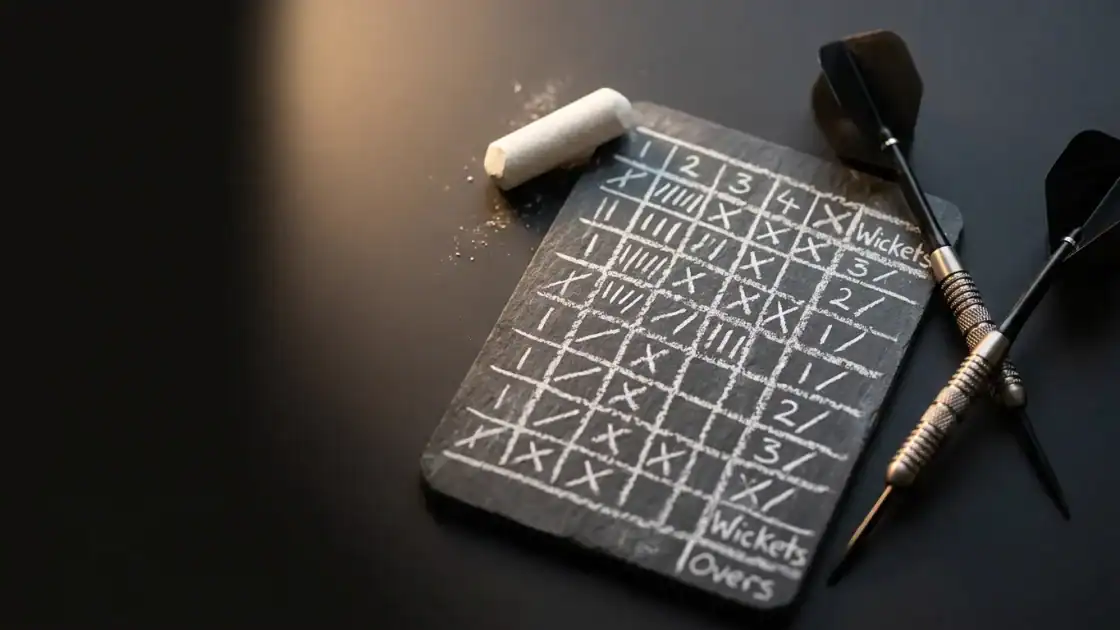
The traditional cricket scoreboard has the 7 target numbers listed vertically down the centre, with each player’s marks on either side and point totals at the bottom.
Marks are recorded with a simple notation: first hit = a slash (/), second hit = an X (the slash becomes a cross), third hit = circle the X (number is closed). Points are tallied in a running total below.
On electronic dartboards, all of this is handled automatically – you just throw. For bristle boards, you’ll need a chalkboard, whiteboard, or a phone app. DartCounter and My Dart Training both support cricket scoring. TheDartScout recommends DartCounter for cricket because it tracks marks visually and calculates points automatically.

What Is the Best Strategy for Cricket Darts?
Cricket strategy breaks into three phases: opening, middle game, and endgame. Most beginners play all three the same way. Don’t.
Opening strategy: close 20 first
Most players start with 20. It’s the highest-value number, which means it scores the most points once you’ve closed it and costs you the most if your opponent closes it first. A treble 20 on your first dart closes the number instantly and puts immediate pressure on your opponent.
After 20, many players work down through 19 and 18. The logic is simple – higher numbers are worth more points, so closing them early gives you the most scoring potential and denies the most to your opponent. But the descending order is a habit, not a rule. Stronger players break it whenever the board calls for it: attacking a number their opponent is close to owning, or starting on a segment they hit more reliably.
Middle game: close vs score
This is where cricket gets interesting. You’ve closed 20 and your opponent hasn’t. Do you score on 20 (adding points) or move to close 19 (expanding your territory)?
Score when you’re behind
If your opponent is ahead on points, you need to score before closing more numbers. Closing everything while 80 points behind doesn’t win the game – you still have to make up the gap. Score on numbers you’ve closed and your opponent hasn’t, then close.
Close when you’re ahead
If you’re leading on points, close aggressively. Every number you close removes a scoring opportunity from your opponent. The fewer live numbers your opponent has, the harder it is for them to claw back a points deficit.
A common beginner mistake is chasing points without watching the rest of the board. You close 20, score 60 points on it, feel great – then, while you were busy scoring, your opponent closes 20 (killing it for both of you), then 19 and 18. Now they have two live scoring numbers and you have none. Your 60 points still count, but they only hold up if you can close 19 and 18 before your opponent outscores you on them.
TheDartScout’s rule of thumb: let the scoreboard decide. When you’re level or ahead on points, close – especially numbers your opponent owns. When you’re behind, score on a number you own until you’re back in front, then go back to closing. Marks and points both matter; neither one alone tells you who is winning.
Endgame: when to go for the bull
Most players leave the bullseye until last. It’s the smallest target in cricket (the inner bull is 12.7mm in diameter and the whole bull, outer ring included, is 31.8mm across), and with no treble available you can earn at most 2 marks per dart on it. Working through 20 to 15 first usually gives you more scoring options. Bull-last is a tendency, not a law, though – if the bull is the number deciding the game, go for it.
Be clear about what closing the bull does. If your opponent has closed everything except the bull, closing it yourself won’t stop them finishing – their bull hits still earn the marks they need. It only stops them scoring on it. If they’re level or ahead on points, their third bull mark wins. If they’re behind, closing the board isn’t enough; they have to keep scoring on numbers you haven’t closed. So when you’re trailing and the bull is the only number they haven’t closed, it’s your only possible scoring number: close it, then score on it to get in front before they finish.
Advanced: reading your opponent’s marks
The scoreboard tells you a lot. If your opponent has 2 marks on 18, they’re one mark from closing it. If you close 18 first, their closing mark makes it dead and they never score there – and you can score on it in the meantime. If you don’t, expect them to score on 18 until you get your third mark.
Good cricket players weigh mark differentials alongside the points, not just their own closing progress. Being a mark ahead on several low numbers can matter less than being two behind on a high number your opponent is about to own. Neither marks nor points tell the whole story on their own – the remaining targets and how reliably each of you hits them matter too. Count the marks. React to the board. Don’t autopilot down 20-19-18.
One specific tactic: if your opponent has 2 marks on a number you haven’t touched, consider throwing all 3 darts at it. Only your third mark protects you – close it first and their closing mark scores nothing. Two marks give you no protection at all. If you both sit on 2 marks on 18 and they hit treble 18, one mark closes it and the other two score 36 points. Even then, their scoring window isn’t permanent: you can still shut it by landing your third mark on a later turn.
SCOUT’S TAKE
Cricket rewards reading your opponent more than any other dart game. Watch what they’re throwing at. If they’re hammering 19 and you haven’t started marking it, drop everything and get your 3 marks on 19 before they start scoring. React to what’s happening on the scoreboard, not what your pre-planned sequence says.
What Are the Different Cricket Variations?
Standard cricket is just the beginning. These variations change the strategy completely.
BEST FOR GROUPS
Cutthroat Cricket: the 3+ player version
In cutthroat, once you close a number, your extra hits add points to the total of every opponent who hasn’t closed it yet. Players who have closed it are protected. To win, you need to close all 7 targets with the lowest score. This inverts everything – you want to close numbers fast, both to protect yourself and to load points onto opponents. Close a number your opponents haven’t? You now have a weapon. Once every opponent has closed it, that weapon is gone. With 3 or more players, cutthroat creates constantly shifting alliances and betrayals.
No-Score Cricket strips away the point-scoring entirely. First player to close all 7 targets wins. No maths, no strategy about when to score vs close – just close faster. Games run quicker than standard cricket, and it’s a good starting point for beginners who find the scoring mechanic confusing.
Tactics extends the board down to 10: you play 10 through 20 plus the bull, with normal cricket marks and scoring. With 12 targets instead of 7, games run longer and the lower numbers become real battlegrounds. DartConnect supports Tactics in its scoring app. If you want randomly chosen targets instead, that’s Random Cricket, offered on DARTSLIVE machines, where the target numbers are picked at random. It forces you to aim at unfamiliar segments – a game where the targets turn out to be 3, 7, 11, 14, 2, and 9 is a very different experience from standard cricket.
Team Cricket pairs players into teams of 2. Partners alternate throws (Player A1 throws, then B1, then A2, then B2). Team strategy adds a communication element – you need to coordinate which numbers to attack and when to switch from closing to scoring. Each team shares one set of marks and one score, so every turn builds on what your partner left you.
Wild Card Cricket is an electronic-board game found on machines such as Arachnid’s. The number targets are picked at random and keep changing: after every turn, any target nobody has marked yet is swapped for a new random number. Once a player puts a mark on a target, it’s locked in for the rest of the game. The bull stays fixed. If a low number like 3 or 7 gets locked in, the game suddenly includes segments nobody practises, which narrows the gap between experienced and casual players.
Overkill Cricket caps runaway scoring. Under the overkill rule in a DARTSLIVE league rulebook, once a team leads by 200 points or more, it earns no points even when it hits a scoring number. The game doesn’t end and the trailing side isn’t handed the win – the leader simply has to get on with closing. It’s worth trying if your regular cricket games have become one-sided and one player keeps farming points instead of finishing.

Common Mistakes When Learning Cricket Darts
Once you know how to play cricket darts, these 5 mistakes are the ones that cost you games.
1. Scoring without watching the board. You close 20 and keep scoring on it. Meanwhile your opponent closes 19, 18, and 17, then 20 – which kills it for both of you. Your points still count, but you now have no live scoring numbers and they have three. Unless you can close 19, 18, and 17 before they outscore your lead, the points you banked won’t be enough.
2. Ignoring the scoreboard. Cricket is a game of relative position, not absolute points. A 200-180 lead is fragile if your opponent has more live scoring numbers than you do. Check the board after every turn. Adjust your strategy based on what’s happening, not what you planned before the game started.
3. Going for the bull too early. The bullseye is hard to hit and the points (25 or 50) rarely justify the difficulty compared to treble 20 (60 per hit). In most games it pays to close 20-15 first and treat the bull as your finishing move.
4. Throwing darts at a number that’s already dead. If you’ve already closed 20 and your opponent has too, hitting 20 again does nothing. Move on. Every dart thrown at a dead number is a dart you’ve given away.
5. Not targeting your opponent’s open numbers. If your opponent has closed 19 and you haven’t, and they’re scoring 57 points with every treble 19 – you need to close 19 immediately. Letting an opponent score freely on an open number is the fastest way to lose. Defensive closing is as important as offensive closing.
The best defence in cricket is closing your opponent’s scoring numbers. Every one you close is a door you’ve locked. Every number they own that you haven’t closed is a door they can walk through – at up to 60 points a dart on 20.
How Is Cricket Different from 501?
They’re fundamentally different games that happen to use the same board.
| Cricket | 501 | |
|---|---|---|
| Board segments used | 7 (15-20 + bull) | All 20 + bull |
| Scoring | Add points on closed numbers | Subtract from 501 to zero |
| Strategy | Close vs score decisions every turn | Route calculation for checkouts |
| Finish | Close all numbers with equal or more points | Hit exact double to reach zero |
| Doubles pressure | Low (doubles just = 2 marks) | High (must finish on a double) |
| Pro format | DARTSLIVE (Asia), USA leagues | PDC, WDF, most European leagues |
501 rewards raw scoring power and checkout accuracy. Cricket rewards tactical thinking and board awareness. Many players end up preferring one – cricket tends to suit players who enjoy tactics, 501 those who enjoy finishing under pressure.
TheDartScout recommends playing both regularly. Cricket improves your ability to aim at specific segments across the board (not just treble 20), while 501 improves your doubles finishing and mental arithmetic. A player who only plays cricket gets little checkout practice. A player who only plays 501 rarely aims at 15s and 16s. Combining both makes you a more complete darts player.
For the full 501 rules, scoring breakdown, and checkout strategy, see our dart rules explained guide.
How to Get Better at Cricket Darts
Knowing how to play cricket darts is one thing. Getting good at it is another. Improving requires practising two separate skills: accuracy on the 7 target segments, and game sense (when to close vs score).
For accuracy: throw 10 sets of 3 darts at each cricket number and record two figures: how many of your 30 darts hit the target, and how many marks they earned. Marks run higher than hits because doubles and trebles count 2 and 3 – the ceiling is 90 marks on a number (30 trebles) and 60 on the bull (30 inner bulls). The segments where you score lowest are the ones costing you games. Practise those segments specifically, not just the ones you’re already good at.
For game sense: play no-score cricket first. Without the distraction of points, you’ll focus entirely on closing speed. Once you can close all 7 numbers in under 30 darts consistently, switch back to standard cricket and focus on the score-vs-close decision. Ask yourself before every throw: “Am I closing or scoring this turn, and why?” If you can’t answer that question, you’re not playing strategically.
For broader practice routines that include cricket-specific drills, see our guide to practising darts alone.
Frequently Asked Questions
How many players can play cricket darts?
Standard cricket works best with 2 players or 2 teams. With 3+ players, switch to cutthroat cricket where you score on opponents (lowest wins). Standard cricket with 3+ players is technically possible but the waiting between turns slows the game and the 2-way closing mechanic doesn’t translate cleanly to multiplayer.
What happens if you close all numbers but have fewer points?
You don’t win yet. You must keep scoring on numbers your opponent hasn’t closed until your point total equals or exceeds theirs – the moment it does, with every number closed, you win. Meanwhile your opponent is trying to close those numbers and finish first. This rule prevents the “close everything fast and ignore scoring” strategy from working.
Is cricket played professionally?
Not in the PDC or WDF (the two major professional darts organisations). Professional steel-tip darts in the UK and Europe is played almost entirely as 501. Cricket has professional competition through DARTSLIVE in Asia and some organised leagues in the USA, but it doesn’t have the same elite-level infrastructure as 501. Where cricket really thrives is casual, bar, and league play, particularly in the USA.
Do you have to play numbers in order (20, 19, 18…)?
No. You can close numbers in any order. Starting with 20 and working down is a common approach (because higher numbers score more points) but it’s not a rule. Some players deliberately break the sequence to attack a number their opponent has partially marked, or to target a segment they’re more accurate at.
Can you score on the bullseye before closing it?
No. Like every other number in cricket, you must close the bullseye (3 marks) before you can score points on it. The outer bull counts as 1 mark and scores 25 points once closed. The inner bull counts as 2 marks and scores 50 points once closed.
What does a treble do in cricket?
A treble counts as 3 marks in one dart. Hit treble 20 and you’ve instantly closed 20 – no need for 2 more darts. If you’ve already closed 20 and your opponent hasn’t, treble 20 scores 60 points (20 x 3). Trebles are the most efficient way to play cricket because they close numbers in a single dart or score maximum points. The treble 20 bed is only about 8mm deep and roughly 32mm long on a regulation steel-tip board, which is why even good players miss it regularly.
How long does a game of cricket take?
It depends mostly on skill. Strong players can close out a game in a handful of turns, while beginners take much longer because more darts miss the target segments entirely. No-score cricket is quicker because there’s no point-chasing phase, and cutthroat with 4 players runs longer because of the wait between turns. Electronic boards speed things up because there’s no manual score-keeping, and some leagues and machines cap cricket at a set number of rounds.
What happens if the points are tied?
Under standard rules, a tie on points isn’t a draw. Players throw in turns, so two players can never close their final number at the same moment. The first player to close all 7 targets with equal or more points wins – so if the scores are level, whoever closes the board first takes the game. The exception is league or electronic play with a round limit, where a separate tie-break applies if the rounds run out before anyone closes out. One DARTSLIVE league rulebook, for example, caps cricket at 15 rounds and settles level scores with a bull-up if nobody has closed the board.
For more dart games beyond cricket, see our complete dart games guide covering 22 games for every situation. For 501 rules and scoring, read dart rules explained. For solo practice routines that improve your cricket aim, see how to practice darts alone. For checkout calculations in 501, use the checkout calculator. Keep your equipment match-ready with our cleaning and repointing guides.