QUICK ANSWER
A surround protects your wall. A ring light kills shadows.
A dartboard surround and lighting setup costs £15–60 (~$20–75) total. Together they solve the two biggest problems with playing darts at home: stray darts destroying your wall and shadows making it hard to see the board. This guide covers materials, sizes, lighting types, colour temperature, and DIY options for both.
Most home dart players buy a board and darts, hang them on the wall, and call it done. Within a week, the wall around the board looks like it survived a woodpecker attack. The single overhead bulb casts shadows across the scoring segments every time a dart lands.
A dartboard surround and lighting fix both problems cheaply. This guide explains what to look for in each, which materials actually work, and how to build your own if you prefer the DIY route. For the full equipment list and budget tiers, see our home darts setup guide.
Do You Need a Dartboard Surround?
If every dart hits the board, no. In practice, stray darts are inevitable – even professionals miss the board occasionally during practice. A surround catches those strays before they punch holes in your wall, chip your paintwork, or dent the plaster.
A surround also reduces noise. A dart hitting bare wall makes a sharp crack. The same dart hitting foam makes almost no sound. If you play late at night or share walls with neighbours, a dartboard surround is not optional – it is essential. For more on noise control, see our section in the home darts setup guide.
KEY TAKEAWAY
A dartboard surround is the cheapest upgrade that makes the biggest practical difference. At £8–25 (~$10–30), it pays for itself in avoided wall repairs after a few weeks of regular play.
What Material Should a Dartboard Surround Be?
Surrounds come in three main materials. Each handles stray darts differently, and the right choice depends on your budget and how much you care about long-term durability.
| Material | How it works | Durability | Price |
|---|---|---|---|
| EVA foam | Darts embed in the foam and stay put. Self-seals after removal. | High – lasts years of regular play | £8–25 (~$10–30) |
| Polyurethane foam | Same as EVA but denser. Snugger fit, heavier feel. | Very high – premium longevity | £15–35 (~$20–45) |
| Rubber | Darts may bounce off rather than embed. Still protects the wall. | Medium – surface hardens over time | £10–20 (~$13–25) |
EVA foam is the standard for good reason. It is light, cheap, and catches darts cleanly. The foam compresses around the dart point on impact and springs back when the dart is removed, leaving minimal scarring. After hundreds of hits in the same area, the foam starts to break down – but that takes months of daily play.
Polyurethane (used by Winmau) is denser and heavier. It grips darts more firmly and resists breakdown longer than EVA. The trade-off is price – roughly double. Rubber works as a wall protector but does not hold darts as well, which means more darts falling to the floor and more noise.
According to TheDartScout’s analysis, EVA foam offers the best value for home players. Polyurethane is worth the upgrade only if you throw daily and want a surround that still looks new after two years.
What Size Surround Should You Get?
A standard dartboard is 17.75 inches (451 mm) in diameter. Surrounds come in two broad categories based on how much extra coverage they add.
| Shape | Coverage | Best for |
|---|---|---|
| Round (~26 inches total) | Adds ~4 inches per side around the board | Accurate throwers, tidy appearance |
| Square / rectangular (32–45 inches) | Catches wide misses well beyond the board edge | Beginners, shared boards, pub setups |
If you are a beginner, go square. Your misses will be wider than you expect, especially when aiming at the bottom segments (double 3, double 19). A round surround only adds four inches of protection – that is not enough for a new player’s stray darts. Once your accuracy improves, a round surround is fine.
Pay attention to how the surround attaches. Most round surrounds friction-fit directly onto the dartboard – no screws, no adhesive. They hold in place by gripping the board’s bevelled edge. Square surrounds typically mount to the wall with screws or hang on the same bracket as the board. Either way, installation takes under five minutes.
Can You Make a DIY Dartboard Surround?
Yes, and DIY surrounds often provide more wall coverage than shop-bought ones. Here are three proven approaches.
Cork Sheet on MDF
Glue 12 mm cork tiles to a 9 mm MDF board cut to your desired size. Paint or stain the edges for a clean look. Total cost: £10–15 (~$13–20). Cork stops darts well but crumbles over time – expect to replace tiles every 6–12 months in high-traffic areas around the treble 20.
Foam Insulation and Felt
Glue one-inch rigid foam insulation to an OSB or MDF backing, then cover the front with black felt using spray adhesive. Dart holes disappear in the dark felt. Total cost: £8–12 (~$10–15). This is the cheapest option that actually looks good.
Wine Cork Wall
Hot-glue wine corks to a backing board or directly to the wall. You need roughly 1,200 corks for a 150 × 100 cm (60 × 40 inch) area. Free if you collect them – but time-intensive. The result is visually striking and catches darts well.
Do You Need a Dedicated Dartboard Light?
Not strictly, but it makes a noticeable difference. Most rooms have a single ceiling light positioned above and behind the throwing line. This creates downward shadows from every dart that lands in the board. The shadow falls across the scoring segments below the dart, making it harder to read the numbers and see the thin treble and double beds.
The problem is geometry. A single light source above and behind you means every dart blocks light from reaching the area directly below it. The higher the ceiling light, the longer the shadow. In rooms with low ceilings and a single bulb, the shadows are so bad that the bottom third of the board becomes hard to read clearly from the oche.
A dedicated dartboard light sits around or just behind the board, pointing light directly at the face from all angles. Shadows disappear because no single light direction dominates. The effect is immediate and obvious the first time you switch it on.
What Type of Dartboard Light Eliminates Shadows?
There are four common approaches to dartboard surround and lighting, each with different shadow coverage and cost. Here is how they compare.
| Type | Shadow coverage | Price | Installation |
|---|---|---|---|
| 360° LED ring | Full elimination | £20–60 (~$25–75) | Clips or magnets to board |
| 270° LED ring | Near-full (90° gap at top for dart retrieval) | £15–40 (~$20–50) | Magnets, no tools |
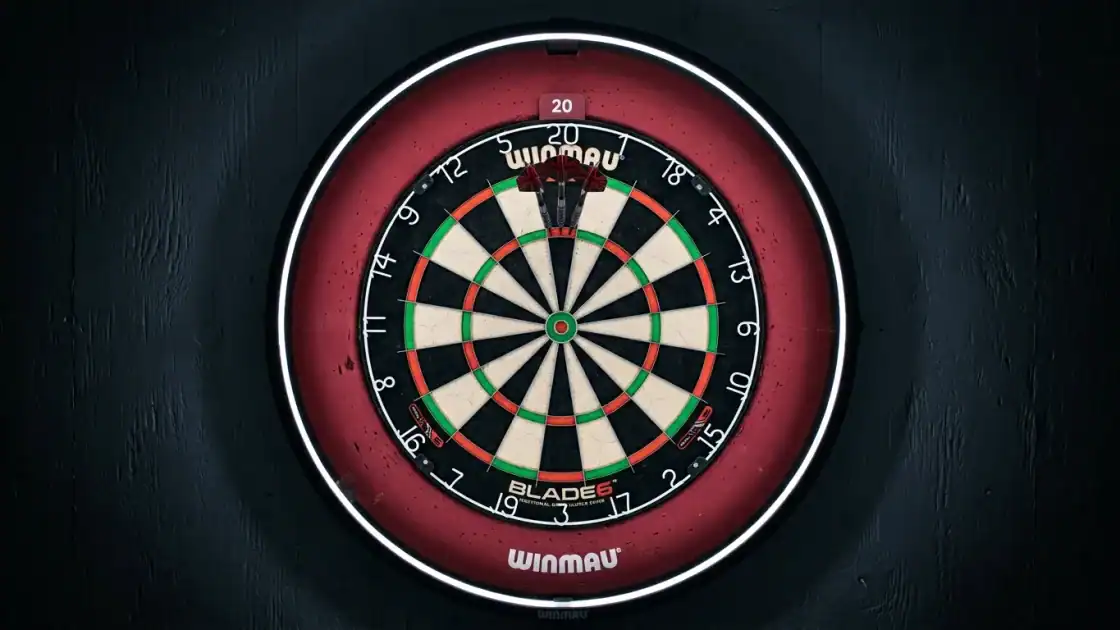
| Surround with built-in LEDs | Full elimination + wall protection | £30–70 (~$40–90) | Replaces standard surround |
| Single ceiling spotlight | Partial – casts shadows from one direction | £5–15 (~$7–20) | Ceiling or wall mount |
A 360° LED ring is the gold standard. It wraps around the board and lights the face evenly from every angle. According to TheDartScout’s testing, even budget LED rings eliminate shadows completely – you do not need to spend more than £25 (~$30) for a functional ring light.
A surround with built-in LEDs combines both accessories into one unit. It costs more than buying them separately, but saves mounting hassle and looks cleaner. If you are starting from scratch and want a tidy setup, this is the most convenient option.
Avoid relying on a single spotlight. It is better than nothing, but every dart on the board will cast a visible shadow across the segments below it. Multiple spotlights reduce the problem but never eliminate it fully.
SCOUT’S TAKE
If you are choosing between a better surround and a lighting ring, buy the lighting ring first. A surround protects the wall, but a light improves every single throw by letting you see the board clearly. You can tape cardboard around the board as a temporary wall protector. You cannot tape better visibility.
What Colour Temperature Is Best for a Dartboard?
Colour temperature is measured in Kelvin (K) and determines whether the light looks warm (yellowish) or cool (bluish). For dartboards, neutral white is best.
| Temperature | Appearance | Dartboard suitability |
|---|---|---|
| Below 3500 K | Warm yellow | Poor – segments blur together, hard to read numbers |
| 4000–5000 K | Neutral white | Ideal – clear segment contrast, no glare, comfortable for long sessions |
| Above 5500 K | Cool blue-white | Too harsh – causes eye strain and glare on the wire dividers |
Most dedicated dartboard lights ship at 4500–5000 K. If you are buying a generic LED strip or bulb for a DIY setup, check the listing for colour temperature and aim for 5000 K. The PDC televised events use neutral white lighting in the same range.
Can You DIY Dartboard Lighting?
Yes. A 5000 K LED strip and a 12 V power adapter cost £10–15 (~$13–20) total. Here is the simplest method.
Step 1: Buy a 5000 K adhesive LED strip (at least 2 metres) and a 12 V DC adapter.
Step 2: Stick the strip around the inside edge of your surround ring, facing inward toward the board face. If you use a flat backboard, mount the strip around the circular cutout for the board.
Step 3: Route the cable down behind the surround and along the wall to a power socket.
The result is a DIY ring light for a fraction of the cost of a branded one. The light coverage will not be perfectly even – LED strips have slight gaps between diodes that create minor bright spots. But it eliminates the worst shadows and is a massive upgrade over a single ceiling bulb.
One common mistake with DIY lighting is pointing the LEDs outward instead of inward. The strip must face the board, not the room. If the LEDs face outward, they light up the surround but leave the board face in shadow – the exact opposite of what you want.
How Much Does a Dartboard Surround and Lighting Setup Cost?
Here is a quick cost summary for three levels of dartboard surround and lighting.
| Level | Surround | Lighting | Total |
|---|---|---|---|
| DIY budget | Foam + felt: £8–12 (~$10–15) | LED strip + adapter: £10–15 (~$13–20) | £18–27 (~$23–35) |
| Mid-range | EVA foam surround: £12–20 (~$15–25) | 270° or 360° LED ring: £15–35 (~$20–45) | £27–55 (~$35–70) |
| Premium | Surround with built-in LEDs: £30–70 (~$40–90) | Included | £30–70 (~$40–90) |
According to TheDartScout’s analysis, the mid-range option gives the best value. A separate EVA surround plus a basic 360° ring light costs £30–50 (~$40–65) and solves both problems permanently. The premium all-in-one is convenient but you pay extra for the integration.
Frequently Asked Questions
Do dartboard surrounds fit all boards?
Standard surrounds fit any regulation 17.75-inch (451 mm) dartboard. That includes all bristle boards from Winmau, Unicorn, Target, and Shot. Electronic boards vary in size – check the diameter before buying. For help choosing a board, see how to choose a dartboard.
Can you use a dartboard surround with a cabinet?
Usually not. Cabinets house the board inside a wooden frame, leaving no room for a surround. The cabinet doors and frame serve as wall protection instead, though they are less effective at catching darts than foam.
How long do dartboard surrounds last?
EVA foam surrounds last 2–4 years of regular play. The area around treble 20 wears fastest because that is where most stray darts land. Polyurethane lasts longer. Cork DIY surrounds need tile replacement every 6–12 months in heavy-use zones.
Do dartboard lights use a lot of electricity?
No. LED ring lights draw 5–12 watts – roughly the same as a phone charger. Running one for four hours a day costs less than £1 (~$1.30) per year in electricity.
For board selection, read how to choose a dartboard. For mounting height and distance, see how to set up a dartboard. For a full budget breakdown, check home darts setup. For housing your board, see our best dartboard cabinet guide. the two most practical accessories you can add to a home setup. For mounting distances and board height, read how to set up a dartboard. To understand how board type affects your surround choice, see steel tip vs soft tip darts. And for the complete equipment breakdown, see our home darts setup guide or start with the beginner’s guide to darts.