QUICK ANSWER
Replace flights when they are torn, creased, or no longer hold their shape.
For regular players, that means every 1-4 weeks depending on how often you play and what thickness you use. A torn flight changes your dart’s flight path more than most players realise.
This guide covers the five signs, the lifespan by thickness, and why spending more on flights actually costs less.
Flights are the cheapest component on your dart and the one that wears out fastest. They take damage every session – from incoming darts hitting them, from being pulled out of the board, from being dropped on the floor. Most players ignore flight condition until a vane falls off completely. By that point, the flight has been hurting your accuracy for weeks.
Knowing when to replace dart flights is one of the simplest ways to maintain consistent performance. TheDartScout’s equipment analysis shows that a damaged flight can shift your dart’s landing position by 5-15mm at the board – enough to turn a treble into a single or miss a double entirely. This guide tells you exactly what to look for and how long each type of flight should last.
What Are the Five Signs a Flight Needs Replacing?
Check your flights before each session. It takes ten seconds and saves you from throwing with compromised equipment. Here are the five signs, in order of how common they are.
1
Torn or Split Vanes
Any tear, no matter how small, changes the drag profile. Replace immediately.
2
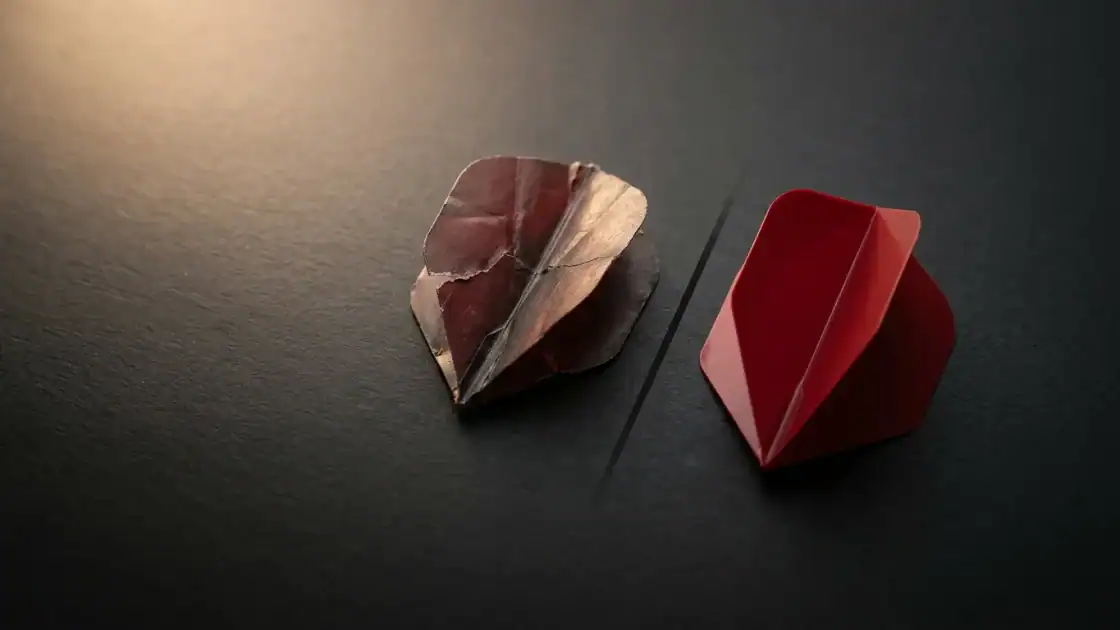
Creased or Bent Shape
Flights should sit at 90-degree angles. A crease means uneven drag on one side.
3
Frayed or Rough Edges
Ragged edges create turbulence. The dart wobbles instead of flying clean.
Sign 4: Loose fit on the shaft. A flight should slot firmly into the shaft and stay put. If it spins freely, falls out during your throw, or needs constant re-seating between rounds, the slot at the base of the flight has widened from use. The flight cannot do its job if it moves independently of the shaft.
Sign 5: The vanes do not spring back. Hold the flight between your fingers and squeeze two vanes together. Release. A healthy flight snaps back to its 90-degree cross shape instantly. A worn flight stays compressed or returns slowly. This means the material has fatigued and is no longer generating consistent drag in flight.
If you would not play snooker with a warped cue tip, do not play darts with a damaged flight. The flight is the steering – everything downstream depends on it.
How Long Do Dart Flights Last by Thickness?
Flight thickness is measured in microns. Thicker flights cost more but last longer and hold their shape better. Here is what to expect from each thickness based on regular play (3-5 sessions per week).
| Thickness | Typical lifespan | Cost per set | How they fail |
|---|---|---|---|
| 75 micron | 3-7 days | £0.50-1 (~$0.65-1.25) | Rip and tear at the edges |
| 100 micron (standard) | 1-3 weeks | £1-2 (~$1.25-2.50) | Crease and lose shape |
| 150 micron | 3-6 weeks | £2-4 (~$2.50-5) | Nicks at edges, slow shape loss |
| 180 micron | 4-8 weeks | £3-5 (~$4-6.50) | Nicks only, holds shape well |
These timelines assume you are playing with steel tip darts on a bristle board. Soft tip darts on electronic boards cause less flight damage because there is less impact force. Playing in a league where three players throw at the same board causes more damage than solo practice because incoming darts hit your flights more often.
KEY TAKEAWAY
100 micron flights are the default. If you replace them weekly, switch to 150 micron. You will replace them monthly instead and spend less over a year despite the higher per-set price.
Why Does a Damaged Flight Affect Your Throw?
A flight creates drag at the back of the dart. This drag keeps the rear behind the front as the dart travels toward the board – like the feathers on an arrow. The drag must be symmetrical. If all four vanes are identical and undamaged, the dart flies straight along its intended line. If one vane is torn or bent, the drag is uneven and the dart curves or wobbles.
The effect is subtle at short range. At the regulation throwing distance of 2.37 metres, even a small asymmetry translates into a measurable shift at the board. According to TheDartScout’s testing, a flight with one torn vane produced a lateral drift of 8-12mm compared to the same dart with a new flight. That is the difference between the treble bed and the single next to it.
A creased flight is worse than a torn one in some ways because it is harder to spot. A tear is obvious. A crease looks minor but it changes the angle of one or two vanes relative to the others, creating a consistent bias in one direction. You compensate unconsciously by adjusting your aim, and when you finally replace the flight your aim is off in the other direction until you readjust. Better to replace early and keep the variable out of the equation.

THE COST MATHS
Cheap flights are not cheaper.
A pack of 75-micron flights costs £0.50 (~$0.65) and lasts a week. That is £26 (~$35) per year. A pack of 150-micron flights costs £3 (~$4) and lasts a month. That is £36 (~$45) per year – but you change flights 12 times instead of 52. The real cost is not just money. It is the sessions you play with a damaged flight because you ran out of spares and could not be bothered to order more.
Does Flight Shape Affect How Quickly They Wear?
Yes. Larger flights take more damage because they present a bigger target for incoming darts.
Standard Flights
Largest common shape. Most drag, most stability, most damage from deflections. Wear out 30-50% faster than slim flights because the vanes extend further and catch more incoming darts.
Slim Flights
Narrower profile. Less drag, less stability, but far less damage because the reduced surface area is harder to hit. Last roughly twice as long as standards at the same thickness.
Pear and kite shapes sit between the two. If you are replacing standard flights every week and it frustrates you, try slim flights at the same thickness before buying thicker standards. The shape change might solve the longevity problem while also suiting a faster throw. For a full shape comparison, see our flight selection guide.
Do Flight Protectors Work?
Flight protectors are small plastic or aluminium caps that clip onto the back of the flight. They protect the trailing edge of the flight from being split by an incoming dart. When your second or third dart lands close to the first, its point would normally hit the flight and tear it. The protector deflects the point instead.
They work. Players who group tightly – particularly around the treble 20 – see a noticeable increase in flight lifespan with protectors. The downside is that protectors add a small amount of weight to the back of the dart and can cause deflections that push the incoming dart away from its intended target. Some players find the deflection worse than the flight damage it prevents.
If you are replacing flights more than once a week due to tear damage from grouping, try protectors. If your flights mainly fail from creasing or edge fraying rather than tears, protectors will not help because those failures come from general handling and impact with the board, not from dart-on-dart contact.
How Does Shaft Length Affect Flight Damage?
Shorter shafts position the flight closer to the barrel. This means the flight sits closer to the board when the dart lands, and incoming darts are more likely to hit it. Players who use extra-short or short shafts and group tightly will go through flights faster than players using medium or long shafts.
This is a tradeoff. Short shafts give you a more responsive dart with less rear drag. But they cost you in flight longevity. If you prefer short shafts, budget for more frequent flight replacements or use thicker flights to compensate. For shaft options, see our shaft selection guide.
Spinning shaft tops (like Target’s rotating system) also reduce flight damage. When an incoming dart hits a flight on a spinning top, the flight rotates out of the way instead of absorbing the full impact. This extends flight life noticeably for tight groupers.
What About Moulded One-Piece Flights?
Systems like Condor AXE, L-style, and Fit Flight use rigid moulded flights that integrate the shaft and flight into one piece. These last much longer than traditional folding flights because the material is thicker and the vanes cannot crease or fold. Some players report moulded flights lasting 3-6 months of regular play.
The tradeoff is cost. A set of Condor AXE flights costs £8-12 (~$10-15) compared to £1-3 (~$1.25-4) for traditional flights. But if you are currently replacing traditional flights weekly, the moulded system pays for itself within two months. The other consideration is that moulded flights use proprietary shaft fittings – you cannot mix brands freely the way you can with traditional 2BA shafts and push-in flights. For component compatibility, see anatomy of a dart.
What Do Professional Players Do About Flight Wear?
Professional players on the PDC tour change flights before every match. Some change them between sets. For a professional, knowing when to replace dart flights is not a question – they replace them on a fixed schedule regardless of visible wear. The cost is trivial relative to the prize money at stake.
You do not need to be that aggressive. But the principle is sound: replace on a schedule rather than waiting for obvious damage. If you play three or more times per week, set a day each week to swap in fresh flights. This removes the guesswork about when to replace dart flights and ensures you are never throwing with compromised equipment. A fresh set of flights costs less than a pint. Your consistency is worth more than that.
How Should You Store Spare Flights?
Keep spare flights flat, not folded. Storing folding flights in their original packaging or in a flight wallet preserves the crease lines. Flights that sit crushed in the bottom of a dart case develop permanent bends before you even use them. A flight case or wallet costs under £5 (~$6.50) and keeps a dozen sets flat and ready.
Buy flights in bulk. A pack of 10 sets of 100-micron flights costs £8-15 (~$10-19) – roughly £1 (~$1.25) per set. That gives you three to six months of replacements on hand. Running out of spares is how you end up playing with damaged flights for weeks because you forgot to reorder. If you play in a league, keep a full spare set of three flights in your case at all times. Tournaments are worse – you cannot pause a match to buy flights from the pro shop. Preparation costs nothing. Poor preparation costs legs.
Temperature also matters for storage. Do not leave flights in a car during summer. Heat softens the plastic and causes permanent warping. Keep your dart case indoors at room temperature. This applies to moulded flights too – even rigid systems like Condor can distort at high temperatures.
SCOUT’S TAKE
Flights are consumables. Treat them like guitar strings or tennis grips – they wear out and you replace them as part of the routine. The players who struggle most with consistency are often the ones throwing with flights they should have binned two weeks ago. Keep a spare set in your case. When your current flights show any of the five signs, swap them out before your next throw.

Frequently Asked Questions
Can I straighten a bent flight instead of replacing it?
You can try, but it rarely works well. Once a flight has creased, the material at the crease point is permanently weakened. Even if you flatten it, the crease line remains and the flight will bend again at the same point during your next session. Flights cost pence each. Replace rather than repair.
Do thicker flights change how the dart flies?
Slightly. Thicker flights are more rigid, which means they hold their shape more consistently in the air. This produces marginally more stable flight and slightly more drag. Most players cannot feel the difference between 100 and 150 micron during actual play – the durability benefit far outweighs the aerodynamic difference. For how flights interact with shafts and barrel weight, see how flights and shafts affect your throw.
How many spare flight sets should I carry?
At minimum, one complete spare set (3 flights) in your dart case. For league nights or tournaments, carry two spare sets. For extended sessions or competitions, carry three. Running out of spares mid-session means playing with damaged flights or borrowing mismatched ones from another player.
When to replace dart flights if I only play once a week?
Check them before each session. With weekly play, 100-micron flights typically last 4-8 weeks. 150-micron flights can last 2-3 months. Replace based on the five signs above rather than on a fixed schedule. Casual players often keep flights far longer than they should because the damage accumulates slowly and they do not notice the gradual decline in performance.
For flight shapes and sizes, read how to choose dart flights. For shaft compatibility, see how to choose dart shafts. To understand how flights and shafts work as a system, read how flights and shafts affect your throw. For component breakdowns, see anatomy of a dart. If your darts wobble in flight, the problem might be your flights – see why darts wobble in flight. New to darts? Start with the beginner’s guide.