QUICK ANSWER
Four main dart point types: fixed steel, moveable steel, soft tip, and conversion.
Fixed steel points are the standard for bristle boards. Moveable points reduce bounce-outs with a spring mechanism. Soft tips are plastic for electronic boards. Conversion points let you switch between the two.
This guide covers every dart point type, how length and surface texture affect your game, and how to maintain them.
The point is the smallest component on your dart but it has a direct impact on whether the dart sticks, bounces, or falls out of the board. Most players never think about dart point types beyond “steel or soft.” But point length, surface texture, attachment system, and tip shape all affect how the dart interacts with the board surface and the wires between segments.
TheDartScout breaks down every dart point type so you can match the right point to your board, your throw, and your playing style. Whether you are replacing worn points, reducing bounce-outs, or switching between bristle and electronic boards, the point is where it starts.
THE TWO WORLDS
Steel tip and soft tip are different sports equipment.
Steel tips penetrate sisal fibres on bristle boards. Soft tips click into small holes on electronic boards. The barrels, shafts, and flights can be the same. The point is what determines which board you can use.
What Are the Main Dart Point Types?
There are four categories of dart point types. Each serves a different purpose and fits different equipment.
Fixed steel tip points
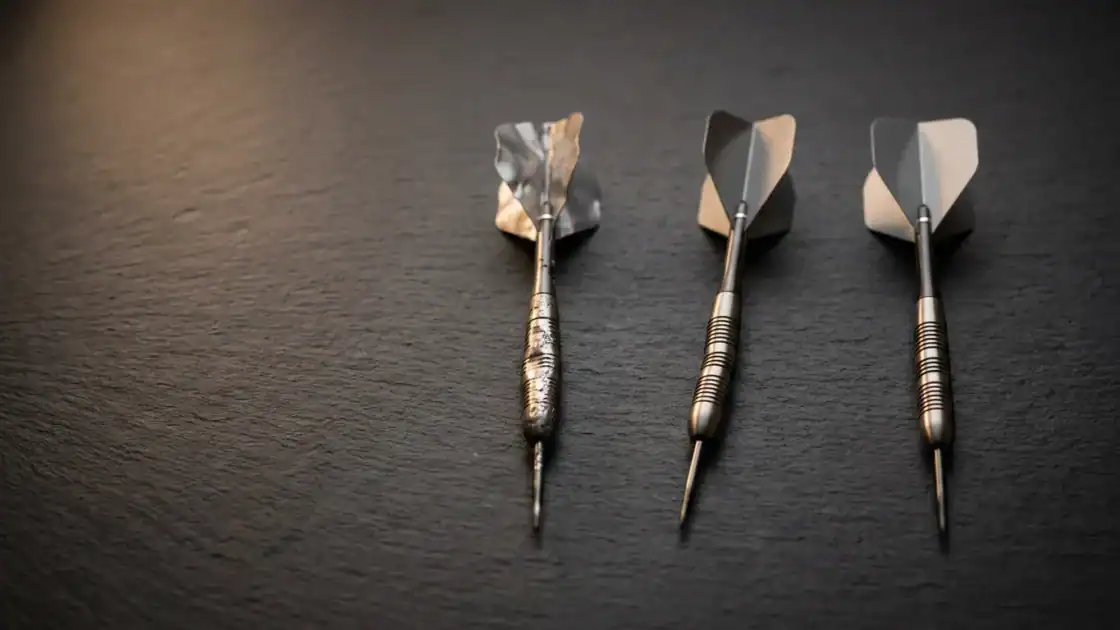
The most common type. A solid steel rod with a smooth rear section that is pressed into the nose of the barrel during manufacturing. The point and barrel become a single unit – you cannot remove or replace the point without specialist tools. Fixed points are standard on the vast majority of steel tip darts sold worldwide.
Fixed points are reliable and simple. There are no moving parts, no threads to loosen, and no mechanism to fail. The point sits perfectly aligned with the barrel axis because it was machined as part of the assembly. For most players, fixed steel tip points are all they will ever need.
The downside is that when the point wears out, bends, or gets damaged, you cannot swap it. You either reshape it with a sharpener or replace the entire barrel. In practice, fixed points last years of heavy use before needing attention beyond occasional sharpening.
Replaceable (screw-in) steel tip points
Some barrels have internal threading at the nose that accepts screw-in points. This lets you change point length, surface texture, or replace a damaged point without buying a new barrel. Target, One80, and Laserdarts are the main brands offering proprietary screw-in point systems.
The advantage is flexibility. You can try 32mm points one week and 41mm the next to see which suits your throw. You can swap from smooth points to grooved points to test which grips the board better. The disadvantage is that the threaded connection can loosen over time, particularly under repeated impact. A loose point that wobbles in the barrel will throw off your accuracy.
Moveable (retractable) steel tip points
Moveable point systems use a spring-loaded tip that retracts slightly into the barrel on impact. When the point hits a blade wire on the dartboard, the spring absorbs the force. Instead of bouncing off the wire, the dart continues forward and the point slides into the sisal beside the wire. This reduces bounce-outs noticeably.
The main moveable point brands are Winmau (Trident 180 system), Target (Storm points), and Harrows (Apex points). Each uses a different mechanism but the principle is the same. Moveable points cost £3-6 (~$4-8) per set and fit specific barrel systems – they are not universal.
Fixed Points
Press-fit into barrel. No moving parts. Cannot be replaced individually.
Best for: most players. Reliable, zero maintenance beyond sharpening.
Moveable Points
Spring-loaded. Retract on wire contact. Reduce bounce-outs by 30-50%.
Best for: tight groupers hitting wires often, or players on round-wire boards.
Soft tip points
Soft tip points are made from nylon or reinforced plastic. They screw into the barrel nose using a standard 2BA thread (the same thread used for shafts). Soft tips are designed for electronic dartboards, which have small holes across the playing surface. The plastic point clicks into the hole and triggers a sensor that registers the score automatically.
Soft tips break. It is part of the design – the plastic flexes on impact to protect the electronic board, and over time the tips snap at the thread or the tip itself. Serious soft tip players buy points in bulk packs of 50-200. A pack of 100 soft tips costs £3-8 (~$4-10). Budget for replacing tips every few sessions.
Soft tip darts are typically lighter than steel tip darts (16-20g vs 20-26g) because electronic boards cannot handle the impact force of heavy steel tip darts. The lighter weight means the point has a proportionally larger effect on the dart’s balance. For the full comparison between the two systems, see our steel tip vs soft tip guide.
Conversion points
Conversion points let you use a soft tip barrel on a bristle board (or vice versa). A steel-to-soft conversion point screws into a steel tip barrel’s nose threading and replaces the steel point with a plastic one. A soft-to-steel conversion screws into a soft tip barrel and adds a steel point.
Conversion points cost £3-8 (~$4-10) per set. They work well for players who own one set of barrels and want to play on both board types. The tradeoff is that conversion points add a small amount of length to the front of the dart and can change the balance point slightly. If you play both formats regularly, dedicated barrels for each are better than converting back and forth. But for occasional crossover, conversions are a practical solution.

How Does Point Length Affect Your Throw?
Steel tip points come in several standard lengths. The most common are 32mm, 36mm, 38mm, and 41mm. Some manufacturers offer 26mm (short) and 50mm (extra long) options. The length you choose affects three things: centre of gravity, grouping space, and how the dart sits in the board.
Steel Tip Point Lengths
Centre of gravity shift. A longer point moves weight forward. On a 24g dart, switching from 32mm to 41mm shifts the balance point forward by roughly 2-3mm. This makes the dart fly more point-first, which suits players who throw with a flat arc. If your darts tend to land tail-up in the board, a longer point can help them sit flatter.
Grouping space. Longer points create more physical space between the barrel and the board surface when the dart lands. This means your second and third darts have more room to fit alongside the first without deflecting off it. Players who group tightly – particularly around the treble 20 – often prefer 36mm or 41mm points for this reason.
Board interaction. A longer point has more leverage on impact. It pushes deeper into the sisal and is less likely to fall out under its own weight. The tradeoff is that longer points can damage the board more because they create deeper holes. On a quality blade-wire board this is negligible. On a budget board with soft sisal, it can shorten the board’s life.
KEY TAKEAWAY
Start with 32mm (the standard). If your darts land tail-up or you struggle with grouping space, try 36mm. Only go to 41mm if you have tested 36mm and want more forward balance. Point length is a fine-tuning tool, not a fix for fundamental technique issues.
What Does the Point Surface Texture Do?
Not all dart point types have the same surface. The texture of the point affects how it grips the sisal fibres inside the board. There are four common surface textures, each with a different purpose.
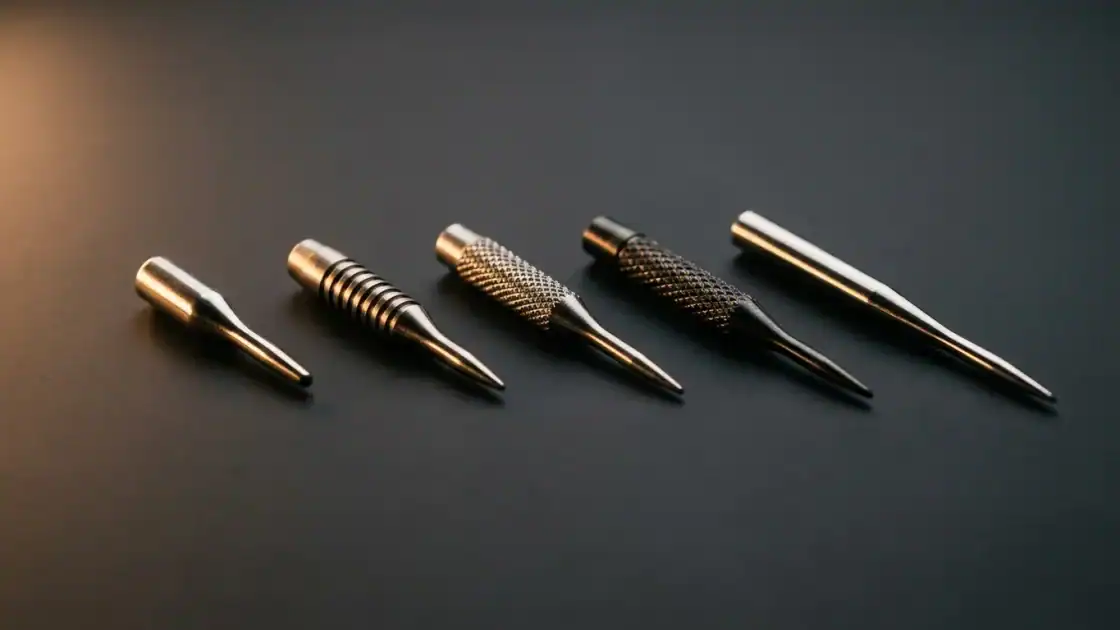
Smooth points. The default on most darts. A polished steel surface with no texture. Smooth points slide easily into the sisal and pull out cleanly. They cause the least board wear. The downside is that smooth points can slip back out of worn sisal, causing drop-outs (where the dart sticks for a moment then falls out).
Ringed points. Shallow horizontal grooves cut into the point surface. The rings create friction against the sisal fibres, helping the dart stay embedded. Ringed points are the most common upgrade from smooth – they grip better without causing excessive board damage.
Knurled points. A crosshatch texture similar to a barrel grip pattern but finer. Knurled points grip sisal aggressively. They are excellent on worn boards where the sisal has lost density. The tradeoff is accelerated board wear – the rough texture tears the sisal fibres on entry and exit. If you play on a competition-grade blade board, knurled points may be overkill.
Diamond-cut points. A precision-machined geometric pattern. These sit between ringed and knurled for grip strength. They offer strong hold without the aggressive wear of a full knurl. Diamond-cut points are the premium option, typically found on higher-end replacement point sets.
Match the point texture to the board, not to your preference. A brand-new blade board needs smooth or ringed points. A worn board that drops darts needs knurled or diamond-cut.
How Do You Sharpen and Maintain Dart Points?
Steel tip points wear down over time. The tip gradually flattens from hitting the board and the wires. A flat point cannot penetrate sisal cleanly and bounces off wires instead of sliding past them. Sharpening restores the tip to a gently rounded shape that works with the board rather than against it.
1
Test the Tip
Run your fingertip across the point. If it feels glassy smooth or visibly flat, it needs sharpening. If it pricks like a needle, it is too sharp.
2
Sharpen
Hold the dart at a slight angle. Rotate it while drawing across a sharpening stone or 150-grit sandpaper. 10 seconds per dart.
3
Check the Shape
The tip should be gently rounded, not needle-sharp. A rounded point slides past wires. A needle point digs in and bounces.
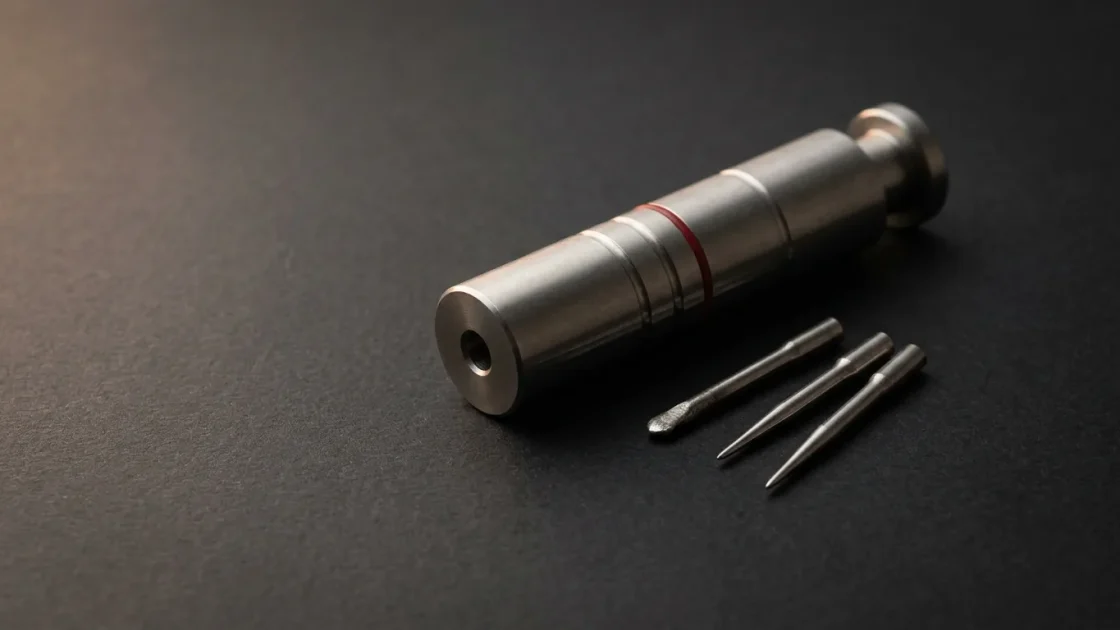
Sharpen every 2-4 weeks if you play regularly. A dart sharpener (a small cylindrical stone with a hole in the centre) costs under £3 (~$4) and lasts years. Some dart cases have an integrated sharpener in the lid. For detailed maintenance including barrel cleaning, see our dart cleaning guide.
The ideal point shape is a gently rounded dome – not a needle point and not a flat end. A needle-sharp point digs into the blade wire on contact and stops dead, bouncing the dart back. A flat point cannot push past the wire at all. The rounded shape slides along the wire surface and finds the sisal gap beside it. According to PDC equipment data, most professional players keep their points lightly rounded with a slightly rough texture. For more on bounce-out causes, see our bounce-out guide.
Which Dart Point Types Suit Which Boards?
The right point depends on what you are throwing at. Here is a quick guide by board type.
| Board Type | Best Point | Why |
|---|---|---|
| Premium blade-wire bristle (Winmau Blade, Unicorn Eclipse) | Fixed steel, smooth or ringed, 32-36mm | Thin wires mean fewer bounce-outs. Smooth points preserve the high-quality sisal. |
| Mid-range bristle (triangle wire) | Fixed steel, ringed, 32-36mm | Ringed points grip better on boards with wider wire profiles. |
| Budget bristle (round wire + staples) | Moveable steel or knurled fixed, 36-41mm | Thick wires cause frequent bounce-outs. Moveable points reduce them. Longer points clear staple heads. |
| Electronic board | Soft tip (nylon/plastic) | Steel tips damage electronic boards and void warranties. Only soft tips trigger scoring sensors. |
| Both (switching between boards) | Conversion points or two sets of darts | Conversion points let one barrel work on both. Dedicated sets are better for serious play. |
For help choosing the right board, see our dartboard guide. For how board construction affects bounce-outs, see why darts bounce out.

How Do You Know When to Replace a Point? (full repointing guide)
Fixed steel points rarely need replacing. They can be resharpened dozens of times over their lifespan. Replace a fixed point only if it is visibly bent (the dart will not fly straight), cracked, or worn down to a stub after years of use. At that stage, you are replacing the barrel, not just the point.
Screw-in steel points should be replaced when the threading is worn or when the point wobbles in the barrel even when tightened. A wobbling point means the thread fit is no longer secure and accuracy will suffer. Moveable points should be replaced when the spring mechanism stops retracting properly – you can test this by pressing the point against a hard surface. It should compress smoothly and spring back instantly.
Soft tip points should be replaced as soon as they show any sign of bending, cracking, or thread wear. A bent soft tip will not seat properly in the electronic board holes and may damage the sensor. Carry spares – at least 10-20 replacement tips per session. They are consumables, not permanent equipment.
How Do You Choose Between Dart Point Types for Your Setup?
Start with what you have. Most darts come with 32mm fixed smooth steel tip points. Play with these for at least a month before changing anything. If you experience specific problems – frequent bounce-outs, darts falling out, darts landing tail-up, or grouping issues – then consider a point change as one possible fix.
If your darts bounce off the wire regularly, try moveable points or switch to a blade-wire board. If your darts stick but then fall out, try ringed or knurled points for more grip. If your darts land tail-heavy, try 36mm or 41mm points to shift the balance forward. If you group so tightly that your darts knock each other out, longer points give more clearance between the barrel and the board.
Avoid changing multiple things at once. If you switch from 32mm smooth to 41mm knurled, you will not know which change helped. Change one variable at a time, throw 100 darts, and see what happens. That is how you build a setup that works for your specific throw rather than copying what a professional uses. For grip and barrel choices that complement your point selection, see how to choose dart weight.
Do Points Affect How the Dart Flies?
Yes, but subtly. The point is relatively light compared to the barrel (typically 2-4g vs 18-24g for the barrel). Its main effect on flight is through the centre of gravity. A longer, heavier point shifts the CoG forward, which makes the dart fly more nose-down. A shorter point keeps the CoG closer to the grip zone.
TheDartScout’s testing shows that switching from 32mm to 41mm points on a 24g torpedo barrel moved the balance point forward by about 3mm. For a player with a smooth, consistent release, this produced a slightly flatter flight arc and the dart landed about 5 degrees more point-down in the board. For a player with an inconsistent release, the effect was masked by other variables in the throw.
The practical takeaway: point length is a fine-tuning adjustment, not a transformation. Get your barrel weight, flight, and shaft right first. Then experiment with point length to dial in the last few percent. For the full picture of how components interact, see anatomy of a dart.
SCOUT’S TAKE
Points are the component that gets the least attention and often needs the most. A blunt point on a £200 (~$255) tungsten barrel will bounce off the wire just as often as a blunt point on a £15 (~$19) brass barrel. Sharpen your points before you blame your darts, your board, or your throw. It takes 30 seconds and costs nothing.
Frequently Asked Questions
Can I use steel tip darts on an electronic board?
No. Steel tips will damage the plastic segments and sensors on an electronic board. They may also void the board’s warranty. If you want to use your steel tip barrels on an electronic board, buy a set of conversion points that replace the steel tip with a soft tip. Most conversion sets cost £3-8 (~$4-10).
Are moveable points worth the cost?
If you experience frequent bounce-outs (more than 1-2 per session), moveable points will reduce them noticeably. They work best on boards with thicker wire systems where the wire presents a larger deflection surface. On a premium blade-wire board where bounce-outs are already rare, the benefit is marginal. A set of Winmau Trident 180 points costs about £5 (~$6.50) and is worth trying if bounce-outs frustrate you.
What length points do professionals use?
Most PDC professionals use 32mm or 36mm points. Some who favour very tight grouping (particularly around treble 20) use 38mm or 41mm for the extra clearance. Point length at the professional level is a personal preference fine-tuned over years. As a starting point, 32mm is the default. Try 36mm if you want to experiment.
How do I know which dart point types fit my barrel?
Fixed points are press-fit and cannot be changed. For replaceable steel points, check your barrel’s system – Target, One80, and Laserdarts each use proprietary threading. For soft tips, the standard 2BA thread fits most barrels. If in doubt, check your barrel manufacturer’s specifications. For component compatibility, see anatomy of a dart which covers thread standards.
Can I sharpen soft tip points?
No. Soft tips are plastic and cannot be sharpened. When they wear or bend, replace them. At their price (a few pence each in bulk), there is no reason to repair them. Keep a bag of spares in your dart case at all times.
For the full picture of how dart components work together, read anatomy of a dart. For barrel choices, see dart barrel shapes and how to choose dart weight. For board selection, see how to choose a dartboard. To keep your equipment in condition, read how to clean tungsten darts and when to replace dart flights. New to darts? Start with the beginner’s guide or take the dart recommendation quiz.