QUICK ANSWER
Start at 501, subtract your score each turn, finish on a double.
That is 501 in one sentence – and 501 is the game that matters most. But darts has half a dozen popular formats, each with different rules and strategies. This guide walks through 501, 301, Cricket, Around the Clock, Killer, and Shanghai with real scoring examples so you can follow along even if you have never picked up a dart.
With the dart rules explained below, you will see that every game shares the same foundation: throw three darts per turn at a standard board. What changes between games is how you score, how you win, and what you aim at. Some formats reward pure accuracy, others reward strategy, and a few reward both.
This guide has the dart rules explained for six games, starting with the one you will play most. Each section includes a turn-by-turn example so you can see how a real leg unfolds – not just the rules in the abstract.
How Do You Play 501?
501 is the standard format in professional darts. The PDC, WDF, and virtually every league worldwide use it. Both players start at 501 points, subtract their score each turn, and race to reach exactly zero. The catch: the final dart must land in a double or the inner bullseye.
Scoring Zones
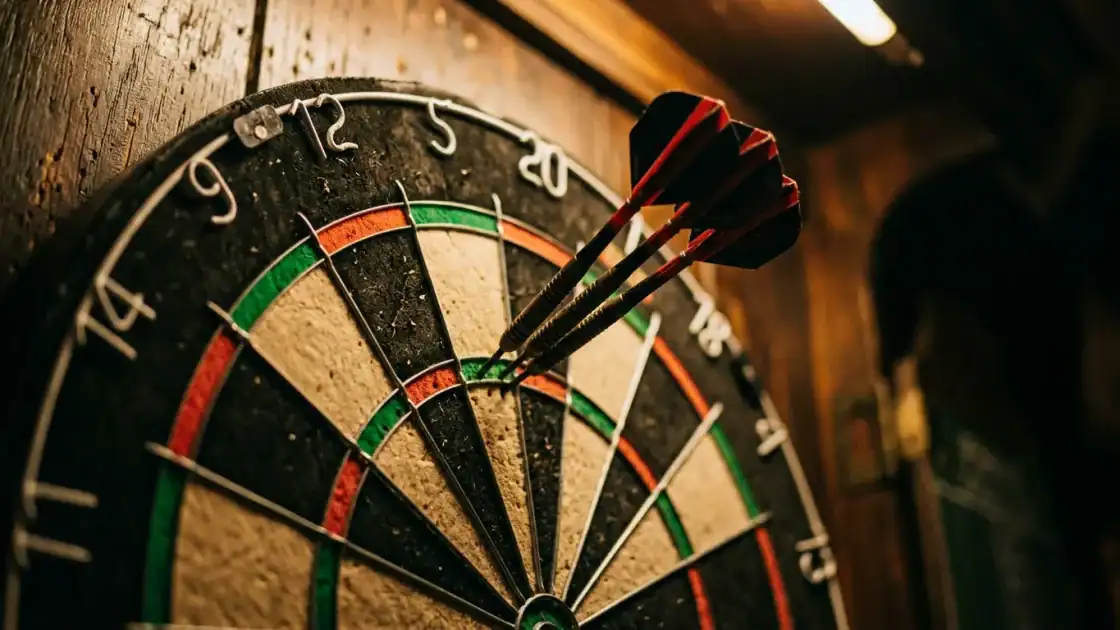
Before diving into the rules, you need to know what each area of the board scores. If you already know the board layout, skip to the walkthrough below.
| Zone | Score | Example (segment 20) |
|---|---|---|
| Single (large bed) | Face value | 20 |
| Single (thin inner bed) | Face value | 20 |
| Double ring (outer edge) | 2× face value | D20 = 40 |
| Treble ring (inner ring) | 3× face value | T20 = 60 |
| Outer bull (green) | 25 | – |
| Inner bull / bullseye (red) | 50 | – |
The highest single-dart score is 60 (treble 20). The highest three-dart score is 180 – three treble twenties, called “a maximum.” The highest checkout (finishing score) is 170: T20, T20, double bull.
The Rules
Start: Both players begin at 501. No double is required to start scoring (“straight in”).
Each turn: Throw three darts. Add up the total and subtract it from your remaining score.
Finishing: The final dart of the leg must land in a double segment or the inner bullseye (double 25). This is called “double out.”
Bust rule: If your three darts would reduce your score below zero, or to exactly 1 (impossible to finish on a double), or to zero without the last dart being a double – the entire turn is void. Your score resets to what it was before you threw.
Example: A Complete Leg of 501
Here is a realistic beginner-level leg between two players. This is not how professionals play – it is how your first few games will actually look.
| Turn | Player A throws | Score | Remaining | Player B throws | Score | Remaining |
|---|---|---|---|---|---|---|
| 1 | S20, S5, S1 | 26 | 475 | S20, S20, S5 | 45 | 456 |
| 2 | S20, T20, S1 | 81 | 394 | S19, S20, S18 | 57 | 399 |
| 3 | S20, S20, S5 | 45 | 349 | T20, S1, S5 | 66 | 333 |
| 4 | S20, S20, S20 | 60 | 289 | S20, S20, S20 | 60 | 273 |
| 5 | T20, S20, S1 | 81 | 208 | S20, T19, S5 | 82 | 191 |
| 6 | S20, S20, T20 | 100 | 108 | S20, S20, S20 | 60 | 131 |
| 7 | T20, S8, D20 | 108 | 0 ✓ | – | – | 131 |
According to TheDartScout’s analysis, Player A wins in 21 darts by finishing 108 with T20, S8, D20. That final dart – double 20 – is the checkout. Without it, the turn would bust. Notice how Player A set up the finish by leaving 108, which has a clean three-dart route to a double. This is the strategic layer of 501: not just scoring high, but leaving the right number. For every checkout route from 170 down to 2, see our checkout route analysis.
KEY TAKEAWAY
501 is subtraction with a twist. The scoring is straightforward, but the double-out rule means you need to plan your finish several turns in advance. That planning is what makes 501 a strategy game, not just a throwing contest.
How Do You Play 301?
301 is identical to 501 except you start at 301 instead of 501. Legs are shorter and faster. Some leagues also require a “double in” – meaning your first scoring dart must also land in a double before you start counting points.
The double-in rule changes the game significantly. Instead of throwing at treble 20 from the first dart, you are throwing at doubles hoping to start scoring. A player who hits double 20 on their first dart starts on 261. A player who misses their first nine darts at doubles is still on 301. This can make 301 frustrating for beginners, which is why most casual play skips the double-in rule.
When to play 301 over 501: When you want quicker legs, when you are practising doubles, or when your league requires it. Most pub leagues use 501 for singles and 301 for doubles pairs.
How Do You Play Cricket?
Cricket is the second most popular dart game worldwide. It is especially common in the US, Japan, and anywhere electronic dartboards are used. The game uses only seven targets: 20, 19, 18, 17, 16, 15, and the bullseye.
The Rules
Close a number: Hit it three times. A single counts as one mark, a double as two marks, and a treble as three marks. So one treble 20 closes the 20s instantly.
Score points: Once you have closed a number but your opponent has not, every additional hit on that number adds its face value to your score. Once both players have closed a number, it is dead – no more points from it.
Win: Close all seven targets and have a score equal to or higher than your opponent. If you close everything first but trail on points, you must keep scoring before your opponent closes you out.
Example: A Cricket Leg
| Turn | Player A throws | Marks/Points | Player B throws | Marks/Points |
|---|---|---|---|---|
| 1 | T20, S20, S20 | 20s closed (3 marks) | S20, S20, S19 | 20: 2 marks, 19: 1 mark |
| 2 | S20 (+20 pts), T19 | +20 pts, 19s closed | S20, T19, S19 | 20s closed, 19: 3 marks but A already closed |
| 3 | T18, S17, S17 | 18s closed, 17: 2 marks | T18, T17 | 18s closed, 17s closed |
| 4 | S17, T16 | 17s closed, 16s closed | S16, S16, S16 | 16s closed |
| 5 | T15, D-Bull | 15s closed, Bull closed. Win. | – | – |
Player A wins by closing all seven targets first while holding a 20-point lead. The key strategic decision in Cricket is whether to close numbers defensively (stop your opponent scoring) or offensively (score on numbers they have not closed). Good players read the board and switch between both.
SCOUT’S TAKE
Cricket rewards board coverage more than 501 does. In 501, you can survive by hammering treble 20 all night. In Cricket, you need to hit every part of the board from 15 to 20 plus the bull. If you want to become a well-rounded player, play Cricket at least once a week alongside your 501 practice.
How Do You Play Around the Clock?
Around the Clock is the best game for beginners. There is no maths, no strategy, and no way to lose track of the score. You simply hit the numbers 1 through 20 in order, then finish with the bullseye. Three darts per turn. Doubles and trebles count as a hit on that number (you do not need to hit the single bed). First player to finish wins.
Why it is valuable: It forces you to aim at every segment on the board. Most beginners only ever throw at 20 and a few doubles. Around the Clock breaks that habit and builds familiarity with the full board layout.
Variant – Doubles Around the Clock: Same game, but you must hit the double of each number. This is an excellent doubles practice drill. If you can complete doubles Around the Clock in under 15 minutes, your doubles game is strong.
How Do You Play Killer?
Killer is a multiplayer elimination game for three or more players. It works well at parties and pub sessions because everyone stays involved, and the rules are simple enough to explain in 30 seconds.
The Rules
Setup: Each player throws one dart with their non-dominant hand. The number they hit becomes “their” number for the game. Write each player’s name next to their number on the scoreboard.
Phase 1 – Become a Killer: Hit the double of your own number. Once you do, you are a “Killer” and a K goes next to your name.
Phase 2 – Eliminate others: Once you are a Killer, hit the double of other players’ numbers to remove one of their three lives. If a Killer hits their own double, they lose a life instead.
Win: Last player with lives remaining wins.
Killer is chaotic and social. Alliances form, grudges develop, and the player who stays quiet often survives the longest. It is not a serious practice game, but it is excellent doubles practice disguised as fun.
How Do You Play Shanghai?
Shanghai is played over seven rounds (sometimes 20). In round one, you throw at the 1 segment. In round two, the 2 segment. And so on. Singles score face value, doubles score double, trebles score treble. Your total across all rounds is your final score. Highest total wins.
The Shanghai rule: If any player hits a single, double, and treble of the current round’s number in one turn, they win instantly – regardless of score. This is called a Shanghai, and it keeps late-round tension high.
Shanghai punishes inconsistency. Missing a high-value round (like the 20s in round 20) is devastating because the points scale with the round number. It teaches you to perform under pressure on specific targets.
Which Game Should a Beginner Play First?
| Stage | Game | Why |
|---|---|---|
| First week | Around the Clock | Learns the full board, no maths required |
| Week 2–3 | Shanghai (7 rounds) | Builds targeting accuracy under scoring pressure |
| Week 3–4 | 301 (no double-in) | Introduces subtraction and basic strategy |
| Month 2+ | 501 (double-out) | Full competitive format, learn checkouts |
| Any time with friends | Killer | Multiplayer fun, doubles practice in disguise |
| Weekly | Cricket | Builds board coverage, rewards strategy |
For a complete breakdown of equipment, technique, and practice structure, see our beginner’s guide to darts. If you already know the rules and want to improve your finish, our checkout calculator shows optimal routes for every score.
Frequently Asked Questions
What happens if you go below zero in 501?
Your entire turn is void and your score resets to what it was before you threw. This is called a bust. It also applies if your darts leave you on exactly 1 (no double available) or if you hit exactly zero without the final dart being a double.
Do you have to start on a double in 501?
No. Standard 501 is “straight in” – you start scoring with your first dart regardless of where it lands. Some 301 leagues require a double-in, but 501 almost never does.
What is the highest score with three darts?
180 – three treble twenties. In professional darts, this is called a maximum. The highest possible checkout (finishing score) is 170: T20, T20, double bull.
Can you finish on the outer bull?
The outer bull (25) is a single, not a double. You cannot finish a leg on it. The inner bull (50) counts as double 25 and is a valid finish. This catches out many beginners who aim at “the bullseye” without knowing only the inner red circle counts as a double.
How many darts do you throw per turn?
Three. This applies to every standard game: 501, 301, Cricket, Around the Clock, Killer, and Shanghai. If you finish a leg before throwing all three darts, the remaining darts are not thrown.
What is a leg, a set, and a match?
A leg is one game from 501 to zero. A set is the best of a fixed number of legs (usually best of 5). A match is the best of a fixed number of sets. The PDC World Championship final is best of 13 sets, with each set being best of 5 legs.
That covers the essential dart rules. For 22 game formats from Around the Clock to Killer, read every dart game worth playing. For checkout strategy, see our checkout route data and try the checkout calculator. To set up your own board, read how to set up a dartboard. For solo practice games, check how to practice darts alone. for every major format. Put them into practice. For setup guidance, read how to set up a dartboard. To find the right equipment, see how to choose dart weight or take our dart recommendation quiz. For technique, start with dart grip styles and how flights and shafts affect your throw. For equipment at every budget, see our home darts setup guide. To sharpen your throw, read how to improve dart accuracy. And when you are ready to master checkouts, read our 501 checkout strategy guide. Explore the checkout calculator.