QUICK ANSWER
Bristle for serious play. Electronic for casual fun and auto-scoring.
Bristle dartboards use steel tip darts on compressed sisal fibre. They are the competition standard, quieter, and last longer. Electronic dartboards use soft tip darts on a plastic surface with automatic scoring and built-in games. They are safer, louder, and more expensive.
This electronic vs bristle dartboard comparison covers every factor so you buy the right one for how you play.
The electronic vs bristle dartboard question is the first decision every dart player faces. The two types use different darts, different scoring systems, and suit different playing environments. Choosing the wrong one means either a board that does not match your goals or darts you cannot use anywhere else.
TheDartScout has tested both types extensively. This guide compares them across eight factors that matter: price, durability, noise, scoring, dart compatibility, bounce-outs, game variety, and competition relevance. By the end, you will know which board belongs on your wall.
How Do They Differ in Construction?
Bristle Dartboard
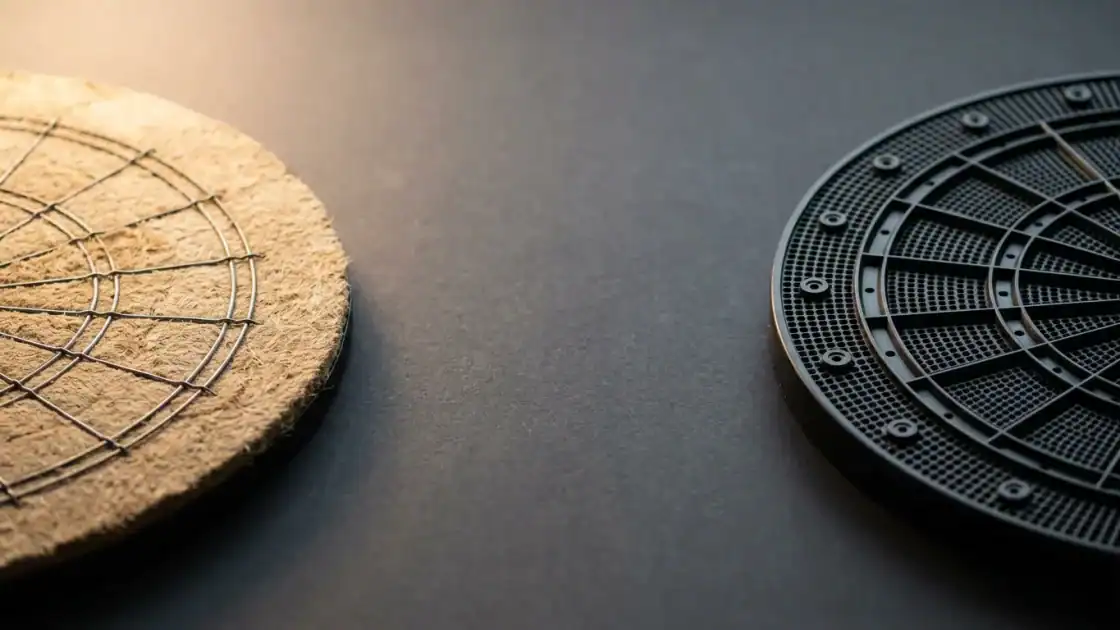
Compressed sisal fibre surface. Blade wire or round wire dividers. Number ring rotates for even wear. Steel tip darts penetrate the fibres and self-heal when removed.
Standard: PDC, WDF, all major competition formats.
Electronic Dartboard
Plastic surface with thousands of small holes. Soft tip darts click into the holes and trigger sensors beneath. Built-in computer calculates scores. Requires mains power or batteries.
Standard: DARTSLIVE, Phoenix (soft tip leagues in USA and Asia).
The construction difference drives every other difference. Sisal fibres grip steel points and close behind them. Plastic holes accept soft tips but reject anything else. You cannot use steel tip darts on an electronic board (they damage the sensors) and soft tip darts will not stick in a bristle board (they bounce off the sisal).

How Does Price Compare?
Bristle boards are cheaper at every quality tier. A competition-grade bristle board like the Winmau Blade 6 costs £35-45 (~$45-57). A competition-grade electronic board like the Arachnid Cricket Pro 800 costs £200-300 (~$255-380). The gap narrows at the budget end – a basic bristle board costs £15-25 (~$19-32) and a basic electronic board costs £40-60 (~$50-75) – but bristle is always less expensive.
Running costs also differ. A bristle board needs no power and no replacement parts. An electronic board needs mains power or batteries, and when plastic segments crack or sensors fail, replacement parts can cost £15-30 (~$19-38) if available at all. Some electronic boards are not repairable – when a segment fails, the board is finished.
Which Lasts Longer?
Bristle boards last longer. A quality bristle board with regular rotation lasts 2-5 years of regular play. The sisal compresses over time in high-traffic areas (treble 20, treble 19), but rotating the number ring spreads the wear. When the sisal eventually dies, the board costs £35-45 (~$45-57) to replace.
Electronic boards have more failure points. The plastic surface cracks under repeated impact, sensors degrade, and the electronics can malfunction. A quality electronic board lasts 1-3 years. Budget models may fail within months. The electronic components are the weak link – the plastic surface can handle the soft tip impact, but the circuitry behind it is vulnerable to dust, moisture, and impact vibration.
How Does Noise Compare?
This is the factor most buyers overlook. Bristle boards are quiet. The dart slides into the sisal with a soft thud. You can play at midnight in a flat without disturbing neighbours. The only noise is the dart hitting the board and the scorer calling the number.
Electronic boards are loud. Each dart impact produces a hard plastic click as the tip hits the surface and snaps into the hole. The built-in speakers play sound effects for scores, checkouts, and sometimes taunting (“heckler” modes). Even with effects turned off, the physical impact noise is sharp and carrying. In a terraced house or flat, an electronic board will be heard through walls.
If you live in a flat, share walls, or play late at night, this single factor should push you toward bristle. No amount of auto-scoring is worth a noise complaint.
How Do Bounce-Outs Compare?
Bounce-outs happen on both board types but for different reasons and at different rates.
On a bristle board, bounce-outs occur when the dart point hits a wire divider. Premium blade-wire boards reduce this to roughly 1-3 bounce-outs per session. Budget round-wire boards bounce more often. The solution is a better board or moveable point darts. For details, see our bounce-out guide.
On an electronic board, bounce-outs occur when the soft tip misses a hole and hits the plastic surface between holes. This happens more often than wire bounce-outs on a quality bristle board. Electronic board manufacturers try to minimise this with tighter hole patterns, but the fundamental limitation of a perforated surface means some darts will always miss the holes. Bounce-outs on electronic boards also do not score – the sensor only triggers when a tip enters a hole.
What About Scoring and Game Variety?
This is where electronic boards have a genuine advantage. Auto-scoring eliminates arithmetic errors and lets you focus on throwing. The built-in computer tracks scores, calculates remaining totals, shows checkout routes, and manages multi-player games automatically. For beginners who do not know the scoring system, this removes a major barrier to entry.
Electronic boards also offer 30-80 built-in game modes beyond standard 501 and cricket. Party games, target challenges, elimination rounds, and practice drills are pre-programmed. This variety makes electronic boards better for social gatherings where not everyone knows how to play traditional darts.
Bristle boards rely on manual scoring (chalkboard, whiteboard, or a scoring app on your phone). This means someone needs to know the rules and do the maths. For experienced players, this is not a burden – it is part of the game. For mixed groups with beginners, it can slow things down. Our checkout calculator and rules guide help bridge the gap.
THE COMPETITION QUESTION
If you want to play in leagues or tournaments, you need bristle.
The PDC, WDF, and every major darts organisation uses bristle boards with steel tip darts. If you practise on an electronic board, your technique will not transfer well because soft tip darts fly differently (lighter, different balance, different release). Practise on the board type you compete on.
Which Is Safer?
Electronic boards are safer. Soft tip darts have plastic points that cannot pierce skin or damage floors and walls. This makes them suitable for homes with young children or for rooms without a surround to catch stray darts. Steel tip darts are sharp metal points that can cause injury if mishandled and will damage walls, floors, and furniture on a miss. A proper surround and backstop eliminate this risk on a bristle setup, but the initial safety advantage goes to electronic. For setup protection, see our surround and lighting guide.
Electronic vs Bristle Dartboard: Full Comparison Table
| Factor | Bristle | Electronic |
|---|---|---|
| Price (quality) | £35-60 (~$45-75) | £100-300 (~$130-380) |
| Dart type | Steel tip (20-26g) | Soft tip (16-20g) |
| Scoring | Manual or app | Automatic |
| Lifespan | 2-5 years | 1-3 years |
| Noise | Quiet thud | Loud plastic click + speakers |
| Bounce-outs | Rare (blade wire) | More frequent (missed holes) |
| Competition | PDC, WDF, all leagues | DARTSLIVE, soft tip leagues |
| Safety | Sharp points – needs surround | Plastic tips – child-safe |
| Game variety | 501, cricket, standard games | 30-80 built-in modes |
| Power required | No | Yes (mains or battery) |
| Running costs | None | Power + replacement segments |
| Wall damage risk | High without surround | Low |
How Does Maintenance Differ?
Bristle boards need almost no maintenance. Rotate the number ring every few weeks to spread wear across the sisal surface. Do not clean with water – just brush off dust with a dry cloth. Do not pull darts straight out – twist gently to let the fibres resettle. A well-maintained bristle board stays playable for years. The only consumable is the board itself when the sisal eventually compresses beyond recovery.
Electronic boards need more attention. Keep the sensor area free of dust – a buildup of dust behind the plastic surface can cause scoring errors. Check that segments are not cracked or loose. Replace batteries regularly if your model is not mains-powered. Some electronic boards allow you to replace individual segments, which extends the board’s life. Others are sealed units where a single segment failure means replacing the entire board.
Soft tip darts themselves need more maintenance than steel tip. Plastic tips break frequently and need replacing every few sessions. Budget for bulk tip packs (100-200 tips for £5-10 / ~$6.50-13). Steel tip darts need only occasional point sharpening – a 30-second job every few weeks. For dart maintenance, see our cleaning guide and point types guide.
How Does the Dart Experience Differ?
Beyond the board itself, the electronic vs bristle dartboard choice changes the feel of the entire game. The darts are different. The throw is different. The feedback is different.
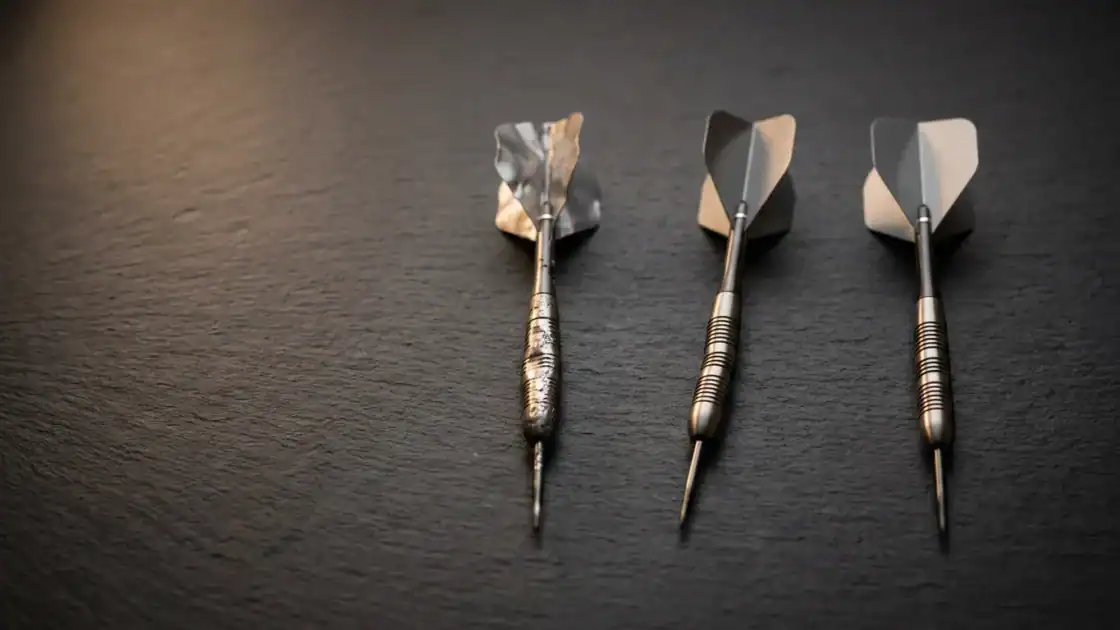
Weight and feel. Steel tip darts for bristle boards weigh 20-26g. They have a solid, substantial feel. The throw is deliberate – you feel the weight carry the dart to the board. Soft tip darts for electronic boards weigh 16-20g. They feel lighter and faster. The throw is quicker and less forceful. Players who switch between the two often struggle with the weight difference – throws calibrated for 24g steel tip darts will overshoot on 18g soft tip darts.
Impact feedback. A steel tip dart landing in sisal produces a satisfying, muted thud. You can feel the dart grip the board through the vibration in your hand when you pull it out. A soft tip dart clicking into a plastic hole produces a sharp, mechanical snap. The satisfaction is different – one is organic, the other is digital. Neither is objectively better, but players who have experienced both almost always prefer the bristle feel.
Scoring accuracy. On a bristle board, the dart stays exactly where it lands. If your dart is on the wire, you can see whether it is in the treble or the single. On an electronic board, the sensor decides. If the tip enters a hole on the boundary between two segments, the sensor in one segment triggers and that score counts. Occasionally the wrong sensor triggers, especially on budget boards with poor alignment. This is rare on quality electronic boards but it does happen.
Grouping visibility. On a bristle board, three darts in the treble 20 are visibly grouped – you can see your accuracy improving over time. On an electronic board, the darts sit flat against the surface (the tips click flush into the holes), making it harder to visually assess grouping. This matters for practice – visual feedback on your grouping is one of the most important learning tools in darts.
What About Wall Space and Setup?
Both board types mount at the same height (bull’s-eye at 1.73m / 5 feet 8 inches from the floor). The throwing distance is different: 2.37m (7 feet 9.25 inches) for steel tip, 2.44m (8 feet) for soft tip. This means a soft tip setup needs slightly more room.
Bristle boards are thinner and lighter. A standard bristle board is roughly 38mm deep and weighs 4-5kg. Electronic boards are thicker (60-100mm deep) and heavier (5-8kg) because of the electronics, speaker, and display. Wall mounting an electronic board requires stronger fixings. Some electronic boards also need a power socket nearby, which constrains placement. For full setup measurements, see how to set up a dartboard.
Bristle boards need a surround to protect the wall from stray steel tip darts. A surround costs £10-20 (~$13-25). Electronic boards do not need a surround because soft tips cannot damage walls. However, electronic boards need a catchment for bounce-outs – soft tip darts that miss the holes fall to the floor, and on hard flooring the tips can snap on impact. A mat or carpet below the board helps.
Who Should Buy a Bristle Board?
Anyone who wants to play competitive darts, practise for league or tournament play, or have the quietest possible setup. Players who value durability and low running costs. Players who already own steel tip darts. Anyone in a flat or terraced house where noise matters. Bristle is also the right choice if you want the premium “feel” of a proper dartboard – the satisfying thud of a dart landing in sisal is part of why people love the sport.
For bristle board recommendations by budget, see our how to choose a dartboard guide. For the complete home setup including bristle board, surround, and lighting, see home darts setup.
Who Should Buy an Electronic Board?
Families with young children where safety is the priority. Social players who want auto-scoring and party game modes. Players in the USA or Asia where soft tip leagues are active. People who find manual scoring tedious or intimidating. Electronic boards lower the barrier to entry and make the game accessible to people who might not otherwise try darts.
If you buy electronic, invest in a quality model (£100+ / ~$130+). Budget electronic boards under £50 (~$65) have poor build quality, inaccurate sensors, and frequent bounce-outs that frustrate rather than entertain.
KEY TAKEAWAY
The electronic vs bristle dartboard choice comes down to one question. Are you playing to improve at competitive darts, or for casual fun? Competitive means bristle. Casual means electronic. Both are valid. But buying the wrong type wastes money.
Can You Have Both?
Yes. Some players mount a bristle board for practice and keep an electronic board for social nights. This makes sense if you compete on bristle but also host game nights where guests prefer auto-scoring. The cost of both (a Winmau Blade 6 at £40 / ~$50 plus a mid-range electronic at £100 / ~$130) is less than a single premium electronic board.
You can also use conversion points to play your steel tip barrels on an electronic board (or vice versa). This lets you keep one set of darts and switch between board types. For conversion point details, see dart point types. For the full differences between steel and soft tip darts, read steel tip vs soft tip.
SCOUT’S TAKE
If you are reading TheDartScout, you are probably serious enough about darts to want a bristle board. Electronic boards are fine products for what they do, but they are a different game. The weight of the darts is different. The feel of the throw is different. The sound is different. If you want to play the game you see on television, that game is played on sisal with steel tip darts. Start there.
Frequently Asked Questions
Can I use steel tip darts on an electronic board?
No. Steel tips damage the plastic segments and electronic sensors. They may also void the manufacturer’s warranty. Use only soft tip darts on electronic boards. If you want to use your steel tip barrels on an electronic board, buy conversion points that replace the steel tip with a plastic one. See dart point types for details.
Which is better for a pub or bar?
Bristle, for three reasons. It is what customers expect. It is what league players need. And it is cheaper to maintain. Most pubs in the UK and Europe use bristle boards. In the USA and Asia, electronic boards are more common in bars because soft tip leagues are popular there. Match the board to the local playing culture.
Do electronic boards improve faster because of auto-scoring?
The auto-scoring removes arithmetic distraction but does not change the physical skill of throwing. You improve by practising your throw, not by having a computer track your score. A phone app on a bristle board gives you the same scoring convenience without the compromises of electronic boards. The best players in the world all practise on bristle.
How noisy is an electronic board compared to bristle?
An electronic board produces roughly 70-80 decibels per dart impact (comparable to a loud conversation). A bristle board produces roughly 40-50 decibels (a quiet room). The electronic board’s built-in speaker adds further noise on top of the physical impact. If noise is a concern in your living situation, bristle is the clear choice.
Can I convert an electronic board to accept steel tips?
No. The plastic surface would be destroyed by steel tips within a few throws. The holes would crack open and the sensors would be damaged beyond repair. If you want to play steel tip, you need a bristle board. The only crossover option is conversion points on your darts – these let you use the same barrel on both board types by swapping the point. See dart point types for conversion options.
What is the best electronic vs bristle dartboard choice for a beginner?
If you are starting alone and want to learn proper darts, buy a bristle board (a Winmau Blade 6 at £35-45 / ~$45-57 is the best value). If you are buying for a family games room where multiple people of different skill levels will play, an electronic board makes the experience smoother because nobody needs to know how to score. The auto-scoring removes the steepest learning curve for non-players while still teaching the fundamentals of aiming and throwing.
Do professional players ever use electronic boards?
In the PDC and WDF circuits (televised darts you see on Sky Sports and ITV), only bristle boards are used. However, there are professional soft tip circuits in Japan and parts of Asia. DARTSLIVE and Phoenix run competitive leagues with prize money. These use specialised electronic boards that are far more advanced (and expensive) than consumer models. If you live in the UK or Europe, professional darts means bristle. If you are in Japan or parts of the USA, soft tip has a competitive scene.
For bristle board recommendations, see how to choose a dartboard. For the full home setup, read home darts setup and surround and lighting. For dart type differences, see steel tip vs soft tip. For mounting and distances, check how to set up a dartboard. New to darts? Start with the beginner’s guide.