QUICK ANSWER
Flights stabilise the dart. Shafts control how much.
Bigger flights and longer shafts increase stability and drag. Smaller flights and shorter shafts reduce both. The restoring torque that keeps a dart flying point-first follows a simple equation: force × distance. This article explains the physics, traces the engineering from turkey feathers to polymer wings, and shows why you cannot tune one component without considering the other.
Every dart has a problem. Its centre of gravity sits in the barrel – toward the front – but it is released imperfectly, with some degree of wobble, tilt, or yaw. Without correction, that wobble would amplify across 2.37 metres of flight and the dart would tumble into the board sideways. The dart flights and shafts exist to prevent that. They are not decorative. They are an engineering solution to an aerodynamic instability problem, and the solution has been refined for over two hundred years.
A Brief History – From Turkey Feathers to Polymer Wings
The earliest darts used three or four split turkey feathers bound to a wooden barrel as flights. These feathers did the same job that modern polymer flights do – they added drag behind the centre of gravity. The problem was consistency. Feathers warped, frayed, and absorbed moisture. A dart that flew well on Monday might wobble on Thursday.
In 1898, American inventor Nathern P. McKenney patented the first paper flight. Commercial paper flights appeared in the 1930s with pre-gummed adhesive, but they tore easily and lasted days rather than weeks. The real breakthrough came in 1949, when the Unicorn Dart Company introduced a screw-threaded plastic adaptor for the shaft-to-barrel connection. This solved the atmospheric swelling problem that had plagued wooden spigots for decades. By the mid-twentieth century, fully moulded plastic flights became standard, and the modern system of separate interchangeable flights and shafts was born.
The materials have changed – polyester, nylon, foil, rip-stop composites – but the engineering principle is identical to the turkey feathers. Create enough drag behind the centre of gravity to keep the point facing forward. Understanding how dart flights and shafts evolved explains why modern setups work the way they do.
How Do Flights Keep a Dart Flying Straight?
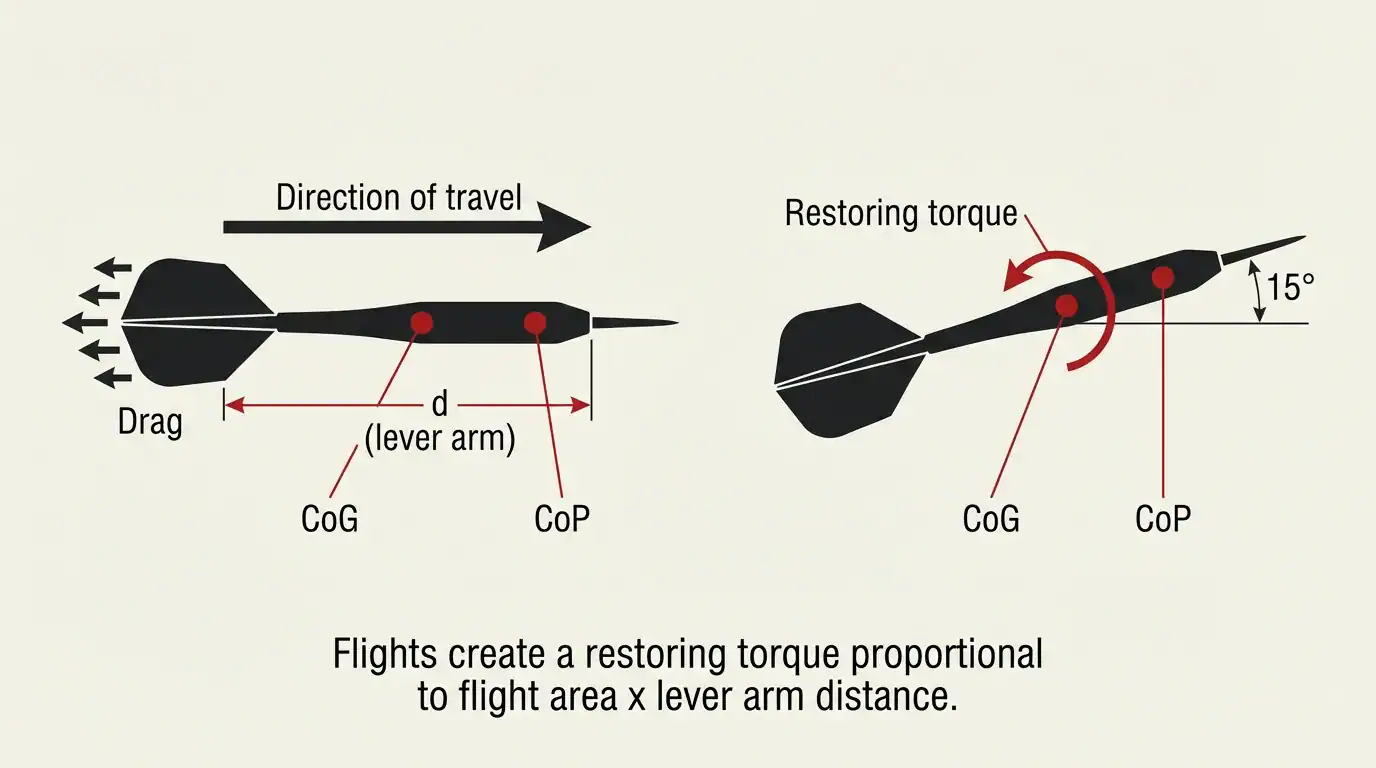
A dart in flight behaves like a weather vane. The flights sit at the rear, where they interact with oncoming air. When the dart’s axis is perfectly aligned with its direction of travel, the flights create pure drag – slowing the dart down but not changing its orientation. When the axis is misaligned – even by a few degrees – the flights create an asymmetric force that produces a restoring torque around the centre of gravity. This torque rotates the dart back toward alignment.
The physics reduces to a single relationship:
Restoring torque ≈ Fdrag × d
Where Fdrag is the aerodynamic drag force on the flights. It scales with surface area, airspeed squared, and angle of attack. d is the distance between the centre of pressure on the flights and the centre of gravity in the barrel. This distance is the lever arm. It is the single most important variable in dart aerodynamics, and it is controlled almost entirely by shaft length.
Academic research published in Sports Engineering found that a dart’s pitch oscillates during flight in a pattern analogous to damped harmonic motion. A well-tuned dart shows rapid damping – the wobble dies out before the dart reaches the board. A poorly tuned dart shows persistent oscillation, arriving at the board with its axis still swinging. The damping rate depends directly on flight area and lever arm length.
KEY TAKEAWAY
A dart self-corrects because its flights generate a restoring torque proportional to flight surface area multiplied by the lever arm distance from the flights to the centre of gravity. Increase either variable and the dart corrects more aggressively – but also decelerates faster.
What Does Each Flight Shape Do to the Air?
Flight shapes are not cosmetic. Each shape represents a different tradeoff between drag force, correction strength, and the physical space the flight occupies in the board.
| Shape | Approx. Size | Surface Area | Drag | Stability |
|---|---|---|---|---|
| Standard | 44 × 35 mm | ~15 cm² | High | Maximum |
| Kite | 38 × 30 mm | ~11 cm² | Medium-high | Good |
| Slim | 44 × 24 mm | ~9 cm² | Medium-low | Moderate |
| Pear | 32 × 24 mm | ~7 cm² | Low | Minimal |
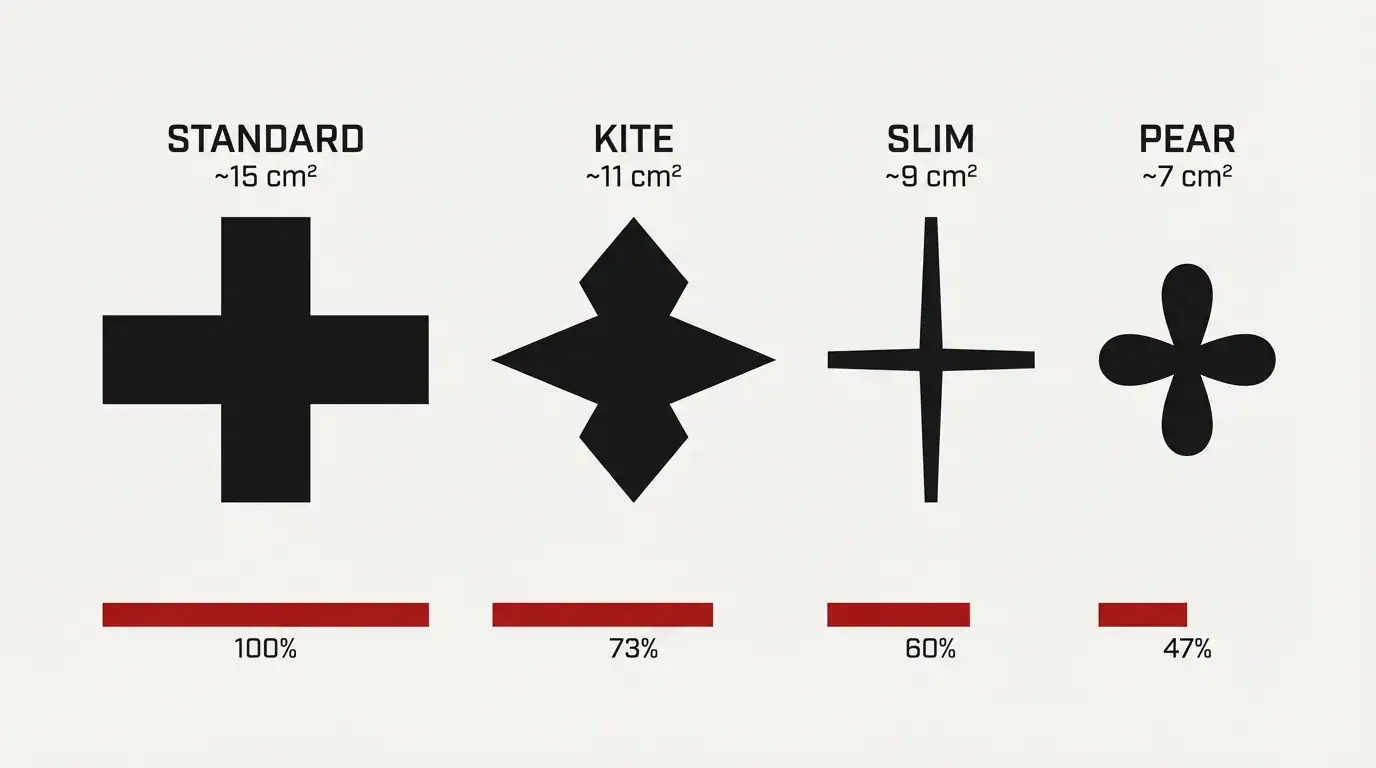
Halving the flight area roughly halves the restoring torque. But it also halves the drag that slows the dart, meaning the dart arrives at the board faster. For hard, flat throwers, less drag is desirable. For slower, more parabolic throws, the additional correction time that drag provides is essential.
Shape matters beyond raw area. Standard flights concentrate their width at the maximum lever arm distance – the widest point is at the trailing edge, furthest from the barrel. Slim flights are tall but narrow, presenting less frontal surface to incoming darts and reducing deflections when grouping tightly. According to TheDartScout’s review of forum discussions on DartsNutz, deflection reduction is the primary reason competitive players switch to slim flights – not aerodynamics.
How Does Shaft Length Control the Lever Arm?
If flights control Fdrag in the torque equation, shafts control d. A longer shaft pushes the flights further from the barrel, increasing the lever arm and amplifying the restoring torque without changing the flight itself.
| Length | Approx. mm | Effect on Stability | Typical Entry Angle |
|---|---|---|---|
| Extra short | ~25 mm | Least stable | Steep (tips up) |
| Short | ~32 mm | Low | Moderate-steep |
| Medium | ~41 mm | Balanced | Moderate |
| Long | ~52 mm | Most stable | Flat (can droop) |
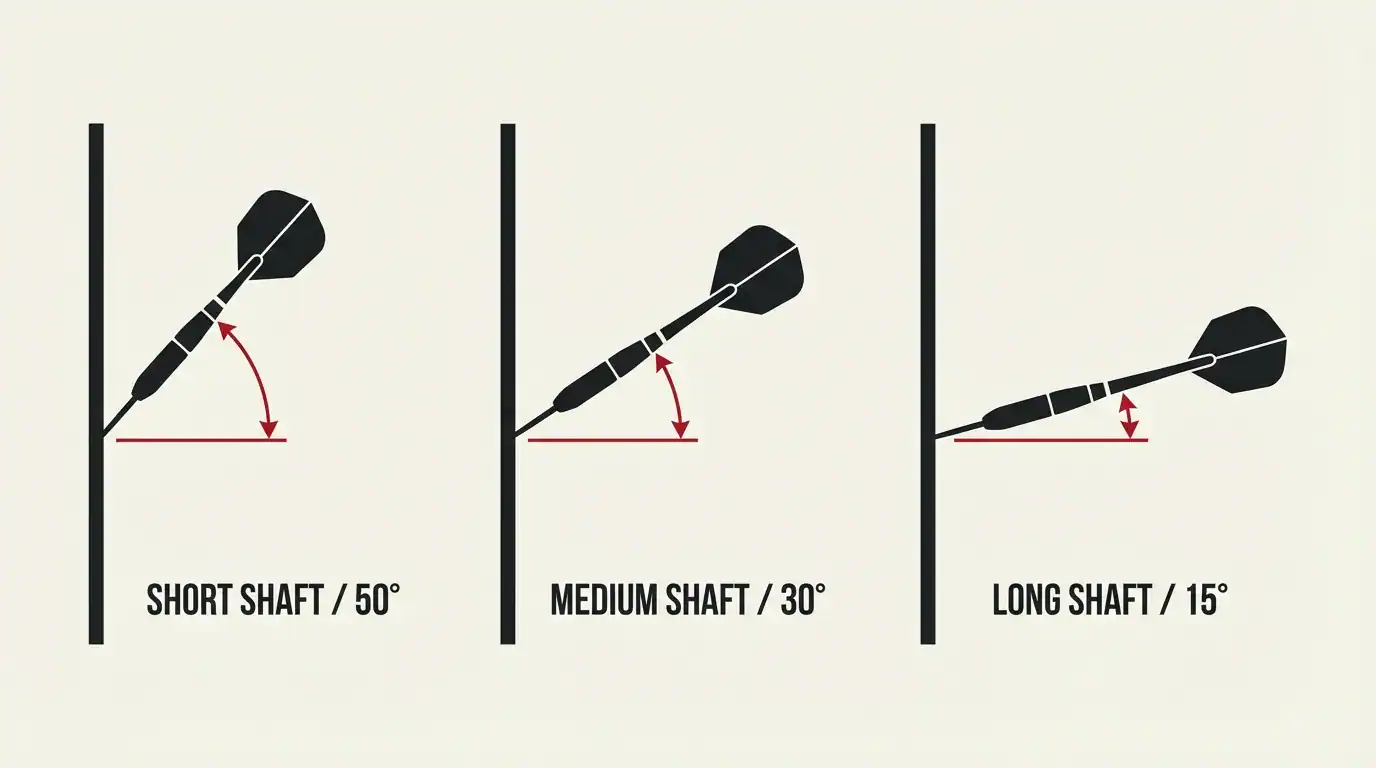
Real players on the DartsNutz forum report that short shafts held at the back of the barrel cause darts to stick upward at steep angles, blocking the treble 20 bed for subsequent throws. Longer shafts produce flatter entry angles but add a slight swirling motion in flight. One experienced player summarised it: “Stem length depends on so many factors – dart length, balance, flight shape, where you grip, arc of your throw, how hard you throw.”
According to TheDartScout’s analysis of the tuning framework published on Dartbase, the key diagnostic is not the entry angle itself. It is the consistency of the angle across throws. When darts stick at widely varying angles, the flight-shaft combination is producing unstable oscillation. Start with medium-length nylon shafts and standard flights. Adjust one variable at a time.
Why You Cannot Tune One Without the Other
Dart flights and shafts are two halves of a single aerodynamic system. Changing one without adjusting the other can make performance worse, not better. A large standard flight on a short shaft produces high drag but a small lever arm – the dart corrects weakly despite the drag. A slim flight on a long shaft produces a large lever arm but minimal drag – the correction force is too small to matter. The system works when drag force and lever arm are balanced against the barrel’s weight distribution and the thrower’s speed.
There is also the grouping problem. Thicker flights (150 micron) are durable but cause subsequent darts to deflect on impact. Thinner flights (75–100 micron) allow darts to slide past each other. Spinning shafts address deflection specifically – the flight rotates out of the way when struck – but they do not change the dart’s aerodynamic behaviour in flight.
SCOUT’S TAKE
Start with medium shafts and standard flights. Throw fifty darts and watch the entry angles. If they vary wildly, the dart is oscillating – try a longer shaft. If they are consistent but too steep, switch to a smaller flight. Change one variable at a time. The physics is real, but at 2.37 metres, your release consistency matters more than your flight choice.
Frequently Asked Questions
Do dart flights actually make a measurable difference?
Yes. Academic research confirms that flight area and shaft length directly control dart pitch oscillation. Changing either variable physically changes how the dart behaves in flight. But at 2.37 metres, your release consistency matters more than equipment choice for most players.
Why do most PDC professionals use small flights?
Professionals have extremely consistent releases, so they need less aerodynamic correction. Smaller flights reduce drag and present less surface for deflections when grouping tightly in the treble bed. They can afford minimal stability because their throw provides it mechanically.
Can a longer shaft compensate for a smaller flight?
Partially. A longer shaft increases the lever arm in the restoring torque equation, compensating for reduced drag from a smaller flight. But it also shifts the centre of gravity rearward, changing the static margin and balance feel. It is not a one-to-one tradeoff.
Why do darts wobble in flight?
Wobble is damped harmonic oscillation. The dart is rarely released with its axis perfectly aligned to its velocity. The resulting angle of attack creates a restoring torque from the flights, which overcorrects, producing oscillation. In a well-tuned setup, this oscillation damps out before reaching the board.
Does the shaft material affect the dart’s flight path?
Minimally. Material affects weight and durability, not aerodynamics. A heavier aluminium shaft shifts the centre of gravity slightly rearward. This reduces entry angle, but the change is marginal. The real difference is lifespan: carbon shafts outlast nylon by years. Deflection behaviour on impact also varies by material.
To choose the right flights, read how to choose flights. For shaft selection, see how to choose shafts. If your darts wobble, check why darts wobble in flight. To tie it all together, read consistent dart throw., see our dart barrel shapes guide. For the material tradeoff between barrel types, read tungsten vs brass darts. And for choosing the right barrel weight – which directly affects the flight-shaft balance – our dart weight guide covers the data. For choosing the right flight on its own, see how to choose dart flights. For specific product recommendations, see our best dart flights guide. Our article on how to choose dart flights. For how grip style changes the way flights stabilise your dart, see our grip styles guide. If you want to dive deeper into shaft materials, lengths, and lock systems specifically, read our dedicated guide on how to choose dart shafts. To know when your flights need swapping, read when to replace dart flights. Brand new to darts? Start with our beginner’s guide. For game rules and scoring, see dart rules explained. To tie it all together, read our guide to a consistent dart throw. If your darts wobble, see why darts wobble in flight.