QUICK ANSWER
The three most damaging common darts mistakes are gripping too tight (which sends tension up your arm and ruins your release), moving your body during the throw (creating a different launch angle every time), and changing technique before it has enough repetitions to work. Every other mistake on this page traces back to one of these three.
Most beginners who plateau aren’t missing because they lack talent. They’re missing because they’re repeating the same three or four mistakes session after session, and nobody has ever named them clearly enough to fix.
This guide covers the most common darts mistakes -not just what they are, but why they happen and what one change actually fixes each one. The biomechanics here come from a combination of professional coaching principles and the most detailed technical analysis of dart throwing mechanics available online.
Why Do Beginners Keep Making the Same Mistakes?
Because darts feels simple. You pick up a dart, you throw it. There’s no coach watching, no feedback loop beyond “hit or miss.” The natural instinct when something goes wrong is to throw harder or aim differently -neither of which addresses the root cause.
The other problem is that darts technique is invisible to the thrower. You can’t see your own elbow drop, your grip tighten, or your body shift mid-throw. You just see where the dart lands. And “I missed left” doesn’t tell you whether the problem was aim, release, stance, or something in between.
The common darts mistakes below are ordered by how early in the throwing motion they occur -so grip comes before stance, stance before the throw, throw before release. Fix them in that order and each correction makes the next one easier.
Are You Gripping the Dart Too Tight?
The death grip is the single most common mistake in darts, and the hardest to self-diagnose because it feels like control. Gripping the dart tightly feels stable. It isn’t. When you tighten your fingers beyond what’s needed to hold the dart, the tension travels up through your wrist and into your forearm and shoulder. What felt like control in your fingers becomes rigidity in your whole arm.
The result is a jerky, inconsistent release. The dart doesn’t fly -it gets launched. And because the tension varies slightly between throws, the launch angle changes every time even when your aim is identical.
The correct grip is firm enough that the dart can’t move between your fingers, but loose enough that you feel no tension in your forearm. If you can’t feel the difference, try this: pick up the dart and squeeze it as hard as you can for three seconds. Feel the tension in your arm. Now relax until the dart is just resting in your fingers. That’s the target grip pressure -much lighter than most beginners use.
KEY TAKEAWAY
If your darts are flying erratically rather than missing consistently in one direction, grip tension is the likely cause. A consistent miss pattern (always left, always low) points to aim or stance. Random scatter points to grip or release.
Read the full breakdown of grip types and finger positions in the dart grip styles guide -it covers pencil, claw, and palm grips with the biomechanics of each.
Is Your Stance Costing You Accuracy?
Your stance is the platform your throw launches from. If it moves -even slightly -between darts, you’ve changed the launch position without changing your aim. The dart goes somewhere different every time.
The most common stance mistake isn’t using the wrong position -it’s using an inconsistent one. Beginners shift their weight, lean further forward as they warm up, or angle their feet differently each visit to the oche. None of these feel significant. All of them affect where the dart lands.
Pick a stance and lock it in. The standard starting point: lead foot on the oche at roughly 45 degrees to the board, dominant shoulder pointing toward the target, weight slightly forward on the front foot. But the exact angle matters less than repeating it identically every time.
One useful mental model: treat your body as a gun turret. The turret is fixed -it doesn’t sway or lean. To adjust aim, you rotate the whole turret (adjust your stance angle), not tilt the barrel. In darts, if you’re missing left consistently, adjust your stance slightly rather than changing your aim. The throw stays the same; the platform rotates.
Are You Aiming with Your Whole Arm?
The arm in darts is not a catapult. It’s a hinge. The elbow is the pivot point -the upper arm holds position while the forearm swings forward, driven by a relaxed shoulder. When beginners try to “aim” the dart by moving their elbow outward or inward during the throw, they convert the pendulum into something much less predictable.
Elbow drop is the most visible version of this mistake. The elbow starts high and falls during the throwing motion, sending the dart upward at an unintended angle. It usually happens as a compensation. Either the grip is too tight and the wrist can’t flex naturally, or the thrower is trying to add power and the shoulder dips to generate force.
There’s also a subtler version: parallax error. The most detailed technical analysis of dart throwing mechanics available dedicates an entire section to this. Your throwing arm is positioned to the right of your eye line (if you’re right-handed), but you’re sighting with your left eye. The dart goes where your arm points, not where your eye points. These aren’t aligned. Closing your non-dominant eye during aiming -or training yourself to sight along the throwing arm -corrects this systematically, rather than unconsciously compensating with arm movement on every throw.
KEY TAKEAWAY
If you want to diagnose whether your problem is aim or release, try the half-distance drill: stand at 4 feet from the board and throw gently. At this range, trajectory and distance compensation drop out. If your groupings tighten sharply at half distance, your issue is release -you’re compensating for the distance in ways that introduce inconsistency. If groupings are just as scattered, the problem is earlier: grip or elbow movement.
Is Your Follow-Through Cutting Short?
A dart throw doesn’t end when the dart leaves your hand. It ends when your throwing arm is fully extended, fingers pointing at the target. Stopping early -collapsing the wrist, dropping the arm, or pulling back -disrupts the release arc in the final milliseconds when the dart is still in contact with your fingers.
But poor follow-through is usually a symptom rather than the root cause. If you’re cutting the follow-through short, something earlier in the motion is triggering it. Common culprits: grip tension that makes the wrist lock before release, or elbow drop that shifts the angle so the natural follow-through direction feels wrong.
Fix the grip and the elbow first. If the follow-through is still short after those are sorted, work on it consciously: hold the pose after each throw, arm fully extended, for a full second before dropping it. It feels theatrical but it retrains the motion.
The how to hold a dart guide covers the full release sequence in detail, including finger position at the point of release and how different grips affect the follow-through angle.
Why Does Changing Your Throw Mid-Session Backfire?
This is the most damaging long-term mistake on this list, and the hardest to resist. You’re throwing badly. Something feels off. So you adjust -change your stance slightly, loosen your grip, try a different release point. And it works, for about six throws. Then it falls apart again.
What’s happening: you’re evaluating a technique change on too few repetitions. Muscle memory doesn’t encode in six throws. It needs hundreds. When you abandon a change after a few misses, you never give it enough repetitions to stabilise. You keep cycling through adjustments, never staying with any long enough to know if it works.
The rule: make one change per session. Commit to it for the entire session, regardless of results. Only evaluate after 200-300 throws. If a technique change genuinely improves your game, it will show up clearly over that volume. If you’re still making random mid-session adjustments, you’re not practising -you’re searching.
This principle is central to the consistent dart throw guide, which covers how to build a repeatable motion from stance through follow-through.
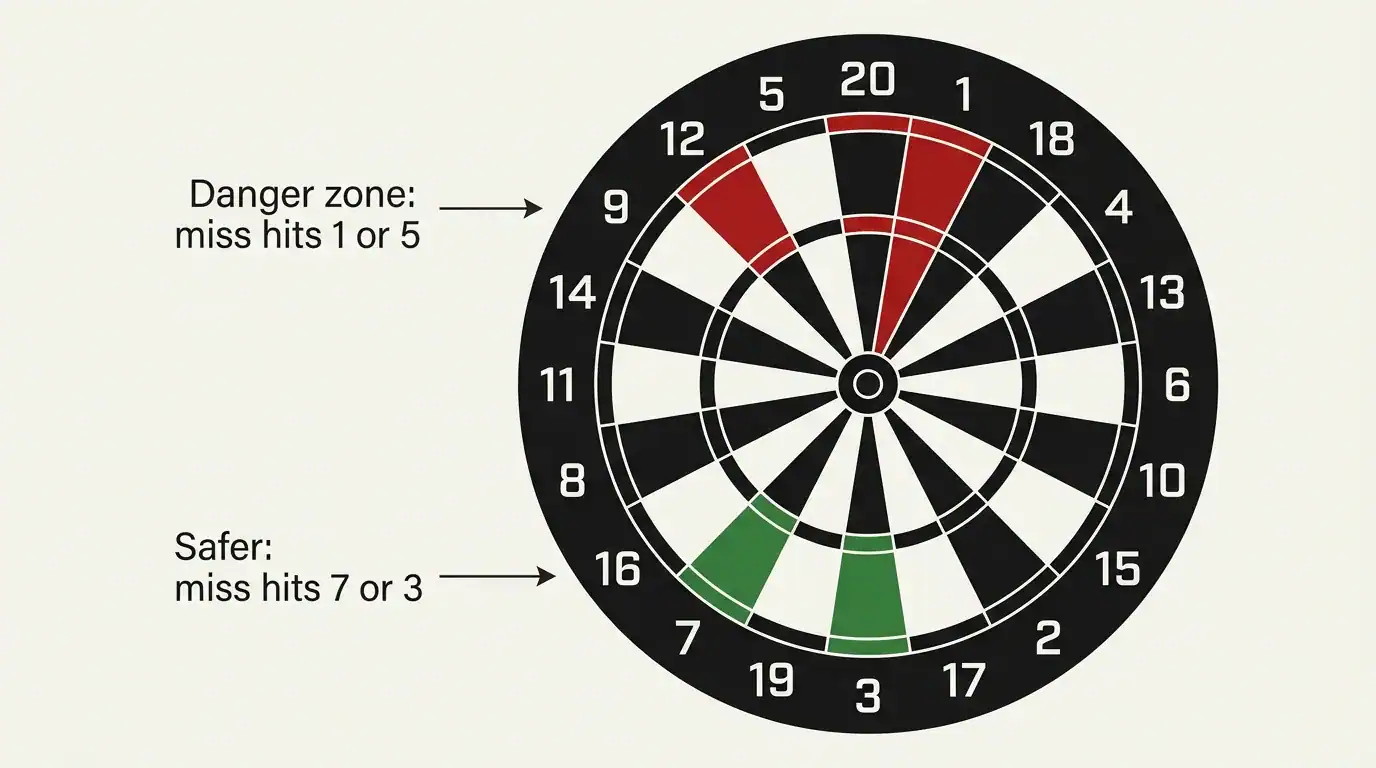
Are You Always Aiming at Treble 20?
THE T20 TRAP
Treble 20 miss penalties
Miss left → 1
Miss right → 5
Average bad miss: 3
Treble 19 miss penalties
Miss left → 7
Miss right → 3
Average bad miss: 5
Treble 20 is the highest-scoring segment on the board -if you hit it. The numbers on either side are 1 and 5. Miss left or right and you’ve scored 1 or 5 points with a dart. Treble 19 has 7 and 3 on either side. A bad miss at T19 still scores 7 -more than a direct hit on T20’s worst neighbour.
Players averaging under 70 points per dart visit are missing trebles more often than hitting them. For these players, T19 is mathematically the better primary target. The switch to T20 as a default target makes sense when you’re consistent enough to be rewarded by the treble more than you’re punished by the miss.
More broadly: doubles practice is neglected by almost every beginner. A player averaging 55 who hits 40% of doubles will win more legs than a player averaging 65 who hits 20% of doubles. Checkout rate converts scoring into wins. Score more in practice, yes -but book one third of your practice time for doubles only.
Are You Using the Wrong Equipment?
Darts equipment doesn’t make a bad thrower good, but the wrong setup can make a good thrower inconsistent. Two mistakes show up repeatedly.
The first: copying a professional’s setup without matching their throw style. If you have a fast, hard throw and you pick up Phil Taylor’s 26g darts because he’s the greatest of all time, you’ll fight the weight every throw. Heavy darts suit relaxed, smooth throwing styles. Lighter darts suit faster, more active throws. The dart should feel like it’s helping the motion, not resisting it.
The second: changing too many things at once. If you buy new darts, change the barrel shape, fit longer stems and smaller flights simultaneously, you have no idea which variable fixed or broke your throw. Change one thing at a time, in this order: weight first, then barrel shape, then stem length, then flight size. Give each change at least two full sessions before evaluating.
The dart weight guide explains how to match weight to throwing style with a simple diagnostic. And the barrel shapes guide covers how geometry affects grip point and release -the two variables beginners get wrong most often.
Do You Track Your Progress?
Casual practice -just throwing and playing -doesn’t create a feedback loop. You’ll improve slightly in the early weeks because everything is new, and then plateau. The plateau isn’t inevitable; it’s the product of practising without targets.
The minimum viable tracking system: pick a single metric to measure each session. Most beginners should use doubles conversion rate -the percentage of doubles attempts you convert. Not scoring. Not hitting T20. Doubles, because that’s what wins legs.
Record it in your phone after each session. A number, a date. After four weeks, look at the trend. If it’s flat or declining, something in your technique or practice structure needs to change. If it’s improving, keep doing what you’re doing. Without the number, “I feel like I’m getting better” is the only feedback you have -and it’s wrong at least half the time.
The solo practice guide has structured drills with built-in scoring targets for every skill level, including specific doubles drills that will give you a meaningful percentage to track.
For a deeper practice framework covering volume, structure, and progression, the dart accuracy guide lays out how to build deliberate practice sessions rather than casual ones.
SCOUT’S TAKE
“The mistake that takes longest to fix isn’t grip or stance -it’s impatience with technique. Every player I’ve seen plateau for years has the same pattern: they find a new thing to try every three weeks, hit a few good throws, declare it working, then abandon it when results dip. Technique changes need 500 repetitions before you can evaluate them honestly. Most players give them 50. The players who improve fastest are the ones who commit to a single change, track one metric, and sit with discomfort long enough to find out whether the change actually works.”
– James Whitmore, TheDartScout
500+
repetitions before a technique change can be evaluated
1
change per session -never more
T19
better primary target below 70 ppd average
Common Darts Mistakes -Summary
| Mistake | Root cause | One fix |
|---|---|---|
| Death grip | Feels like control, creates arm tension | Grip only as tight as needed to hold the dart |
| Moving body mid-throw | No locked stance routine | Pick a foot position, repeat it identically every throw |
| Elbow drop | Compensating for grip tension or generating power from shoulder | Keep upper arm still, let forearm swing as the pendulum |
| Short follow-through | Grip tension locks the wrist before release | Hold the extended pose for 1 second after each throw |
| Changing throw mid-session | Evaluating changes on too few reps | One change per session, commit for 200-300 throws |
| Always aiming T20 | T20 is the “right” answer but the wrong answer for inconsistent throwers | Switch to T19 until you’re averaging 70+ ppd |
| Copying pro equipment | Assuming what works for a pro works for everyone | Match weight and shape to your throw style, not someone else’s |
| Practising without targets | No feedback loop = no improvement signal | Track doubles conversion rate after every session |
Frequently Asked Questions
How do I know if I’m gripping the dart too tight?
Check your forearm during the throw. If you can see or feel muscle tension above your wrist, the grip is too tight. Another sign: darts that scatter randomly rather than missing in a consistent direction. Random scatter means each throw has a different grip pressure -systematic misses (always left, always low) are more likely to be aim or stance.
Should I keep my eyes open or closed when aiming?
Both eyes open is fine for most players, but be aware of parallax -your throwing arm and your sighting eye aren’t in the same position. If you’re right-handed and sight with your left eye, the dart lands slightly left of where you’re aiming. Close the non-dominant eye during practice to recalibrate, or learn to sight along the throwing arm instead.
Is treble 19 really better than treble 20 for beginners?
Yes, for players averaging under 70 points per visit. The neighbours of T20 are 1 and 5. The neighbours of T19 are 7 and 3. A bad miss at T19 scores more than a bad miss at T20. Once you’re hitting T20 more than 40% of the time, switch back to it as your primary target.
How long should I stick with a grip or stance change before I know if it’s working?
At minimum, one full session of 200-300 throws. Ideally two sessions. Muscle memory doesn’t encode in a handful of throws -the first session will usually feel worse because you’re fighting established patterns. Only evaluate after the second session shows a clear trend, positive or negative.
What weight dart should I start with to avoid the equipment mistake?
24-26g is the safe starting range for steel tip darts. Heavier darts suit relaxed, smooth throwing styles; lighter darts suit faster throws. Don’t change weight by more than 2g at a time, and don’t change anything else simultaneously. See the dart weight guide for the full diagnostic.
How do I diagnose whether my problem is aim or release?
Use the half-distance drill. Stand at roughly 4 feet from the board and throw gently. At this distance, trajectory and distance compensation are minimal. If your groupings tighten sharply at half distance, your issue is release -you’re compensating for the full distance in ways that add variability. If groupings are just as scattered at 4 feet, the problem is earlier: grip or elbow movement during the throw.
The most common darts mistakes all share one cause: doing something inconsistent and not knowing it. Fix the grip first -it costs nothing and touches every other part of the throw. Lock in your stance second. Then work through the throwing motion from elbow to follow-through. And track one metric so you know whether any of it is working.
For a complete throwing method to build from scratch, the TheDartScout consistent dart throw guide covers the full sequence. If you want structured drills to put the fixes into practice, the solo practice guide has sessions with built-in scoring targets. And when you start converting more doubles, use the checkout calculator to get the right finish routes for every score.