Most guides on how to choose dart weight say the same thing: start at 22–24g and see how it feels. That’s not wrong. But it skips the useful part. It doesn’t explain why 22g feels different from 24g in your hand. It doesn’t show what changes inside the barrel when you add two grams. And it ignores how the pros ended up at weights ranging from 18g to 32g.
This guide works from data instead. TheDartScout pulled verified weights from 15 PDC player profiles, barrel specs from manufacturer product pages, and weight limits from competition rules. You’ll learn how weight changes a dart’s size, what the top players throw, and where the real gaps in weight advice are.
QUICK ANSWER
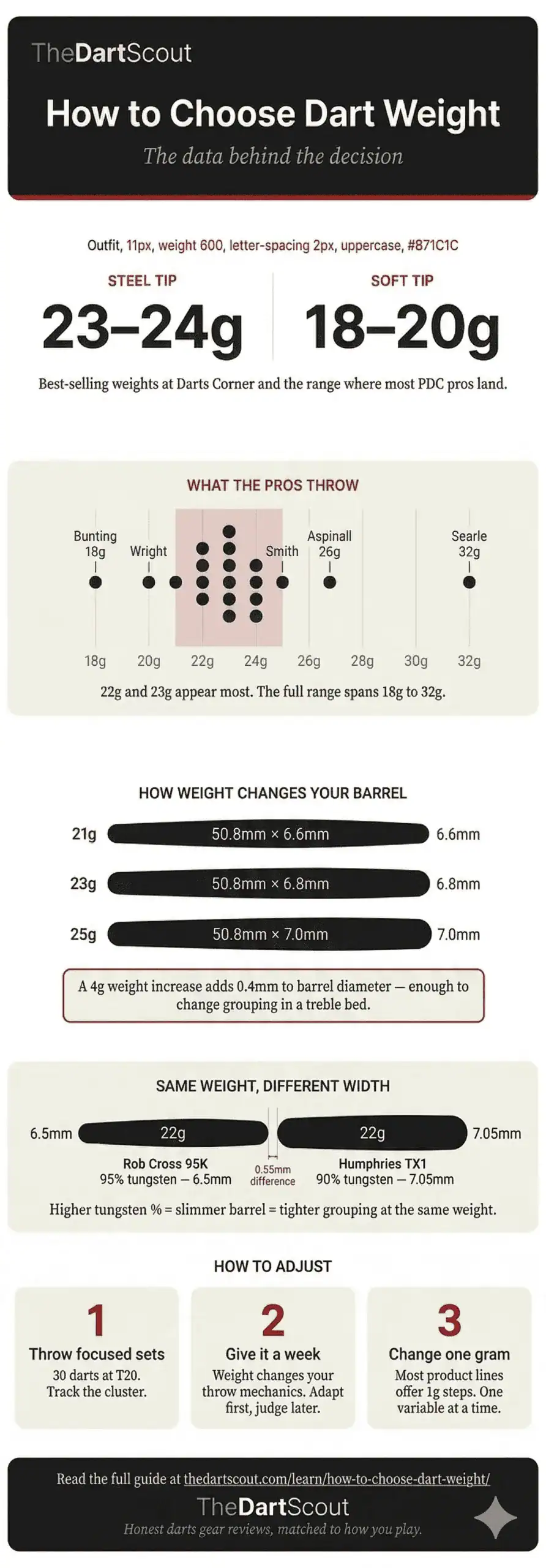
Start at 23–24g for steel tip. Start at 18–20g for soft tip.
Those are the best-selling weights at major retailers and the range where most PDC professionals land. According to TheDartScout’s verified data, the pro average sits at 22–23g, but the full range runs from 18g (Bunting) to 32g (Searle) – so there is no single correct weight.
Pick your starting weight. Throw focused sets for a week. Adjust by 1g based on your grouping. The rest of this guide shows you the data behind that advice.
What “dart weight” means
In competition, dart weight covers the full assembly: point, barrel, shaft, and flight. Both the World Darts Federation and the Darts Regulation Authority define a dart as the point, barrel, and “flighted stem.” Their weight limit applies to that full unit – not the barrel alone. DARTSLIVE’s tournament rulebook states it plainly: each dart shall not exceed 25 grams in total weight.
This matters when you compare specs. When a manufacturer lists a dart at 23g, they mean the barrel. The full assembled dart weighs 1–3g more once you add a shaft and flight.
Competition weight limits
| Format | Governing body | Max weight | Max length | Tip |
|---|---|---|---|---|
| Steel tip | WDF / DRA | 50g | 30.5 cm | Metal point |
| Soft tip | DARTSLIVE | 25g total | 30 cm | Plastic only |
| Soft tip | THE WORLD | 25g total | 30 cm | Plastic only |
The 50g steel-tip cap never comes into play – no mainstream dart gets close. The 25g soft-tip cap is the real constraint. It shapes which products exist in that format.
What Weight Range Do Most Darts Come In?
Darts Corner, one of the largest darts retailers, reports their best-selling steel-tip weights as 22g, 23g, and 24g. For soft tip, 18g and 20g lead sales. That cluster shows where most players settle – and it lines up with what the pros throw.
What the pros throw – 15 PDC players verified
Every weight below comes from the player’s official PDC profile. We matched barrel specs from each manufacturer’s product page. Where we could not verify a barrel model from the manufacturer, we marked it.
| Player | Weight | Brand | Barrel profile | Material |
|---|---|---|---|---|
| Luke Littler | 23g | Target | Multi-grip (Dual Pixel + radial groove) | 90% tungsten |
| Luke Humphries | 22g | Red Dragon | Torpedo, front-weighted | 90% tungsten |
| Michael van Gerwen | 22g | Winmau | Parallel, centre-weighted | 90% tungsten |
| Gerwyn Price | 23g | Red Dragon | Scallop (model-dependent) | 90% tungsten |
| Gary Anderson | 23g | Unicorn | Model-dependent by Phase edition | 90% tungsten |
| Rob Cross | 22g | Target | Straight | 95% tungsten |
| Peter Wright | 21g | Red Dragon | Model-dependent | 90% tungsten |
| Stephen Bunting | 18g | Target | Front-loaded, tapered | 95% tungsten |
| Ryan Searle | 32g | Harrows | Tapered | 90% tungsten |
| Nathan Aspinall | 26g | Target | Tapered front | 95% tungsten |
| Jonny Clayton | 22g | Red Dragon | Specialist, tapered front | 90% tungsten |
| Danny Noppert | 23g | Winmau | Centre-weighted | 90% tungsten |
| Michael Smith | 24g | Shot | Centre-weighted | 90% tungsten |
| Damon Heta | 23g | Harrows | Front-tapered | 90% tungsten |
| Dave Chisnall | 22g | Harrows | Parallel | 90% tungsten |
What the data shows
Most of these 15 players throw between 21g and 24g. The most common weights are 22g and 23g. A retailer analysis of the 2023 PDC rankings confirmed 23g as the top weight at that level.
But the range matters as much as the average. Stephen Bunting competes at 18g. Ryan Searle throws 32g – and went to 34g at the 2023 World Matchplay. Nathan Aspinall sits at 26g. These are not novelty picks. They are weights refined over years of competition.
One precision note: Michael van Gerwen’s PDC profile lists 22g, but a retailer analysis put his barrel at 21.5g. Published weights can differ from true weight due to rounding.
KEY TAKEAWAY
There is no single correct weight at the top of the sport. Fifteen of the world’s best span 18g to 32g. Any guide that hands you one right answer based on body type or grip style is filling in blanks the data doesn’t support.
How Does Weight Change a Dart Barrel’s Dimensions?
This is the detail that matters most when learning how to choose dart weight – and most guides skip it. When a manufacturer adds grams to a barrel in the same tungsten percentage, the mass has to go somewhere. The barrel gets thicker, longer, or both. The change is small in millimetres but real in your hand. It also affects how tight three darts can group in a treble bed.
Here’s what the manufacturer specs show across four product lines.
Rob Cross 95K SP (95% tungsten)
Target keeps barrel length at 48mm and adds diameter per weight step. The 21g barrel is 6.4mm wide. At 22g it’s 6.5mm. At 23g it’s 6.6mm. Same length, wider barrel.
Luke Littler G1 SP (90% tungsten)
Target uses a mixed approach. The 22g barrel measures 50mm × 6.5mm. At 23g they stretch it to 52mm but hold the 6.5mm diameter. At 24g the length stays at 52mm and the diameter grows to 6.65mm. They added weight first by length, then by width.
Gerwyn Price Iceman Contour (90% tungsten)
Red Dragon holds length at 50.8mm across all three weights. Only the diameter changes: 6.6mm at 21g, 6.8mm at 23g, 7.0mm at 25g. A 4g increase adds 0.4mm to the widest point.
Luke Humphries TX1 Pioneer (90% tungsten)
Red Dragon holds length at 43.2mm. Diameter steps from 7.05mm at 22g to 7.50mm at 24g. That’s nearly half a millimetre wider for 2g more weight.
WHY THIS MATTERS
Grouping is a geometry problem
A 2g weight increase can add 0.2–0.5mm to barrel diameter. That sounds small. Multiply it by three darts in a treble segment and it isn’t. Slimmer barrels give you more clearance. This is one reason tungsten percentage matters: Rob Cross’s 22g barrel at 95% tungsten is 6.5mm wide. Luke Humphries’ 22g barrel at 90% tungsten is 7.05mm wide. Same weight, different clearance.
Steel tip vs soft tip – why the ranges differ
If you play soft tip, your weight range is shaped by the rules. Both DARTSLIVE and THE WORLD cap darts at 25g total weight with plastic tips. That ceiling pushes the whole soft-tip product range lighter.
The sales data shows this. Darts Corner reports 18g and 20g as their top soft-tip weights. Steel tip peaks at 22g, 23g, and 24g.
Throwing distance also shifts between formats. Steel tip uses an oche distance of 2.37m to the board face. DARTSLIVE sets a diagonal distance of 298.4cm from the throw line to the bullseye.
If you play both formats
You’ll end up lighter on soft tip. But there’s no official way to convert between formats. We looked – no manufacturer, governing body, or fitting service publishes a “subtract X grams” guide. Treat your soft-tip weight as a separate choice within the 16–20g range.
What Dart Weight Should You Start With?
Here’s where we separate what the evidence supports from what it doesn’t.
Many guides map grip style to weight. Pencil grip suits lighter darts. Palm grip suits heavier. We searched for the source behind these claims. No fitting service, manufacturer, coach, or study in our research links grip type to a gram range. If you see that claim stated as fact, ask for the source. We could not find one.
What we do have is two data points worth trusting.
Data point 1: what sells most
The top steel-tip weights at Darts Corner are 22g, 23g, and 24g. These are the weights that the widest range of players land on after trying options. For soft tip, 18g and 20g lead.
Data point 2: what the pros settled on
Across 15 verified PDC players, the cluster sits at 22–23g. These players have tuned every variable over years. Their landing zone around that range is not a coincidence.
SCOUT’S TAKE
Start at 23g or 24g for steel tip. That sits in the middle of the best-selling range and close to the pro average. It’s heavy enough to forgive an inconsistent release but light enough to leave room to adjust. One retailer guide recommends 28g for beginners – but that’s well above where most players, including elites, end up. For soft tip, start at 18g or 20g.
How Do You Know If Your Dart Weight Is Wrong?
Picking a start weight is easy. Knowing when to adjust is harder.
A common claim: darts landing low means too heavy; landing high means too light. We looked for a source. No manufacturer, coach, or research paper backs that up. It may sound logical, but we can’t call it reliable.
What we can point to: a 2024 study in the Journal of Human Sport and Exercise found that dart weight changes the throwing motion – not just the flight path. Lighter darts shifted elbow and wrist mechanics at the moment of release. The effect differed between skill levels. Weight doesn’t just change where the dart goes. It changes how your body sends it there.
That means you need time to adapt to a new weight. A few throws won’t tell you much.
1
Throw focused sets
Throw 30 darts at treble 20 per session. Track where your grouping sits – not single darts, but the cluster.
2
Give it a week
Your body needs time. Research shows weight changes your throwing motion, not just the result.
3
Change one variable
Most product lines offer 1g steps. Move one gram at a time and repeat the process before judging.
If your group drifts left or right, weight is not the problem. Check your grip and release. Weight affects the vertical plane and the feel of the throw.
Why Does Tungsten Percentage Affect Weight Choice?
Tungsten is dense. A denser material packs the same mass into a slimmer barrel. A slimmer barrel means more room when three darts share a segment.
The numbers from earlier make this clear. At 22g, Rob Cross’s 95% tungsten barrel is 6.5mm wide. Luke Humphries’ 90% tungsten barrel at the same weight is 7.05mm. That’s 0.55mm more – from tungsten percentage alone.
| Material | Density | Barrel width at ~23g | Price range |
|---|---|---|---|
| Brass | Low | Wide (~9–10mm) | £10–20 / $12–25 |
| Nickel silver | Medium | Mid (~8–9mm) | £15–30 / $18–35 |
| 80% tungsten | High | Slim (~7–8mm) | £25–45 / $30–55 |
| 90% tungsten | Higher | Slimmer (~6.5–7.5mm) | £35–70 / $40–85 |
| 95% tungsten | Highest | Slimmest (~6.3–6.7mm) | £50–100+ / $60–120+ |
A 23g brass barrel runs about 9–10mm wide. A 23g barrel in 90% tungsten sits around 6.5–7.5mm. Three brass darts cannot fit as tight as three tungsten darts in the same treble bed. If you’re choosing between a heavy brass dart and a mid-weight tungsten dart at the same price, the tungsten gives you a slimmer barrel and tighter potential grouping. For more on this tradeoff, see our guide on tungsten vs brass darts.
Frequently Asked Questions
What weight darts do most professionals use?
Across 15 verified PDC players, 22g and 23g appear most. The full range runs from 18g (Stephen Bunting) to 32g (Ryan Searle). There is no single standard.
Are heavier darts more accurate?
No study in our review measured accuracy as a function of weight. Heavier darts carry more momentum, which may stabilise flight. But accuracy depends on your release. A dart that’s too heavy for your throw won’t group well no matter its momentum.
Does hand size or grip style set your dart weight?
This claim is common, but we found no evidence for it. No fitting service, manufacturer, or coach in our research maps grip style to a gram range. Start with the market and pro data above instead.
What’s the best weight for soft tip darts?
Rules cap soft-tip darts at 25g total. Retailer data shows 18g and 20g as the top sellers. Start there and adjust.
Can I shift weight by swapping shafts and flights?
Only a little. Shafts and flights add 1–3g total. The barrel holds the vast majority of a dart’s mass. For a real change, you need a different barrel.
Should a beginner go heavier or lighter?
Darts Corner suggests 28g for steel-tip beginners – their logic is that heavier darts forgive sloppy releases. Most pros settled lower, around 22–23g. We recommend 23–24g as a starting point. It balances forgiveness with staying close to where most players end up. For specific product picks, see our best darts for beginners guide. For product picks at that weight, try the dart recommendation quiz – it matches darts to your weight, grip, and budget.
Weight is personal. Anyone who gives you a precise gram number based on your body or grip is guessing. What we can offer: verified data on what works at the top level, the physics of how weight changes your barrel, and an honest starting point. Pick a weight. Throw with it for a week. Let your grouping – not a chart – tell you what to change.
For the material breakdown, read tungsten vs brass darts and 80 vs 90 vs 95 tungsten. To see how weight interacts with barrel geometry, check dart barrel shapes explained. For how the pros select their weight, read how pro players choose darts and what they throw in 2026. Not sure what to buy? Take the dart recommendation quiz. New to darts? Start with the beginner’s guide. Before changing equipment, check whether the issue is technique first: read common darts mistakes. Ready to upgrade? See our best dart barrels 2026 picks.