QUICK ANSWER
Fix your stance, simplify your throw, then practise with purpose.
Most dart accuracy problems trace back to inconsistency, not lack of talent. This guide gives you a structured framework to improve dart accuracy: lock in the fundamentals first, then build targeting and finishing skills with specific drills and measurable milestones.
Search “how to improve dart accuracy” and you will find dozens of articles saying “practise more” and “focus on your target.” That advice is not wrong – it is just useless without structure. Throwing 100 darts at treble 20 with bad mechanics just reinforces bad mechanics.
This guide is different. It breaks how to improve dart accuracy into four phases, each with specific drills and benchmarks so you can measure progress. If you average 35 or 55 per visit, the framework scales to your level.
Why Does Dart Accuracy Matter More Than Power?
Darts is not a power sport. The board is 2.37 metres away and the dart weighs 20–26 grams. You do not need strength – you need repeatability. A study published in the Journal of Human Sport and Exercise found that advanced players show significantly less variation in shoulder and elbow velocity between throws compared to intermediate players. The difference was not that experts threw harder or aimed better – they simply repeated the same motion more consistently.
That is the core insight behind how to improve dart accuracy: it is a product of consistency. Fix the variables that change between throws, and accuracy follows automatically. You do not need to aim better. You need to throw the same way every time.
How Should You Stand at the Oche?
Your stance is the foundation. If it shifts between throws, everything downstream – your eye line, shoulder position, and release point – shifts too.
Foot position: Place your dominant foot forward, touching or just behind the oche line. Angle it roughly 45 degrees toward the board. Your non-dominant foot sits behind for balance.
Weight distribution: Lean forward so 60–80% of your weight is on your front foot. This shortens the effective throwing distance and keeps your upper body stable. Do not lean so far that you feel off-balance – you should be able to hold the position for 10 seconds without wobbling.
Body alignment: Your dominant eye, throwing shoulder, elbow, and the target should form a roughly straight line. Turn your body slightly so your throwing arm faces the board directly. The rest of your body stays still during the throw – only your forearm and wrist move.
Consistency check: Throw nine darts without looking at where they land. Focus only on whether your stance feels identical each time. If it does, your grouping will be tighter than if you had aimed carefully but stood differently each throw. This is the first lesson in how to improve dart accuracy: the body comes before the brain.
There is no single “correct” stance. Some professionals lean heavily forward. Others stand almost upright. What they all share is that their stance never changes between darts. Pick a position that feels balanced and repeatable, then lock it in. For a complete starting point, see our beginner’s guide to darts.

How Should You Grip the Dart?
The grip is personal, but the principles are universal. Hold the dart with your thumb, index, and middle finger on the barrel. Some players add a fourth finger for stability. The key is pressure: firm enough that the dart does not slip, light enough that your fingers release cleanly.
A too-tight grip is the most common accuracy killer for beginners. It restricts wrist movement at release, which sends the dart off-line. If your fingers feel tense or your knuckles are white, you are gripping too hard.
Find your natural grip and keep it the same every throw. The barrel’s grip texture helps – knurled or ringed barrels give your fingers a consistent anchor point. For a full breakdown of grip styles and which barrel shapes match them, see our dart grip styles guide and barrel shapes guide.
What Are the Mechanics of an Accurate Throw?
The throw has four phases. Mastering each one individually, then chaining them together, is how to improve dart accuracy faster than just “throwing more darts.”
1. Setup
Raise the dart to eye level. Your elbow should be at roughly 90 degrees. Point the dart tip at your target. Pause here for a beat – this is your aiming moment. Your eyes lock onto the exact spot you want to hit, not the general area.
2. Backswing
Pull the dart back toward your face by hinging at the elbow. Your upper arm stays still. The backswing does not need to be deep – a few inches is enough. What matters is that it follows the same path every time.
3. Release
Accelerate forward by extending your forearm. Your fingers open and the dart leaves your hand. The release point determines where the dart goes: too early and it flies high, too late and it drops low. Consistent release timing comes from consistent backswing speed – which is why rushing destroys accuracy.
4. Follow-Through
After release, let your arm extend fully toward the target. Your fingers should end up pointing at the spot you aimed for. Cutting the follow-through short pulls the dart off-line. Think of it like a golf swing – the follow-through does not change where the ball goes, but it ensures you did not decelerate before contact.
KEY TAKEAWAY
The throw is a simple hinge motion at the elbow. Your upper arm, shoulder, and body stay still. Only your forearm and wrist move. The fewer body parts involved, the fewer things that can vary between throws – and fewer variables means better accuracy.

What Are the Best Drills to Improve Dart Accuracy?
Aimless throwing builds bad habits. Structured drills build accuracy. Here are five drills, ordered from foundation to advanced, each with a scoring system so you can track progress.
Drill 1: The 20s Test (Grouping)
Throw 9 darts at the 20 segment. Count how many land in the 20 bed (single, double, or treble all count). Record the number. Repeat twice more for a total of 27 darts.
Benchmark: Beginner = 10–14 out of 27. Improver = 15–19. Club level = 20+. This drill measures consistency, not power. Your score should climb over weeks.
Drill 2: Around the Clock (Targeting)
Hit singles 1 through 20 in order. Count the total darts used. Doubles and trebles count as a hit on that number.
Benchmark: Beginner = 80–120 darts. Improver = 50–80. Club level = under 40. This forces you to aim at every part of the board, not just treble 20.
Drill 3: The 27 Game (Doubles)
Start with 27 points. Progress through doubles 1 to 20, then the bullseye. Three darts at each double. Hit a double – add its value to your score. Miss all three – subtract the double’s value. If your score reaches zero, you are out.
Benchmark: Surviving all 21 rounds is an achievement for beginners. Good score = 400+. Excellent = 600+. This is the single best drill for checkout accuracy. For checkout routes, see our checkout route analysis.
Drill 4: Pressure 501 (Match Simulation)
Play a solo leg of 501, finishing on a double. Count the total darts used to finish.
Benchmark: Beginner = 36–50+ darts (12–17 PPD). Improver = 24–36 darts (17–21 PPD). Club level = under 24 darts (21+ PPD). Track this number weekly – it is the single most reliable measure of overall improvement.
Drill 5: Shrinking Target (Precision)
Start by aiming at the whole 20 segment (large target). Once you can hit it 7 out of 9 darts, shrink to the single 20 bed only. Then the treble 20 only. Each step demands tighter grouping.
Benchmark: When you consistently hit treble 20 with 3 out of 9 darts, your scoring average is already competitive at club level.
What Benchmarks Show You Are Improving?
According to TheDartScout’s analysis, these are realistic milestones for a beginner practising 30–60 minutes per day.
| Timeframe | 3-dart average | PPD | What it looks like |
|---|---|---|---|
| Week 1–2 | 30–40 | 10–13 | Darts land in the right half of the board most of the time |
| Month 1 | 40–50 | 13–17 | Consistent singles on the 20 segment. Occasional trebles. |
| Month 2–3 | 50–60 | 17–20 | 5+ consecutive 60+ visits. Doubles hit 1 in 6 attempts. |
| Month 4–6 | 60–70 | 20–23 | Regular treble 20 hits. Finishing legs in under 30 darts. |
| Month 6+ | 70+ | 23+ | Competitive at club/league level. 27 game score 400+. |
These are averages, not guarantees. Progress is not linear – you will hit plateaus where your numbers stall for days or weeks. This is normal. When a plateau lasts more than two weeks, change your practice routine rather than grinding harder at the same drill. Switch from 20s to 19s. Move from scoring drills to doubles. The plateau usually breaks when you challenge a different skill.
According to TheDartScout’s analysis of player progression data, the biggest jumps happen in the first three months. After that, improvement slows but never stops. A player averaging 60 at month three might average 70 at month twelve. The gains get smaller, but they compound – and the drills that got you from 40 to 60 are not the drills that get you from 60 to 70.
What Are the Most Common Accuracy Mistakes?
Knowing what to stop doing is as valuable as knowing what to start doing. These are the six most common accuracy killers, in order of how frequently they appear in beginners.
| Mistake | What happens | Fix |
|---|---|---|
| Gripping too tight | Restricted wrist snap. Dart flies off-line or drops early. | Hold a pencil loosely. That pressure is your baseline. |
| Moving your body during the throw | Shoulder or head shift changes the release plane. | Throw with your back against a wall. If you touch it mid-throw, you are moving. |
| Rushing | No pause at the top of backswing. Release point varies. | Count “one” at the top of each backswing before accelerating. |
| Cutting follow-through short | Decelerating before release pulls the dart low or left. | Finish with your fingers pointing at the target. Hold for one second. |
| Aiming at a general area | No specific target = inconsistent aiming point. | Pick a single wire intersection or segment edge. Never aim at “the 20.” |
| Throwing with damaged flights | Torn or bent flights cause wobble and unpredictable drift. | Replace flights the moment they show damage. Keep spares in your case. |
The wall test (second row) is particularly effective. Stand with your back touching a wall or door frame and throw. If your shoulders or head contact the surface during the throw, your body is moving. This single drill fixes the most common accuracy problem in beginners within a few sessions.
The aiming mistake (fifth row) is subtler. When you aim at “the 20,” your brain picks a different spot within that segment each throw. Your arm follows a slightly different trajectory each time, producing a wider spread. When you pick a specific wire intersection or a mark on the segment, your brain has a precise target to repeat. The darts may not hit that exact spot, but they will cluster more tightly around it.
Does Your Equipment Affect Accuracy?
Yes, but less than most beginners think. Technique accounts for roughly 90% of accuracy. Equipment accounts for the other 10% – but that 10% matters when your technique is already consistent.
Dart weight: Too heavy and the dart drops below your aim point. Too light and it floats above it. If your darts consistently land high or low despite good mechanics, weight may be the issue. See how to choose dart weight.
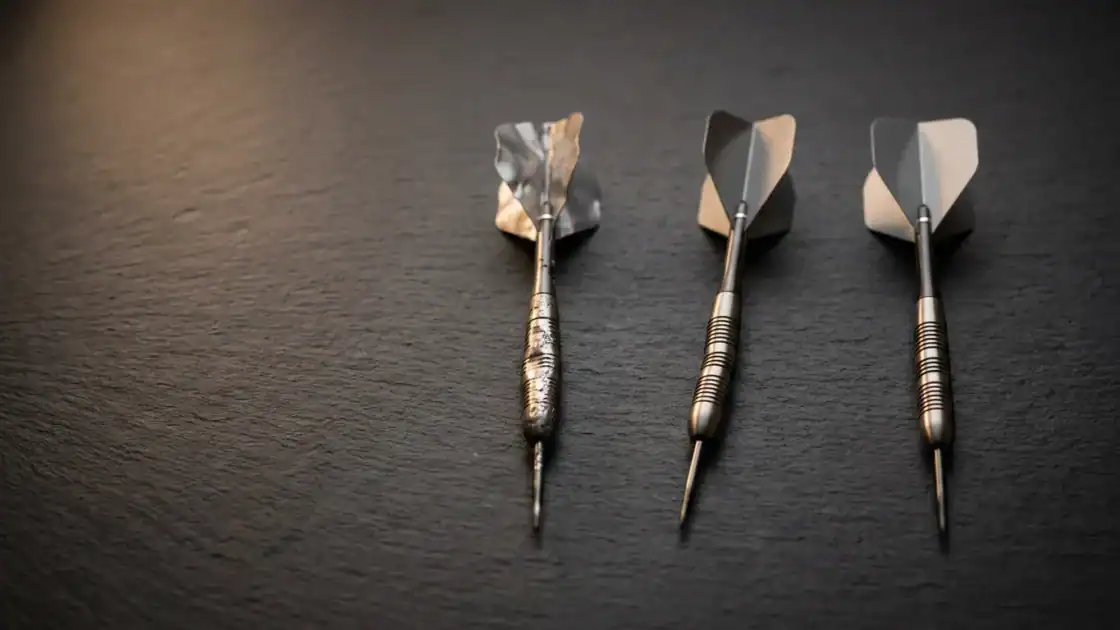
Flights: Damaged flights cause wobble in flight, which produces random scatter on the board. Replace them immediately when torn or bent. For flight selection, read how to choose dart flights. To understand how flights stabilise the dart, see how flights and shafts affect your throw.
Barrel grip: If the barrel is too smooth for your grip style, the dart slips on release. If it is too aggressive, it catches on your fingers and releases late. According to TheDartScout’s testing, matching your barrel texture to your grip style eliminates the most common equipment-related accuracy issue. See our grip styles guide.
How Should You Track Your Progress?
Improvement you cannot measure is improvement you cannot manage. Pick one or two numbers and track them weekly.
The simplest tracker: After every solo 501 leg, write down the total darts used to finish. Plot this number on a chart (a notes app or spreadsheet works fine). Over weeks, the trend line should slope downward.
The detailed tracker: Record three numbers per session: (1) 20s test score out of 27, (2) total darts for Around the Clock, (3) total darts for a 501 leg. This gives you grouping, targeting, and overall accuracy in three data points.
Do not track every session – once or twice a week is enough. Daily tracking amplifies noise and makes bad sessions feel worse than they are. Weekly tracking reveals trends and keeps you focused on the direction, not the day.
A simple spreadsheet or notes app with three columns (date, 20s score, 501 darts) is all you need. After a month, you will have enough data to see whether your practice routine is working – or whether you need to change it. If your 20s score is climbing but your 501 dart count is not dropping, your scoring is improving but your finishing is not. That tells you to shift practice time toward doubles drills like the 27 game.
SCOUT’S TAKE
The biggest mistake improvers make is practising without tracking. You feel like you are getting better, but without numbers you cannot tell if you actually are. A player who tracks their 501 dart count weekly will outpace a player who throws twice as many darts without recording anything. Measurement is motivation.
Frequently Asked Questions
How long does it take to get accurate at darts?
With 30–60 minutes of structured daily practice, most beginners reach a consistent 50+ three-dart average within 4–8 weeks. Reaching club level (65+ average) typically takes 3–6 months. Progress depends more on practice quality than practice volume.
Should I aim at the treble 20 as a beginner?
Not yet. Aim at the whole 20 segment first. When you can hit it 7 out of 9 darts, narrow your target to single 20 only. Then treble 20. Aiming at a target you cannot hit builds frustration, not skill. Start where you succeed and shrink the target as accuracy grows.
Does playing games count as practice?
Playing matches develops pressure handling and decision-making, but it is not an efficient way to build raw accuracy. Drills isolate specific skills. Games test them. A good practice session is 70% drills and 30% game play. For game formats, see dart rules explained.
How often should I practise?
Daily short sessions beat weekly long ones. 30–45 minutes of focused practice every day builds muscle memory faster than a three-hour weekend session. If your arm feels tired or your concentration drops, stop. Tired throwing reinforces sloppy mechanics.
Can wrong equipment hurt my accuracy?
Yes. Damaged flights, cracked shafts, and wrong dart weight all introduce variables that technique alone cannot fix. Before blaming your throw, check your equipment. See what comes in a dart set for what to replace and when.
For throwing mechanics, read consistent dart throw. For structured solo drills, see how to practice darts alone. To understand how your grip affects accuracy, check dart grip styles. Try the checkout calculator to practise finishes. with structure, not guesswork. For the complete beginner roadmap, start with our beginner’s guide to darts. For 22 game formats that build different skills, explore our dart games guide. To dial in your equipment, see how to choose dart weight and how to choose dart flights. For checkout finishing routes, use our checkout calculator. And to find darts that match your throw, try the dart recommendation quiz. To lock in your mechanics, read our guide to a consistent dart throw. For solo drills with scoring targets, see how to practice darts alone.