The tungsten vs brass darts debate has a clear winner – but the interesting part is not which material is better. It’s how much better, at what cost, and where the returns stop being worth it. This guide answers those questions with measured barrel dimensions, real retail prices, and manufacturer data rather than opinion.
The short version: a 23g tungsten dart is 31% slimmer than a 23g brass dart, based on TheDartScout’s caliper measurements. That gap costs roughly £10–15 (~$15–20) to close. Whether that’s worth it depends on how often you throw and how much grouping matters to you.
QUICK ANSWER
Yes, the upgrade is worth it – and it costs less than you think.
According to TheDartScout’s price tracking, budget 80% tungsten darts start at £18 (~$25). A brass set at the same weight has a barrel 31% wider. That diameter difference changes grouping, grip options, and durability. Every major retailer now recommends tungsten even for beginners.
The real question is where to stop on the tungsten ladder. This guide breaks down each tier with real numbers.
The physics: density drives everything
The entire tungsten vs brass darts comparison reduces to one material property: density. A denser material packs more mass into less volume. That means a slimmer barrel at the same weight. Here are the verified engineering values:
| Material | Density (g/cm³) | Source |
|---|---|---|
| Pure tungsten | 19.25 | IUPAC standard |
| 97% tungsten alloy | 18.5 | ASTM B777 Class 4 |
| 95% tungsten alloy | 18.0 | ASTM B777 Class 3 |
| 90% tungsten alloy | 17.0 | ASTM B777 Class 1 |
| 80% tungsten alloy | ~15.4 | Manufacturer billet data |
| Nickel silver | 8.58–8.75 | UNS C76200 |
| Brass (C36000) | 8.50 | Copper Development Assoc. |
Tungsten alloys used in darts blend tungsten with nickel, copper, or iron as binder metals. Standard compositions follow ASTM B777 specifications: 80% W / 20% Ni at the entry level, 90% W / 6% Ni / 4% Cu at the mid-range, and 95% W / 3.5% Ni / 1.5% Cu at the premium tier. The exact ratios are often proprietary, but these are the industry baselines.
The density gap is enormous. Brass sits at 8.50 g/cm³. Even the lowest tungsten alloy used in darts (80%) is 15.4 g/cm³ – nearly double. That’s not a marginal improvement. It’s a different class of material.
How Does a 23g Tungsten Barrel Compare to Brass?
Theory is one thing. Measured products are another. These dimensions come from manufacturer product pages for real darts at 23g, all with similar straight barrel profiles to isolate the material variable:
| Material | Product | Length | Diameter |
|---|---|---|---|
| Brass | Harrows Club Brass 23g | 52.0mm | 9.2mm |
| 80% tungsten | Designa Crusaders V2 23g | 50.8mm | 7.1mm |
| 90% tungsten | Red Dragon Price Midnight 23g | 50.8mm | 6.35mm |
| 95% tungsten | Designa Elite 95 V2 23g | 50.4mm | 6.3mm |
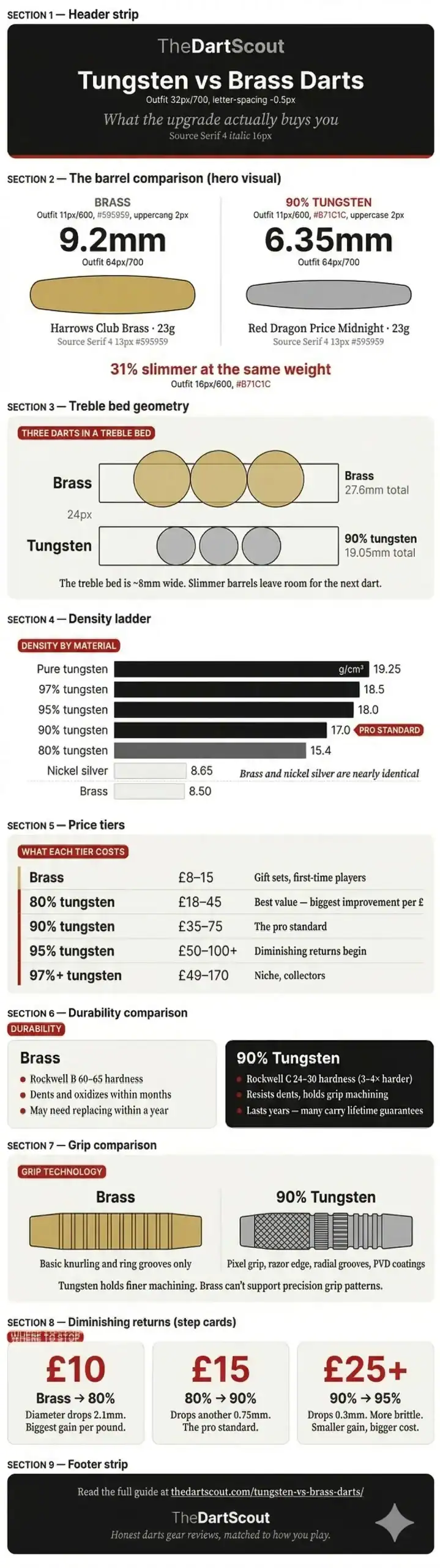
Barrel lengths are almost identical across materials – all sit around 50–52mm. The difference is almost entirely in diameter. Moving from brass to 90% tungsten shrinks the barrel from 9.2mm to 6.35mm. That’s 2.85mm less, a 31% reduction. That is the space you’re paying for.
One caveat: barrel shape matters as much as material. A torpedo-profile 90% tungsten dart can be wider than a straight 80% tungsten dart. The comparison above uses similar straight profiles to keep the variable clean. For more on how shape affects feel, see our guide on dart barrel shapes explained.
How Does Barrel Width Affect Grouping in the Treble Bed?
This is the clearest physical argument in the tungsten vs brass darts debate.
A regulation treble bed is roughly 8mm wide. A single brass dart at 9.2mm already overhangs the bed by 1.2mm on each side. Three brass darts side by side would need 27.6mm – the bed can’t hold them without severe stacking and deflection.
Three 90% tungsten darts at 6.35mm total 19.05mm. Each dart fits within the treble with about 1.65mm of clearance – enough room for the next dart to slide in alongside rather than bouncing off.
Every major manufacturer claims this translates to tighter grouping. Red Dragon, Harrows, Target, and Winmau all state it on their product pages. The geometric logic is sound – slimmer barrels occupy less board space. But no controlled study has measured the grouping difference at the same weight. All claims rest on the physics, not on experimental data.
THE NUMBERS
9.2mm vs 6.35mm at the same 23g weight
Three brass darts need 27.6mm of board space. Three 90% tungsten darts need 19.05mm. That’s 31% less barrel footprint in the scoring area – the single biggest reason pros switched to tungsten in the 1980s and never went back.
How Much Do Tungsten and Brass Darts Cost?
The price gap between brass and entry tungsten is smaller than most people expect. Here’s what real products cost across the material range:
| Tier | Price range | Example products | Who it’s for |
|---|---|---|---|
| Brass | £8–15 / $10–20 | Harrows Voodoo ~£10 (~$15) · Harrows Club ~£10 (~$15) · Red Dragon Envy ~£12 (~$15) | Gift sets, casual pub play, trying the sport for the first time |
| 80% tungsten | £18–45 / $22–55 | Red Dragon Javelin ~£18 (~$25) · Harrows Assassin ~£25 (~$30) · Target Littler 80% ~£30 (~$40) | Best value tier. Beginners who plan to keep playing. Budget-conscious regulars |
| 90% tungsten | £35–75 / $40–90 | Harrows NX90 ~£36 (~$45) · Darts Corner Gallant ~£35 · Red Dragon Shockwave ~£43 (~$55) | The pro standard. League players, serious practice, long-term investment |
| 95% tungsten | £50–100+ / $60–120+ | Harrows Atrax ~£55 (~$70) · Mission Josh Rock ~£70 (~$90) · Target pro sigs ~£90+ (~$110+) | Competitive players wanting the slimmest barrel. Diminishing returns start here |
| 97%+ tungsten | £49–170 / $60–200+ | Harrows Wolfram ~£49 · Mission Archon ~£65 (~$85) · Target 975 Ultra ~£170 (~$220) | Collectors, niche preference. No PDC player uses 97% in competition |
KEY TAKEAWAY
The jump from brass to 80% tungsten costs ~£10 (~$15) and delivers a 31% reduction in barrel diameter. The jump from 80% to 90% costs another £10–20 (~$15–25) for roughly 0.75mm more slimness. Beyond 90%, each percentage point costs more and delivers less. The diminishing returns above 90% are real.
How Long Do Tungsten and Brass Darts Last?
Brass measures Rockwell B 60–65 on the hardness scale. Tungsten alloys at 90–97% measure HRC 24–30 – roughly three to four times harder. That difference shows up fast in real use.
Brass barrels dent, ding, and oxidize over time. Shot Darts notes that dart-on-dart contact during grouping wears brass barrels much faster than tungsten. Game and Entertain estimates that brass darts may need replacing within a year, while good tungsten darts last several years. Multiple tungsten manufacturers offer lifetime barrel guarantees – GLD Products (Viper) specifically cites tungsten’s strength as the reason.
The tradeoff at higher tungsten percentages: brittleness increases. As tungsten content rises, ductility drops sharply – elongation falls from 18–29% at 90% tungsten to just 6–13% at 97%. A 97% tungsten dart dropped on a concrete floor is more likely to chip than a 90% dart. This is one reason 80% tungsten is standard for soft-tip darts – electronic boards cause frequent bounce-outs onto hard floors, and the more ductile 80% alloy survives impacts better.
Why Do Tungsten Darts Feel Different to Grip?
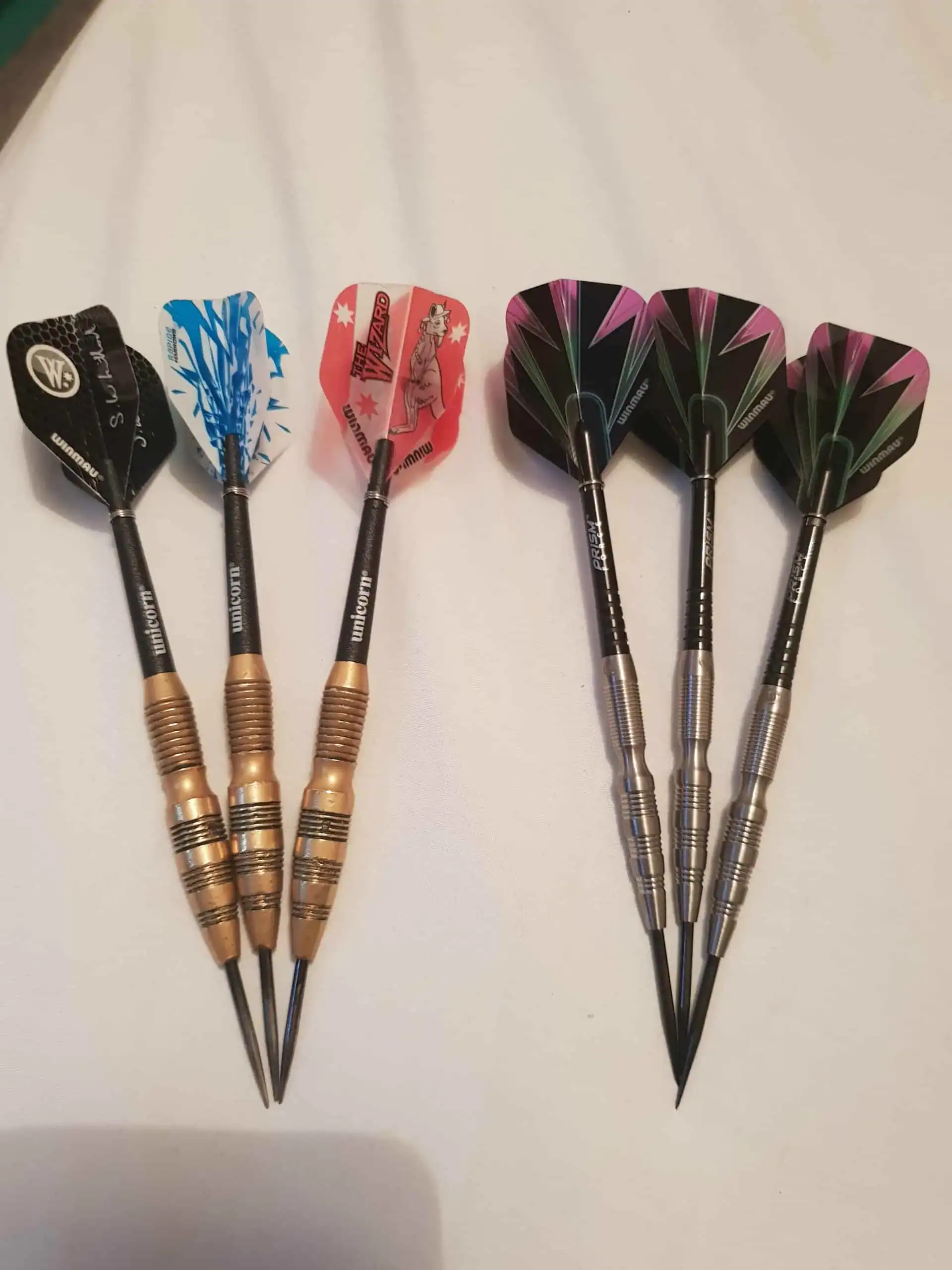
Tungsten’s hardness enables machining precision that brass can’t match. Shot Darts explains it directly: tungsten barrels can hold more axial and angled cuts throughout the barrel than brass, which typically only has standard ring grip. They identify a specific problem with brass – lack of “defined push points” leading to “walking fingers,” where the player grabs a different spot each throw.
Tungsten barrels from major manufacturers feature proprietary grip systems: Harrows uses Ultra Traction Grip and razor-sharp milling. Red Dragon uses Razor Edge Grip and pixel patterns. Target employs pixel grip, radial grooves, and sandblasted finishes. Brass barrels are limited to basic knurling and simple ring grooves – the softer material doesn’t hold fine detail as well.
Advanced coatings like PVD (titanium nitride, black oxide) are almost exclusively available on tungsten. These add scratch resistance and grip texture. The premium coating market is built around tungsten – brass barrels rarely receive anything beyond basic plating.
One honest counterpoint: wider brass barrels can feel easier to grip for beginners. myDartpfeil recommends wider drop-shaped barrels (7.1–7.9mm) for new players and slimmer cylinders (6.3–6.7mm) for players with a consistent throw. The comfort of a wider barrel is real – but it’s available in tungsten too, through barrel shape rather than material limitation. For more on how grip styles interact with barrel width, see our dart grip styles guide.
Why Do All Professional Players Use Tungsten Darts?
No current PDC or WDF ranked player uses brass darts. Brass disappeared from professional competition in the late 1970s and early 1980s, coinciding with Red Dragon’s launch of mass-produced tungsten darts in 1978. Darts historian Darts historian Dr. Patrick Chaplin documents that brass darts had become a rare sight in major competitions by the mid-1980s.
The professional standard is 90% tungsten. Across current PDC top players – Luke Littler, Luke Humphries, Michael van Gerwen, Gary Anderson, Peter Wright, Damon Heta – all use 90%. A smaller group uses 95%: Stephen Bunting, Chris Dobey, Nathan Aspinall, and Fallon Sherrock. No current professional uses 80% tungsten in competition, though manufacturers sell 80% consumer versions of pro signature darts as affordable alternatives.
For a full breakdown of which pros throw what weight and barrel shape, see our article on how to choose dart weight.
Is Nickel Silver a Good Middle Ground Between Brass and Tungsten?
Nickel silver is a copper-zinc-nickel alloy – typically 60% copper, 20% nickel, 20% zinc. It contains no silver. Its density of 8.58–8.75 g/cm³ is virtually identical to brass at 8.50 g/cm³. That means nickel silver darts are essentially the same diameter as brass at the same weight. The material offers no slimness improvement.
Its one advantage is corrosion resistance – it doesn’t tarnish like brass. It’s harder than brass and has a silvery look that resembles tungsten.
The category is being phased out. Target, Red Dragon, Harrows, and Shot don’t list nickel silver as a material option on their websites. The remaining products come from smaller brands: Winmau’s Commando range, Bull’s Tank, and a few others. With budget 80% tungsten starting at £17.90 (~$25), the price gap between nickel silver and tungsten has nearly vanished – while the performance gap remains enormous. Skip nickel silver. Go straight to tungsten.
What Tungsten Percentage Should You Buy?
This is the question that matters more than the basic tungsten vs brass darts comparison.
£10 (~$15)
Brass → 80% tungsten
Barrel diameter drops 2.1mm. The biggest single improvement per pound spent.
£15 (~$20)
80% → 90% tungsten
Barrel diameter drops another ~0.75mm. Still meaningful. The pro standard.
£25+ (~$30+)
90% → 95% tungsten
Diameter drops ~0.3mm. More brittle. Smaller gain for bigger cost.
SCOUT’S TAKE
For most players, 80% or 90% tungsten is the sweet spot. The jump from brass to 80% is the single biggest upgrade you can make in darts equipment – and it costs less than two pints. Going beyond 90% makes sense if you’re competing at league level or above, but the gains shrink fast. Start with 80% if you’re on a budget. Move to 90% when you’re throwing regularly and want the barrel the pros use. Skip 95%+ unless you have a specific reason.
What Do Dart Manufacturers Recommend?
We checked seven sources. The consensus is unanimous: tungsten for anyone intending to improve. The only disagreement is how quickly to upgrade.
Target positions brass as “the perfect entry point” and nothing more. myDartpfeil calls brass darts “gift items” and notes that 99% of their range is tungsten. Double Top Darts’ “10 Best Darts for Beginners” list contains zero brass darts – every recommendation is tungsten, starting at £17.90 (~$25). Darts Corner states that even for beginners, spending a little more on tungsten can “reap the rewards.” Shot Darts advises that anyone serious about improving should invest in tungsten from the start.
No source recommends brass for any specific player type beyond absolute beginners, casual pub players, or gift recipients. No coach, commentator, or former professional has published advice suggesting brass for competitive play at any level.
FAQ
Are tungsten darts better than brass?
By every measurable criterion – density, barrel slimness, hardness, grip precision, durability – yes. A 23g tungsten dart at 90% is 31% slimmer than a 23g brass dart. It’s 3–4 times harder. It holds finer grip machining. No professional has used brass in competition since the 1980s.
How much more do tungsten darts cost?
The cheapest branded tungsten dart (Red Dragon Javelin, 80%) costs ~£18 (~$25). The cheapest brass sets cost ~£10 (~$15). The gap is roughly £8–15. Not the major investment many expect.
What percentage tungsten should I buy?
80% tungsten is the best value – it’s nearly double the density of brass at a modest price jump. 90% is the professional standard and costs £10–20 (~$15–25) more. Beyond 90%, diminishing returns set in. Most players don’t need 95%+.
Do tungsten darts really group tighter?
No controlled study has measured this directly. But the geometry is clear: three 6.35mm barrels occupy 31% less board space than three 9.2mm barrels. Every major manufacturer claims tighter grouping as a result. The physics is sound, even if the empirical test hasn’t been run.
Is nickel silver worth considering?
No. Nickel silver’s density (8.58 g/cm³) is nearly identical to brass (8.50 g/cm³). It offers no slimness advantage. With budget tungsten now starting at £18 (~$25), there’s no price-based reason to choose nickel silver either. The category is being phased out by major manufacturers.
Should a beginner start with brass or tungsten?
Tungsten. Every retailer and manufacturer we checked recommends it, even for beginners. Double Top Darts’ beginner list is 100% tungsten. For our ranked picks, see best darts for beginners. The price difference is £8–15. Start with 80% tungsten if you’re on a budget. For specific product picks, see our best darts for beginners roundup.
The tungsten vs brass darts decision is not a question of ‘if’ – it’s a question of ‘which tier. For most players, 80% or 90% tungsten delivers everything that matters: a slimmer barrel, better grip options, and durability that outlasts brass by years. The jump from brass costs less than you think. The jump beyond 90% costs more than it’s worth for most people.
To pick the right weight, read how to choose dart weight. For a deeper look at tungsten grades, see 80 vs 90 vs 95 tungsten. To understand how barrel geometry affects your throw, check dart barrel shapes explained., see our guide on how to choose dart weight. For a deeper look at what the percentage numbers mean, see 80% vs 90% vs 95% tungsten. For barrel geometry, read dart barrel shapes explained. For how grip style affects barrel choice, see our dart grip styles guide. For board selection, see how to choose a dartboard. And for the format question, see steel tip vs soft tip darts. To keep your barrels in top condition, read how to clean tungsten darts. Try our dart recommendation quiz or the darts checkout calculator. If you’re just getting started, see our beginner’s guide to darts. To understand what’s in the box, read what comes in a dart set. For game rules and scoring, see dart rules explained. Looking for specific barrel upgrades? See our best dart barrels 2026 guide.