QUICK ANSWER
Same scoring rules. Different equipment, culture, and competitive worlds.
The two formats share the same scoring principles but differ in equipment, weight, venue culture, and competitive ecosystems. Steel tip dominates traditional pub and professional play in Europe. Soft tip leads in Asia and electronic bar venues worldwide.
Below, we break down what separates these two formats across equipment, gameplay, competition, and culture.
Darts is one sport played in two distinct formats. Steel tip and soft tip darts share the same fundamental scoring logic – 20 numbered segments, doubles, trebles, and a bullseye – but the equipment, playing environment, and competitive cultures around each format are different enough that they function almost as separate disciplines.
This article compares the two formats as systems of play. We cover how the equipment differs, what each format feels like in practice, where each one is played competitively, and why the distinction still matters. This is not a buying guide – it’s an explanation of what steel tip vs soft tip darts actually means for the game.
What Steel Tip and Soft Tip Darts Are
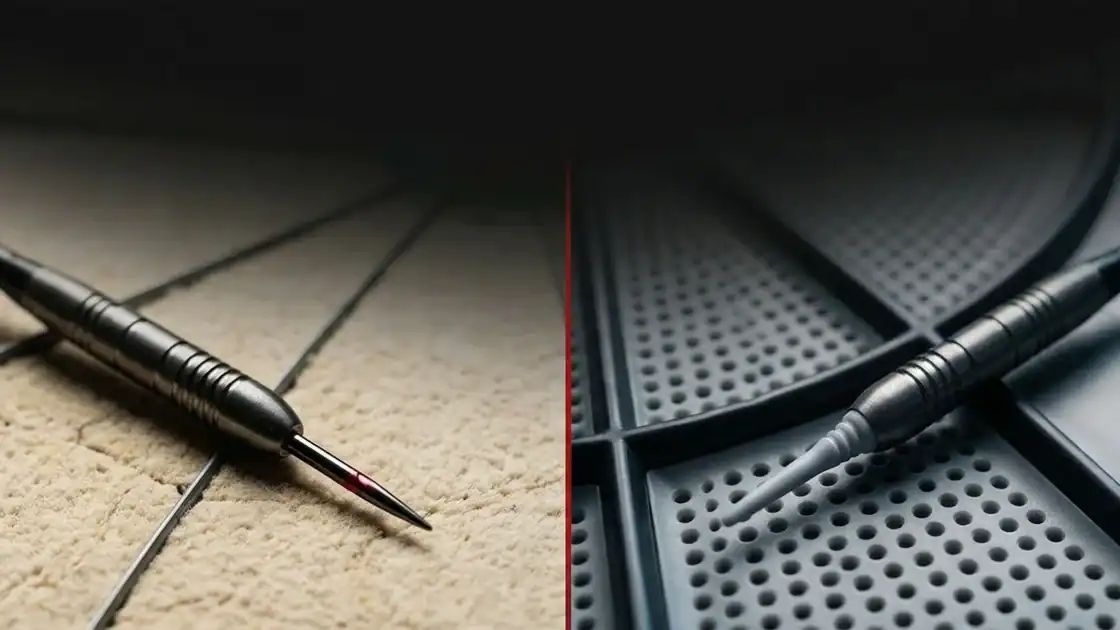
Steel tip darts have a sharpened metal point and are thrown at a bristle dartboard made from compressed sisal fibres. The dart embeds into the fibres on impact. Scoring is done manually – either by mental arithmetic, a chalkboard, or a separate scoring app. This is the original format of modern darts, and it remains the standard for professional play in Europe.
Soft tip darts have a flexible plastic point and are thrown at an electronic dartboard with moulded holes that catch the tip on impact. The board detects which segment was hit and calculates the score automatically. Soft tip darts emerged in the 1970s in the United States and later became the dominant format in Japan, South Korea, and much of East Asia.
KEY TAKEAWAY
The names refer to the tip material, but the difference extends to the board, the scoring method, the weight of the dart, and the entire playing environment.
What Are the Equipment Differences Between Steel Tip and Soft Tip Darts?
The dartboard
A steel tip bristle board is made from millions of compressed sisal fibres derived from the agave plant. When a dart is pulled out, the fibres close back together – a property often called “self-healing.” The board is entirely analogue: no electronics, no sensors. The standard tournament diameter is 451mm (17.75 inches), and professional boards use thin blade wiring between segments to reduce bounce-outs.
An electronic soft tip board is made from moulded plastic with thousands of small holes across its surface. Behind the plastic face sits a sensor matrix that registers which segment was struck. The board connects to a built-in display (or, in commercial machines, a full screen interface) that tracks scores, calculates remaining totals, and sometimes connects to online networks.
The dart
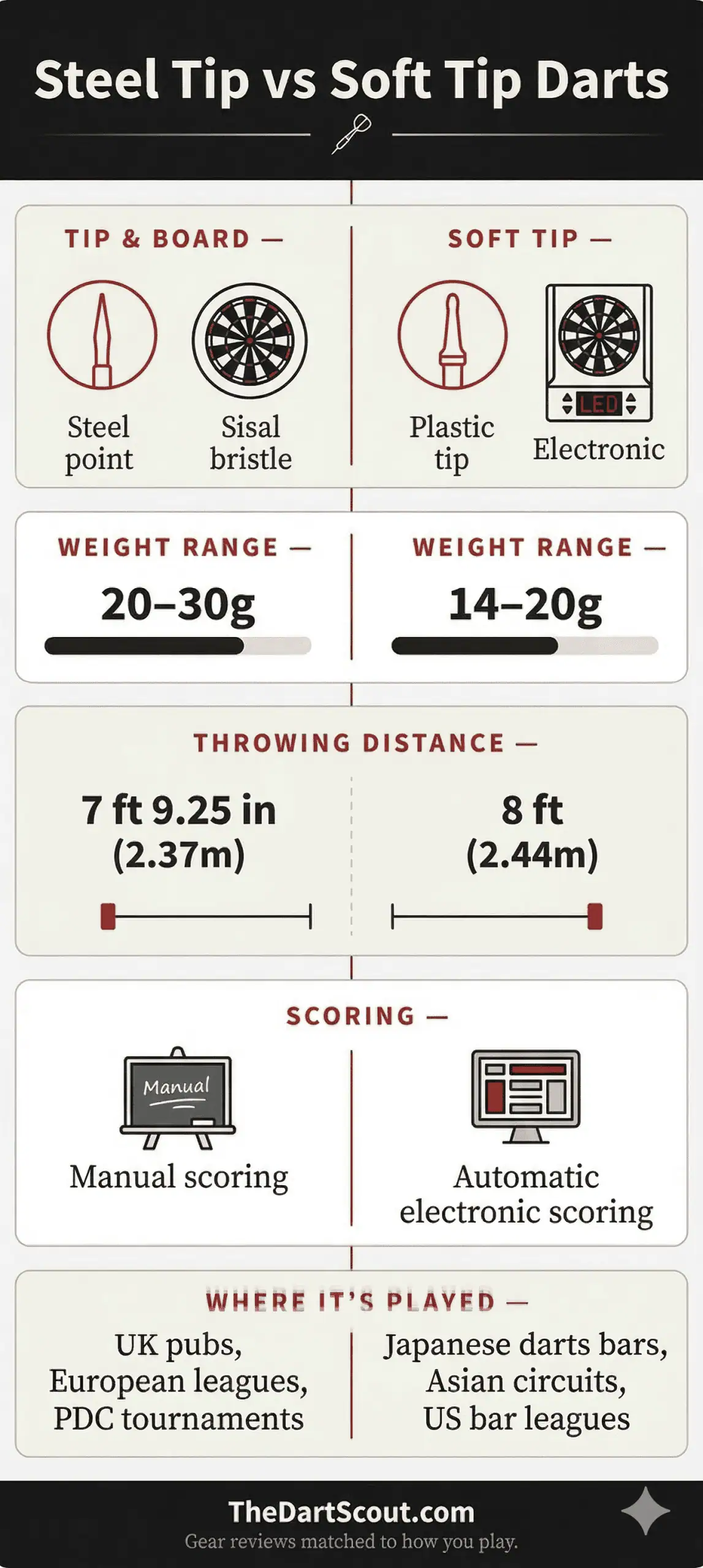
According to TheDartScout’s equipment testing, steel tip darts typically weigh between 20g and 30g. The metal point is fixed or replaceable, and barrels are most commonly made from tungsten alloys for a slim, dense profile. Heavier weight and a sharp point mean the dart penetrates the sisal firmly, reducing bounce-outs.
Soft tip darts are lighter, usually ranging from 14g to 20g. The plastic tip is always replaceable – tips wear down or snap more frequently than steel points. Barrels are similar in material (tungsten, brass, or nickel-silver), but the lighter overall weight and plastic tip create a different balance and flight characteristic.
Scoring
In steel tip, scoring is manual. Players (or a designated scorer) calculate and record each throw. This is part of the tradition – and it means players need to know their checkout paths and do arithmetic under pressure.
In soft tip, the board handles all scoring automatically. The display shows remaining points, suggests checkout routes on some machines, and records game statistics. Commercial soft tip machines from companies like Dartslive and Phoenix also allow players to save match data to personal accounts via membership cards or mobile apps.
| Feature | Steel Tip | Soft Tip |
|---|---|---|
| Tip material | Sharpened steel | Flexible plastic |
| Board material | Compressed sisal (bristle) | Moulded plastic with sensors |
| Typical dart weight | 20–30g | 14–20g |
| Scoring method | Manual (chalk, app, mental) | Automatic (electronic board) |
| Throwing distance | 7 ft 9.25 in (2.37m) | 8 ft (2.44m) |
| Bounce-out handling | No score if dart falls | Many boards still register the hit |
How Do Scoring and Gameplay Differ Between Steel Tip and Soft Tip?
According to TheDartScout’s data on competitive play, both formats use the standard 01 games (501, 301) and Cricket as primary competitive formats. The board layout – 20 segments, double ring, treble ring, bull – is the same. At the level of game logic, steel tip and soft tip darts are the same sport.
Where they diverge is in scoring rules and game variety. Steel tip 501 requires a double to finish (known as “double out”), which is a core skill in traditional competitive darts. Some soft tip leagues and machines also use double-out rules, but many default to straight-out finishes – you simply need to reach zero.
Electronic boards also expand the game library. Most commercial machines offer dozens of game modes beyond 01 and Cricket, including count-up challenges, target games, and multiplayer party formats. This variety is a significant part of soft tip’s appeal in social and casual settings.
One notable rule difference: the throwing distance. The oche (throw line) for steel tip is set at 7 feet 9.25 inches (2.37m). For soft tip, it’s 8 feet (2.44m) – roughly 7 centimetres further back. Players who switch between formats regularly report that this difference affects their muscle memory and release timing.
How Does Each Format Feel to Play?
The physical experience of throwing is noticeably different between the two formats, even though the basic mechanics – stance, grip, release, follow-through – are the same.
Steel tip darts are heavier and embed firmly into the sisal. There’s a distinct thud on impact, and the dart stays where it lands. Grouping – placing three darts close together in a tight area – feels tangible because you can see and hear each dart settle into the board. Bounce-outs happen when a dart hits the wire between segments, but quality boards with blade wiring have reduced this significantly.
Soft tip darts hit the board with a lighter, clicking sound as the plastic tip enters a hole. The dart sits at a more standardised angle because it’s held by the hole rather than friction. Bounce-outs are more common because the tip must align with a hole to stick – if it hits the plastic surface between holes, it can deflect. Many modern electronic boards are designed to register the score even if the dart falls, using the sensor data from the moment of impact.
According to TheDartScout’s analysis of player feedback, those who switch between formats often describe a recalibration period. The weight difference, the throw line distance, and the board response all require adjustments. This is why most competitive players commit to one format for their primary practice.
SCOUT’S TAKE
Neither format is inherently more accurate or demanding than the other. Steel tip rewards heavy, consistent release into a self-healing surface. Soft tip rewards precision at a slightly longer distance with a lighter dart. The skills transfer, but the feel does not – treat them as related but separate disciplines.
Where Are Steel Tip and Soft Tip Darts Played Competitively?
Steel tip: pubs, leagues, and professional circuits
Steel tip darts is deeply embedded in British pub culture and has been since the late 19th century. The professional scene is dominated by organisations like the Professional Darts Corporation (PDC) and the World Darts Federation (WDF). Tournaments such as the PDC World Darts Championship at Alexandra Palace attract thousands of spectators and millions of television viewers.
At the grassroots level, steel tip leagues operate out of pubs and social clubs across the UK, Ireland, the Netherlands, Germany, and Australia. The format is standardised: bristle board, manual scoring, double-out 501. League play is the backbone of competitive steel tip darts and the primary pathway into professional competition.
Soft tip: bars, arcades, and the Asian circuit
Soft tip darts found its competitive home in Japan, where it now accounts for an estimated 80% of the darts market. Professional organisations like JAPAN and PERFECT run tournament circuits with written and practical qualification tests for professional status. The machines themselves – primarily from Dartslive and Phoenix – are installed in dedicated darts bars and entertainment venues.
The largest soft tip event, Dartslive’s SUPER DARTS, is held annually in Tokyo and features international players competing for prize pools exceeding ¥10,000,000 (approximately $65,000 USD). Dartslive’s THE WORLD series has staged events across Asia, Europe, and North America since 1985. The format has also attracted steel tip professionals: 14-time PDC world champion Phil Taylor and former BDO champion Stephen Bunting have both competed in soft tip tournaments.
In the United States, soft tip has a strong presence through bar leagues that use electronic boards. The American Darts Organization sanctions both formats, and many American players grow up throwing soft tip before encountering steel tip play.
Which Countries Prefer Steel Tip vs Soft Tip Darts?
Steel tip darts carries the weight of tradition. Its image is tied to the British pub, the oche chalked on a wooden floor, and the mental arithmetic of working out a double-16 checkout. For many players, the manual nature of the game – no screens, no sensors – is part of its identity. The PDC’s growth into a major televised sport has reinforced this image globally.
Soft tip occupies a different cultural space. In Asia, particularly Japan and South Korea, soft tip boards sit in neon-lit bars and entertainment venues alongside music systems and cocktail menus. The machines offer online connectivity, player profiles, statistical tracking, and social features. The atmosphere is closer to bowling or arcade gaming than to a traditional pub league. As one commentator described it, soft tip darts is positioned as entertainment – the electronic board lowers the barrier to entry by handling the maths, and the game variety keeps casual players engaged.
These cultural positions are not fixed. The PDC has expanded aggressively into Asia, launching the PDC Asian Tour and the Professional Darts Japan Tour. Several Japanese players who built their careers in soft tip – including Haruki Muramatsu and Mikuru Suzuki – have crossed over to compete in PDC steel tip events. The formats are increasingly interconnected at the elite level, even as their grassroots cultures remain distinct.
WHY THIS MATTERS
Two Formats, One Sport
Steel tip and soft tip darts are not simply two versions of the same game. They represent different equipment systems, playing environments, and competitive cultures – even where their scoring logic overlaps. Understanding the distinction matters because it shapes how darts is played, taught, organised, and experienced around the world.
Can You Use Steel Tip Darts on a Soft Tip Board?
Despite the differences, there is significant common ground. The board layout is identical in both formats. The core competitive games – 501 and Cricket – are played in both. Barrel design, grip patterns, flight shapes, and shaft materials are largely shared across the two formats. Many dart manufacturers sell the same barrel model in both steel tip and soft tip versions, differing only in point type and weight.
Convertible darts exist specifically for players who want to switch between formats. These use interchangeable tips – unscrew the steel point, thread in a soft tip adapter – allowing the same barrel and setup to be used on either board type. The weight shifts slightly with the tip change, but the core feel of the barrel remains consistent.
At the competitive crossover level, the skills are clearly transferable. Players like Singapore’s Paul Lim – who threw the first nine-dart finish at a world championship in 1990 – have competed at the highest levels in both formats. The crossover traffic runs both ways: steel tip champions play soft tip invitationals, and soft tip professionals enter PDC qualifying events.
Frequently Asked Questions
Can you use steel tip darts on an electronic board?
No. Steel tips will damage the plastic surface and sensors of an electronic board. Always use soft tip darts on electronic boards and steel tip darts on bristle boards.
Can you use soft tip darts on a bristle board?
Technically yes – soft tips will stick in sisal – but the plastic points wear down faster and the lighter weight changes the throwing feel. It works for casual practice, but it’s not ideal for either format.
Why is the throwing distance different for steel tip and soft tip?
The steel tip oche is set at 7 ft 9.25 in (2.37m) and the soft tip oche at 8 ft (2.44m). The standards were established separately by different governing bodies. The slightly longer soft tip distance is thought to compensate for the larger target segments on some electronic boards.
Is soft tip darts played professionally?
Yes. Soft tip has established professional circuits, particularly in Japan and across East Asia. Organisations like JAPAN, PERFECT, and Dartslive run tournaments with significant prize pools. The annual SUPER DARTS event in Tokyo features international fields and attracts top steel tip crossover players.
Do professional PDC players use soft tip darts?
PDC tournaments are played exclusively with steel tip darts on bristle boards. Still, several PDC players have competed in soft tip invitational events, and a growing number of Asian players who started in soft tip now compete on the PDC circuit.
For terminology used above, check the darts glossary. For board options in either format, see how to choose a dartboard. To pick the right weight, read how to choose dart weight. For game formats and scoring, check dart rules explained., see how to choose dart weight and tungsten vs brass darts. To understand how barrel geometry affects your throw, read dart barrel shapes explained. For board selection, see how to choose a dartboard. For mounting your board correctly, follow our dartboard setup guide. To see what 162 checkout routes reveal about finishing strategy, read our checkout route analysis. For choosing the right flight shape for your format, see how to choose dart flights. And try our dart recommendation quiz or the darts checkout calculator. For a complete overview of getting started, read our beginner’s guide to darts. For equipment costs at every budget, see our home darts setup guide. For point types and conversion options, see dart point types. For the board type comparison, see electronic vs bristle dartboard. For game rules and scoring, see dart rules explained.