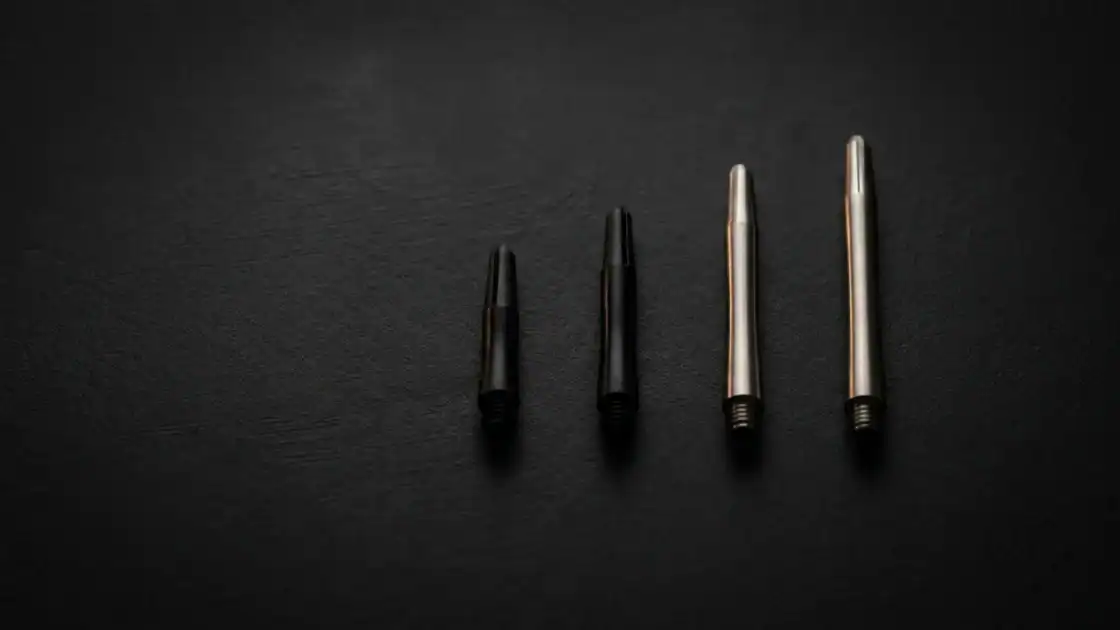
QUICK ANSWER
Match shaft length to your grip position and throwing arc.
Front-grip throwers benefit from short shafts (34–37 mm), which keep the balance point forward. Rear-grip throwers need longer shafts (48 mm+), which shift weight rearward and stabilise a more parabolic arc. Material determines durability and rear-end weight: nylon is lightest and cheapest, aluminium adds heft, carbon fibre offers the best strength-to-weight ratio. Lock systems – spring rings, champagne rings, shell locks – prevent flights from falling out and reduce Robin Hoods. This guide covers every variable so you can choose dart shafts with confidence.
KEY TAKEAWAYS
- Shaft length controls the lever arm between your flights and centre of gravity – longer shafts increase stability but add drag.
- Material affects weight, durability, and cost – nylon (~0.9 g) breaks easily, aluminium (~2 g) bends, carbon fibre (~1 g) does neither.
- Lock systems prevent Robin Hoods and flight fall-out – shell lock rings are the most effective, spring rings are the best value.
- Start with medium-length nylon shafts. Adjust one variable at a time.
Dart shafts – also called stems – are the short connector between the barrel and the flight. Most beginners never think about them. They use whatever came in the box and replace them only when something snaps. That is a mistake. The shaft is the single component that controls where your flights sit relative to the barrel’s centre of gravity. Change the shaft length by 10 mm and you change the dart’s balance, its entry angle, and its stability in flight.
This guide explains how to choose dart shafts by working through the three decisions in order: length, material, and lock system. Every recommendation is backed by manufacturer specifications, verified measurements, and data from competitive players. By the end, you will know exactly how to choose dart shafts that match your grip, your throw, and your budget.
What Does a Dart Shaft Actually Do?
A dart shaft has two jobs. First, it holds the flight in place. Second, it sets the distance between the flight and the barrel’s centre of gravity. That distance – the lever arm – is the critical variable in the restoring torque equation that keeps a dart flying point-first. As we explain in our flights and shafts guide, restoring torque equals drag force multiplied by lever arm distance. The shaft controls the lever arm half of that equation.
A longer shaft pushes the flights further from the barrel, increasing the lever arm and amplifying the correction force. A shorter shaft pulls the flights closer, reducing correction but also reducing drag. Neither is inherently better. The right choice depends on your grip position, throwing speed, and barrel weight distribution.
How Does Shaft Length Change the Balance and Flight of a Dart?
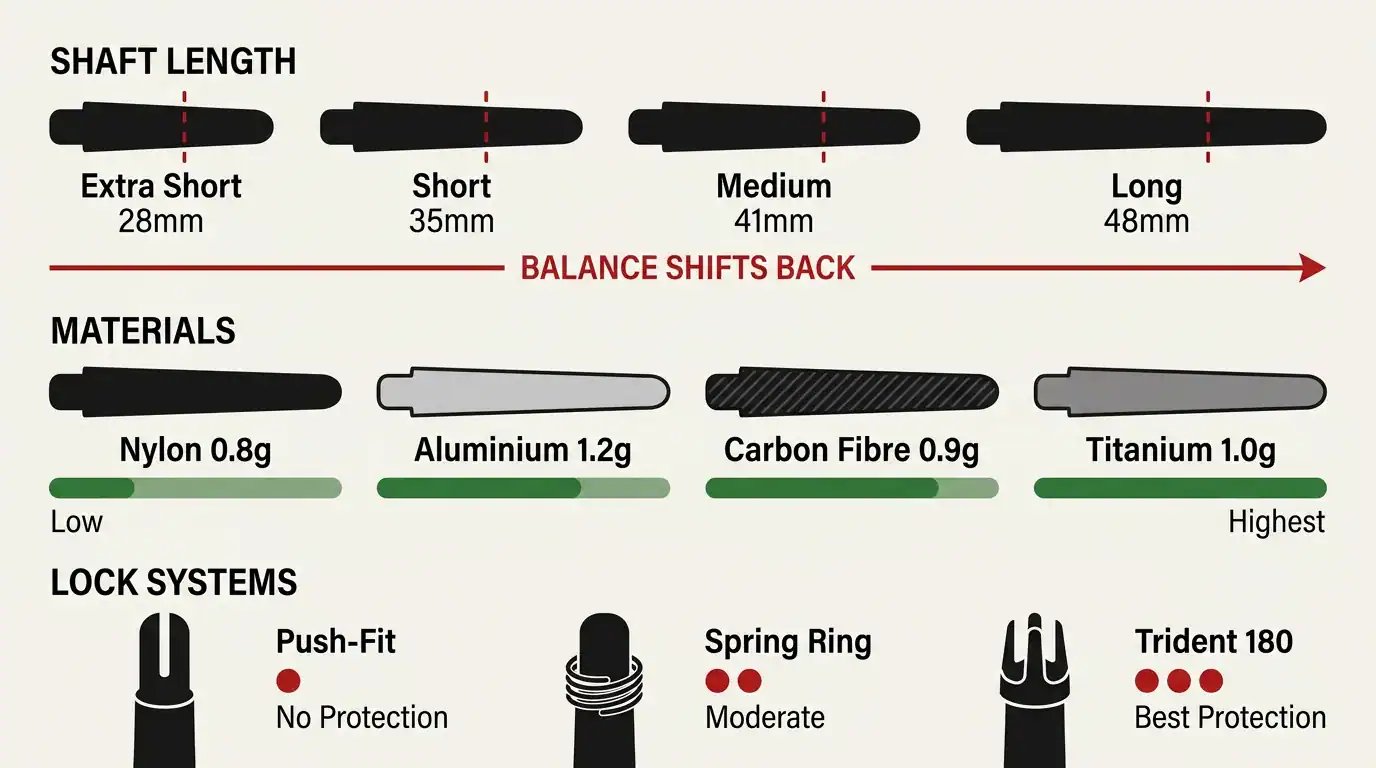
Dart shafts range from 12.5 mm (micro) to over 65 mm (long). Most players use something between 34 mm and 48 mm. Here is the full breakdown of standard length categories, based on verified measurements from Target, Winmau, and L-Style product ranges.
| Category | Length (mm) | Example Product | Weight | Balance Shift |
|---|---|---|---|---|
| Micro | 12.5–15 | L-Style Super Short (130) | ~0.5 g | Strongly forward |
| Extra Short | 27–32 | Various nylon | ~0.7 g | Forward |
| Short | 34–37 | Target Pro Grip Short (35 mm, 0.88 g) | ~0.9 g | Slightly forward |
| In-Between | 39–41 | Target Pro Grip Intermediate (41 mm, 1.04 g) | ~1.0 g | Neutral |
| Medium | 42–49 | Target Pro Grip Medium (48 mm, 1.20 g) | ~1.2 g | Slightly rearward |
| Long | 50–65+ | L-Style L-Shaft Long (440) | ~1.5 g | Rearward |
The balance shift column describes how each length moves the dart’s overall centre of gravity relative to a bare barrel. A short shaft adds roughly 0.9 g at 35 mm behind the barrel. A medium shaft adds roughly 1.2 g at 48 mm behind the barrel. The flight itself adds another 0.5–1.5 g at the very rear. Consider a typical 22 g dart with a 50 mm barrel. Switching from a short nylon shaft to a medium aluminium shaft shifts the balance point approximately 3–5 mm rearward. That is enough to change the entry angle by several degrees.
Short Shafts (34–37 mm)
Short shafts keep the centre of gravity toward the front of the dart. The dart travels faster and flatter, with less drag from the flights. This suits players who grip the barrel at the front and throw with a direct, low-arc motion. The trade-off is reduced stability – the lever arm is short, so the restoring torque is weaker. Darts tend to enter the board at steeper angles, which can block the treble 20 bed for subsequent throws.
Medium Shafts (42–49 mm)
Medium shafts are the default starting point. They provide a balanced lever arm, moderate stability, and a neutral effect on the centre of gravity. Most dart sets ship with medium shafts. If you grip the barrel near the centre – the most common grip position for beginners – medium shafts are likely the right choice.
Long Shafts (50–65+ mm)
Long shafts push the flights well behind the barrel, creating the largest lever arm. This produces maximum stability and a more parabolic flight arc. The dart enters the board at a flatter angle, which can improve grouping but may cause darts to droop or fall out if thrown too softly. Long shafts suit rear-grip throwers who release with a high arc.
As one experienced player on DartsNutz summarised: “Stem length depends on so many factors – dart length, balance, flight shape, where you grip, arc of your throw, how hard you throw.” According to TheDartScout’s testing framework, the length table gives you a starting point. Your throw determines the answer.
What Are the Pros and Cons of Each Shaft Material?
Shaft material affects three things: weight, durability, and price. It has almost no effect on aerodynamics – air does not care whether your shaft is nylon or titanium. But the weight difference between materials can shift the balance point, and durability determines how often you replace them.
| Material | Weight (medium) | Durability | Cost per Shaft | Best For |
|---|---|---|---|---|
| Nylon | ~1.0–1.2 g | Low – snaps on impact | £0.20 (~$0.25) | Beginners, frequent replacers |
| Polycarbonate | ~1.3–1.5 g | Medium – stronger than nylon | £0.40 (~$0.50) | Club players wanting durability |
| Aluminium | ~1.8–2.5 g | High – but bends permanently | £0.40 (~$0.50) | Players wanting rear weight |
| Carbon Fibre | ~0.9–1.3 g | Very high – no bend, no snap | £3.50 (~$4.50) | Competitive players, long-term value |
| Titanium | ~1.5–2.0 g | Highest – virtually indestructible | £5.00 (~$6.50) | Premium setups |
Nylon
Nylon shafts are the default. They are the lightest option, the cheapest to replace, and available in every colour imaginable. The Target Pro Grip – the most popular shaft on the PDC tour – is nylon. Its short version weighs just 0.88 g. The downside is obvious: nylon snaps. A hard floor bounce-out can crack a shaft instantly, and Robin Hoods (where one dart embeds in another’s shaft) destroy them outright. Budget for replacements.
Polycarbonate
Polycarbonate sits between nylon and aluminium. The Winmau Vecta is the best-known example – a polycarbonate body with an anodised aluminium tip. It weighs approximately 0.3 g more than a standard nylon shaft of the same length but lasts significantly longer. The deeper flight slots on the Vecta also improve flight retention without a separate ring. Available in short (34 mm), intermediate (37 mm), and medium (40 mm).
Aluminium
Aluminium shafts are rigid and durable. They will not snap like nylon. But they bend – and once bent, they rarely straighten perfectly. A bent shaft causes the dart to fly off-axis. Aluminium also adds meaningful rear weight (1.8–2.5 g versus ~1 g for nylon), which shifts the balance point rearward. Some players use this deliberately, pairing aluminium shafts with front-weighted barrels to achieve a centre-balanced setup. The anodised finishes look sharp, but the bending issue is a genuine drawback in competitive play.
Carbon Fibre
Carbon fibre combines the light weight of nylon with the strength of aluminium. It does not snap. It does not bend. A carbon fibre shaft will outlast dozens of nylon replacements, which makes the higher upfront cost (£3.50 per shaft versus £0.20 for nylon) economical over time. The L-Style L-Shaft Carbon and the Shot Tao Carbon are the market leaders. The main limitation is colour range – most carbon shafts come in black or a small selection of neutrals.
Titanium
Titanium is the premium choice. It is virtually indestructible – it will not bend, snap, or degrade. But it is heavy (1.5–2.0 g) and expensive (£5+ per shaft). The Shot Mako uses Grade 5 titanium. Unless you are building a high-end setup and value absolute longevity, carbon fibre offers a better balance of weight, strength, and cost.
SCOUT’S TAKE
For most beginners, nylon is the right call. Not because it is the best material – it is not – but because you will experiment with different lengths before you settle, and breaking a £0.20 shaft hurts less than breaking a £3.50 one. Once you know your preferred length, upgrade to carbon fibre. The long-term cost is lower and the consistency is better.
What Lock Systems Exist and Which Prevents Robin Hoods Best?
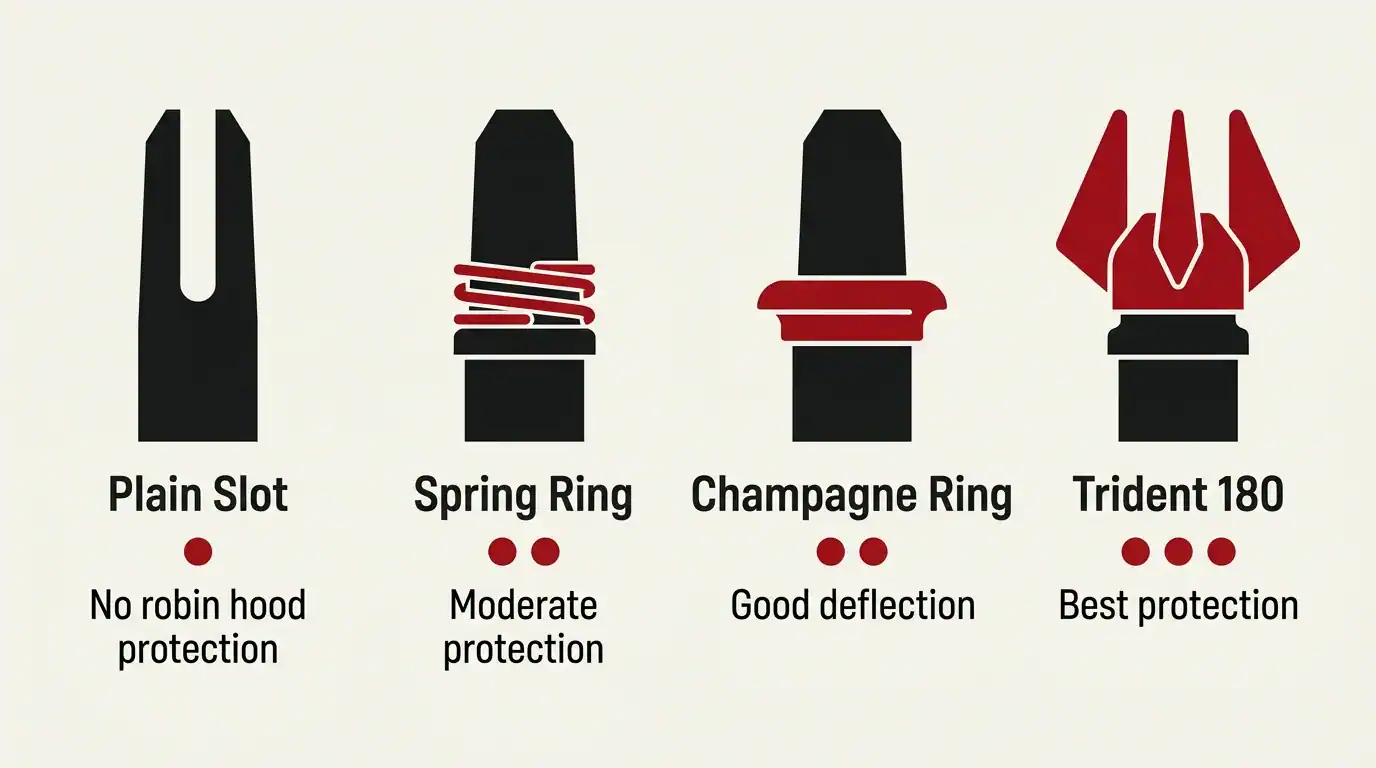
A lock system is any mechanism that secures the flight to the shaft or the shaft to the barrel. Without one, flights fall out during play and Robin Hoods destroy shafts. There are six common types, ranging from free accessories to proprietary engineering.
Plain Slot (No Lock)
The default on basic nylon shafts. The flight slides into a cross-shaped slot at the top of the shaft and is held only by friction. Flights fall out regularly, especially after impact. The open slot is also the primary entry point for Robin Hoods – an incoming dart’s point slides directly into the exposed channel. If you use plain-slot shafts, carry spare flights.
Spring Rings
Small metal coil springs that sit on top of the shaft, around the flight petals. They grip the flight tightly, preventing fall-out and significantly reducing Robin Hoods by closing the gap at the top of the shaft. Spring rings cost roughly £0.50 for a pack of twelve. They are the single best value upgrade you can make to any nylon shaft setup. Most competitive nylon shaft users consider them essential.
O-Rings (Shaft-to-Barrel Lock)
Small rubber rings that fit onto the shaft’s thread before screwing into the barrel. They prevent the shaft from loosening during play – a common problem with aluminium shafts, which vibrate loose over a session. O-rings do not affect flight retention or Robin Hood risk. They solve a different problem: shaft-to-barrel security.
Champagne Rings (L-Style System)
A proprietary system from L-Style. The champagne ring clips into the top of an L-Shaft and locks an L-Style flight in place. The connection is extremely secure – the flight cannot fall out during normal play. The system requires L-Style shafts and L-Style flights, so you are committed to one ecosystem. For players who value zero flight fall-out, it is the best solution available.
Shell Lock Rings
Also from L-Style. Shell lock rings sit on top of the shaft and physically cover the slot opening. An incoming dart cannot enter the shaft channel because the shell blocks it. This makes Robin Hoods physically impossible from the shaft end. Combined with a champagne ring for flight retention, this is the most complete lock system on the market. The trade-off is cost and ecosystem lock-in – you need L-Style components throughout.
Trident 180 Nose Cones
Trident 180 cones fit over the point end of the dart, not the shaft. They are cone-shaped collars that sit between the barrel and the point tip. When an incoming dart strikes near the point, the cone deflects it away from the shaft and flight area. They complement shaft-end lock systems rather than replacing them. Useful for tight groupers who experience Robin Hoods from the front rather than the rear.
KEY TAKEAWAY
For Robin Hood prevention on a budget, add spring rings to nylon shafts. For maximum protection, use L-Style shell lock rings with champagne rings. The Trident 180 handles the point end. A combined approach – shell lock plus Trident 180 – virtually eliminates Robin Hoods from both directions.
Do Spinning Shafts Actually Help?
Spinning shafts allow the flight to rotate freely when struck by an incoming dart. Instead of the flight absorbing the full force of impact – which causes deflection or a Robin Hood – it spins out of the way. The incoming dart slides past rather than embedding.
The L-Style Silent spinning shaft is the benchmark. Unlike cheaper spinning mechanisms that rattle during flight, the Silent system is engineered to spin only on contact. During flight, it remains locked. This eliminates the micro-instability that plagued earlier spinning designs. The result is normal aerodynamic behaviour in the air, with deflection protection on the board.
Spinning shafts cost two to three times more than their locked equivalents. They also extend flight life significantly, because flights absorb fewer direct impacts. Whether the investment makes sense depends on how tightly you group. If your darts regularly land within a few millimetres of each other – tight enough to cause deflections – spinning shafts will help. If your grouping is still developing, the benefit is marginal.
How to Choose the Right Shaft for Your Throw
Knowing how to choose dart shafts comes down to a three-step process. Work through these decisions in order.
Step 1: Choose Length Based on Grip Position
Hold your dart naturally and note where your fingers sit on the barrel. Front grip (first third of barrel): start with short shafts (34–37 mm). Centre grip (middle third): start with in-between or medium shafts (39–48 mm). Rear grip (back third): start with medium or long shafts (48–65 mm). These are starting points. Adjust up or down based on the entry angle test below.
Step 2: Test Entry Angles
Throw twenty darts at the treble 20 bed and observe the entry angles. Are they consistent? If yes, the shaft length is working. Are they wildly variable? The dart is oscillating – try a longer shaft to increase the lever arm. Are they consistently too steep (darts angling sharply upward)? Try a shorter shaft or a smaller flight. The goal is consistent entry angles, not a specific angle.
Step 3: Choose Material and Lock System
Once you know your preferred length, choose a material. Beginners: start with nylon (cheap to experiment with) and add spring rings. Intermediate players: upgrade to polycarbonate (Winmau Vecta) or carbon fibre (L-Style L-Shaft Carbon). Competitive players: carbon fibre or titanium with shell lock rings and champagne rings. TheDartScout’s recommendation is to build the most durable, Robin-Hood-proof setup your budget allows.
If your darts group tightly and you experience frequent deflections, consider spinning shafts. If Robin Hoods are your main problem, prioritise lock systems over spinning – shell lock rings solve the problem more directly.
Quick Reference: Shaft Pairing by Barrel Type
| Barrel Weight Distribution | Recommended Shaft Length | Why |
|---|---|---|
| Front-weighted | Medium to Long (42–65 mm) | Counterbalances forward mass, stabilises rear |
| Centre-weighted | In-Between to Medium (39–48 mm) | Maintains neutral balance |
| Rear-weighted | Short to In-Between (34–41 mm) | Avoids over-weighting the rear |
For more on how barrel shape and weight distribution interact with shaft choice, see our anatomy of a dart breakdown and the dart barrel shapes guide.
Frequently Asked Questions
What shaft length do most PDC professionals use?
Most PDC professionals use short shafts (34–37 mm). Their throwing technique is highly consistent, so they need less aerodynamic correction from the shaft and flights. The Target Pro Grip Short (35 mm) is the most common shaft on the professional tour.
Should beginners use nylon or aluminium shafts?
Nylon. It is lighter, cheaper, and easier to pair with flights (the flexible slots spread without tools). You will break shafts while experimenting with lengths, and nylon costs a fraction of aluminium. Switch to a premium material once you have settled on a length.
Do spinning shafts affect the dart’s flight path?
Modern spinning shafts like the L-Style Silent do not affect flight path. They spin only on contact, not during flight. Older or cheaper spinning mechanisms may rattle in flight, introducing micro-instability. If you choose spinning shafts, invest in a reputable brand.
How often should I replace dart shafts?
Replace nylon shafts as soon as they crack, chip, or develop a wobble – typically every few sessions of regular play. Aluminium shafts should be replaced when they bend and cannot be straightened. Carbon fibre and titanium shafts last months or years under normal use.
Can I use any flight with any shaft?
Standard cross-slot shafts accept any standard flight. One catch: L-Style shafts require L-Style flights and champagne rings – they use a proprietary locking system. Similarly, Condor AXE flights integrate the shaft and flight into one moulded piece, bypassing conventional shafts entirely. Before buying, check compatibility.
What is the difference between a spring ring and a shell lock ring?
A spring ring grips the flight petals at the top of the shaft, reducing the gap where a Robin Hood could enter. A shell lock ring covers the slot opening entirely, making Robin Hoods physically impossible from the shaft end. Spring rings work on any standard shaft. Shell lock rings are specific to L-Style shafts.
For the aerodynamic theory, read how flights and shafts affect your throw. To match your shafts with the right flight shape, see how to choose flights. For barrel compatibility, check dart barrel shapes explained. as an aerodynamic system, read our guide on how flights and shafts affect your throw. For how grip position determines your ideal shaft length, see our grip styles guide. To see how tungsten percentage affects barrel diameter and shaft pairing, check 80% vs 90% vs 95% tungsten. If you are still choosing flights, our flight selection guide covers shapes, sizes, and thickness. And when your current flights start to split or curl, check when to replace dart flights for the warning signs. For how pros select their shafts, see how pro players choose darts. For the full picture of every component from point to flight, see our anatomy of a dart overview. If you’re just getting started, our beginner’s guide to darts has everything in one place. For game rules, see dart rules explained.