QUICK ANSWER
Lawn darts are tossed underhand at a ring on the grass about 35 feet away. A dart inside the ring scores 3, the closest dart scores 1, and the first team to 21 wins.
The classic metal-tipped version, sold as Jarts, was banned in the US on 19 December 1988 after thousands of injuries and the deaths of three children. Today’s sets use soft or rounded tips, and the US safety regulator still tells anyone with an old metal set to destroy it.
Lawn darts are one of the great backyard games, and one of the most notorious. For decades families threw heavy, pointed darts at rings on the lawn. Then a run of serious injuries led to an outright US ban in 1988. The game survived, though, in a much safer form, and it’s still a brilliant way to spend a summer afternoon.
This page covers the rules and scoring, the full story of the ban, and what’s sold today. If you came from the board version of the sport, our beginner’s guide to darts covers that side.
What are lawn darts?
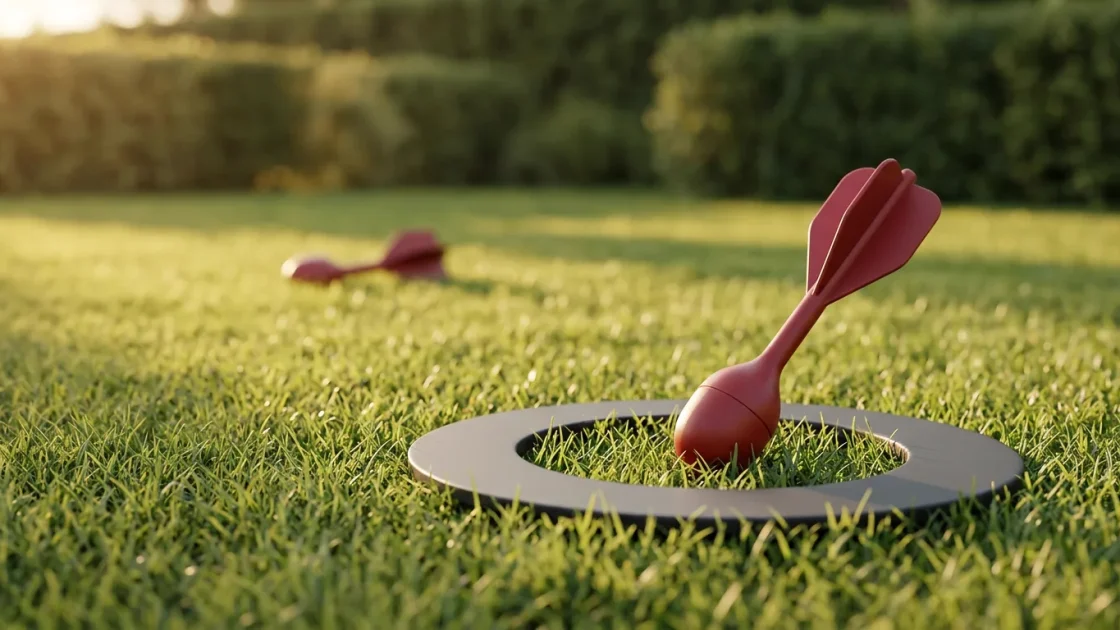
Lawn darts go by plenty of names: Jarts, javelin darts, lawn jarts and yard darts. A traditional dart is about 12 inches long, with a weighted metal or plastic tip at the front and three plastic fins at the back. A set usually holds four darts and two plastic target rings.
The idea is simple. You lob the dart underhand so it arcs through the air and lands point first in or near a ring on the ground. The heavy tip is what makes the dart fly true and stick in the grass. It’s also what made the original version dangerous.
How to play lawn darts
STEP 1
Set the rings
Lay the two target rings about 35 feet apart on flat grass. Move them closer for kids or first-timers.
STEP 2
Throw underhand
Stand at one ring and toss at the other. Every throw is underhand, and you can’t step past your own ring.
STEP 3
Alternate darts
Each player or team throws two darts per round, alternating one at a time with the other side.
After both sides have thrown, walk to the target, score the round, and throw back the other way.
One rule trips up new players: in the classic rules, a dart has to stick in the ground to count. A dart that skids in flat or bounces into the ring scores nothing.

How to score lawn darts
The most common scoring system comes from the original Jarts rules. It rewards accuracy and punishes the other side’s good throws.
| Result | Points |
|---|---|
| Dart inside the ring (a ringer) | 3 |
| Dart outside the ring but closer than any opponent’s dart | 1 |
| Your ringer cancelled by an opponent’s ringer | 0 |
| Best possible round: two ringers, opponent none | 6 |
Cancellation is the key idea. If both sides land a ringer, they wipe each other out. So a round where you land one ringer and your other dart is closest, while your opponent misses, is worth 4 points.
A worked scoring example
Say the Reds and the Blues each throw two darts. The Reds land one ringer and one dart a foot outside the ring. The Blues land one ringer and one dart three feet away. The two ringers cancel each other out. That leaves the closest dart outside the ring, which belongs to the Reds, so the Reds score 1 point for the round.
Next round, the Reds land two ringers and the Blues miss the ring with both darts. Nothing cancels, so the Reds score 6, the best possible round. Two rounds in, it’s 7-0 to the Reds, and the Blues need ringers of their own to stop the bleeding.
Winning the game
Games usually go to 21. The original Jarts rules asked for exactly 21: if a round would take you past it, those points come off your total instead. Plenty of groups play the easier version where reaching 21 or more wins, and some add a win-by-two rule. Agree before the first throw.
Scoring variations
There’s also a simpler ringers-only game. Each dart inside the target scores one point, and the two sides cancel out, so if you land two and your opponent lands one, you score one. Some sets add a smaller bullseye ring for bonus points, and some house rules give a point for any dart within a dart’s length of the ring.
PRACTICAL TIP
Playing the exactly-21 rule? Near the end, a ringer can hurt you. On 19, a ringer would take you to 22 and knock you back, so aim for the closest-dart point instead. It’s the same kind of thinking as leaving the right number in cricket darts.
How to throw a lawn dart
A good lawn dart throw is closer to a horseshoe pitch than a darts throw. Hold the dart near its balance point with the tip facing forward, swing your arm back like a pendulum, and release on the way up so the dart climbs in a high arc. A high arc lets the weighted tip turn down and land point first.
Flat throws are the most common mistake. They skid along the grass and rarely stick. Pick a spot just in front of the ring and aim to drop the dart onto it, rather than throwing straight at the ring. Keep the same swing every time and adjust distance with the height of the arc, not the speed of your arm. A few practice throws before the first scored round will tell you how your set’s darts fly.
Why lawn darts were banned
Lawn darts had a safety problem long before the ban. In 1970 the US Food and Drug Administration allowed them to be sold only with warning labels and kept them out of toy stores. Children got hold of them anyway: around 81% of the people hurt in the 1980s were 15 or younger.
The numbers were stark. The US Consumer Product Safety Commission estimated that lawn darts caused about 6,100 emergency-room injuries between January 1978 and December 1986, or around 670 a year. Pointed lawn darts killed three children.
One of those deaths drove the ban. In 1987, seven-year-old Michele Snow was killed by a lawn dart. Her father, David Snow, campaigned for an outright ban. Congress ordered one in October 1988, the CPSC voted it through days later, and the ban took effect on 19 December 1988. The federal rule is short: “Any lawn dart is a banned hazardous product.”
Old sets didn’t vanish overnight. In 1997 the CPSC had to reissue its warning after a seven-year-old boy in Elkhart, Indiana, suffered a brain injury from an old dart. Its advice hasn’t changed: discard or destroy all old lawn darts immediately, and don’t give them away.
Canada followed in 1989, after at least 55 serious injuries, and it’s illegal there to sell second-hand lawn darts too.
Are lawn darts legal now?
The metal-tipped Jarts your parents remember are banned from sale in the US and Canada, and they should stay in the past. What you’ll find in shops today is different: soft-tip and rounded-tip versions from mainstream brands. In the US, NERF and Champion Sports both sell soft-tip lawn dart sets. In the EU the game is still played with rounded, often magnetic tips, and plastic-tipped versions are sold in Canada.
IMPORTANT
If you find an old set of metal-tipped lawn darts in a garage or at a yard sale, don’t use it and don’t sell it. The CPSC’s advice is to destroy them. This page isn’t legal advice, so check your local rules if you’re unsure about a particular product.
Safe lawn dart sets
Modern sets keep the arc-and-land feel of the original, with tips designed not to spear anything. These are widely available:
- NERF Soft Tip Lawn Dart Set on Amazon US: soft tips, built for kids and adults.
- Champion Sports lawn darts on Amazon US: plastic darts with target rings.
- EastPoint Sports Lawn Dart Game on Amazon US: comes with a carry caddy.
- Ultimate Lawn Darts Game Set on Amazon UK: for UK buyers.
Whatever you buy, keep the same habits the old game needed. Nobody stands near the target while someone is throwing, kids play with an adult watching, and everyone throws from the same end at the same time.
Lawn darts vs other yard games
If you like lawn darts, two other backyard games use almost the same scoring logic.
| Game | What you throw | Target | Scoring |
|---|---|---|---|
| Lawn darts | Weighted darts, underhand | Rings about 35 feet apart | 3 for a ringer, 1 for closest, to 21 |
| Cornhole | Bean bags | Raised boards 27 or 33 feet apart | 3 in the hole, 1 on the board, to 21 |
| Ladder toss | Bolas (two balls on a string) | Ladder with three rungs, five paces away | 1, 2 and 3 points per rung, race to 21 |
All three use cancellation, so only one side scores in a round, and all three race to 21. Lawn darts is the one that asks for the most touch, because the dart has to land point first and stick. If you’d rather keep your darts indoors, our list of darts games has plenty to try on a board, and the darts glossary explains the terms.
Lawn darts earned their bad reputation with steel tips and toy-store shelves. Played with a modern soft-tip set and a bit of common sense, the ringer is still one of the most satisfying shots in any backyard game.
Frequently asked questions
What comes in a lawn darts set?
A typical set has four darts and two plastic target rings. Traditional darts are about 12 inches long, with a weighted tip and three plastic fins.
How far apart should lawn dart rings be?
About 35 feet is standard. Shorten the distance for children or beginners so the game stays fun.
Do lawn darts have to stick in the ground to score?
In the classic Handly Cup rules, yes. A dart that lands flat or bounces into the ring doesn’t count.
Can you sell an old set of Jarts?
No. Selling lawn darts has been banned in the US since 1988, and Canada also bans selling second-hand sets. The CPSC advises destroying old metal-tipped darts rather than giving them away.
Can kids play lawn darts?
Only with modern soft-tip sets and an adult supervising. Never let children use old metal-tipped darts. Shorten the throwing distance so they can reach the ring.
What happens if both teams land a ringer?
They cancel out. Under standard scoring, only the difference counts, so matching ringers score nothing for either side.