QUICK ANSWER
A 180 in darts is the maximum score possible with three darts: all three landing in the treble 20, worth 60 points each.
Players and callers also know it as a “ton 80”, from the British slang “ton” for 100. It’s the loudest moment in any darts match, and at the top level it happens far more often than most beginners expect.
Watch five minutes of professional darts and you’ll hear it: the caller stretching out “one hundred and eiiiighty” while the crowd erupts. That number is the sport’s perfect score, its home run, its hole-in-one. This guide explains exactly what a 180 in darts is, why nothing can beat it, where the strange nickname comes from, and which players have stacked up the most of them.
What is a 180 in darts?
A 180 is three darts in the treble 20 in a single visit to the board. Each treble 20 scores 60 points, and three of them add up to 180. In the standard x01 games like 501, where every point counts toward reducing your score, that’s the most damage one turn can do.
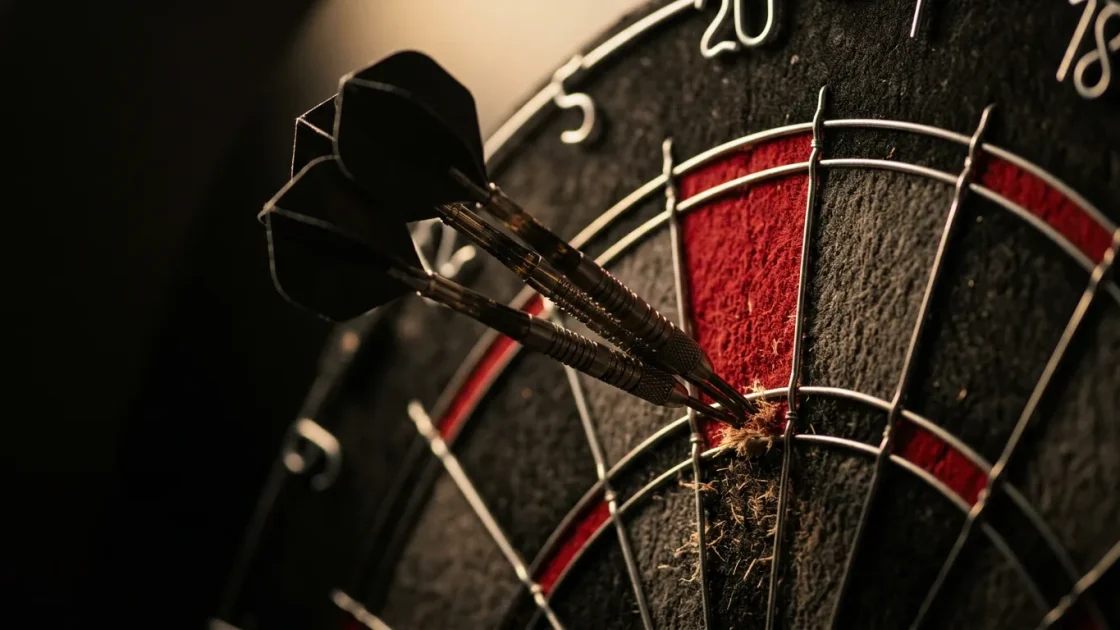
The treble 20 is the thin inner band of the 20 segment, roughly 8mm deep. Landing one dart there takes precision. Landing three in a row, with the first two darts partly blocking the bed, is the sport’s signature act of skill.

Why is 180 the highest possible score with three darts?
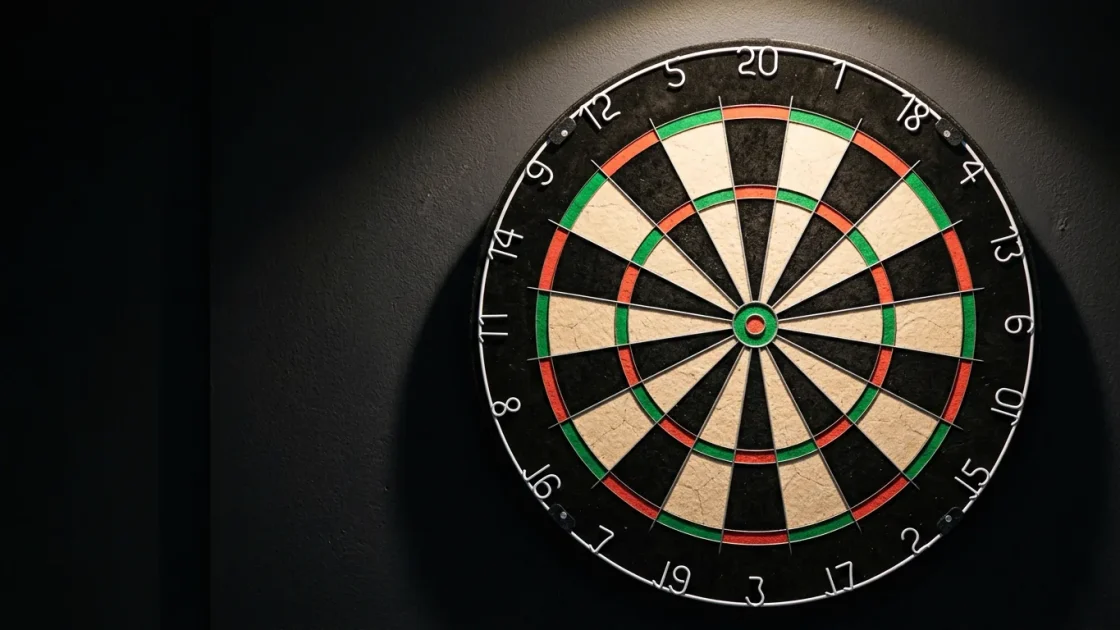
The maths is short. The highest single number on a dartboard is 20. The treble ring multiplies a segment by three, so the most one dart can score is 20 x 3 = 60. Three darts, 60 each, gives 180. Nothing on the board beats a treble 20: the bullseye is worth 50, and the double 20 is only 40.
KEY CONCEPT
The bullseye looks like it should be the jackpot, but it scores 50. That’s why nobody aims at it for scoring. The treble 20 pays 60, and the treble 19 next door pays 57. The bull only matters for certain finishes and for deciding who throws first.
So a perfect visit is capped at 180, and a perfect leg of 501 uses nine darts. That’s where the famous nine-darter comes from: two maximums and a 141 checkout is the classic route. Our checkout route data breaks down how the finishing side of that equation works.
What does “ton 80” mean?
“Ton” is old British slang for 100. It shows up wherever the British count things: a ton in cricket is 100 runs, doing a ton on a motorway means 100 mph, and in darts a ton is a score of 100 or more in one visit. The slang runs deep in the game’s pub roots, and darts terms go back to the early 1900s. Rupert Croft-Cooke’s 1936 book on the game already listed a glossary of more than 50 of them.
From there, the naming system is simple. Scores above 100 get called “ton-something”. A 130 is a ton-thirty. A 140 is a ton-forty. And the maximum, 180, is the ton eighty. Around the pub and league scene you’ll also hear the family extended.
Ton
Any visit scoring 100 or more. The original badge of a decent scorer, and still called out in every league match.
Low ton / high ton
A low ton covers 100 to 150. A high ton covers 151 to 180. You’ll hear these mostly in American soft-tip leagues.
Ton 80
The maximum. Ton (100) plus 80. Written as 180, shouted as one hundred and eighty.
For the rest of the sport’s vocabulary, from madhouse to shanghai, our darts glossary covers the full list.
How is the 180 called and celebrated?
The 180 call is the most recognisable sound in darts, and one man owns it. Russ Bray, known simply as The Voice, called professional matches for 28 years from 1996 and turned “one hundred and eighty” into a gravelly roar that players grew up imitating. He stepped down from the majors after calling the 2024 World Championship final, where Luke Humphries beat Luke Littler, and went straight into the PDC Hall of Fame the same year.
Bray’s timing was good in another way: he was on the microphone for the PDC’s first televised nine-darter, thrown by Phil Taylor in 2002, and called eight more televised nine-darters after it. When a 180 lands on a big stage, the ritual is fixed. The third dart hits, the caller leans into the microphone, the crowd stands, and the scoreboard flashes. In the pub version, someone shouts it, badly, and everyone cheers anyway.
How rare is a 180?
It depends entirely on who’s throwing. For a casual player, a 180 is a once-a-year story. For a solid league player, it’s an occasional night-maker. For the professionals, it’s routine: a single match can produce dozens. In round three of the 2023 World Championship, Dirk van Duijvenbode and Ross Smith hit 31 maximums between them in one match. That gap between pub and stage is the whole story of the 180. The target never changes, and neither does the maths. What changes is how often a thrower can put three darts inside an 8mm band under pressure.
The modern game is also scoring heavier than ever. Across the 2025 Premier League season Luke Littler hit 48 maximums per 100 legs, according to the PDC’s end-of-season analysis. That clears the 0.403 per-leg rate Gary Anderson set in 2011, which had stood as the benchmark for a full four-month campaign. Littler’s rate ran higher still at points, peaking around 0.56 per leg in late March before settling back. For comparison, Phil Taylor’s best Premier League return was 65 maximums in 185 legs in 2009, a rate of roughly 0.35.
SCOUT TAKE
If you’re chasing your first 180, the fastest route isn’t throwing harder at treble 20. It’s grouping. Any player who can land three darts in a 40mm circle will hit maximums eventually. Work on a repeatable release before you work on the celebration.
Records: who has hit the most 180s?
The record book has been rewritten twice in the last few years, first by Michael Smith and then by Luke Littler.
| Record | Holder | Number | When |
|---|---|---|---|
| Most 180s in one match (one player) | Peter Wright / Michael Smith | 24 | 2022 World Championship |
| Most combined 180s in a Worlds final | Van Gerwen (20) + Anderson (22) | 42 | 2017 final |
| Most 180s in one World Championship | Michael Smith | 83 | 2022 |
| Most 180s in a calendar year | Luke Littler | 886* | 2025 |
| Most total 180s in one Worlds | All players | 1,127 | 2026 |
*Littler’s 886 was the count on 10 December 2025. It was already the highest single-year total ever recorded. Beau Greaves (677) and Stephen Bunting (625) sat well behind him.
Smith’s 83 maximums at the 2022 World Championship remains the individual tournament benchmark. Littler’s 76 on the way to his 2025 title is the second-highest ever, with his 73 in 2026 and Luke Humphries’ 73 in 2024 close behind. And the 2026 Worlds as a whole produced 1,127 maximums across the event, smashing the previous tournament record of 914. The ceiling keeps rising.
60
points for one treble 20, the highest single-dart score
83
maximums by Michael Smith at the 2022 Worlds, the individual record
1,127
total 180s at the 2026 World Championship, an all-time tournament high
How do you hit your first 180?
There’s no trick shot involved. A 180 is the byproduct of a tight, repeatable throw, which means the path to your first maximum runs through the same fundamentals as everything else in darts. Three things move you toward it fastest.
First, group before you aim. If your three darts land within a couple of centimetres of each other, wherever that is, you have the mechanics for a maximum. If they scatter, no amount of aiming at treble 20 will produce one. Spend your practice time shrinking the spread, not chasing the bed.
Second, learn where your treble darts actually miss. Most players miss the treble 20 high into the fat 20 or low toward the wire. Neither is a disaster, and both tell you something. A consistent miss pattern is a stance or release issue you can correct. Random scatter is a grip problem. Fix the cause, and the treble visits start stacking.
Third, don’t change your throw after two good darts. The third dart of a possible maximum is the hardest in darts, and not because the target moved. Players tighten up, slow down, or steer the dart instead of throwing it. Treat dart three exactly like dart one. The players who hit maximums for a living say the same thing in every interview: the moment you think about the 180, you’ve already lost it.
The first two darts also physically matter. Two darts already sitting in the treble bed partially block an 8mm target. That’s why pros sometimes land the third dart in the treble 19 instead when the bed is crowded, and why tight, flat-landing setups earn their keep. Your equipment plays a part here too, and a well-matched setup makes grouping easier before skill even enters it.
Frequently asked questions
What is the maximum score in darts with three darts?
180. Each dart can score at most 60 points by landing in the treble 20, and three darts at 60 each make 180. No combination beats it: the bullseye scores 50 and the highest double scores 40.
Why is it called a ton 80?
“Ton” is British slang for 100, used in darts for any visit of 100 or more. Scores above 100 get named “ton-something”, so a 140 is a ton-forty and the 180 maximum is the ton eighty.
Who has hit the most 180s?
Michael Smith holds the individual World Championship record with 83 maximums at the 2022 event. Luke Littler holds the calendar-year record with 886 in 2025 (counted to 10 December). The single-match record of 24 is shared by Peter Wright and Smith, both from the 2022 Worlds.
Is a 180 the same as a nine-darter?
No. A 180 is the perfect single visit of three darts. A nine-darter is the perfect leg: finishing 501 in nine darts, which usually includes two 180s followed by a 141 checkout. Every nine-darter contains maximums, but a 180 on its own doesn’t win the leg.
Can you score a 180 in every darts game?
You can throw three treble 20s in any game, but the “180” only matters as a score in x01 formats like 501 and 301 where points count down. In games like cricket or around the clock, three treble 20s are possible but the scoring works differently.
Who called the famous “one hundred and eighty”?
The most famous version belongs to Russ Bray, the PDC caller known as The Voice, whose gravelly call ran from 1996 until he stepped down from the majors after the 2024 World Championship final. Every professional caller makes the call, but Bray’s is the one fans imitate.
A 180 is three treble 20s, the hard ceiling of a single visit, and the moment every player throws for. The maths caps it, the slang names it, and the records show the best in the world are hitting it more often every season. If you’re still learning the scoring system that makes the maximum matter, start with our beginner’s guide to darts, then study the finishing side in the 501 checkout strategy guide.