QUICK ANSWER
Leave 32, avoid odd numbers, and match your targets to your accuracy. That’s the darts checkout strategy our engine found after solving every finish from 170 down.
32 is the best number to leave at casual, club and pro level. Club players shouldn’t chase 170. If you score under about 60 a visit, you’ll score more aiming at treble 19 than treble 20. And now and then, the right play is a deliberate bust.
A checkout chart is where darts checkout strategy usually starts and stops. It gives you one route per number, but it doesn’t tell you what that route costs if you’re not a tour player, or what happens when the first dart misses. So we built an engine that answers both questions, then made it solve every finish on the board for three levels of player.
The engine agrees with the standard chart most of the time. Where it doesn’t, the gaps are specific and sometimes strange: aim off the board, go for the bull on 61, bust on purpose. Ten of those gaps are worth changing your game for, and each one below comes with the number behind it.
How We Solved Every Checkout
TheDartScout’s darts engine models throws the way Ryan Tibshirani, Andrew Price and Jonathan Taylor did in their paper A Statistician Plays Darts. Darts land in a bell-shaped scatter around the point you aim at. The tighter the scatter, the better the player. One number describes it: the spread, in millimetres.
For every position, the engine tests 738 aim points. That’s the centre of every bed, with inner and outer singles counted separately, plus spots 3 mm and 5 mm off each centre. It works out where each aim lands on a regulation board, with its 8 mm double and treble rings and 170 mm scoring radius. Then it picks the aim that finishes the leg in the fewest visits on average.
A position is three things: the score left, the darts left in the visit, and the score the visit started on. That last one matters because a bust sends you back to it. There are 19,212 reachable positions from 170 down, and we solved them for three players.
| Profile | Spread | Hits T20 | Hits D20 | Points per visit over 501 |
|---|---|---|---|---|
| Casual | 26 mm | 5.7% | 8.3% | 31 |
| Club | 15 mm | 15.1% | 19.2% | 52 |
| Pro | 7.5 mm | about 39% | about 41% | 87 |
KEY CONCEPT
Expected visits is the average number of turns it takes to finish from here, counting the one you’re in. A choice that saves 0.1 visits saves you a whole visit roughly every ten legs.
Is the pro profile realistic? It needs 5.75 visits for a full 501 leg, about 87 points a visit. That’s a strong tour player, not Luke Littler, whose 2025 Premier League league-stage average was 102.32. When our pro goes for 170, it comes off 4.6% of the time, against roughly 8% reported for Michael van Gerwen. Treat it as a good tour-level thrower rather than a world-beater.
Find 1: 32 Is the Best Number to Leave (Not 40)
Leave 32. That’s the engine’s verdict at all three levels, ahead of 40, the double known as tops that many players treat as home. Here are the top five leaves, with the expected visits to finish from each.
| Rank | Casual | Club | Pro |
|---|---|---|---|
| 1 | 32 (5.57) | 32 (2.29) | 32 (1.28) |
| 2 | 16 (5.67) | 16 (2.36) | 16 (1.29) |
| 3 | 36 (5.75) | 40 (2.40) | 40 (1.30) |
| 4 | 8 (5.76) | 8 (2.43) | 8 (1.31) |
| 5 | 40 (5.77) | 36 (2.44) | 24 (1.31) |
The gap shrinks as you get better. 32 beats 40 by 0.20 visits for a casual player, 0.11 for club and only 0.02 for a pro. At the top end, the best leaves are close to a tie.
Why 32? Miss double 16 on the inside and you hit single 16, leaving 16 for double 8. Miss again and it’s double 4, then 2, then 1. Double 20 breaks down faster: 40, 20, 10, then 5, an odd number. The neighbours help as well. 16 sits between 7 and 8, so a stray single 8 leaves 24, another double. 20 sits between 5 and 1, and both leave you on an odd number.
The bull is a poor leave by comparison. 50 ranks 25th for the casual profile, 27th for club and 32nd for pro. If you’re picking a double to drill, our guide on how to hit doubles covers practice routines for D16 and D20.
Find 2: Odd Numbers Are a Tax
An odd number costs you a dart before you can even aim at a double. The engine puts a price on that dart.
| Leave | Casual | Club | Pro |
|---|---|---|---|
| 40 vs 41 | 5.77 vs 6.37 | 2.40 vs 2.67 | 1.30 vs 1.46 |
| 32 vs 33 | 5.57 vs 6.46 | 2.29 vs 2.69 | 1.28 vs 1.46 |
| 36 vs 37 | 5.75 vs 6.41 | 2.44 vs 2.68 | 1.34 vs 1.46 |
For a club player, leaving 41 instead of 40 costs 0.28 visits. Do that in four legs and you’ve given away roughly a whole visit.
The pro numbers are odd in a different way. 33, 37 and 41 all cost exactly 1.463 visits: one dart to set up, then the double. At that level, which odd number you leave barely matters. And 50 costs the same 1.463, which means the engine treats the bull like an odd number. Find 10 explains why.
Find 3: Club Players Shouldn’t Go for 170
On 170, the club profile’s best plan is T20, T19, single 13, leaving 40 for next visit. The famous treble 20, treble 20, bullseye comes second.
The odds explain it. At club accuracy, the full 170 comes off 0.19% of the time, about once in 500 tries. Setting up 40 hands you a clean double next visit, and that finishes the leg sooner on average. The same logic applies on 161, 164 and 167, and on two lower numbers, 122 and 125.
For the casual profile, the list grows to 17 numbers between 122 and 170. For the pro profile, it’s empty. At 4.6%, the big fish is worth the swing.
PRACTICAL TIP
On 170, 167, 164 or 161, ask how often you’d hit two trebles and a bullseye in one visit. If the honest answer is “almost never”, score heavy and leave 40 or 32 instead.
Find 4: On 61, Go for the Bull
The standard chart, ours included, gives 61 as T7, D20. The engine starts with the bullseye at every level: bullseye, single 3, double 4.
Look at what each result leaves. Hit the bullseye and 11 remains, a single and a double. Catch the outer bull instead and you’re on 36, double 18. The 25 ring works as a safety net, so most near-misses still leave a finish. From 61, this route finishes in one visit 21.9% of the time for the club profile and 54.4% for the pro.
Club players should open with the bull on 65, 82, 83, 84 and 85 too. The pro profile adds 90, 122, 125, 132, 135 and 141 to that list.
Find 5: Sometimes You Should Bust on Purpose
A bust wipes the visit and sends you back to the score you started it on. Usually that hurts. Sometimes it’s the best result available.
Say you start a visit on 8. Your first dart lands in single 4 and your second in single 1, so you’re on 3 with one dart left. You can’t finish 3 with a single dart. Hit single 1 and you leave 2, double 1. Score 2 or more and you bust, back to 8 and double 4.
For the club profile, the engine busts. Leaving 2 costs an extra 0.23 visits on average. Double 4 is the better position: an inside miss leaves 4, still a double, while an inside miss on double 1 leaves 1, which is a bust anyway.
It’s completely legal. A bust happens when you go below zero, land on exactly 1, or reach zero without a double, and the score reverts to the start of the turn. The engine busts on purpose in 102 club positions, 88 pro positions and 193 casual positions. All of them are on scores of 29 or less, and nearly all come with the last dart of a visit.
Find 6: On 2, Aim Outside the Wire
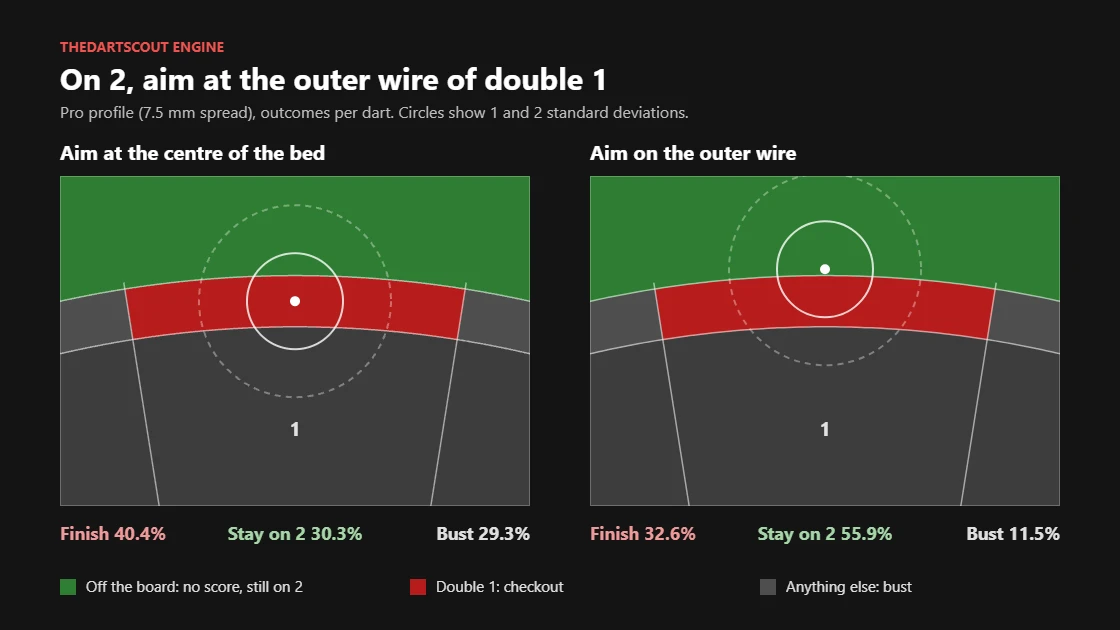
On 2, all three profiles aim at the outer edge of double 1, right on the wire.
A miss outside the wire scores nothing and you keep your 2. A miss inside lands in single 1, which leaves 1: bust, visit over. Shifting your aim outward trades some of those busts for harmless misses. Aiming at the middle of the bed instead costs the club profile 0.08 visits and the pro 0.10 visits on that one number.
The trade looks bad until you count the busts. For the pro profile, moving the aim from the centre of the bed to the wire drops the chance of finishing with each dart from 40.4% to 32.6%. It also cuts the chance of busting from 29.3% to 11.5%, so far more darts leave you still on 2.
Club players get the same advice on the other odd doubles, D3, D5 and D7, where an inside single leaves an odd number. Casual players get it on 15 of the 20 doubles, because their misses spread wider and an off-board dart is cheaper than a bad single.
Find 7: Weaker Players Should Aim at the Treble to Hit the Single
For a casual player on 23, the engine aims at treble 19 and expects single 19, leaving double 2.
That sounds backwards until you look at the board. The treble ring runs across the middle of the 19 segment, with single 19 on both sides of it. Aim at the treble and nearly everything close by is a 19. Hitting the treble itself would bust you, but at casual accuracy that’s rare.
The pattern shows up in 988 casual positions, against 12 for club and 3 for pro. On 3, for example, a casual player should aim at double 1 to land single 1. A miss off the board costs nothing, and single 1 leaves the 2 you wanted.
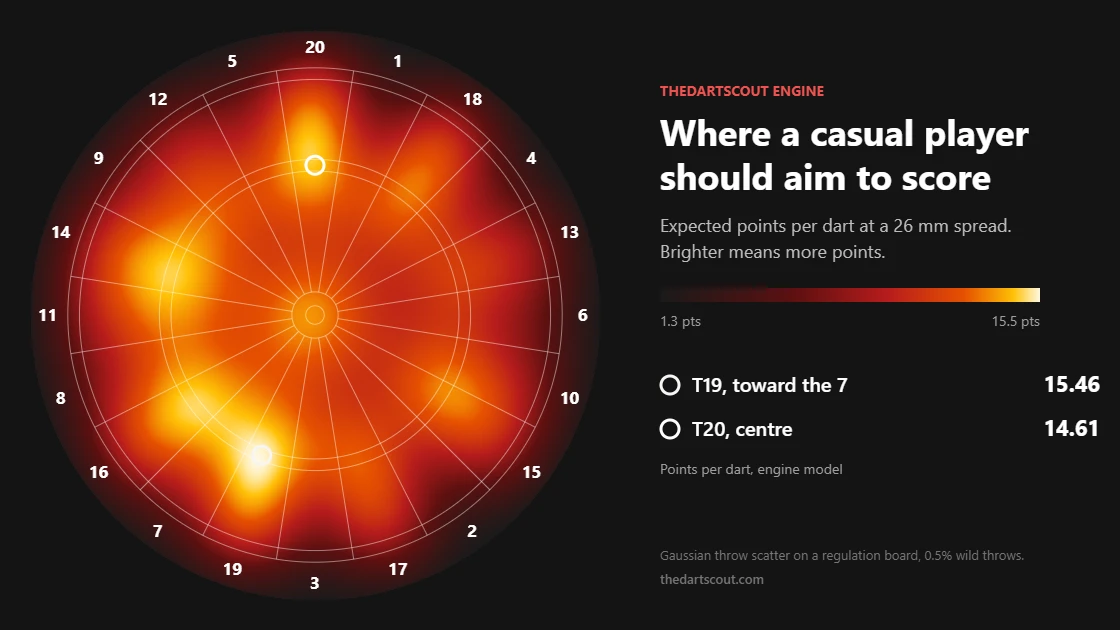
Find 8: Score Under About 60 a Visit? Aim at Treble 19, Not Treble 20
Below a certain accuracy, treble 20 stops being the best place to score. The engine finds the switch at a spread of about 17 mm, where the best scoring rate is roughly 59 points per three darts. Better than that, aim at T20. Worse, aim at T19, edging toward the 7.
| Spread | Best scoring aim | Points per dart | Best T20 aim |
|---|---|---|---|
| 14 mm | T20 | 22.85 | 22.85 |
| 17 mm | T19, toward the 7 | 19.65 | 19.62 |
| 20 mm | T19, toward the 7 | 17.68 | 17.39 |
| 26 mm | T19, toward the 7 | 15.46 | 14.70 |
| 30 mm | T19, toward the 7 | 14.60 | 13.68 |
At casual accuracy, T19 is worth 15.46 points a dart against 14.61 at the centre of T20. That’s about 2.5 points a visit you get just by moving your aim.
The geometry is simple. 20 sits between 5 and 1, two of the lowest numbers on the board, with 12 and 18 one segment further out. 19 sits between 7 and 3, with 16 and 17 next along. A wide miss off T19 still collects decent singles. A wide miss off T20 often doesn’t.
Statisticians got here first, which is reassuring. Tibshirani and his co-authors found that a player with a 26.9 mm spread should aim “in the T19, close to the border it shares with the 7.” Our engine, working at 26 mm with a different method, picks T19 shifted toward the 7. Same spot, two routes to it. The club and pro profiles should keep aiming at T20, which is still the only road to a 180.
Find 9: 3 Is Harder Than 100
For the club profile, 3 is the hardest number under 100. It costs 3.74 expected visits, more than 100 (3.44) or 99 (3.47).
You can’t finish 3 with one dart. You need single 1 first, and the 20 and 18 on either side of it both bust you. Then you’re on double 1, where any inside miss busts you again. For casual players it’s worse still: 3 costs 9.18 visits against 7.37 for 100. Pros cope, and their hardest numbers under 100 are 99, 98, 95 and 100.
The practical lesson: if a set-up dart could leave you on 3, pick a different set-up.
Find 10: The Checkout Chart Agrees With the Engine Less Than You’d Think
We checked the engine against TheDartScout’s own printable 501 checkout chart. The exact route matches 58% of the time for the pro profile, 51% for club and 36% for casual.
That sounds worse than it is. Most disagreements are near-ties. For the pro profile, the chart’s first dart is within 0.01 visits of the engine’s best on 126 of 162 numbers. For club, it’s 118 of 162. The real cost sits in a handful of numbers.
| Score | Chart’s first dart | Engine route | Extra visits from the chart dart |
|---|---|---|---|
| 50 (club) | Bullseye | S18, D16 | 0.14 |
| 79 (club) | T13 | S19, S20, D20 | 0.13 |
| 76 (club) | T12 | T20, D8 | 0.12 |
| 73 (pro) | T11 | T19, D8 | 0.11 |
| 2 (pro) | D1, centre | D1, outer wire | 0.10 |
| 50 (pro) | Bullseye | S18, D16 | 0.07 |
| 82 (pro) | T14 | Bullseye, D16 | 0.07 |
Three patterns stand out. On 50, don’t aim at the bull: single 18 to leave 32 is better for club and pro alike. On numbers like 73, 76 and 79, the chart reaches for a small treble to leave a favourite double. The engine sticks with T19 or T20 and settles for D8 or a two-dart set-up. And on 2 and 82, it’s Find 6 and Find 4 again.
A chart gives one route per number, usually the tour-standard one. It’s a fine default. It just can’t adjust for your accuracy, and that’s where most of these gaps come from.
SCOUT TAKE
Keep the chart. Just overwrite a few numbers in your head: on 50, set up 32 with single 18; on 61, go bull first; on 2, aim at the outer wire; and when the chart sends you at a small treble to leave a double, take T19 or T20 instead.
What Should You Change in Your Game Tonight?
Five rules sum up the darts checkout strategy the engine supports.
- Leave 32 when you have the choice. It’s the best leave at every level, with 16 and 40 close behind.
- Don’t leave an odd number if an even one is on. For a club player, 41 costs over a quarter of a visit more than 40.
- Score under about 60 a visit? Move to T19. Aim at the treble, edging toward the 7.
- Below pro level, set up on 161, 164, 167 and 170. Leave 40 or 32 rather than chasing the bull.
- On 2, aim at the outer wire of D1. On 61, go for the bull. Both protect you from the misses that hurt most.
If you want the full rules behind busts and double-out finishes, our guide to how to play 501 walks through a complete leg. To check a specific score, try the darts checkout calculator.
Where Could This Model Be Wrong?
Every number here comes from a model, and the model makes choices you should know about.
- Same spread everywhere. Real players are tighter on the targets they practise most, usually T20 and a favourite double.
- No pressure. The model throws a match dart exactly like a practice dart. Real players don’t, as our piece on the mental game of darts covers.
- No opponent. The engine minimises your visits. It doesn’t know your opponent is sitting on 32, which can justify a riskier shot.
- Three preset players. Your spread won’t be exactly 15 mm or 26 mm. Tibshirani’s team showed you can estimate yours from around 50 scored throws at the bullseye.
- Simplified board physics. Wires have no width, bounce-outs aren’t modelled, and 0.5% of darts are treated as wild throws anywhere on the board.
- Offsets are model picks. When the engine says “toward the 7”, that’s a few millimetres. It isn’t a claim that anyone can place a dart that precisely on demand.
The headline findings lean on board geometry more than fine detail, which makes them sturdier than the decimals suggest. 16 still halves cleanly, single 1 still sits next to the 20 and 18, and the outer bull still catches a missed bullseye on 61.
Frequently asked questions
How do I know which skill profile I am?
Count your treble 20s. In our model, the casual profile hits about 6% of darts aimed at T20 and 8% at D20. The club profile hits about 15% and 19%, and the pro profile about 39% and 41%. For a sharper estimate, score 50 throws aimed at the bullseye and use the method in Tibshirani’s paper.
What should I do on 169?
Set up a good leave, because 169 can’t be finished in three darts. The engine’s plan for the club profile is T19, T20, single 20, leaving 32. For the pro profile it’s T20, T20, single 17, also leaving 32. The casual profile aims T19, T19, single 15 to leave 40.
Why would the best route have a lower finish chance than another route?
Because the engine minimises visits for the whole leg, not just this one. On 121, the club profile’s best route is T19, T16, D8, which finishes this visit 0.6% of the time. T17, T20, D5 finishes 1.9% of the time. The T19 route leaves better numbers when it fails, so it gets the leg done sooner on average.
Do these findings apply to 301 and other double-out games?
Yes, for the finishing positions. The engine only looks at the score left, the darts left in the visit and the score the visit started on. A 61 in 301 is the same problem as a 61 in 501, so the same routes apply.
Does the bullseye count as a double when checking out?
Yes. The bullseye is worth 50 and counts as double 25, which is why 170 finishes treble 20, treble 20, bullseye. The outer bull is a single 25, so it can’t end a leg. Our guide to how to play 501 covers the full double-out rules.