QUICK ANSWER
Most PDC pros throw 21-24g tungsten darts with front-weighted barrels.
The typical pro setup is a 90% tungsten barrel at 21-24g with a torpedo shape. Medium or short shafts. Standard or slim flights. Every player has a signature model. But the specs cluster around a narrow range.
This guide reveals what darts do pros use in 2026, player by player, with the reasoning behind their choices.
Knowing what darts do pros use in 2026 is useful because it shows you the equipment that works at the highest level. You should not copy a professional’s setup blindly – their throw is different from yours. But understanding the patterns in their equipment choices helps you make smarter decisions about your own. If 90% of PDC professionals throw between 21g and 24g, that tells you something about what works.
TheDartScout has compiled the current setups of the top PDC players for 2026. This is not a list of signature dart reviews – it is an analysis of what they actually throw, why they chose it, and what you can learn from it.
What Do the Top PDC Players Throw in 2026?
Here are the current setups for the top PDC players. Data is from manufacturer specs and tournament records.
| Player | Weight | Brand | Tungsten | Barrel Style |
|---|---|---|---|---|
| Luke Littler | 23g | Target | 90% | Front-weighted, dual-pixel grip, PVD coating |
| Luke Humphries | 22g | Red Dragon | 90% | Front-weighted torpedo, multi-ring grip |
| Michael van Gerwen | 21.5g | Winmau | 90% | Straight to subtly front-loaded, slim profile |
| Gerwyn Price | 24g | Red Dragon | 90% | Straight, shark fin groove pattern |
| Gary Anderson | 23g | Unicorn | 90% | Phase 6 Duo, dual grip zones |
| Peter Wright | 22g | Red Dragon | 90% | Various – changes frequently |
| Nathan Aspinall | 23g | Target | 90% | Front-weighted, Swiss Point system |
| Rob Cross | 21g | Target | 90% | Voltage, straight slim profile, radial grooves |
| Jonny Clayton | 22g | Red Dragon | 90% | Front-loaded, medium knurl |
| Dave Chisnall | 22g | Harrows | 90% | Torpedo, ring grip |
The pattern is clear. Every player on this list throws 90% tungsten. Weight ranges from 21g (Rob Cross) to 24g (Gerwyn Price), with the majority sitting at 22-23g. Most barrel shapes are torpedo or front-weighted. The three dominant brands are Target, Red Dragon, and Winmau, with Unicorn and Harrows also represented.

Why Do Most Pros Throw 21-24g?
This weight range represents the sweet spot between momentum and control. Darts below 20g do not carry enough energy to penetrate the board consistently at the speed professionals throw. Darts above 26g are harder to group tightly because the increased weight amplifies small release errors.
Within the 21-24g range, the choice is personal. Lighter darts (21-22g) suit faster, more direct throws. Players like Rob Cross and Michael van Gerwen throw with a quick, flat action and prefer lighter darts that match their tempo. Heavier darts (23-24g) suit slower, more deliberate throws. Gerwyn Price throws with more force and uses the extra weight to stabilise the dart through a longer flight path.
Luke Littler’s 23g choice is interesting because it sits right in the middle. His throw is fast but smooth, and the 23g weight gives him the momentum of a heavier dart without the slower flight of 24g+. For weight selection advice, see our dart weight guide.
Why Do All Pros Use 90% Tungsten?
Every player in the top 50 uses 90% tungsten or higher. The reason is barrel diameter. At 90% tungsten, a 23g barrel can be machined to roughly 6.0-6.5mm in diameter. At 80% tungsten, the same weight produces a barrel closer to 7.0-7.5mm. That extra millimetre matters when you are trying to fit three darts into the treble 20 bed, which is only about 10mm wide.
The difference between 90% and 95% tungsten is smaller – perhaps 0.3mm in diameter for the same weight. Some pros use 95% (Josh Rock, for example), but the majority stick with 90% because it is slightly more durable and much cheaper to manufacture. The barrel thinness at 90% is already sufficient for world-class grouping. For the full material comparison, see 80 vs 90 vs 95 tungsten.
KEY TAKEAWAY
90% tungsten at 22-23g is the centre of gravity of professional darts. If you are choosing your first serious tungsten barrel, this specification is a safe starting point that the majority of the world’s best have validated.
What Barrel Shapes Do Pros Prefer?
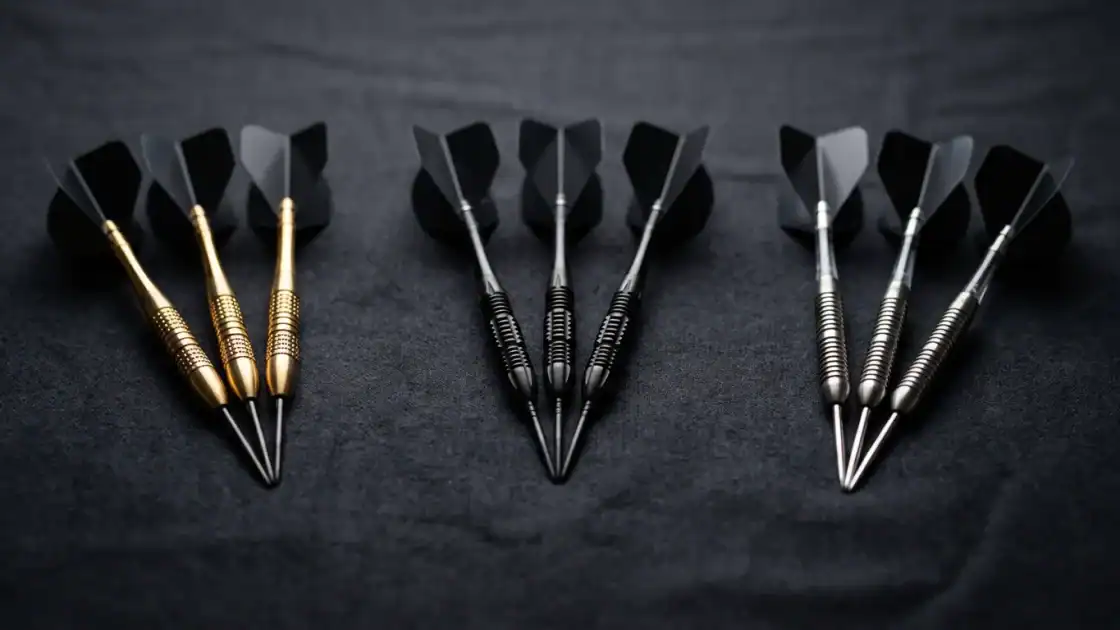
The torpedo (front-weighted) barrel dominates the professional circuit. Players like Luke Humphries, Luke Littler, and Nathan Aspinall all use barrels where the widest point is in the front third and the barrel tapers toward the back. This pushes the centre of gravity forward, which helps the dart fly point-first with minimal wobble.
Gerwyn Price is the notable exception – he uses a straight barrel with shark fin grooves. Straight barrels have a uniform diameter and a more centred balance point. Price grips further back on his barrel and throws with a distinctive snap release that suits the even weight distribution. Gary Anderson uses a design with dual grip zones that sits between torpedo and straight.
Torpedo (Most Pros)
Wider front, tapered back. Forward CoG. Flies point-first. Suits pencil and fingertip grips. Used by Littler, Humphries, Aspinall, Clayton, Chisnall.
Straight (Minority)
Uniform diameter. Centred CoG. Even balance. Suits rear grip and snap throws. Used by Price, van Gerwen, Cross. Less common but equally valid for the right technique.
Peter Wright deserves special mention because he changes his darts constantly – sometimes between matches, sometimes between legs. He has used dozens of different barrels over his career. While entertaining, this approach is not recommended for most players. Consistency in equipment builds consistency in throw. For barrel shape details, see dart barrel shapes.
Player Spotlight: How Three Champions Set Up Their Darts
Looking at what darts do pros use in 2026 at the individual level reveals how much personalisation matters even within the narrow spec range.
Luke Littler – the new generation
Littler’s Target Gen 1 darts weigh 23g with a front-weighted barrel. The dual-pixel grip is a fine, precision-machined pattern that provides moderate texture without being aggressive. The black PVD coating gives the barrel a distinctive look but also serves a purpose – it provides a slightly grippier surface than raw tungsten. Littler uses Target’s Swiss Point system with 26mm K-Flex shafts and No.6 standard flights. His setup is remarkably conventional for someone who has redefined the sport’s age expectations.
What stands out is how balanced his setup is. The 23g weight sits dead centre of the pro range. The front-weighted barrel is the most popular shape on tour. The standard flights provide maximum stability. There is nothing experimental about his equipment. The brilliance is in his throw, not his darts.
Michael van Gerwen – the veteran’s refinement
MVG’s Winmau darts are among the lightest on tour at 21.5g. His torpedo barrel is slim and designed for speed. Van Gerwen throws with one of the fastest actions in professional darts – a quick, whipping motion that generates enormous velocity. The light weight matches this speed. A heavier dart at his throwing speed would fly too far and too flat.
His barrel has remained fundamentally the same shape for over a decade. The weight has varied by 0.5g at times, but the profile has not changed. This is the strongest argument for finding your setup and committing to it. MVG has won three World Championships with the same basic dart design. The equipment is not the variable.
Gerwyn Price – the outlier
Price’s 24g Red Dragon darts are the heaviest among the current top five. His straight barrel is the only non-torpedo design in the elite group. The shark fin groove pattern is aggressive – deep V-shaped channels cut at regular intervals. Price grips the barrel firmly and throws with a snap release from the back of the barrel. The heavier weight and rear grip create a different flight dynamic from the front-weighted throws of his rivals.
Price proves that the torpedo-front-weighted consensus is not a rule. It is a preference shared by most players. If your throw is different – if you grip further back, if you throw with more force, if you prefer a centred balance – a straight barrel at 24g is equally valid. TheDartScout’s equipment testing confirms that barrel shape matters more than any other specification for how the dart feels in the hand.
How to Build a Pro-Spec Setup on a Budget
You do not need to buy a signature model to match professional specifications. Here is how to build a pro-equivalent setup for under £30 (~$40).
1
Barrel
90% tungsten, 22-23g, torpedo shape. Designa Patriot X or similar. £20-25 (~$25-32).
2
Shafts
Medium nylon or aluminium. Any brand. £1-3 (~$1.25-4) per set of three.
3
Flights
Standard shape, 100 micron. Any brand. £1-2 (~$1.25-2.50) per set of three.
Total cost: roughly £25 (~$32). The barrel is doing 95% of the work. The shafts and flights are consumables. This setup matches the core specifications of what the top 50 PDC players throw. The difference between this and a £60 (~$75) signature model is cosmetics, branding, and point systems – not playing performance. For barrel recommendations, see barrel shapes.
What Flights and Shafts Do Pros Use?
Flights and shafts get less attention than barrels, but professionals are equally deliberate about their choices. The trend in 2026 is toward smaller flights and shorter shafts compared to a decade ago.
Flights: most PDC professionals use standard or slightly smaller shapes (pear, kite). Very few use slim flights despite their aerodynamic advantages because the reduced stability makes the dart more sensitive to release errors. At the speed professionals throw, a standard flight provides enough drag without over-stabilising the dart. Flight thickness is typically 100 or 150 micron. For flight options, see how to choose dart flights.
Shafts: short and medium lengths dominate. Extra-short shafts are rare because they position the flight too close to the barrel and cause excessive deflection when grouping tightly. Long shafts are also rare because they create a longer overall dart that can feel unwieldy at professional throwing speeds. Nylon and aluminium are both common. Target’s carbon-fibre shafts are increasingly popular for their combination of light weight and rigidity. For shaft options, see how to choose dart shafts.
Point systems: Target’s Swiss Point system is used by several top players (Littler, Aspinall, Cross). This system allows screw-in point replacement, so players can change point length or texture between matches without changing barrels. Winmau and Red Dragon players typically use fixed press-in points. For point options, see dart point types.
THE BRAND LANDSCAPE
Three brands sponsor most of the top 20.
Target has a strong stable of top players including Littler, Aspinall, and Cross. Red Dragon sponsors Humphries, Price, and Wright. Winmau sponsors van Gerwen. Unicorn has Anderson. Each brand’s product line is shaped by its sponsored players’ preferences, which means their consumer darts reflect genuine professional specifications, not marketing exercises.
What Can You Learn from Professional Setups?
The pro data shows clear patterns. These are useful for choosing your own equipment.
The weight cluster is narrow. Despite having access to any weight from 14g to 50g, every top professional throws between 21g and 24g. This range has been validated by thousands of hours of competitive play. If you are unsure about weight, start within this range.
90% tungsten is the standard, not 95% or 97%. Higher percentages offer marginally thinner barrels but at higher cost and with slightly more brittleness. The professionals who could have any percentage free of charge choose 90% because the performance-to-durability balance is optimal.
Front-weighted barrels dominate. This is not a coincidence. A forward centre of gravity helps the dart fly point-first, which reduces wobble and produces more consistent grouping. If you have not tried a torpedo barrel, it is worth experimenting with one.
Grip patterns vary more than any other spec. This is the most personal element. Some pros want aggressive knurl (Price), others want precision-milled grooves (Humphries), others want dual-zone designs (Anderson). No two pros have exactly the same grip preference. This is the component where copying a pro is least useful – your grip is unique to your hands. See dart grip styles for how to find yours.
Copy the specifications, not the player. A 22g, 90% tungsten torpedo barrel is a proven template. But the grip pattern, shaft length, and flight shape need to match YOUR throw, not theirs.
How Much Do Professional-Grade Darts Cost?
The signature models used by top players retail between £40 (~$50) and £80 (~$100) per set of three. This is not entry-level pricing, but it is not astronomical either. A set of Target Luke Littler Gen 1 darts costs approximately £55 (~$70). Winmau Michael van Gerwen Ambition 2 darts cost roughly £45 (~$57). Red Dragon Gerwyn Price Iceman darts cost around £50 (~$65).
You do not need to buy a signature model to get the same specifications. The brands also sell non-signature darts at 90% tungsten in the 21-24g range for £25-40 (~$32-50). The barrel specifications are identical – you are paying a premium for the player’s name and cosmetic finish on the signature models. For the best value tungsten darts, see our tungsten vs brass comparison which covers entry-level tungsten options.
What Boards Do the Pros Play On?
The PDC’s official board is the Winmau Blade 6 Triple Core Carbon. This has been the tournament standard since 2022 under a multi-year sponsorship agreement. Every PDC televised event – the World Championship, the Premier League, the World Grand Prix – uses this board. If you want to practise on the same surface the pros compete on, this is the board to buy. It costs £40-50 (~$50-65).
The Blade 6 uses ultra-thin blade wire dividers with no staples or clips. The wire profile is roughly 50% thinner than round-wire boards, which reduces bounce-outs to near zero. The sisal fibre is compressed at higher density than consumer boards, which means it grips dart points more firmly and self-heals more effectively. For most players, a Blade 6 is the last bristle board they will ever need to research. For the full board comparison, see how to choose a dartboard.
The WDF (World Darts Federation) and BDO-era tournaments have used various boards including the Unicorn Eclipse series. These are also excellent competition boards with similar blade-wire technology. The key takeaway is that all professional darts is played on premium blade-wire bristle boards. No professional tournament uses electronic boards, round-wire boards, or any board with staples. For the board type comparison, see electronic vs bristle dartboard.
What About Women’s Professional Darts?
The women’s professional circuit has grown rapidly. Fallon Sherrock, Beau Greaves, and Lisa Ashton are among the most prominent players. Their equipment choices follow the same patterns as the men’s game – 90% tungsten, 21-24g, torpedo or front-weighted barrels.
Beau Greaves uses One80 darts at 22g with a front-loaded barrel. Fallon Sherrock has signature models with Red Dragon. Lisa Ashton uses Target darts. The weight range is slightly lower on average (21-23g vs 22-24g for men) but the overlap is almost complete. The equipment does not differ by gender – it differs by individual throw characteristics.
What darts do pros use in 2026 is the same question regardless of the circuit. The answer is consistent: 90% tungsten, narrow weight range, front-weighted barrels, quality blade-wire boards.
Do Pros Change Their Darts Often?
Less than you might think. Most professionals find a barrel weight and shape that works and stick with it for years. They replace flights every few days, shafts every few weeks, and occasionally adjust point length. But the barrel itself – the core of the dart – stays the same.
When pros do change, it is usually because their sponsor releases a new model or because they are working through a form slump and want a fresh feel. Luke Littler went from his Gen 1 darts through the early stages of his career and has made minimal changes because they work. Michael van Gerwen has used variations of the same barrel profile for over a decade.
The lesson is consistency. Find darts that work, then stop looking. Practice and technique improvement will do more for your game than any equipment change. The pros who win the most titles are the ones who settled on their setup earliest and spent the most time practising with it. Phil Taylor used the same basic barrel design for over 15 years. Gary Anderson has used variations of the same shape since his first World Championship. The equipment becomes invisible – it is just an extension of the throw. That should be your goal too. The only reason to change barrels is if something fundamental about your throw changes – a grip adjustment, a weight preference shift, or a barrel that is physically worn out. For barrel maintenance, see how to re-grip a dart barrel. For practice routines that build consistency, see how to practice darts alone and consistent dart throw.
TheDartScout’s analysis of equipment changes among the top 20 PDC players shows that the average pro has used the same barrel weight for over five years. Shaft and flight changes are more frequent but even these tend to settle into a pattern. The most common reason for a pro to change their barrel is a new sponsorship deal, not a performance issue. For equipment maintenance to keep your current darts performing, see how to clean tungsten darts and how to re-grip a dart barrel.
SCOUT’S TAKE
The question “what darts do pros use in 2026” is interesting, but the more useful question is “why.” The answer is not because they have access to magic equipment – their darts cost £40-80 (~$50-100), the same as what you can buy online. The answer is that they have found the weight, shape, and grip that matches their specific throw and then practised with it relentlessly. Find yours and do the same.
Frequently Asked Questions
What weight darts does Luke Littler use?
Luke Littler uses 23g Target darts with 90% tungsten barrels. His Gen 1 model features a front-weighted design with a dual-pixel grip pattern and black PVD coating. The barrel uses Target’s Swiss Point system, allowing interchangeable point lengths.
Do pros use the same darts they sell to the public?
Yes, in most cases. The signature models available in shops are the same specifications the player uses on stage. The barrel weight, tungsten percentage, shape, and grip pattern are identical. The player may have a set that has been used longer and worn to their preference, but the manufacturing spec is the same as what you buy.
Why do most pros use 90% tungsten instead of 95%?
The barrel diameter difference between 90% and 95% tungsten is roughly 0.3mm at the same weight. This is barely perceptible during play. 90% tungsten is slightly more durable (less prone to chipping on the CNC-machined grip) and is easier for manufacturers to produce consistently. The practical performance difference is negligible, so pros default to the tougher, more reliable alloy.
Should I buy the same darts as my favourite player?
Only if the specifications match your throw. If your favourite player throws 21g and you prefer 24g, buying their signature model will not help. Use the pro data as a guide for specifications (weight range, tungsten percentage, barrel shape) but choose the specific model based on how it feels in YOUR hand. Try before you buy if possible, or buy from a retailer with a returns policy. For personalised recommendations, take our dart recommendation quiz.
What darts do pros use 2026 compared to 2020?
The weight range has not changed – 21-24g was standard in 2020 and remains standard now. The barrel shapes have shifted slightly toward more front-weighted designs. The biggest change is in point systems – screw-in replaceable points (like Target Swiss Point) are now more common than five years ago. Flight and shaft technology has not changed materially. The fundamentals of what works at the professional level have been stable for decades.
For weight selection, see how to choose dart weight. For barrel shapes, read dart barrel shapes. For the entrance music behind these players, see the 25 most iconic walk-on songs. For tungsten percentages, see 80 vs 90 vs 95 tungsten. For how pros build their checkout strategy, read 501 checkout strategy. To understand every component, see anatomy of a dart. New to darts? Start with the beginner’s guide or take the dart recommendation quiz.