QUICK ANSWER
Dartitis is the sudden, involuntary inability to release the dart cleanly. Research links it to task-specific focal dystonia, the same family of motor-control conditions as the golf yips and musician’s cramp. It isn’t a character flaw and it isn’t a curse. Some players recover with grip changes, slower throws, and time off competition. Others manage it for life. Eric Bristow and Berry van Peer are the two most documented cases.
You step up to the oche, you load the dart, and your hand will not let go. Not for lack of trying. The arm pulls back, the shoulder turns, and then nothing. The dart stays glued to your fingers while the rest of the throw fires without it.
That is dartitis. It feels like your body has betrayed you, and in a sense it has. But the condition has a name, a documented history, and a small body of treatment evidence drawn from neighbouring sports and from musicians who deal with the same wiring problem. This page lays it out plainly: what dartitis is, who has had it, what to try, and what tends to make it worse.
What Dartitis Actually Is
Dartitis is the involuntary inability to let go of a dart on time. The word joins the sport name to the medical suffix “-itis”. Editor Robbie Dyson coined it in Darts World magazine in 1981. Collins English Dictionary later defined it as “nervous twitching or tension that destroys the concentration and spoils performance”.
That is the surface description. The deeper story is more useful. The current best framing, from neurology and sports-medicine literature, is that dartitis sits inside a broader category called task-specific focal dystonia. The Cleveland Clinic describes focal dystonia as a neurological condition where a muscle or group of muscles in one part of the body contracts involuntarily during a very specific activity. The musician version is called musician’s dystonia. The sport version, when it appears in golfers, baseball pitchers, and dart players, is what everyone calls the yips.
That framing matters because it changes what you do about it. If dartitis is “weak nerves” or “not wanting it enough”, you push harder. If dartitis is a motor-control wiring problem with an anxiety amplifier on top, you stop hammering the same throw and try something different.
KEY TAKEAWAY
Dartitis is treated by researchers as a task-specific motor-control disorder with a strong anxiety component, not as a willpower problem. Treat it that way and you will pick better tools.
How Dartitis Shows Up
The classic sign is the lock-up at release. The arm pulls back, the throwing motion begins, and the fingers refuse to open. Some players abort the throw, rebound the dart back, and reset. Others force the release and the dart sprays. Both look painful from outside, and both feel worse from inside.
The dystonia literature lists more signs. Cramps in the hand and forearm. Brief muscle spasms you can’t control. A wrist that wants to clench at the wrong moment. Some players also report knock-on effects. Poor sleep, low mood, and a clear dip in focus on practice nights.
It is worth separating dartitis from two things it gets confused with. Ordinary nerves produce broad signs: sweating palms, a faster heartbeat, a shaky stance. Dartitis is narrower. The same hand can still pick up a pint, sign your name, and untie a shoelace. It only seizes when you try to throw a dart. The other confusion is target panic, more common in archery, where the issue is rushed or yanked release timing rather than a locked grip. They overlap, but they are not identical.
What Causes Dartitis
Research on focal dystonia keeps returning to one finding: the people most likely to develop it are the people who repeat a fine-motor skill thousands of times. Musicians, writers, surgeons, dart throwers. A 2018 review in Brain proposed a unifying framework where the over-trained motor map in the cortex starts to overlap with neighbouring maps, and the brain loses the clean signal it once had for one specific movement. In plain terms: too many reps of one tiny act, done with too much attention on the act itself, can rewire the circuit that runs it.
That same review reports something practical. Skilled motor performance gets worse when attention shifts to the mechanics. Tell a pianist to focus on which finger lands next and the piece falls apart. Tell a dart player to focus on the exact angle their thumb leaves the barrel and the release stops working. Internal focus on technique drags performance down. External focus on the target keeps it intact.
Personality plays a part too. The same body of research links task-specific dystonia to high anxiety and to perfectionist tendencies, both of which push the thrower into exactly the kind of internal focus that makes things worse. Some researchers split the yips into Type I (mostly neurological focal dystonia) and Type II (mostly psychological, stress-driven). Dartitis often shows both at once: a motor glitch with an anxiety loop wrapped around it.
KEY TAKEAWAY
If you’ve hit dartitis after a long, intense practice block, that pattern fits the research. Hammering the same release for hours under tension is the exact recipe focal dystonia studies describe.

Famous Cases of Dartitis
Two cases dominate the conversation. The first is the one that put the word into mainstream darts coverage.
Eric Bristow
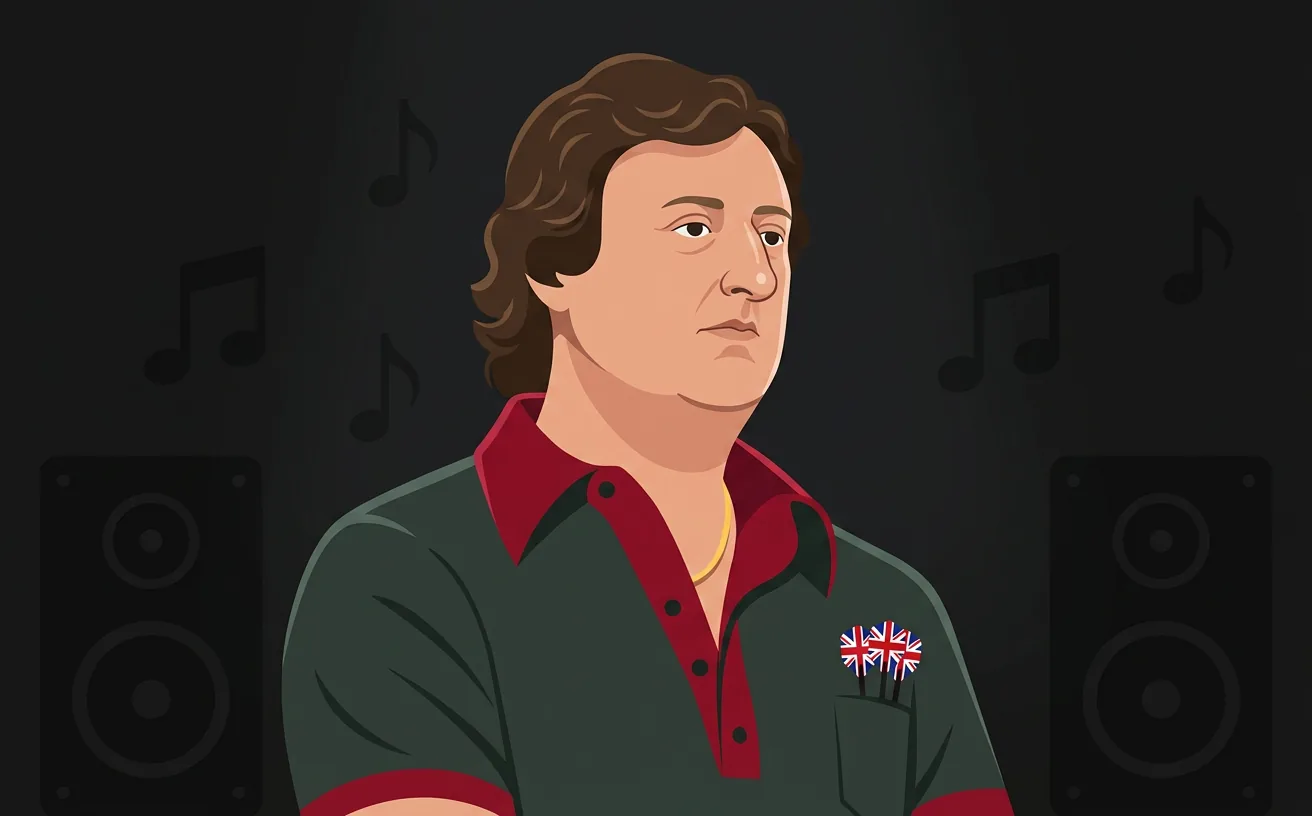
Bristow was a five-time BDO World Champion and the dominant figure in darts through the early-to-mid 1980s. His throwing problems became visible at the Swedish Open in November 1986, where he could not let go of the dart properly. He kept playing. He reached further world finals after the onset and briefly regained the world number-one ranking in 1990. He never returned to the level of dominance he held before 1986.
One myth worth clearing up: there is no reliable record of Bristow permanently switching throwing hand to manage dartitis. He stayed a right-hander throughout his career. He did play left-handed in exhibition matches as a stunt, including a well-known one against a soldier in Berlin, but that was showmanship, not therapy. The coping route he is actually documented as taking was practising with a young Phil Taylor at his pub in Stoke-on-Trent, where Taylor sharpened his game and Bristow worked on his throw against a player who would soon overtake him.
Berry van Peer
The second case, three decades later, was younger and even more public. At the 2017 Grand Slam of Darts in Wolverhampton, 21-year-old Berry van Peer played his group with dartitis visibly affecting him at the oche. He battled past Simon Whitlock 5-4 in his opening match, lost 5-1 to Gary Anderson in a televised game where he held back tears between throws, then beat Cameron Menzies 5-4 to reach the last 16, where he lost 10-2 to Mensur Suljović. Wayne Mardle, on commentary for Sky Sports, called what van Peer did “one of the bravest performances I’ve seen from a human being in any sport”.
Van Peer worked with a psychologist after the Grand Slam and returned to competitive form. He won the WDF Dutch Open in 2023 and several other titles that year. His public account of what was happening at Wolverhampton matches the dystonia description almost exactly: “you want to release the dart and it just doesn’t happen”.
Mensur Suljović is Not a Dartitis Case
Suljović gets mentioned a lot in dartitis threads on forums because of his deliberate, paused release. He holds the dart up at his eye line, settles, and lets it go on his own time. That is a personal style, not a yip. He is not a documented dartitis sufferer. The confusion comes from how unusual his rhythm looks compared to a fast-throwing thirteen-darter, not from any actual lock-up at release.
Can You Cure Dartitis?
The honest answer is “sometimes”. A 2024 systematic review in the Journal of Science and Medicine in Sport (Open) looked at 31 studies of athlete dystonia treatment. It found weak evidence across the board. No single treatment had reliable success. The authors called for larger trials. A separate case series tried behavioural therapy plus hypnosis on four elite athletes over 16 weeks. It reported gains, but the sample is tiny.
So the truthful framing is this. Some players have come back. Berry van Peer did. Plenty of amateurs report grinding their way back over months. Other players, including Bristow, never returned to their pre-dartitis ceiling. There is no guaranteed cure, and anyone selling one is overpromising.
How to Treat Dartitis: What Players Actually Try
Across coaching sites, player interviews, and the dystonia treatment literature, the same set of options keeps appearing. None of them are guaranteed. All of them are worth a try if you’re stuck.
STEP 1
Change the grip
Move a finger, switch from pencil to claw, or open the hand by one position. The aim is to break the locked-in motor pattern, not to find the perfect grip.
STEP 2
Slow the throw down
Drop the drawback speed, shorten the pull-back, and stretch the rhythm out. Most lock-ups happen on quick, tense throws.
STEP 3
Practise without scoring
Throw for rhythm, not numbers. Start at half distance, focus on a clean release, ignore where the dart lands.
STEP 4
Distract the mind
Count backwards from 100 by twos while you throw. Look only at the target, never at your hand. External focus protects skilled motor patterns.
STEP 5
Try the non-dominant hand
Some amateur players have reported recovering form within months by training the other hand. This is documented as a coping route, not a cure.
STEP 6
Get psychological support
Sports psychologists who work with golfers and shooters have transferable methods. Behavioural therapy combined with relaxation training has the best published evidence to date.
What not to do is just as important. Don’t grind through the lock-up with hours of the same release. Repetition under tension is what the focal-dystonia research keeps flagging as the reinforcing pattern. Don’t keep playing competitive matches if every leg makes the problem worse; a real break of weeks or months is one of the few things that has worked for several documented cases. And don’t ignore equipment. A different barrel weight or a longer stem changes the feel enough to give the motor system a small reset.
Want to dig further into the mechanics? The building a consistent dart throw guide breaks the throwing motion down phase by phase. And how to hit doubles consistently walks through the release patterns that doubles drills tend to expose.

How to Avoid Dartitis in the First Place
Prevention advice mostly comes from the musician’s-dystonia world, because that condition has been studied for longer and shares the same wiring pattern. Three points come up repeatedly. Vary your practice rather than drilling one identical motion for hours; mix scoring games, doubles drills, and shorter-range throws so the motor system isn’t carving one groove. Rest properly; fatigue and tension in long sessions are exactly the conditions where focal dystonia tends to take root. And keep your attention on the target, not on your hand. The research is consistent on this last point: internal focus on the mechanics actively degrades performance over time.
The second prevention layer is one most darts players ignore. Match-pressure management. The anxiety amplifier sits on top of the motor problem. Good breathing routines, a pre-shot ritual, and an honest nod to your nerves all keep that amplifier turned down. The mental game of darts guide covers the routines pros use to stay loose under pressure.
KEY TAKEAWAY
Dartitis is not a moral test, and there’s no badge for grinding through it. Some of the smartest moves are the ones that look like giving up: long breaks, a hand switch, a complete grip rebuild, a season off competition. They are exactly what the published evidence supports.
When to Worry, and When to See a Doctor
One more honest note. TheDartScout is not a clinic. If you’re getting cramps, spasms, or movement problems in the same hand outside darts (writing, typing, eating), or if the symptoms persist for months and don’t shift with rest, that’s worth taking to a neurologist. Task-specific dystonias are diagnosable conditions, and a proper assessment can rule out other causes and open up treatment options like behavioural therapy or, in some cases, botulinum-toxin injections. The treatments listed earlier on this page are documented player tactics. The medical route is a separate conversation, and a worthwhile one if the problem is sticking around.
For most players the bout is short and tied to one heavy practice block. The playbook is familiar. Rest. Change something. Drop the scoring. Throw for rhythm. Give it time. Many of the throwing-motion errors that drag a player off the rails show up in the common darts mistakes guide. A fair share of dartitis flare-ups trace back to one of them in the weeks before.
Frequently Asked Questions
What is dartitis?
Dartitis is the inability to let go of a dart on time. Research links it to task-specific focal dystonia. That is the same family as the golf yips and musician’s cramp.
Is dartitis curable?
Sometimes. A 2024 systematic review found weak evidence across treatments and no reliable single cure. Some players have come back. Berry van Peer is one. Others have not. Eric Bristow never returned to his pre-dartitis level.
How long does dartitis last?
It varies widely. Some flare-ups settle within weeks of rest and a grip change. Other cases run for years or end careers outright. The longer the condition is reinforced by repetition under tension, the harder it tends to be to break.
Did Eric Bristow recover from dartitis?
Partially. Bristow developed dartitis at the Swedish Open in November 1986, after winning five BDO world titles. He briefly regained the world number-one ranking in 1990, but he never returned to his pre-1986 dominance. He stayed a right-handed thrower throughout, despite the persistent myth that he switched hands.
Is dartitis the same as the yips?
Closely related. “The yips” is the broader sport term for sudden involuntary motor problems in a trained skill. Dartitis is the darts-specific instance. Both overlap with task-specific focal dystonia, which is the neurological label that covers musicians, writers, and athletes with the same wiring problem.
Can switching to your other hand fix dartitis?
It has worked for some amateur players as a coping route, including documented cases who returned to competitive form within months on the non-dominant hand. Eric Bristow, the most famous sufferer, did not permanently switch hands. Treat the hand switch as a workaround that bypasses the affected motor pattern, not as a cure.